The modern monitored home is built around a remarkably simple idea: the important event can happen in one place while the person responsible for responding to it is somewhere else. A door opens at midnight, a sensor changes state, information leaves the house, and a monitoring center interprets the signal. That sequence feels inseparable from computers, cellular networks and cloud software, yet almost the entire architecture was already visible in the business Edwin Holmes built during the nineteenth century.
Holmes did not invent the first electromagnetic burglar alarm. That credit belongs to Augustus Russell Pope. Holmes’s contribution was arguably more consequential for what came later. He recognized that an alarm did not have to remain an isolated machine ringing inside the building it protected. Once the condition of a door or window had been converted into an electrical signal, that signal could be carried somewhere else. From there it could be monitored, logged and acted upon. The alarm could become a service, the service could become a network, and the network could eventually share infrastructure with the new telephone.
That is the moment the history of the burglar alarm stops being a story about bells and begins looking like the prehistory of the smart home.
Before Holmes, Augustus Pope Gave the House an Electrical State
Augustus Russell Pope received U.S. Patent No. 9,802 on June 21, 1853, for an electromagnetic alarm designed to protect doors and windows. The system used a battery, electrical wiring, contacts, an electromagnet, an armature and a bell. Moving a protected door or window altered the circuit, energizing the magnet and causing repeated blows of the hammer against the bell.
The old demonstration apparatus above is important precisely because it looks so simple. There is no camera, telephone or remote computer. The conceptual leap occurs before any of those things are added. A part of the architecture—the door or window—has been attached to an electrical circuit capable of representing whether the physical world is in its expected condition.
Pope’s own patent language makes the intention explicit. The apparatus was meant to be applied to a door, a window or both so that an attempted entrance would automatically produce an alarm. The continuous ringing did not depend upon falling weights or conventional clockwork; the electrical circuit itself drove the action.
That means the basic sensor problem had been solved. The next question was what to do with the information.
Edwin Holmes Bought the Alarm and Turned It Into a Business
Edwin Holmes acquired Pope’s rights in the late 1850s and began commercializing the system. The Holmes Electric Protective Company’s own 1924 centennial history remembered Holmes coming to New York from Boston in 1858 with a model house because potential customers were unfamiliar with electrical protection and often skeptical that the apparatus really worked. Its little windows and door were connected electrically to a battery and roof bell, allowing Holmes to demonstrate the system in front of prospective buyers.


That combination of portrait and demonstration model captures an interesting transitional moment. Holmes was selling electricity before electricity had become ordinary household infrastructure. He could not assume that the customer understood what an electrical sensor was supposed to do. He had to make the invisible relationship between door, wire and bell physically obvious.
The business nevertheless grew. Later accounts describe Holmes installing large numbers of local alarm systems in New York, particularly for businesses with enough property or merchandise to justify the expense. Yet even a successful local alarm still had a limitation. It could only warn whoever happened to be close enough to hear it.
Holmes’s more important move was to remove that limitation.
The Alarm Leaves the Building
By 1872 Holmes had instituted what later courts repeatedly called the central office system of burglar alarm protection. Protected premises were connected to a remote signal station by low-voltage electrical wires. If someone interfered with the protected property, the electrical change registered at the central office. A New York court describing the system decades later summarized it with unusual clarity: an unauthorized opening at the building became an electric signal at the station, where the signal was understood to mean that something had been opened without authority.
This old Holmes apparatus still has the visual language of telegraphy: electromagnetic coils, terminals, a lever, a substantial bell and a wooden base. What matters is what happened when devices like this became parts of a larger system rather than standalone machines.
The Holmes company’s 1924 history says the Holmes Burglar Alarm Telegraph Company was organized in 1872 specifically to furnish protection from central stations. By January 1882, after becoming the Holmes Electric Protective Company, it operated two New York central stations at 194 Broadway and 518 Broadway and served 471 subscribers.
Four hundred seventy-one customers did not require 471 men sitting inside 471 buildings. Their premises could report into two centers.
That is central monitoring.
A Building Could Now Be Watched Without a Watchman Standing Inside It
This is the point where the language of modern security begins to fit surprisingly well. The building contains distributed sensors. The sensors are connected to communications wiring. A remote station receives abnormal conditions. Operators interpret the signals and initiate whatever response the system requires.
A court later described Holmes’s business as running wires from its main office near the New York Stock Exchange to branch offices and then into buildings throughout the city, linking protected properties with the company’s stations for protection against burglary and fire.
That network changed the economics of attention. A traditional watchman was expensive because attention had to exist physically at the property. Holmes could concentrate attention. One station could watch many subscribers simultaneously because the property itself was doing part of the observing.
The importance of that should not be lost in the antique hardware. Central monitoring means separating the monitored object from the human observer. Modern alarm companies do precisely that, except the copper wire may now be fiber, cellular radio or an internet connection.
Holmes was already working on the central problem more than 150 years ago.
Holmes Even Started Automating the Schedule
The system also had to distinguish between authorized and unauthorized changes. A store would naturally open its doors in the morning; a burglar alarm that treated normal business opening as a break-in would not remain useful very long.
Holmes patented a device in 1867 that could automatically break or close the circuit at predetermined times. His patent specifically referred to using the mechanism with the earlier Pope alarm so that a house or business could be opened in the morning without unnecessarily sounding the alarm.
That feature deserves more attention than it usually receives because it introduces something resembling programmed state management. The same doorway could be considered alarming at one hour and ordinary at another. Security was no longer simply a mechanical reaction to movement; it was beginning to incorporate time, expected condition and operating mode.
A modern security panel calls this arming and disarming according to a schedule. Holmes was solving the primitive version mechanically.
The Central Station Was Becoming an Information Center
The surviving Holmes Electric Protective Company letterhead gives an unexpectedly good visual representation of what the company was becoming. The elaborate corporate design is surrounded by the imagery of urban electricity, wiring and protective service, while the company officers are presented almost like executives of an infrastructure utility.
This was not merely a manufacturer selling bells. Holmes was selling continuous electrical connection between a property and an organization.
That distinction explains why the business naturally began to overlap with telegraphy and then telephony. Once many customers already had wires reaching a central office, the obvious question was whether those wires could carry more than a simple alarm state.
The answer helped place the Holmes family surprisingly close to the birth of the telephone exchange.
The Burglar Alarm Network Becomes a Telephone Network
Alexander Graham Bell patented the telephone in 1876. Almost immediately, the new invention confronted a major practical problem: a telephone between two fixed points is useful, but a network in which any subscriber can reach many others is dramatically more valuable.
A central exchange was the solution.
The Holmes alarm business already possessed one.
A contemporary historical account published in Popular Science Monthly in 1906 describes how Edwin T. Holmes, Edwin Holmes’s son, used Bell hand telephones with the Boston central-office burglar-alarm system in May 1877. Several alarm circuits were routed through a small brass pin switchboard so that an operator could connect a telephone to whichever alarm line was required.
That is an extraordinary moment in communications history.
The alarm network did not merely coexist with early telephony.
Its central-office architecture helped provide a working environment in which the telephone could become a networked service.


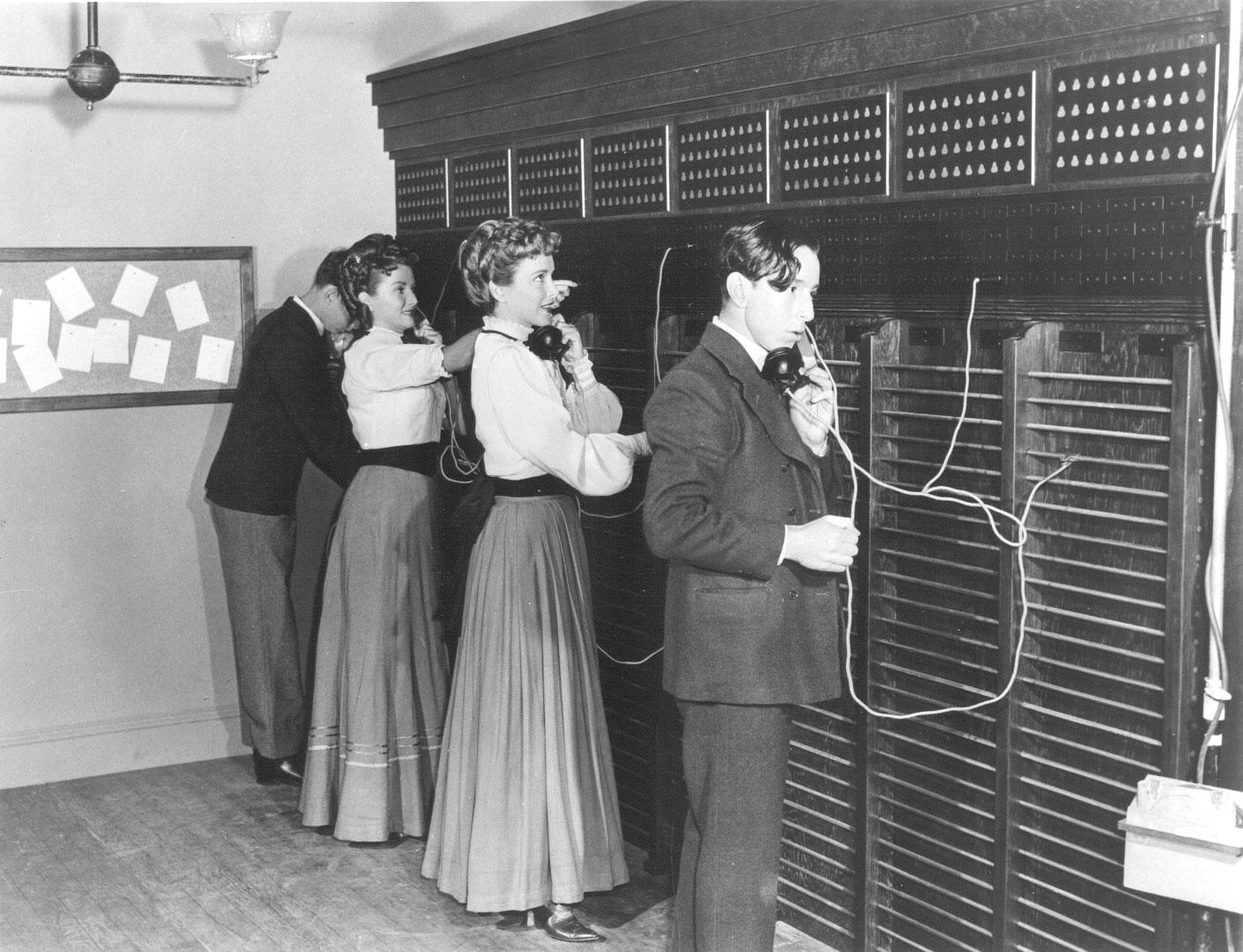
The switchboard images above belong to the early telephone-exchange world that followed. Human operators sat at central boards filled with sockets and cords, connecting distant subscribers manually. The visual resemblance to a modern network-operations center is stronger than the hardware suggests: many endpoints converge on one point where an operator interprets requests and establishes connections.
According to the 1906 account, Holmes initially used five alarm wires in the experimental system. Telephone instruments were subsequently installed in businesses so customers could contact the Holmes central office and request services such as sending an express company to collect packages. By March 1878 the system reportedly had 256 hand telephones in use.
The security central station had begun turning into a communications exchange.
One Set of Wires, Two Different Kinds of Information
The technical connection between telephone and alarm service is easier to understand if we ignore the devices and think about the network.
The burglar alarm sends a very limited message: something changed at this protected point.
The telephone sends an extraordinarily rich message: human speech.
Yet both require a path between a remote subscriber and a central system.
Edwin T. Holmes recognized that the existing protective infrastructure could support telephone service, while the emerging telephone infrastructure could in turn become useful to the alarm business. Later legal descriptions of Holmes’s system note that local telephone-company wires eventually formed part of the company’s central protective network.
This is where the histories of security and telecommunications become difficult to separate neatly. The same urban wire can be understood as a communications line by day and as part of a security architecture at night. The distinction between “telephone infrastructure” and “alarm infrastructure” is obvious to us because mature industries eventually separated their services. In the 1870s, the important fact was that a wire reached the premises.
Once it did, the building could communicate.
Holmes Was Close to the Bell Company for a Reason
The Holmes connection to the Bell telephone enterprise was not accidental. Edwin Holmes became involved with the early Bell telephone business, and secondary histories identify him as an investor and officer in the emerging telephone company.
His value to that environment makes sense once the alarm business is understood properly. Holmes already knew how to sell electrical service to businesses skeptical of new technology. He understood subscriber wiring. He understood central stations. He understood the economics of protecting or servicing multiple customers from a single office.
Most importantly, the Holmes organization already understood that electricity was more useful when sold as an ongoing service relationship rather than simply as a machine.
A customer purchasing a bell buys a product once.
A customer connected to a central station buys continued attention.
Telephone companies would build one of the most successful subscription businesses in modern history around precisely that kind of continuing connection.
The Alarm Central Station and the Telephone Exchange Are Variations on the Same Idea
This 1880 illustration of a European telephone exchange shows the mature form appearing remarkably quickly: rows of subscriber connections, operators positioned at the center, and wires converging on a controlled interior space.
Holmes’s alarm center solved a related problem before telephone exchanges became ordinary. A large number of remote endpoints had to be connected to an organization capable of identifying where a signal originated and deciding what should happen next.
The telephone exchange asked, “Who does this subscriber want to reach?”
The alarm station asked, “Which subscriber has changed condition?”
Those are different messages moving through nearly the same architecture.
That is why the burglar alarm belongs in the history of networking, not merely in the history of locks.
The Central Station Could Do Something the Telephone Exchange Could Not
There was another distinction, though, and it points directly toward today’s monitored security services.
Telephone exchanges connected people so the people could decide what to say and do. Holmes’s security station was receiving signals that already had operational meaning.
A change on a particular circuit might mean a protected door had been opened. A failure of the circuit could indicate interference. An alarm might require a watchman to inspect the premises.
The Holmes system employed watchmen who patrolled and inspected protected property and the apparatus connected to it. Courts describing the business specifically mention these patrol functions as an incident of the central-office protection system.
So the complete architecture was already recognizable: sensor, communications line, central monitoring station, interpretation, response.
The only parts missing were the digital computer and modern communications protocols.
This Is Where ADT Enters the Same Technological World
Holmes was not ADT, and the history becomes misleading if every early security company is forced into a single corporate lineage. American District Telegraph developed from district telegraph service and call-box networks rather than simply inheriting Holmes’s company.
Yet ADT soon occupied remarkably similar territory.
The company dates its organization to 1874, after Edward Callahan developed a telegraph-based call box capable of summoning assistance from a central office. ADT describes the early system as linking approximately 50 homes into a neighborhood network before the American District Telegraph company was formally incorporated in Baltimore that August.
That makes Holmes and ADT parallel solutions to the same emerging problem.
Holmes’s protected property could send an automatic alarm inward.
ADT’s customer could send a request inward.
Both depended upon centralized response.
The broader historical change was that security no longer had to be organized separately at every building.
It could be organized as a network.
Holmes’s Real Product Was Continuous Connection
This may be the most useful way to reinterpret Edwin Holmes.
His famous product was the burglar alarm, but his most important commercial idea became the permanent electrical relationship between a building and a remote organization.
That relationship is the ancestor of today’s monitored security subscription.
A modern homeowner may install a sensor on a door and assume the innovation lies in the sensor. The sensor is actually the easy part. The value of monitoring comes from everything behind it: communications, account identification, constant availability, event interpretation, escalation and response.
Holmes discovered that nineteenth-century version of the same economics.
A bell could be sold once.
Connection could be sold continuously.
The Smart Home Begins When the House Gets an Address on the Network
There is another way to describe what happened.
Before electrical monitoring, a house had a physical address.
After central monitoring, it effectively acquired an electrical address as well.
The central office needed to distinguish the signal from one customer from the signal belonging to another. A particular wire, circuit or station represented a particular protected premises. The remote house had become identifiable inside a network.
That abstraction is fundamental to nearly everything that followed.
A modern alarm system does not merely know that “a door opened.” It knows that the rear kitchen door at subscriber account X opened at a specific time while the security system was armed.
The Holmes system was primitive by comparison, but the structure was already present. The center knew which protected circuit had changed.
The property existed electrically somewhere other than where the property physically stood.
Then the Wires Stop Caring What Kind of Information They Carry
Once the same communications architecture could accommodate alarms and telephones, an important technological principle had become obvious: wires are indifferent to the social meaning of the signal.
The customer decides whether the information means “burglar,” “send an express wagon,” or “connect me with another subscriber.”
The infrastructure moves the electrical state.
That separation between physical network and meaning carried over the network is one of the foundations of later telecommunications and computing.
The alarm company had stumbled directly into it because security was one of the earliest commercial reasons to wire a private building to a remote center.
This is why Holmes belongs beside Bell in the larger history of networks even though the two men are remembered for completely different inventions.
Bell gave the wire a voice.
Holmes had already taught the building how to call.
The Central Station Becomes the Ancestor of the Security Operations Center
Today’s security operations centers are filled with screens rather than telegraph relays, but the organizational geometry is almost unchanged.
Thousands of remote sensors can send information to one center. Operators examine exceptions rather than continuously staring at every protected doorway. Events are time-stamped and associated with specific properties. Communications systems contact responders. Software helps determine which signals require escalation.
Holmes’s nineteenth-century station did these things at radically lower resolution.
It did not know who entered the door.
It did not stream video.
It could not calculate risk scores.
It did know that the expected electrical condition of a customer’s premises had changed and that the change had meaning.
That was enough to create central monitoring.
From Monitoring to Automation
The distinction between Holmes and later building-control companies such as Honeywell comes at the final step.
Holmes’s architecture largely sent information toward a human response. The alarm arrived at the center, and people decided what to do.
The technologies that eventually became Honeywell increasingly closed the loop automatically. A temperature sensor could detect that a room had moved outside its expected range and cause equipment to respond without requiring a monitoring employee to dispatch somebody to the furnace.
That is why security history and thermostat history eventually converge.
Both begin by making physical conditions electrically legible.
Holmes specializes in remote awareness.
Automatic regulators specialize in automatic correction.
Modern smart buildings combine both.
A contemporary system can detect an unauthorized door opening, adjust ventilation, lock an access point, report smoke, regulate temperature, switch equipment off, or summon a human operator, all through variations of the same sensing-and-response architecture.
Holmes’s central station supplied one of the critical early pieces.
The Burglar Alarm Was Really a Networking Experiment


Put these objects beside one another and their relationship becomes easier to see. The first is an electromagnetic alarm. The second represents the Holmes protective company and its electrical network. The third shows the switchboard world into which that network could expand.
They belong to a period when nobody yet knew exactly where one electrical industry ended and another began.
Alarm systems, telegraphy, telephones, annunciators, call bells and central stations shared components, technicians and infrastructure. The markets eventually separated into recognizable industries, but the technological vocabulary remained common.
A sensor creates a signal.
A wire moves it.
A center receives it.
An operator—or eventually a machine—decides what it means.
That is a network.
Before Alexa, Before Wi-Fi, Before the Thermostat App
The word “smart” has become attached to devices that would have seemed miraculous to Holmes: cameras capable of recognizing motion, thermostats that learn schedules, doorbells transmitting video around the world, locks operated remotely from a phone, and monitoring centers receiving encrypted signals without a single dedicated copper wire.
Yet the smartest conceptual leap may have occurred before any of them.
It occurred when Holmes stopped treating the alarm as a bell and started treating the protected property as a remote subscriber.
Once that happened, the house no longer needed to contain the intelligence of the whole system.
The intelligence could live somewhere else.
That principle survives everywhere in modern connected technology.
The sensor can be cheap because the network is powerful.
The building can be remote because the center is always reachable.
The physical event can be local while the interpretation happens somewhere completely different.
That is central monitoring.
The Smart Home Started With a House That Could Call Out
Edwin Holmes is often described as the man who commercialized the burglar alarm, and that is true. It is also too small a description of what his business ultimately demonstrated.
Pope’s invention gave the house an electrical reaction.
Holmes transformed that reaction into information.
The central station gave the information somewhere to go.
Edwin T. Holmes’s Boston operation demonstrated that the same central-office wiring could carry telephone service, linking the history of protected buildings directly with the birth of networked voice communication. By the end of the century, security was no longer confined to locks, guards and bells. It had become a communications problem.
That is why the road to today’s monitored home does not begin with a smartphone.
It begins with a door contact, an electromagnet, a wire leaving the building and somebody waiting at the other end.
The house had learned how to call for help.