The Texas Banker, the Knights of the Golden Circle, and the Strange Money Trail Behind Ford Motor Company
There were two prominent men named Henry Ford in America at the turn of the twentieth century, and only one of them was building automobiles. The younger Henry Ford was the Michigan mechanic whose first two automobile ventures had failed and who was still scrambling for money in 1902 and 1903. The older Henry Ford lived in Brownwood, Texas, where he had gone from cowboy and cattleman to county official, civic leader and private banker with enough financial standing to help fund businesses throughout central Texas.
That coincidence would already make a good historical footnote, but Brownwood produced a much stranger tradition around its Henry Ford. Local stories connected the banker with Jesse and Frank James, Cole Younger, former Confederate guerrillas and the Knights of the Golden Circle. Some residents went so far as to believe that Henry Ford of Brownwood was actually Jesse James living under another identity, while another version of the story kept the men separate but placed them within the same postwar circle. From that tradition came an even more provocative claim: Jesse Woodson James somehow provided money for the Michigan Henry Ford’s early automobile experiments.
There is no surviving document presently known that proves Jesse James financed Ford Motor Company. The surviving Ford Motor books instead identify a Detroit-centered group of investors led financially by Alexander Malcomson and his circle. What makes the Texas story worth examining is that so much of the landscape surrounding the legend is real: Brownwood really had a banker named Henry Ford, his bank really financed regional development, Jesse James folklore really attached itself to him, and the Detroit Henry Ford really came perilously close to running out of cash just before his first automobile sales arrived.


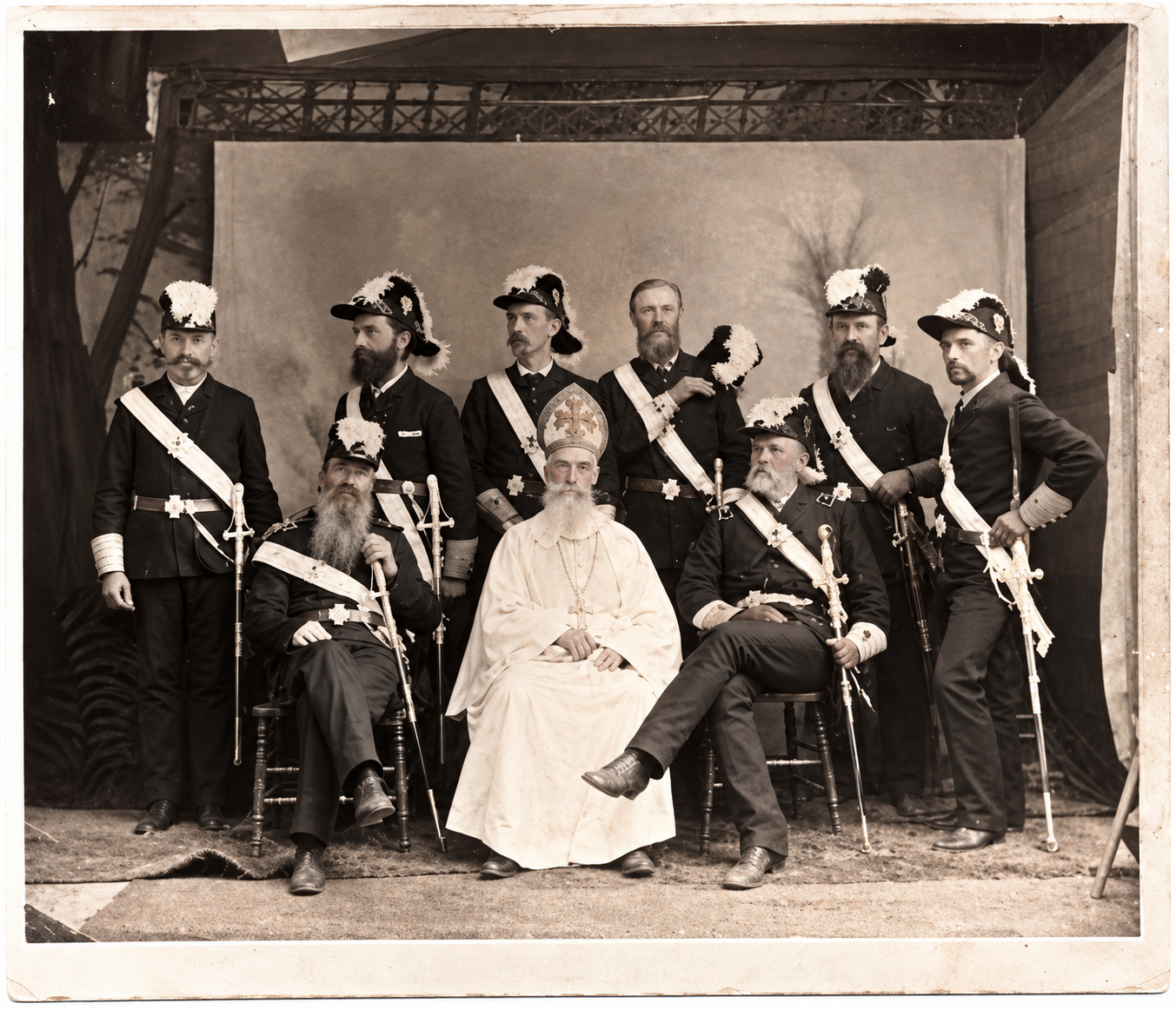
The three images establish the worlds that eventually became entangled. Brownwood’s official Henry Ford marker commemorates a banker and civic leader, the Jesse James portrait represents the outlaw whose identity became attached to him in local lore, and the 1861 Authentic Exposition of the K.G.C. represents a real antebellum secret organization around which a much larger postwar mythology later developed.
Brownwood’s Henry Ford Was Real, Wealthy, and Well Documented
Henry Ford of Brownwood was born in 1845 and came to Texas while still young. He worked in the cattle country before settling in Brownwood, where he served at different times as county clerk, mayor, county treasurer, school trustee and businessman before becoming prominently associated with private banking. Texas’s official historical marker credits him with helping bring the Santa Fe Railroad to Brownwood and with playing an important role in the community’s commercial development.
He was not a shadowy character who appears only in outlaw books. Texas Tech’s Southwest Collection holds approximately 5,791 leaves of Henry Ford papers covering correspondence, financial records, legal material, notebooks, diaries, printed material, photographs and maps, while a separate Coggin collection contains business records from Coggin Brothers and Ford, Bankers. The archival record reaches back into the 1870s and establishes Ford as a substantial Brown County businessman with cattle, banking and other financial interests.
A remarkable 1898 photograph places Ford physically inside that banking world. Brownwood News published the labeled photograph of businessmen gathered inside the Coggin-Ford Bank building, identifying Henry Ford as figure number eight and banker-rancher Samuel R. Coggin as number twelve. The importance of the photograph is not simply that we can see Ford’s face; it shows that the mysterious Texas Ford occupied the respectable center of Brownwood’s commercial establishment rather than its margins.
The bank itself handled real regional capital. Brown County history credits Coggin Brothers and Ford with financing numerous business and industrial ventures during the late nineteenth century, while a 1908 newspaper advertisement for the successor Coggin & Ford Company advertised $250,000 in paid-up capital and individual responsibility of $1.5 million, with Henry Ford named among its stockholders.
That matters enormously when we reach the automobile legend. A story that says some completely unknown Texas wanderer financed Henry Ford can be dismissed quickly, but Brownwood’s Henry Ford was genuinely a banker involved in moving significant amounts of capital around the Southwest.
The Brownwood Ford Had Connections Far Beyond the Bank Counter
The Texas Ford’s world was not limited to checking accounts. Texas Tech records show the Coggins and Ford involved in cattle and banking, while the Texas State Historical Association documents a 1901 partnership involving the Coggins, Henry Ford and James M. Ingle in an Idaho mining concern. Brownwood’s Ford therefore participated in precisely the kind of dispersed western investment network through which money could move from cattle and land into railroads, mining and other speculative enterprises.
The local history also places him close to transportation development. His state marker specifically credits him with helping bring the Santa Fe Railroad to Brownwood, which means that one of the major civic achievements remembered under his name involved connecting Brown County more tightly to national markets.
There was also a long local tradition of Ford lending money during difficult periods. Brown County accounts remember him as a figure willing to obtain capital and extend credit when local farmers and businessmen needed it, reinforcing an image of Ford as something more personal than an institutional banker. Whether every detail of those remembered loan stories can be reconstructed perfectly today, the broader reputation is consistent with the documented role of Coggin Brothers and Ford as a financier of regional development.
This becomes the first important ingredient in the later Ford Motor story. Brownwood already had an older Henry Ford whose known profession was finding, handling and lending money.
Then Jesse James Entered the Brownwood Story
The standard historical account places Jesse James’s death in St. Joseph, Missouri, on April 3, 1882, when Robert Ford shot him. Brownwood nevertheless developed a persistent alternative tradition identifying its banker Henry Ford with the supposedly surviving outlaw, a rumor prominent enough that the Handbook of Texas includes it in Ford’s biographical entry.
The Jesse James Photo Album research tradition associated with Brownwood researcher Jay Longley takes that local mystery much farther. Longley has argued in related published discussions that Henry Ford belonged to a postwar Brownwood circle of former Confederate guerrillas and Knights of the Golden Circle and that Ford was particularly close to William C. Anderson, a Brown County man whom Longley’s research identifies with the supposedly surviving “Bloody Bill” Anderson. Longley also collected local traditions of hidden tunnels beneath downtown Brownwood, including an alleged entrance associated with the old Coggin-Ford banking property. These are claims of the Brownwood KGC research tradition, not conclusions established by conventional archival history.
That distinction is especially important with the Knights of the Golden Circle. The KGC itself was real: it was a secretive antebellum organization associated with pro-slavery expansionism, secessionist activity and ambitions focused heavily on Mexico, the Caribbean and the American South. The Texas State Historical Association says that reliable evidence for the organization surviving the Civil War as a meaningful nationwide structure is lacking, even though later investigators have connected the KGC to Jesse James, John Wilkes Booth and numerous postwar conspiracies.

The Brownwood tradition therefore extends beyond what mainstream KGC scholarship presently demonstrates. Longley’s material describes photographs interpreted as KGC or related fraternal groups, supposed underground passages, postwar Confederate networks and Ford’s alleged place among them; critics in the same discussions repeatedly asked for contemporary membership rolls, oaths or other direct documentation proving the postwar KGC claims.
That unresolved evidence problem does not make the Brownwood material useless. It means that the KGC component of the story has to be treated as a historical tradition with identifiable sources rather than as a proven organizational chart.
The Most Interesting Brownwood Tradition May Be the People Who Supposedly Came Back to See Ford
The identity legend surrounding Henry Ford did not rest only on a resemblance to Jesse James. Brownwood stories placed known members of the James-Younger world in contact with Ford long after the Civil War.
A story preserved in Brown County and later Jesse James research says Cole Younger visited Brownwood and greeted Ford familiarly. Another account recalled Frank James and Cole Younger visiting their “old friend” Henry Ford after the turn of the century, with local historian T. R. Havins remembering Ford and Younger addressing one another simply as “Henry” and “Cole.”
The funeral story is stranger still. In Longley’s research tradition, Frank James supposedly came to Brownwood when Ford died in 1910, and Jesse and Frank’s mother, Zerelda Samuel, was also said locally to have attended. One version claims Frank warned residents not to place a marker on Ford’s grave, while another Brownwood tradition identified Zerelda because she had lost part of an arm after the 1875 Pinkerton raid on the James-Samuel home. These are oral-history claims rather than facts established by the official Texas biography of Ford, but they are important because they show what Brownwood itself believed about the mysterious banker’s relationship to the James family.
The best version of the story does not require deciding immediately whether all of those recollections are accurate. It is enough to notice that the Brownwood Ford accumulated a remarkably specific outlaw mythology involving Jesse, Frank, Cole Younger, guerrilla networks and secret societies rather than a vague claim that he simply “looked mysterious.”
Even the Jesse James Photo Album Researcher Did Not Believe Texas Henry Ford Was Jesse James
There is an important detail inside this material that often gets lost. Jay Longley, whose Brownwood research helped circulate many of the KGC and Jesse James connections, explicitly wrote in 2007 that his own research led him to believe Brown County Henry Ford and Jesse Woodson James were two different men. He based that conclusion partly on a book about Ford written by Ford’s great-grandson, even while continuing to investigate Ford’s alleged relationships with guerrilla and KGC figures.
That actually makes the automobile-financing story more interesting. If Jesse James and Texas Henry Ford are treated as separate figures rather than collapsed into one person, a different possibility appears inside the folklore: Brownwood’s banker could have been part of a western financial and personal network connected to former guerrillas, while Jesse James traditions attached themselves to that network independently.
The same 2007 exchange contains the automobile claim in unusually clear form. Another participant told Longley that Jesse Woodson James had financed Henry Ford’s first attempts to build automobiles, adding that some people identified the Texas Ford with James while he himself considered them associates instead. Longley replied that he had heard “a little” about the Jesse James/Ford automobile information but had not followed it up.
That is an important source point because it tells us exactly how strong the evidence was even within the community researching these traditions. The automobile-loan story was circulating, but one of the people most deeply engaged in the Brownwood material did not present it as something he had personally documented.
Meanwhile, the Other Henry Ford Was Desperate for Money
In Detroit, the automobile Henry Ford was having genuine financial problems. He had left the Edison Illuminating Company in 1899 to enter the automobile business, but the Detroit Automobile Company failed, and his second venture, the Henry Ford Company, ended with Ford’s departure before that company evolved into Cadillac. By 1902 he had engineering experience and publicity from racing, but he still needed somebody willing to finance another attempt.
Alexander Y. Malcomson became that person. A successful Detroit coal dealer, Malcomson backed Ford’s new venture and helped recruit other investors, including his wealthy uncle John S. Gray, president of Detroit’s German-American Bank. Gray’s standing in Detroit finance helped reassure other investors, and he ultimately became Ford Motor Company’s first president while Henry Ford initially served as vice president.


These are the men in the documented Detroit financing chain. Henry Ford supplied the mechanical project and intellectual property, Malcomson supplied crucial early backing and recruited investors, and banker John S. Gray provided financial credibility as well as capital at moments when Malcomson needed help.
Ford and Malcomson were in trouble even before the corporation formally existed. In March 1903 the Dodge brothers demanded $5,000 for automobile components they had begun producing, while much of the money supposedly committed by potential investors existed as notes rather than usable cash. The Henry Ford Heritage Association says that Malcomson frequently depended upon Gray in such crises and that the bulk of the cash used to jump-start Ford Motor Company came from Malcomson’s friends and relatives.
That surviving record is a major problem for the Texas loan story if the claim is that Jesse James secretly supplied the central startup capital. The known Ford Motor investors are listed in the company’s original 1903 Articles of Association: Henry Ford, Alexander Malcomson, John W. Anderson, C. H. Bennett, James Couzens, Horace and John Dodge, Vernon Fry, John S. Gray, Horace Rackham, Albert Strelow and Charles Woodall. Neither Brownwood Henry Ford nor Jesse James appears.
Then Comes the Checkbook
The best evidence for understanding just how close Ford came to failure is Ford Motor Company’s first surviving checkbook. The document, now held by The Henry Ford, starts with only $14,500 actually available in the company’s bank account on June 26, 1903, even though the corporation was nominally capitalized at $100,000. Ford and Malcomson each received $25,500 worth of stock largely in exchange for machinery, patents, plans and previous work rather than fresh cash, while several other investors had provided notes instead of fully paid subscriptions.
The money disappeared quickly. The first check reimbursed Malcomson $10,000 that he had already paid the Dodge brothers, after which payments went out for tires, blueprints, rent, salaries, postage and the mundane expenses required to turn a prototype into a functioning business. By July 10, the company had only $223.65 left in its checking account and had yet to sell a single automobile.


The checkbook is the strongest photograph in this entire story because it replaces mythology with actual money. Beside it, the Mack Avenue factory and an early Model A show how small the company still was: a rented wooden plant assembling cars from parts made by suppliers, not yet the giant vertically integrated Ford empire that later generations would imagine.
The ledger then records the turnaround. Investor Albert Strelow supplied another $5,000, and the first customer payments began arriving in July. The company’s first Model A sales finally put money back into the account, and by late August the balance had risen dramatically.
There is no mysterious Texas deposit identified in that visible sequence. The rescue we can document came from known investors and, crucially, from customers beginning to pay for automobiles.
Why the Texas Loan Story Is So Difficult to Kill
The absence of Jesse James from Ford Motor Company’s corporate books does not explain why the loan story developed, but the two Henry Fords provide almost perfect raw material for folklore.
Texas Henry Ford was nearly twenty years older than the automaker, was a genuine banker, had a mysterious early biography in local memory and was linked by oral tradition to men from the James-Younger guerrilla world. Michigan Henry Ford was repeatedly short of money, failed in two automobile ventures and needed private financiers to keep his third attempt alive. By 1903, somebody retelling the story from memory could truthfully say that “Henry Ford needed a loan” while another historical tradition could truthfully say that “Henry Ford was a banker in Texas,” and the names themselves invite confusion.
There is another real Ford loan hidden inside the documented history. Henry Ford’s cousin John N. Ford allowed Henry to use the John Ford farm as collateral for a loan around the time Henry purchased his father’s fifty-one-acre farm in 1902. The Henry Ford Heritage Association explicitly notes that this cousin was the only Ford relative known to have helped him financially in the creation period surrounding the company.
Now add the Brownwood story. An older banker named Henry Ford is associated with railroad development, cattle capital and a bank known for financing regional enterprises; stories connect him to Jesse and Frank James; KGC researchers describe him as part of an underground postwar network; and another tradition says Jesse James helped finance the automobile Henry Ford. Over time, the distinction among Henry Ford the banker, Henry Ford the inventor, Jesse James the outlaw and John Ford the lending cousin can become remarkably easy to lose.
That is how folklore becomes structurally believable even when the decisive document remains absent.
The KGC Story Changes the Meaning of the Alleged Loan
The Jesse James Photo Album material adds another layer because it does not treat the claimed automobile financing as an isolated act of friendship. Within the broader KGC interpretation, former Confederate guerrillas and sympathetic businessmen are imagined as participating in a long-lived underground financial network that survived the Civil War and moved money through banks, mining, land, transportation and hidden caches.
Brownwood becomes especially important in that reading. Longley has described the town as a refuge for former guerrillas and Confederates, claimed that Ford belonged to the KGC world, and argued that tunnels and symbols around downtown Brownwood preserve evidence of the network. Related discussions identify the old banking property as part of that geography and connect Ford socially to William C. Anderson, Cole Younger and the James circle.
That is the framework in which a secret Ford Motor loan makes conceptual sense. If one accepts the premise of a surviving KGC financial network, then money moving quietly from western banking circles into an emerging industrial enterprise would fit the theory perfectly.
The problem is that this is exactly where documentation becomes thinner rather than stronger. The Texas State Historical Association’s KGC history says dependable evidence for meaningful organizational survival after the Civil War is lacking, and Longley’s postwar Brownwood claims remain contested even among researchers interested in the subject.
The KGC interpretation therefore gives us a possible story architecture, but it does not supply the missing bank instrument. To move the claim from historical legend into documented history, somebody still has to find the money.
The Brownwood Bank Is the Logical Place to Look
Unlike many outlaw legends, this one has a concrete archive that can actually be investigated. Texas Tech holds thousands of pages of Henry Ford’s business and personal papers, while the Coggin Brothers and Associates records contain correspondence, financial documents and material from Coggin Brothers and Ford, Bankers covering the relevant period.
That makes the test surprisingly straightforward. A search through the Brownwood records for Detroit, Michigan, Henry Ford of Dearborn, Alexander Malcomson, John S. Gray, James Couzens, the Dodge brothers, automobile manufacturing or a suspiciously large transfer around 1901–1903 could potentially establish whether a Texas financial connection existed.
The Ford Motor side can be tested simultaneously because so much survived there as well. The Articles of Association identify the shareholders, the checkbook identifies incoming and outgoing cash, stock certificates survive, and the early correspondence surrounding Malcomson and the company’s investors has been heavily preserved.
If the alleged transaction was a private personal loan made before incorporation, it might not appear in Ford Motor’s corporate books. That possibility is one reason the Texas archive matters, although it should not be transformed into evidence that the loan occurred simply because a secret transaction is theoretically possible.
Jesse James and Henry Ford Actually Crossed Again Later, in a Much Better Documented Way
There is an odd postscript to the story. Decades after Ford Motor Company became successful, Henry Ford developed a strong interest in collecting the material history of America for the museum he was building in Dearborn. Surviving correspondence from around 1940 shows Ford’s representatives interested in obtaining firearms attributed to Jesse James after they had been displayed at the 1939 New York World’s Fair.
That episode does not prove the early financing legend, but it produces an eerie reversal. The story says Jesse James may have provided money to Ford before the automobile empire existed; several decades later, the automobile magnate was unquestionably trying to acquire Jesse James artifacts for his historical collection.
By then, Ford had enough money to collect the outlaw rather than borrow from him.
What Can Actually Be Said About the Loan?
The surviving evidence allows a much sharper conclusion than either simply believing or dismissing the story. There is presently no documented proof that Jesse James, Brownwood’s Henry Ford or a KGC fund financed Ford Motor Company’s formation in 1903, and the company’s surviving incorporation and checkbook records instead identify a Detroit investor network centered on Malcomson, Gray, Couzens and the other original shareholders.
At the same time, the legend did not attach itself to an imaginary Texas character. Brownwood’s Henry Ford was a real and substantial banker with access to capital, a documented role in western business and a longstanding local mythology connecting him to the James-Younger world.
The automobile-financing claim can also be traced inside the same research community that preserved the Brownwood KGC material. In the 2007 discussion, the claim that Jesse James financed Henry Ford’s first attempts to build cars was stated directly, but Jay Longley responded that he had only heard a little about that information and had not investigated it, while explicitly maintaining that Brownwood Henry Ford and Jesse James were separate men.
That is probably the right place to leave the evidence today. The story is old enough and specific enough to deserve investigation, but the proof threshold has not yet been crossed.
Two Henry Fords, One Jesse James, and $223.65
The most compelling way to look at the story is to place two artifacts beside one another. In Brownwood, a Texas historical marker commemorates an older Henry Ford who became a banker, civic official and railroad booster while local folklore turned his unknown early life into a Jesse James mystery. In Dearborn, Ford Motor Company’s first checkbook preserves the exact moment when another Henry Ford’s automobile dream had dwindled to $223.65.
Those objects are not folklore. They are physical evidence of two real lives that happened to intersect through one of the most powerful names in American industrial history.
Between them sits the unresolved story. Jesse James survival traditions say the outlaw lived beyond 1882; Brownwood traditions connect Henry Ford with Jesse’s family and former guerrilla associates; KGC researchers place Ford inside a hidden postwar network; and one version of the legend carries money from that world all the way to the struggling Michigan mechanic trying to build automobiles.
The official Ford Motor books do not presently show that transaction. Instead, they show Malcomson, Gray, Couzens, the Dodges and a small circle of Detroit investors trying to keep the company alive until customers finally began paying for cars.
That may eventually prove that the Texas story is simply what happens when several true histories become tangled together. It may also mean that anyone wanting to test the legend has been looking in the wrong place, because the next useful evidence would not come from another outlaw story or another treasure map; it would come from a century-old banking file.
Brownwood Henry Ford left thousands of pages behind.
Ford Motor Company left its first checkbook behind.
The Jesse James tradition left the claim behind.
What history has not yet produced is the canceled check connecting them.