The modern smart building looks like a product of software: cameras feeding dashboards, badge readers talking to access-control servers, thermostats adjusting themselves, fire sensors reporting to central panels, and maintenance systems watching motors and valves for signs of trouble. Strip away the screens, however, and the underlying logic is much older. A physical condition changes, a sensor notices, a signal travels somewhere else, that signal is interpreted, and a response follows.
That basic sequence was already being assembled in the middle of the nineteenth century. Augustus Russell Pope taught a door or window to trigger an electrical warning. Edwin Holmes transformed the alarm into a commercial system and then into a remotely monitored network. American District Telegraph organized whole neighborhoods and businesses around central stations, call boxes, messengers and watchmen. In Minneapolis, Albert Butz pushed the same electrical logic toward automatic temperature regulation, while in Wabash, Indiana, Mark C. Honeywell built a heating-control business that eventually joined the Minneapolis company to create Minneapolis-Honeywell.
These companies do not form a simple ownership chain in which Holmes literally became ADT and ADT literally became Honeywell. The connection is more interesting than that. They represent stages in the development of the same architecture: detection, communication, centralized interpretation and automatic control.
Edwin Holmes and the Moment a Building Learned to Report Itself


The man on the left is Edwin Holmes, photographed around the period when electrical alarm technology was becoming a real commercial business. The second image shows the kind of miniature house Holmes used to demonstrate the system to customers: open the little door or raise the window, and the electrical apparatus caused the bell to ring.
The invention beneath Holmes’s business belonged originally to Augustus Russell Pope of Somerville, Massachusetts. Pope received U.S. Patent No. 9,802 in June 1853 for an electromagnetic alarm designed to protect doors and windows. His system used electrical contacts, an electromagnet and a bell so that opening a protected entry point completed the circuit and produced repeated blows on the alarm.
That mechanism seems almost embarrassingly simple beside a modern security system, but it contained a huge conceptual breakthrough. A building component had acquired an electrical state. The door was no longer merely open or closed in the physical sense; its condition could now be represented electrically and communicated to another device.
Holmes purchased Pope’s patent rights and began commercializing the alarm. A company history published by the Holmes Electric Protective Company described Holmes arriving in New York in 1858 with a small demonstration house because many potential customers had so little familiarity with electricity that they doubted his claims. The model’s doors and windows were wired to a battery and roof-mounted bell so Holmes could demonstrate the principle directly.
The important part of that story is not that people thought electricity looked like magic. It is that Holmes quickly realized the bell itself was not the end of the invention.
The circuit was.
A Burglar Alarm Becomes a Communications System
This surviving Holmes-style electromagnetic alarm still looks like something halfway between a telegraph instrument and a household appliance. That is exactly the technological territory in which early security developed: springs, contacts, batteries, electromagnets, bells and wires arranged so that something happening at one point could become known at another.
By 1872, the Holmes Burglar Alarm Telegraph Company had been organized specifically to provide protection through central stations. According to the firm’s own historical account, the company was renamed Holmes Electric Protective Company in 1882, at which point its two New York central stations—at 194 Broadway and 518 Broadway—were serving 471 subscribers.
That change transformed the alarm from an appliance into a network.
A local bell says, in effect, “something is happening here.” A central-station system says, “something is happening there, and somebody somewhere else now knows about it.”
Once that step is taken, the protected building stops being an isolated object. It becomes a node.
A bank vault can sit blocks from the monitoring office. A jewelry-store window can report a change without anyone standing beside it. An office door can be watched after the employees have gone home. The physical property has been translated into electrical information and attached to a larger communications system.
The same logic would later underlie virtually every form of remote monitoring.
ADT Turns the City Into a Grid of Signals


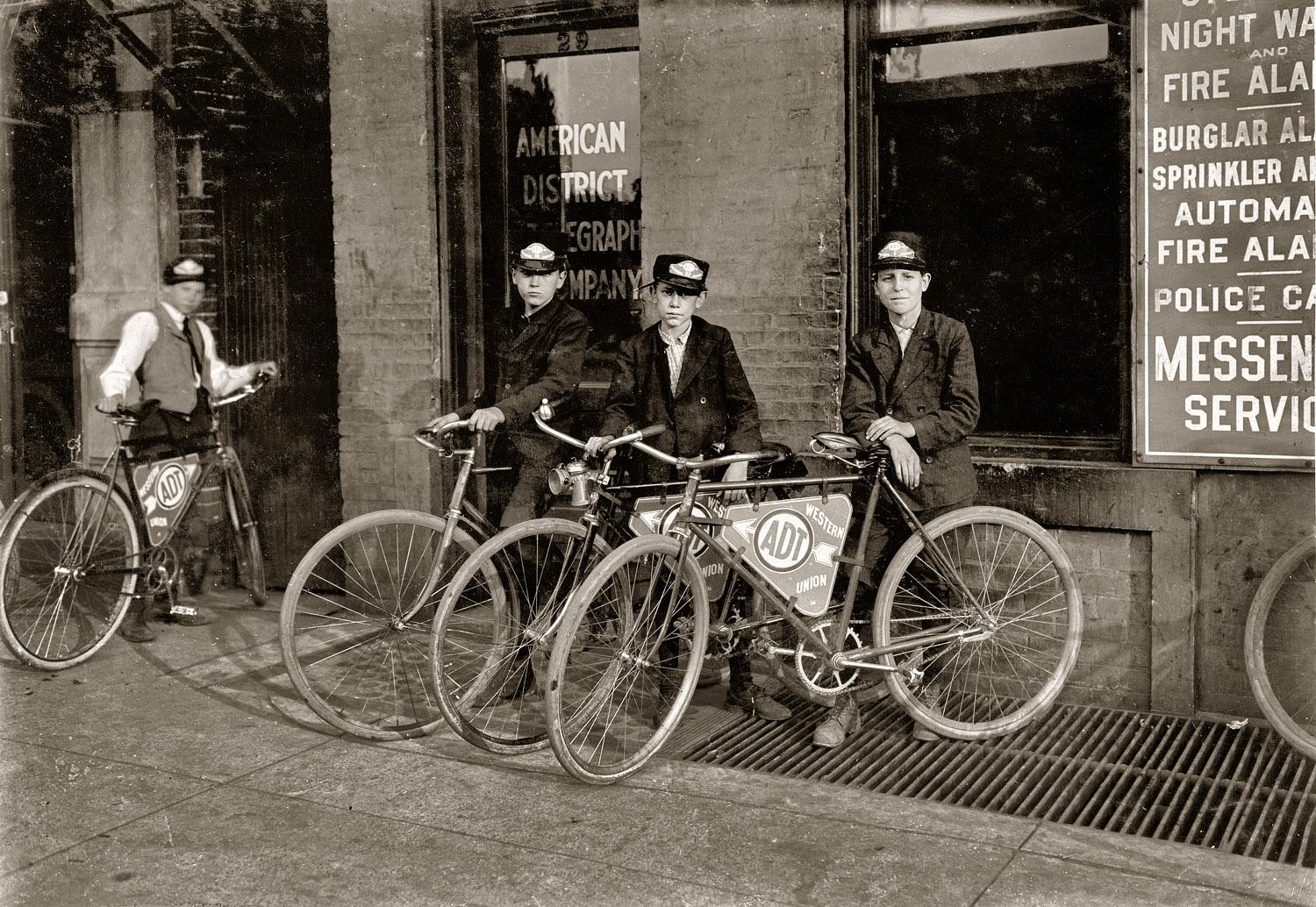
The red instrument above is an American District Telegraph fire-alarm call box preserved by the Smithsonian’s National Museum of American History. Beside it are ADT bicycle messengers standing outside an American District Telegraph office, surrounded by signage advertising fire alarms, burglar alarms, police calls, messenger service and night watch. The two images together show what ADT really was: not simply a box on a wall, but a communications-and-response organization.
ADT traces its origin to Edward Callahan’s telegraph-based call-box system and its incorporation in Baltimore on August 14, 1874. The company’s historical account describes Callahan connecting dozens of homes so customers could signal a central office for assistance, creating an early residential security network.
The key word is central.
The customer no longer needed to know exactly whom to find in an emergency. The premises—or the occupant using the call box—only had to send the signal. The central office received the message and handled the next stage.
ADT’s later Roundsmen made that architecture physical. Employees patrolled customer properties, checked for fire or burglary problems and responded to abnormal conditions. Messenger boys carried messages through the city, and many were later recruited into the company’s security operation as telephony displaced some of the older telegraph-delivery business.
The technology and labor therefore formed one machine. Wires carried information inward, while messengers, Roundsmen, police or fire responders carried action outward.
That is already the outline of a modern control system.
Before Computers, the Central Station Was the Brain
A nineteenth-century alarm network can be understood as a crude nervous system. Contacts at doors, windows, safes and alarm boxes acted as sensory endings. Telegraph wires carried the signal. The central station received and interpreted it. Human responders became the muscle that moved after the information arrived.
This comparison becomes more useful when we stop concentrating on the individual gadgets. A bell, call box and telegraph register can look like unrelated antiques, but the system connecting them is recognizable: distributed sensing attached to centralized decision-making.
Holmes and ADT developed as separate enterprises, and their histories should not be flattened together. They nevertheless occupied overlapping portions of the same emerging industry. Holmes specialized heavily in protective electrical systems and central-station burglary protection, while ADT grew from district telegraph and messenger infrastructure into monitoring, watch and alarm services.
Their commercial worlds eventually intersected directly. By the early twentieth century, the central-station protection industry had become concentrated enough that later antitrust litigation examined agreements and market arrangements involving companies such as ADT and Holmes. The corporate details changed, but the nineteenth-century achievement beneath them remained the same: urban property could now be remotely legible.
The city was beginning to sense itself.
Telegraph, Telephone and Alarm Were Parts of the Same Electrical Revolution
The alarm network also developed beside early telephony rather than in a completely separate technological universe. The telephone, telegraph and alarm circuit all solved versions of the same problem: how to make an event occurring at one location electrically intelligible at another.
A telegraph carried coded pulses. A telephone carried voice. A burglar system carried a change of state.
Historical accounts of early switching place the Holmes alarm organization directly inside this communications transition. In Boston, Holmes infrastructure became associated with one of the earliest central-office telephone arrangements, showing how naturally alarm and telephone networks could overlap when both depended upon bringing many subscribers into a centralized wired system.
Holmes himself also patented improvements for the alarm circuits he was developing. One 1867 patent describes a timed method for breaking or closing the electrical circuit of an alarm system based specifically on the earlier Pope apparatus, demonstrating how the original alarm was already becoming a more sophisticated controlled network rather than a simple bell attached to a door.
The deeper shift was architectural. Houses, stores, banks and offices were acquiring electrical connections to systems outside themselves.
They were becoming endpoints.
The Next Leap Was Making the Building Respond Without Waiting for a Person
Security networks learned how to detect a change and tell somebody about it. Automatic control introduced another question: could the electrical system respond directly, without waiting for a human operator to travel back through the network?
That question leads toward Honeywell.
This early Minneapolis Heat Regulator mechanism makes the transition visible. It is still obviously mechanical, with a lever, terminals and switching apparatus, but it belongs to a line of technology that came out of Albert Butz’s automatic furnace regulator.
Honeywell’s corporate history dates this control lineage to Butz’s furnace regulator of the 1880s. The famous “damper flapper” could automatically influence furnace operation in response to temperature, helping remove the need for someone to adjust heating equipment manually. Butz’s business eventually passed through the Electric Heat Regulator Company and became Minneapolis Heat Regulator Company under W. R. Sweatt.
Notice how close the underlying logic is to Pope’s burglar alarm.
The burglar alarm asks whether the door has departed from its expected condition. The temperature regulator asks whether the room has departed from its expected condition.
Both sense a difference.
Both convert that difference into a signal.
The major distinction is what happens next.
Holmes and ADT generally sent the information toward a person. Automatic regulation increasingly sent the information toward machinery.
The Thermostat Is an Alarm With a Reflex
This is where the history of security and the history of heating begin to look like parts of one larger technological story. A thermostat and a burglar sensor appear unrelated because one protects comfort and the other protects property, yet the electrical logic underneath them is remarkably similar.
A monitored door has an expected condition. A room has an expected temperature. A boiler has an expected pressure. A sprinkler line has an expected state. A smoke detector has an expected level of particulate concentration.
Control begins when the system can compare what is happening with what should be happening.
The nineteenth-century alarm was already performing the first half of that operation. Automatic regulators added the ability to push a correction back into the physical world.
That creates feedback.
The building is no longer merely talking.
It is beginning to act.
Then the Story Lands in Wabash, Indiana


Wabash is an unusually appropriate place for the Honeywell side of this story because electricity had already become part of the town’s identity before Mark Honeywell built his company there. On March 31, 1880, four Brush arc lamps mounted above the Wabash County Courthouse illuminated the town, powered by an electrical system the municipality had deliberately purchased and installed. The Library of Congress describes Wabash as the first municipality to obtain and install the Brush electric-lighting system.
The popular claim that Wabash was simply the first place on Earth ever illuminated electrically is too broad; other demonstrations and installations preceded it. The more defensible and more interesting point is that Wabash embraced electrical lighting as municipal infrastructure extremely early.
The town was not merely watching a traveling inventor perform a demonstration.
It was putting electricity to work.
That distinction matters because Mark C. Honeywell was born in Wabash in 1874 and later built his heating business there. He came of age in a community where electrical technology had already been folded into a local story about modernization and civic progress.
There is no evidence that the courthouse arc lamps somehow caused Honeywell’s later career, and the technological chains should not be forced together. Yet the geography remains striking: one of America’s most famous early municipal electrical experiments and one of the country’s major future control-system companies emerged from the same small Indiana city.
Mark Honeywell Builds the Wabash Half of the System
This early Honeywell Heating Specialty Company material still identifies the firm plainly with Wabash, Indiana. The company’s business was initially centered on hot-water heating equipment rather than the electronic building-management systems associated with Honeywell today.
Honeywell’s official company history dates the formation of the Honeywell Heating Specialty Company to 1906. Mark Honeywell had developed heating equipment through his plumbing and heating work, and the business grew around equipment for hot-water systems.
The important point is that Honeywell was developing a second branch of the control story at precisely the period when alarm and communications networks were maturing elsewhere.
Holmes and ADT were concerned primarily with abnormal events: unauthorized entry, fire, calls for police assistance, interrupted watch circuits or other conditions requiring a response.
Heating control concerned continuous regulation.
Instead of waiting for a crisis, the system monitored the environment repeatedly and continually adjusted it.
That moves automation from emergency reaction into ordinary operation.
Minneapolis and Wabash Merge
The Honeywell known today came from the joining of two histories rather than from a single uninterrupted Wabash line. Albert Butz’s Minneapolis regulator business had evolved into Minneapolis Heat Regulator Company, while Mark Honeywell’s business developed independently in Indiana.
In 1927, Minneapolis Heat Regulator Company and Honeywell Heating Specialty Company merged to form Minneapolis-Honeywell Regulator Company. Honeywell’s corporate history identifies W. R. Sweatt and Mark Honeywell as central figures in that merger, which combined the Minneapolis automatic-regulator tradition with the Wabash heating-equipment business.
This is an important distinction because it mirrors the larger story of building control itself.
Different industries were developing different pieces of the system.
Security companies developed detection and centralized monitoring.
Telephone and telegraph companies developed communications infrastructure.
Regulator companies developed sensing and automatic feedback.
Heating manufacturers developed equipment that could actually change conditions inside the structure.
Eventually those functions stopped looking like separate technologies.
They became the nervous system of the building.
The Control Business Becomes Mass Production
By the middle of the twentieth century, Honeywell control equipment had moved far beyond experimental furnace mechanisms. This factory photograph shows rows of Honeywell Round thermostats being assembled in Minnesota, with large numbers of identical control devices moving through a production line.
The famous Round thermostat was introduced in the 1950s and became one of the most recognizable pieces of industrial design in American domestic life. The Minnesota Historical Society’s material on the device shows how thoroughly automatic temperature control had moved from specialist engineering into ordinary buildings.
That is a major historical shift.
In Pope’s era, an electric alarm was unusual enough to require a traveling demonstration house.
By the Honeywell era, people expected a wall-mounted sensor to watch the temperature constantly and control equipment hidden somewhere else in the building.
Automation had become normal.
The magic disappeared into the wall.
From the Alarm Bell to the Control Panel
The easiest way to see the larger progression is to follow what happens to the human being in the loop.
In Pope’s alarm, the electrical circuit rings a bell and a person hears it.
In Holmes’s central-station system, the signal travels away from the building so an operator can interpret it.
In ADT’s network, the central office can coordinate Roundsmen, messengers, police or fire response across a wider territory.
In the automatic regulator, the electrical condition can cause machinery itself to respond.
By the time large building-control systems appear, thousands of such loops can operate simultaneously. Temperature, pressure, flow, smoke, intrusion, equipment condition and occupancy can all be converted into signals, and increasingly the system can respond before a human operator touches anything.
The difference between the alarm business and the automation business begins to collapse.
Security and Honeywell Eventually Meet in the Same Building
Modern building systems bring these once-separate histories back together. Honeywell’s current building business includes fire detection, access control, security systems, HVAC control, energy management and other building technologies that would once have belonged to completely different industries.
The old burglar contact and the thermostat now report into the same conceptual environment.
A door sensor says whether an entry is secure.
A badge reader says whether a person is authorized.
A thermostat says whether the room is too warm.
A pressure sensor says whether a mechanical system is behaving correctly.
A smoke detector says whether the atmosphere has moved outside normal conditions.
They all perform the same basic act.
They turn a piece of physical reality into information.
That information can be displayed, stored, compared, transmitted or acted upon automatically.
The nineteenth-century alarm circuit has grown until it encompasses the building.
The ADT Messenger and the Honeywell Valve Are Doing the Same Job at Different Speeds

These two images look as though they belong to completely different histories. One shows human ADT messengers standing beside bicycles outside a telegraph office; the other shows an electromechanical heating-control mechanism from the Minneapolis regulator tradition.
Yet structurally they occupy the same place in a control loop.
The ADT system receives a message and sends a person.
The regulator receives a condition and moves a mechanism.
One response is human and geographically slow.
The other is mechanical and nearly immediate.
Once that distinction is recognized, the transition from telegraph security to automatic building control becomes much easier to see. Automation did not invent the idea of centralized response. It replaced more and more of the human response with machinery.
The messenger became a relay.
The watchman became a sensor.
The person turning the damper became a motor.
The clerk staring at the central station eventually became software.
Wabash Sits at a Particularly Strange Intersection
The Wabash connection deserves more attention precisely because it is not the obvious center of the American electrical industry. New York had telegraph companies and central alarm stations. Boston had Pope, Holmes, Bell and early telephone experiments. Minneapolis had Butz and the regulator industry. Chicago and the East Coast contained vast industrial markets.
Then there is Wabash.
A small Indiana city puts Brush arc lamps over its courthouse in 1880 and makes municipal electrification part of its public identity. A boy born there six years earlier grows into an engineer and businessman whose name becomes attached to a heating-control firm. That Wabash company later merges with the Minneapolis regulator enterprise and helps create one of the most important control companies of the twentieth century.
Again, coincidence is not causation.
But historical geography matters because technologies do not develop in abstractions. They develop inside places where people become accustomed to particular possibilities.
Wabash was learning unusually early that electricity could operate civic infrastructure.
Mark Honeywell later built a business around the proposition that controlled machinery could operate the interior environment.
Those are at least chapters in the same local story.
What Holmes Really Invented Was Distance
Edwin Holmes is usually remembered as the burglar-alarm pioneer, but that label can make his importance seem smaller than it was.
The deeper achievement was distance.
Pope had established that a door could trigger an electrical event. Holmes increasingly established that the person who needed to know about the event did not have to be standing beside the door.
Once that principle exists, the rest of the modern system becomes imaginable.
A bank can be monitored from another block.
A warehouse can be watched from another neighborhood.
A boiler can be controlled from another room.
An office tower can be supervised from a central control room.
A portfolio of buildings can eventually be monitored from another state.
The geographic distance changes.
The information architecture does not.
The Smart Building Is the Old Central Station Turned Inside Out
The most interesting way to understand today’s smart building may be to imagine that the old Holmes or ADT central station has expanded until it occupies the structure itself.
The building contains hundreds or thousands of monitored points. Doors, windows, smoke detectors, thermostats, cameras, dampers, fans, pumps, valves, elevators and electrical equipment continually report their condition.
The old central station operator once received relatively simple signals and decided who should be sent.
Modern control software receives vastly more information and can execute many responses automatically.
The building has effectively swallowed the central station.
Its walls contain the wires.
Its rooms contain the sensors.
Its mechanical systems provide the response.
Its computer becomes the operator.
That is why the history of burglar alarms belongs inside the history of building automation.
The Real Line Runs From Detection to Control
It would be tempting to draw a neat corporate arrow saying Holmes → ADT → Honeywell, but that would sacrifice the real history for a cleaner story.
Holmes and ADT were different organizations.
Honeywell descended through different control and heating businesses.
What connects them is the architecture they helped build.
Pope made the physical condition of a door electrically detectable. Holmes commercialized that idea and pushed protection toward remote central stations. ADT organized distributed premises, communications infrastructure and human response into a scalable network. Butz and the Minneapolis regulator line made environmental sensing part of an automatic feedback system. Mark Honeywell’s Wabash company brought another heating-and-control tradition into the 1927 Minneapolis-Honeywell merger.
Each stage added another capability.
The building learned to notice.
Then it learned to communicate.
Then it learned to summon a response.
Eventually it learned to respond by itself.
That is the real line from the burglar bell to the smart building.
The Building Learned to Watch Itself
When Augustus Pope patented his alarm in 1853, a protected door could finally announce electrically that it had moved. When Edwin Holmes built central protection around that principle, a building could report the event to somebody who was not there. ADT expanded the same logic into organized district networks connecting communication with human response, while the regulator companies that became Minneapolis-Honeywell increasingly eliminated the need for a human to perform every corrective action.
The change took nearly a century, but the underlying thought remained remarkably stable. A physical environment could be translated into signals, those signals could be concentrated somewhere, and the information could be used to alter what happened next.
That is why an old burglar bell, an ADT call box, a Wabash courthouse lamp and a Honeywell thermostat belong in the same technological history. They are different pieces of the period when electricity stopped being merely something people looked at and became something buildings used to understand and manage themselves.
The modern smart building is the mature version of that idea. It began long before computers, hidden inside a door contact, a telegraph wire, a central office and a furnace regulator.