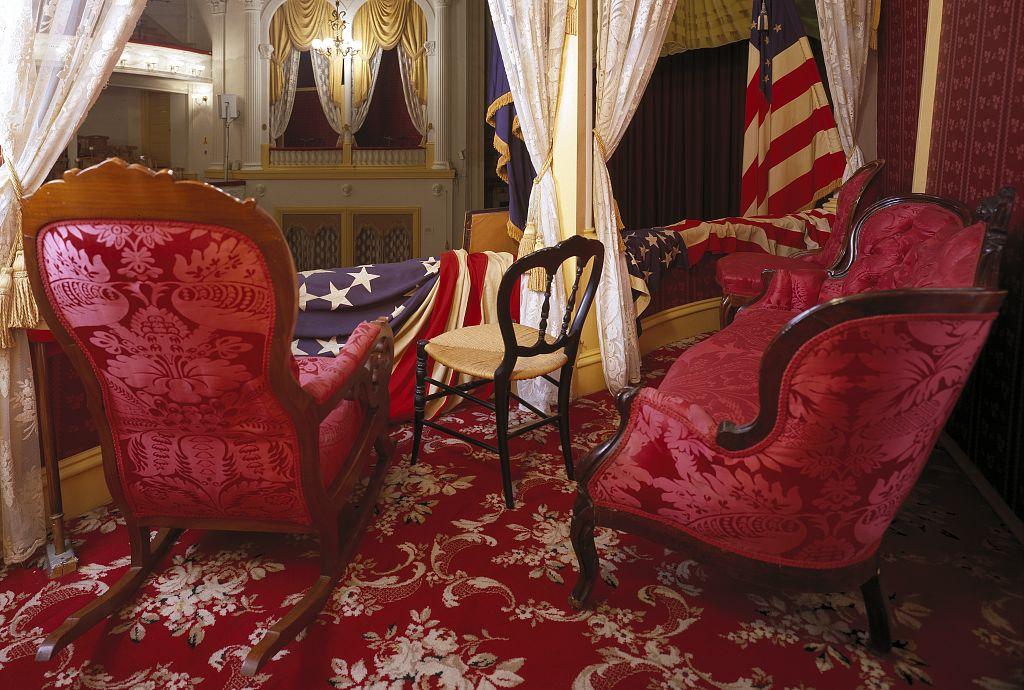
Abraham Lincoln was not killed in an alley, on a battlefield, or while moving through an uncontrolled crowd. He was shot inside one of Washington’s best-known theaters, in a private box overlooking a stage, while roughly seventeen hundred people watched a comedy only a short distance away. The location has become so familiar that “Ford’s Theatre” now sounds almost inseparable from “Lincoln assassination,” which makes it easy to forget that before April 14, 1865, Ford’s was a functioning commercial theater with employees, actors, entrances, exits, backstage passages, mail deliveries, rehearsal habits, favored patrons, and people who knew exactly how to move through it.
That ordinary working environment is what makes the assassination worth looking at from another angle. John Wilkes Booth did not have to break into an unfamiliar government building or bluff his way into a secure presidential residence; he entered a theater where he was already known as a famous actor, a friend of owner John T. Ford, and a performer who had appeared on that very stage. The National Park Service notes that Booth was familiar enough with Ford’s that he received mail there while staying in Washington, and it was while collecting his mail on the morning of April 14 that he learned Lincoln would attend Our American Cousin that night.


The images above place the principal elements of the scene together: Lincoln’s presidential box at Ford’s shortly after the assassination, a contemporary depiction of the shooting, and John Wilkes Booth as Americans of the period knew him. The surviving 1865 photograph of the box is especially useful because it reminds us that this was a physical environment with curtains, doors, railings, sightlines, and routes through which people actually moved.
Before It Was an Assassination Site
Ford’s Theatre began with a church. A Baptist congregation had built on Tenth Street in the 1830s, and John T. Ford later acquired the former church property and converted it into a theater; after an 1862 fire destroyed the first theatrical conversion, Ford rebuilt, creating the building in which Lincoln would eventually be shot.
By 1865 the rebuilt theater was not a marginal entertainment hall. It was part of Washington’s professional theatrical life, and Ford himself belonged to a broader theatrical world centered heavily on Baltimore as well as Washington. The Ford business connected managers, touring actors, stagehands, performers, newspapers, hotels, railroads, audiences, costumes, scenery, and correspondence across cities, which is one reason The Lincoln Log treats the theater as an institution rather than simply as the room where Booth happened to find Lincoln.
That distinction matters because a theater is built around controlled movement. Audiences generally move through one set of doors and occupy one kind of space, performers move through others, employees know the back passages, managers control access to private areas, and people who belong to the profession can appear backstage without creating the alarm that an unfamiliar stranger might generate.
Booth occupied exactly that kind of privileged social position. He had acted at Ford’s several times and had even performed there in November 1863 in The Marble Heart while Lincoln himself sat in the audience, meaning that the future assassin and future victim had previously occupied the same theater under completely ordinary theatrical circumstances.
Booth Did Not Look Like an Intruder
John Wilkes Booth was one of the better-known actors in America. He came from the famous Booth theatrical family, had performed across the country, and was recognizable to theater employees and many members of the public, which gave him an advantage that had nothing to do with secret codes or elaborate disguises.
On April 14, seeing Booth around Ford’s would not automatically have meant that anything unusual was happening. The National Park Service specifically notes that his friendship with John T. Ford, his acting career, his previous appearances at the theater, and his habit of receiving mail there all made his presence unsurprising.
That is a very different security problem from a stranger forcing his way toward the president. Booth’s social identity already answered the first question that normally protects a restricted place: “Why is this man here?”
Everyone had an answer.
He was an actor.
The more important question was what an actor who knew the building could do once no one considered his presence remarkable.
The Presidential Box Was Part of the Theater, Not a Fortress
Lincoln arrived late for the April 14 performance with Mary Lincoln, Major Henry Rathbone, and Rathbone’s fiancée, Clara Harris. The play stopped briefly, the orchestra played “Hail to the Chief,” the audience applauded, and the presidential party entered the decorated state box above the stage.
From the audience’s perspective, the box provided separation and prestige. From Booth’s perspective, however, it was still a room inside a theater he knew well, approached through interior spaces that were part of the building’s everyday operational geography.
The Lincoln Log makes that physical point explicitly. It describes Ford’s as an environment of entrances, exits, sightlines, employees, routines, privileges, and back passages, arguing that a theater naturally divides what an audience sees from the machinery and movement occurring around it.
That does not mean the theater was constructed for assassination or that the Ford family had to be part of Booth’s plot. It means the architecture offered Booth something an assassin would normally struggle to obtain: proximity to the target inside a building where his own presence did not automatically appear threatening.
The building performed its normal function right up to the moment Booth exploited it.
The Comedy Was Part of the Opportunity
Lincoln was watching Our American Cousin, a hugely popular comedy associated particularly with actress and manager Laura Keene. The play had been successful for years before 1865, and there was nothing inherently political about Lincoln attending it on the night the war-weary city was celebrating what looked like the collapse of the Confederacy.
Yet Booth understood the play professionally. He knew theatrical rhythm, knew how audiences behaved, and knew that the third act contained a reliably enormous laugh.
The National Park Service places the shooting around 10:15 p.m. during Act III, Scene 2, when actor Harry Hawk delivered the production’s largest laugh line. The audience erupted, and Booth used that moment to enter the presidential box and fire his single-shot derringer into the back of Lincoln’s head.
The laughter mattered because it affected attention and sound. NPS accounts note that many people in the theater either did not immediately understand what they had heard or failed to hear the gunshot clearly over the audience reaction, while even Major Rathbone, seated in the box, did not realize Booth had entered until after the pistol discharged.
This is one of the places where the theater becomes more than scenery. A professional actor understood that a crowded room could contain nearly two thousand people and still produce a moment in which almost everyone’s attention was directed toward the same point onstage.
The Lincoln Log describes the play as mechanism rather than mere literary background. Its argument is that comedy created a predictable rhythm of release, and Booth could exploit that rhythm because he understood how a theater audience behaved when the line landed.
The audience did nothing intentionally to help him. Their laughter simply created the few seconds of acoustic and psychological confusion he needed.
Almost Nobody Saw the Shot
One of the stranger facts about the most famous theater assassination in American history is how few people actually witnessed the trigger being pulled. The National Park Service says only one recorded eyewitness, restaurant owner James P. Ferguson, claimed to have directly seen the flash from Booth’s pistol inside the box.
Hundreds of people heard or eventually understood that something had happened, but their eyes had been pointed toward the performance. When Booth appeared at the front of the presidential box after firing, fought with Rathbone, and jumped down toward the stage, the assassination suddenly moved from an almost private act into a public spectacle.
That transition took only seconds. Booth had entered the box as someone largely unseen by the crowd, fired from behind Lincoln, and then emerged into the audience’s field of vision by doing something actors normally did for a living: appearing onstage.
The difference was that he reached the stage from the president’s box.
Booth’s Escape Was Also Theatrical Geography
After firing the pistol, Booth struggled with Rathbone and stabbed him with a dagger. He then moved to the front of the box, jumped toward the stage, became entangled in the decorations, landed awkwardly, and crossed the stage while the audience tried to understand what had happened.
From there he did not have to push his way back through the audience and exit through the same public doors used by theatergoers. Booth ran across the stage and escaped through a rear door that opened into what was then called Baptist Alley, where theater worker Joseph “Peanuts John” Burroughs was holding Booth’s horse.
That route explains why the building itself deserves attention. The box gave Booth proximity, the comedy gave him timing, the stage gave him a transitional space, and the rear theater door gave him access to an alley where a horse could be positioned beyond the audience’s view.
None of those things proves a larger conspiracy inside Ford’s. Together, however, they demonstrate how Booth’s familiarity with a working theater converted ordinary theatrical infrastructure into an assassination route.


John T. Ford, shown here in a surviving carte-de-visite portrait, gave his name to a theater that would permanently become associated with Lincoln’s death. The second image shows the presidential box as it exists within the theater environment, where what appears from the audience to be a ceremonial space also had approaches and doors that mattered enormously on April 14.
John T. Ford and the Question of the Building
John T. Ford is sometimes swallowed by the enormous personalities of Lincoln and Booth, but the theater carried his name because it was his business. The relationship between Ford and Booth is documented: Booth was Ford’s friend, had performed in his theater, and belonged to the professional theatrical world that made informal access possible.
That relationship has encouraged much larger theories about Ford’s role over the years, but the surviving evidence does not require turning Ford himself into a proven architect of the assassination. The Lincoln Log makes a narrower structural argument: the assassination occurred inside an institution whose business was managing access, performance, backstage movement, special guests, employees, and public attention, and Booth had unusually favorable standing inside that institution.
That is already historically significant. A theater proprietor does not have to know that an assassination is coming for the routines of his theater to become useful to someone who does.
The building did not pull the trigger.
The building helped determine how close the man with the trigger could get.
The Playbill Announced the President
There was another feature of the evening that would be difficult to imagine in a modern presidential security environment: Lincoln’s attendance became part of the theater’s publicity. A surviving April 14 playbill at the Library of Congress announces that the evening’s performance would be “honored by the presence of President Lincoln.”
That information helped sell tickets, and the NPS notes that word of Lincoln’s attendance boosted the crowd toward the upper end of Ford’s normal capacity. The presidential visit was therefore simultaneously a security fact and a commercial event.
For Booth, the important intelligence was even simpler. He did not need an elaborate espionage service to discover where Lincoln would be that night because he learned of the visit while stopping at the theater for his own mail.
The president’s destination, Booth’s professional familiarity, and the theater’s routines converged during the course of an ordinary business day.
By evening, the assassination location was already waiting.
What Happened to Ford’s After the Shot
The theater’s ordinary life effectively ended the moment Lincoln was shot. After the assassination, Secretary of War Edwin Stanton placed Ford’s under federal control, military guards restricted access, and Mathew Brady’s studio was permitted to photograph the crime scene.
John T. Ford attempted to reopen the theater in July 1865. More than two hundred tickets were sold for a planned performance of The Octoroon, but Stanton ordered the building closed again, soldiers turned patrons away, and the federal government eventually began leasing the property rather than allowing it to return to ordinary theatrical use.
Then something remarkable happened to the assassination scene. Contractors removed the theatrical interior, dismantled the presidential box, constructed multiple office floors inside the shell, and transformed the former theater into federal working space. Congress approved funds for its acquisition, and by 1867 the building housed Army medical records, the Surgeon General’s library, and the Army Medical Museum.
The place where theatrical machinery had hidden movement became an administrative records building.
That transformation fits uncannily well with the larger custody story running through The Lincoln Log. The body entered funeral and burial custody, photographs entered archival custody, papers entered family and institutional custody, and the physical room where Lincoln was shot entered federal custody.
The assassination scene itself became paperwork.
The Theater Became a Crime Scene, Then an Archive
There is something unusually revealing in the government’s decision to gut the interior. The theater had become politically toxic as a functioning entertainment venue, while the exterior walls could still be used for government purposes, so the federal response effectively separated the building from the activity that had given the building its meaning.
The National Park Service notes that by the fall of 1865 the original theatrical interior had disappeared almost completely. The exterior walls and façade survived, but inside them stood three floors designed for offices and records rather than balconies, boxes, actors, audiences, and scenery.
That physical conversion complicates the modern experience of Ford’s Theatre. The theater visitors encounter today is a reconstruction produced through later restoration work, aided in part by the Brady photographs made immediately after the assassination.
In other words, the federal government first photographed the room as evidence, then dismantled the room, and later generations used the photographs to rebuild the room as history.
The crime scene became an archive capable of reconstructing itself.
Then Ford’s Became a Death Site Again
The building’s strange history continued long after Lincoln. By the 1890s hundreds of federal clerks were working inside the former theater, many in the War Department’s Records and Pensions Office.
On June 9, 1893, excavation work destabilized the structure and roughly forty feet of the interior collapsed. Twenty-two government employees were killed and dozens more were injured, giving Ford’s Theatre a second major association with sudden death even though the building had not functioned as a theater for decades.
That later disaster has nothing to do with a Lincoln conspiracy, but it reinforces how strange the physical afterlife of the place became. Ford’s moved from church to theater, from presidential crime scene to federal records building, from records building to disaster site, and eventually back into a reconstructed theater and national historic site.
The building accumulated meanings because the original event never released it.
Why the Theater Matters to The Lincoln Log
The conventional assassination narrative understandably concentrates on Booth. He had Confederate sympathies, had previously organized a kidnapping plot against Lincoln, moved to assassination after the Confederacy’s collapse, entered Ford’s Theatre armed, shot Lincoln, stabbed Rathbone, fled through Maryland and Virginia, and died twelve days later at Garrett’s farm.
None of that is disputed by The Lincoln Log. The book’s question is what happens when Booth is restored to the physical and institutional environment in which the assassination actually occurred rather than allowed to absorb the entire scene by himself.
Ford’s Theatre supplies a remarkably clear case study because almost every practical requirement of the act can be seen in one building. Booth needed knowledge that Lincoln would attend, permission to move without immediately alarming employees, access to the level containing the presidential box, knowledge of theatrical timing, a moment when attention and sound were concentrated elsewhere, a route from box to stage, a rear exit, and transportation waiting beyond the building.
Those elements did not magically appear at 10:15 p.m.
They belonged to the theater.
The manuscript therefore treats Ford’s as what it calls a “managed environment,” emphasizing that theaters contain entrances, exits, sightlines, employees, privileges, back passages, and routines that insiders understand differently from spectators.
That distinction allows a more useful question than simply asking whether somebody inside Ford’s was secretly “in on it.” The historical question is how an assassin who belonged to the theatrical world was able to convert a familiar professional environment into a remarkably efficient route to the president.
The Audience Watched the Stage
The final irony is built into the nature of theater itself. A successful theater asks hundreds or thousands of people to sit together and voluntarily direct their attention toward the same illuminated rectangle while unseen labor continues around them.
On April 14, 1865, that arrangement worked exactly as intended until Booth turned it against the room. The audience watched Harry Hawk, laughed at the comedy, heard a sound many initially could not identify, and then suddenly saw a famous actor appear from the presidential box and land on the stage.
For a few seconds, assassination and performance became almost impossible to separate.
That does not make Lincoln’s murder fictional or theatrical in the metaphorical sense. It means Booth chose a location where performance was the ordinary operating condition, and his familiarity with that condition helped him move from unseen approach to public spectacle to backstage escape in extraordinarily little time.
The Lincoln Log: The Machinery Behind the Lincoln Assassination uses Ford’s Theatre to widen the investigation from the man holding the pistol to the system surrounding him. The book follows the building, the theatrical network, Maryland routes, money, federal security, family custody, and other institutions that shaped the assassination and its aftermath, while keeping documented fact separate from structural inference.
Ford’s Theatre remains the most famous room in the story because Lincoln was shot there, but the room becomes more interesting when it stops being treated as a passive backdrop. Booth knew the theater, the theater knew Booth, and on April 14, 1865, the ordinary machinery of performance gave an assassin exactly the kind of access that a fortified capital should have made difficult.
You can continue into that larger investigation in The Lincoln Log: The Machinery Behind the Lincoln Assassination. The book is available here: The Lincoln Log on Amazon.