There is a tendency to tell the history of aviation as though almost nothing happened before December 1903. Human beings dreamed about flight, a handful of eccentric inventors experimented with balloons and gliders, and then the Wright brothers finally transformed fantasy into technology. It is a useful story for textbooks because it gives aviation a clean beginning, but the actual history is considerably messier. By the time the Wright brothers reached Kitty Hawk, inventors had already spent generations experimenting with powered balloons, dirigibles, gliders, propellers, engines, lightweight frames and commercial schemes intended to turn the sky into a new transportation system.
One of the strangest survivors of that forgotten period appeared in Indianapolis. In 1892, eleven years before the Wright brothers flew, an actual corporation called the Brightwood Aerial Navigation Company was organized there. The surviving papers of Boyd Mercer Kerr Ralston, now held by Indiana University’s Lilly Library, identify the company directly and preserve material relating to the enterprise. That makes Brightwood something substantially more interesting than a forgotten newspaper rumor. Someone in Indianapolis created a corporate organization around the idea of navigating the air, recruited officers, attempted to finance the project and left enough of a documentary trail that pieces of the enterprise survived.
To understand why that is not as technologically bizarre as it initially sounds, look at what existed only eight years earlier.
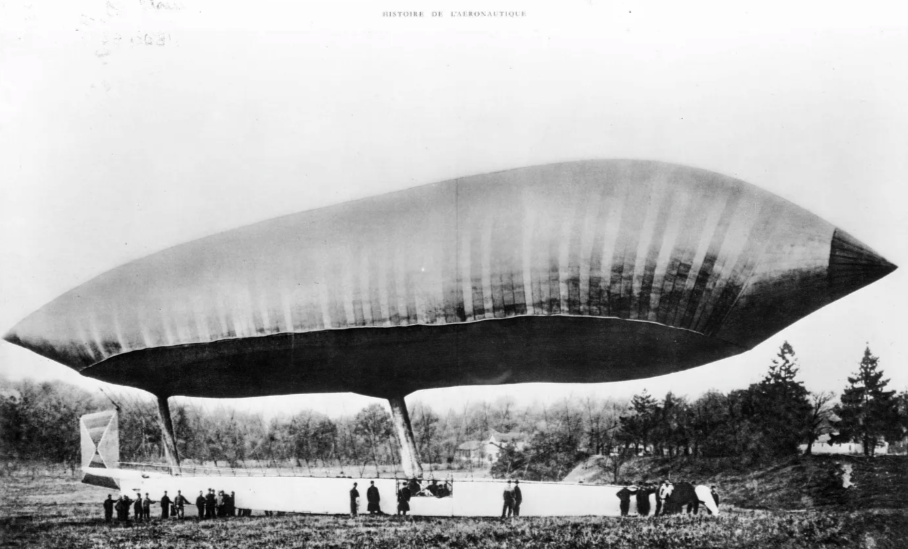
La France, the French military dirigible designed by Charles Renard and Arthur Krebs. In 1884 it demonstrated controlled powered flight and a return to its point of departure, eight years before the Brightwood company appeared. The surviving designs and imagery are now public domain.
The location matters almost as much as the date. Brightwood was an industrial railroad community on the northeastern side of Indianapolis, embedded in the transportation and manufacturing world of the late nineteenth-century Midwest. This was not some isolated farm where a lone dreamer was hammering together a machine in a barn. Indianapolis was tied by rail to Cincinnati, Chicago, Louisville and the larger industrial economy of the Ohio Valley and Great Lakes. Machine shops, foundries, railroad facilities, pattern makers, machinists, metalworkers and skilled mechanics were already part of the city’s working landscape. If someone wanted to construct a strange experimental flying machine in the 1890s, Brightwood was exactly the kind of place where the necessary labor and material culture could exist.
The surviving Brightwood story centers on a young inventor generally identified in later accounts as Walter or W. A. Mercer. Retrospective Indiana sources remembered Mercer as the inventor associated with the company and described an aircraft project that ended unsuccessfully, followed by the disappearance or destruction of its plans. Those later recollections have to be treated carefully because a story remembered decades afterward is not the same thing as a contemporary engineering record. The company itself, however, is independently documented, which leaves us with a fascinating gap between what can be established and what remains unresolved. We know the enterprise existed, we know who some of its officers were, and we know that material relating to it survived. What remains much less certain is precisely what Mercer intended to build and how far the project progressed.
That missing machine sits inside one of the most important transitional periods in aviation history. By 1892, the basic idea of controlled powered flight was no longer purely speculative. Henri Giffard had flown a steam-powered dirigible in France in 1852. American inventor Solomon Andrews had experimented successfully with his unusual Aereon during the Civil War era. Then, in 1884, Charles Renard and Arthur Krebs flew La France, an electrically powered dirigible capable of completing a controlled circuit and returning to its starting point. Brightwood therefore appeared after the world already possessed examples of controlled aerial navigation, but before anyone had established the practical airplane as the dominant solution.
The technological lineage can even be seen in the surviving drawings of La France. The machine possessed a long streamlined envelope, a gondola suspended beneath it, propulsion equipment and deliberate steering architecture. Krebs’s original gondola plans also survive, reminding us that these were engineered machines rather than illustrations from speculative fiction.
The late nineteenth century was full of experimental machines, speculative companies and attempts to solve different pieces of the flight problem. Investors were already learning that aerial navigation could be promoted through corporations. Engineers were studying propellers, steering systems, engines, gas envelopes and lightweight structures. Patent offices were receiving flying-machine designs. Military planners had already discovered the value of balloons for observation. Newspapers regularly reported proposals for new aircraft, while inventors moved between workshops, public demonstrations, patent offices and groups of subscribers willing to gamble on technologies that might never work.
One of the clearest American precedents came from Solomon Andrews, who did more than build an experimental airship. After demonstrating his Aereon, Andrews established an Aerial Navigation Company intended to commercialize flight. His surviving prospectus shows that the phrase itself had a practical nineteenth-century meaning. The business model was recognizable: develop a machine, demonstrate that it could move through the air, organize a company, attract capital and attempt to convert experimental technology into transportation. Brightwood appeared several decades later in a world where this model was already known.
That context makes Boyd Mercer Kerr Ralston especially interesting. Ralston was not primarily known as an aeronautical engineer. He was an Indianapolis businessman associated with real estate and civic affairs, which may help explain why he would appear as president of an experimental aviation company. Flying machines required far more than invention. They required money, legal organization, land, workshop space, suppliers, transportation, publicity and people capable of persuading others that the machine might eventually become valuable. Mercer could supply the technical idea, while men such as Ralston could help supply the institutional machinery needed to turn an invention into a company.
This is one of the places where the standard heroic-inventor story of aviation becomes misleading. Aircraft did not emerge from engineering alone. They emerged from networks of machinists, investors, lawyers, patent agents, printers, railroad men, real-estate promoters and local businessmen who created the infrastructure around experimental technology. The Wright brothers eventually solved a particular combination of problems involving control, lift, propulsion and structural efficiency, and their achievement deserves its place in history. What their success should not erase is the crowded technological world that preceded them.
Brightwood also matters because of what happened only a few years later. During 1896 and 1897, newspapers across the United States reported one of the strangest aerial episodes of the nineteenth century: the so-called mystery-airship wave. Some reports were obvious hoaxes, some were probably astronomical misidentifications, and others were embellished by newspapers competing for attention. Yet the assumption that nobody in the American interior could possibly have been experimenting with airships becomes harder to sustain once forgotten enterprises such as Brightwood are restored to the chronology. Brightwood does not prove that the mystery airships were real machines, but it proves that serious enough interest in aerial navigation existed in the Midwest for people to incorporate a company around it before that wave even began.
The archival survival of the Brightwood story gives it another layer. Somewhere within the surviving paper trail may be a clearer explanation of Mercer’s machine, the capital structure of the company, the people who subscribed to it, the materials purchased for the project, the workshops used to construct it and the reasons the enterprise disappeared. Those are archival questions rather than speculative ones. Brightwood is compelling because the company itself existed, while the unresolved problem is what it actually built, how far the work progressed and why something apparently significant enough to organize as a corporation vanished so completely from the standard history of flight.