How Ferdinand Marcos’s real hidden fortune became entangled with Yamashita’s treasure, covert finance, apartheid-era intelligence networks, Erle Cocke Jr., Nugan Hand Bank, and the extraordinary claims of Wolfgang Struck.
The problem with the story usually called Project Hammer is that the unbelievable material does not begin in an unbelievable place. It begins with Ferdinand Marcos, a president whose family really did maintain enormous concealed assets abroad; with Swiss banks that really did hold hundreds of millions of dollars linked to those assets; and with courts that really did spend years sorting through foundations, nominees and accounts designed to obscure ownership. From there the trail passes through a Filipino treasure hunter, a giant golden Buddha, Japanese wartime occupation, a South African military-intelligence operative, an American general who once commanded the American Legion, an infamous Australian bank, and eventually a former German handball goalkeeper named Wolfgang Struck.
The temptation is to force all those pieces into one enormous secret operation. That is essentially what later Hammer literature does, connecting Japanese war loot, Marcos gold, intelligence agencies, bank guarantees and hidden collateral accounts into a continuous financial system. The evidence is far less tidy. What makes the subject interesting is that a surprising number of the individual people, institutions, lawsuits and covert networks are independently real even where the gigantic financial theory built around them remains unproven.


4
The images establish the political bookends. Ferdinand and Imelda Marcos were received by Ronald Reagan at the White House in September 1982; by February 1986 Marcos was making his final appearances at Malacañang as the People Power uprising filled Manila, and the contents of the presidential residence—including Imelda Marcos’s immense shoe collection—were becoming symbols of the family’s wealth. The Reagan Presidential Library independently records the Marcos state visit, while the Philippine Supreme Court’s later decisions provide a much more important financial record of what had been concealed behind the public spectacle.
The Marcos Money Was Real
The strongest place to start is Switzerland because no legend is required. After Marcos lost power in February 1986, Swiss authorities froze assets associated with him and his entourage. Switzerland’s government now describes the Marcos affair as the case that effectively launched its modern policy for freezing and returning illicit assets held by foreign political figures. In 2003, Switzerland recorded the return of $684 million to the Philippines from the Marcos case.
The Philippine judicial record is even more specific. The Supreme Court has repeatedly stated that $658,175,373.60 in Swiss deposits associated with the Marcoses was ill-gotten wealth and subject to forfeiture to the state. In discussing the evidence, the Court emphasized both the size of the accounts and the failure to reconcile them with the family’s lawful income, while noting the layers of foundations and corporate entities used to hold the money.
That point is fundamental because the later Marcos-gold mythology did not invent the idea that Ferdinand Marcos controlled a hidden offshore fortune. Investigators and courts had already established that concealed wealth existed. What remains disputed is how much additional wealth existed beyond the recovered accounts, where it originated, and whether any substantial portion consisted of wartime bullion rather than money accumulated through political corruption and related schemes.
The famous photographs of Imelda Marcos’s shoes can obscure that distinction. The shoes became the visual shorthand, while the bank accounts were the more consequential evidence. What eventually fed the treasure mythology was the collision of that verified secret fortune with another story that had been circulating in the Philippines for years: the story of Rogelio Roxas and Yamashita’s gold.
Rogelio Roxas and the Golden Buddha
Rogelio Roxas was a locksmith and treasure hunter in Baguio who claimed that information ultimately derived from Japanese wartime sources led him to an underground location containing treasure. According to the allegations that later entered the Hawaii courts, Roxas and his associates excavated the site around 1970–71 and recovered objects including gold bars and an extremely heavy golden Buddha. Roxas maintained that the Buddha’s removable head contained precious stones and that additional treasure remained underground.
Roxas then claimed that armed men acting for Ferdinand Marcos raided his home, removed the Buddha and gold, and that he was subsequently detained and abused. Those accusations eventually became the foundation of litigation pursued against the Marcos estate in Hawaii. The courts did not validate every later claim made under the heading “Yamashita treasure,” but the litigation transformed what might otherwise have remained treasure-hunter folklore into a complicated judicial dispute involving testimony, photographs, property claims and damages.

The first photograph is associated with Roxas and the golden Buddha claim; the second is a U.S. Army Signal Corps photograph preserved by the National WWII Museum showing the surrender of Japanese General Tomoyuki Yamashita at Baguio in 1945. The proximity of Baguio to both Yamashita’s surrender and Roxas’s later treasure story helped give the legend a historical geography that readers could readily understand. The museum identifies the surrender image as an August 1945 photograph from the Philippines.
The appellate history of the Roxas case is important because it actually cuts both ways. The litigation took Roxas’s allegations seriously, but the Hawaii Supreme Court also rejected the idea that a jury could simply assign him the value of the entire legendary Yamashita hoard based on speculative calculations. In other words, a treasure dispute could be genuine litigation without establishing every subsequent claim about the size and provenance of the treasure.
That distinction gets lost constantly in later writing. A court fight over a Buddha and some gold becomes proof of “Golden Lily”; Golden Lily becomes proof of a continental looting program; the looted treasure becomes proof of huge clandestine bank deposits; and eventually the existence of any one part of the chain is offered as proof of every other part.
The actual record is more interesting because it leaves room for something real to have happened without requiring every expansion of the story to be true.
The Moment Treasure Became Finance
An ordinary buried-treasure story is fundamentally physical. Someone obtains a map, digs into a hillside, opens a chamber, discovers bars or jewels, and then has to transport the material somewhere else. The later Marcos-gold narrative changes character when physical treasure becomes financial collateral.
Once that conceptual move is made, the gold no longer needs to travel. A claimed owner can say the metal remains in a vault while certificates, warehouse receipts, guarantees, safekeeping receipts, letters of credit or beneficial ownership instruments circulate instead. Those instruments can supposedly support credit, and that credit can theoretically be traded many times over.
This is the conceptual universe in which Project Hammer becomes possible. A wartime treasure hidden in 1945 can, in the story, remain physically untouched while becoming the foundation for transactions occurring in London, New York, Zurich, Manila or Johannesburg forty years later. The essential question therefore changes from “Where are the bars?” to “Who controls the paper?”
That was also a period in which genuine governments and intelligence services operated front companies, covert procurement networks and sanctions-evasion systems. South Africa during the final decades of apartheid provides unusually good documentation of that world, which is why the South African component of Hammer deserves far more attention than it usually receives.
Operation Hammer Appears in South Africa
In April 2000, South Africa’s Mail & Guardian published an investigation involving businessmen Riaan Stander and Roelof “Rolf” van Rooyen. According to the newspaper, three American and Australian investors had hired Stander’s company Intercol in 1990 to recover approximately $70 million in commissions they alleged had been withheld from a transaction they called Operation Hammer.
The alleged Hammer transaction was described as a sanctions-busting financial program using letters of credit from large international banks. The investors’ attorney asserted that U.S., British and German intelligence organizations had some relationship with the arrangement and that non-liquid assets had supposedly been deposited with Citibank so they could be converted into usable financial instruments. Those are allegations reported by the newspaper, rather than findings independently established by the Mail & Guardian, which is an important distinction.
The same article contains a detail that later Hammer accounts often blur. The attorney specifically said that Operation Hammer was separate from the later operation undertaken by Stander and Van Rooyen to recover the missing commissions. That raises the possibility that different transactions, recovery operations and later narratives became compressed into one “Hammer” story after the fact.
A second Mail & Guardian report in 2002 described litigation by American businessmen against South African authorities and again connected the dispute to alleged Operation Hammer proceeds. The paper reported claims concerning electronic transfers as large as tens of millions of dollars and a $100 million deposit allegedly associated with Van Rooyen. Again, these were allegations contained in legal papers rather than a judicial finding that the underlying Hammer program operated as described.
Riaan Stander Was Actually Inside Military Intelligence
This is the point where the South African story becomes substantially more important. Riaan Stander’s intelligence background is not dependent on Hammer researchers. South Africa’s Truth and Reconciliation Commission archive identifies him plainly as a Military Intelligence agent during the 1980s.
In an interview preserved by the TRC project, Stander said that in 1986 he became involved in the Transkei while working for Longreach. His description is unusually direct: he called Longreach a “Military Intelligence front company” operated by himself, Craig Williamson and several other people, and said his assignment involved monitoring intelligence activities in the Transkei.
The same TRC material places Stander around the covert political struggle surrounding Transkei leader Bantu Holomisa. It records his account of intelligence activities, attempts to manipulate political outcomes and what he described as financial interests running through companies operating beneath Military Intelligence protection. None of that proves the enormous financial claims attributed to Hammer, but it establishes that Stander was not merely pretending after the fact to possess an intelligence background.


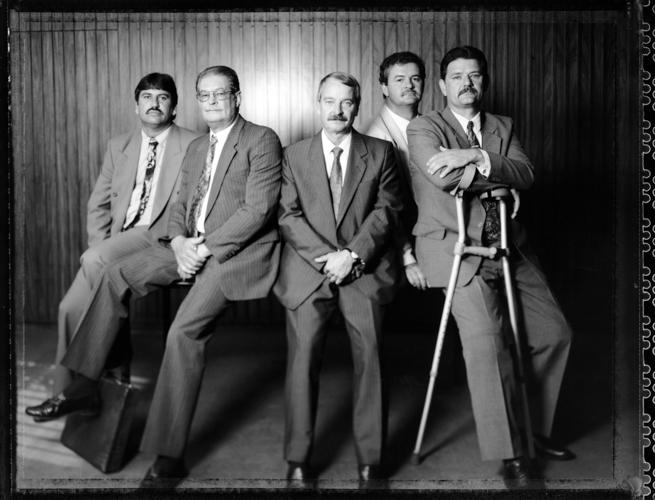
These images are context for Stander’s intelligence environment, not photographs of Stander or Van Rooyen. The first shows apartheid operative Craig Williamson at a Truth and Reconciliation Commission hearing; Stander himself identified Williamson as one of the men involved with Longreach. The second shows former Vlakplaas personnel during later amnesty proceedings, while the third shows the Vlakplaas property itself. They are useful because the Mail & Guardian reported Van Rooyen describing links between Intercol-connected operations and South African security units, including Vlakplaas, while the TRC independently documented how front organizations and covert operations functioned during this period.
This is precisely why the South African piece should not be treated as decorative conspiracy scenery. Apartheid South Africa really did maintain clandestine structures whose personnel moved among intelligence activity, commercial fronts, arms procurement, overseas operations and political manipulation. The argument over Hammer concerns whether the particular financial program attributed to those networks existed as claimed, not whether secret state-commercial structures existed at all.
Van Rooyen, Düsseldorf and the $100 Million Claim
According to the Mail & Guardian, Stander and Van Rooyen received an initial $185,000 in March 1990 and another $117,000 in October from investors who believed the men could recover their Hammer commissions. The paper reported that Stander subsequently stated in an affidavit that Intercol had “taken title” to $100 million and would pay the investors, but the promised money did not arrive.
Van Rooyen was eventually detained in Düsseldorf in February 1995 and questioned by German police with a South African police officer present. The newspaper reported that Van Rooyen acknowledged at least $100 million being held in New York and made assertions concerning Intercol, security organizations and intelligence agencies. Stander was arrested in South Africa on fraud and Bank Act charges, but the prosecution encountered difficulty when Van Rooyen could not be returned for trial.
Later Hammer researcher David Guyatt circulated what he described as material from that German interrogation. In Guyatt’s reproduction, Van Rooyen refers to “Operation Hamer,” using a single “m,” and describes an enormous international operation involving Oceantech and authorities in several countries. The crucial limitation is provenance: the complete original German police file is not readily available through a public official archive, so the responsible way to present those statements is as Guyatt’s reproduced version of the interrogation rather than independently authenticated proof of the wider operation.
The Van Rooyen material nevertheless helps explain how two separate Hammer traditions began converging. On one side were investors talking about lost commissions and letters of credit. On the other side were researchers gradually attaching those transactions to intelligence finance and eventually to historical bullion.
Then Erle Cocke entered the story.
Erle Cocke Jr. Was No Anonymous Treasure Promoter
Erle Cocke Jr. had one of those biographies that makes later extraordinary claims difficult to dismiss simply by dismissing the man. During World War II, he served in the U.S. Army in Europe, was captured multiple times, escaped multiple times and survived being shot four times during an attempted German execution in April 1945. The American Legion recounts seventeen operations during his recovery and says he subsequently entered Harvard Business School.
Cocke rose remarkably quickly within the American Legion. On October 12, 1950, at only twenty-nine years old, he was elected national commander, making him the youngest person ever to hold the position. He later served in federal and international posts, and the Washington Post records his work as a U.S. delegate to the United Nations and his appointment by President John F. Kennedy as alternate executive director at the International Bank for Reconstruction and Development.
World Bank records independently confirm his presence there. Official Bank documentation from the period lists Erle Cocke Jr. as the U.S. alternate executive director, and a later World Bank oral-history interview preserves Cocke discussing his work inside the institution.

The first photograph, from the American Legion archive, shows Cocke walking with General Douglas MacArthur during a national-convention parade in Miami. The second is a 1951 photograph of Cocke meeting President Harry Truman. The third shows Cocke in American Legion life during the same general period. These are far more useful to the story than a generic photograph of gold because they immediately show why Cocke’s later presence in the Hammer material is so unusual.
Cocke was not just a veterans’ organization figure. His postwar career placed him around defense, aviation, government, lobbying and international finance. The Washington Post described him at the end of his life as an international management consultant who had held appointments under multiple administrations, while the World Bank record documents his institutional financial role.
And before Hammer, his name had already appeared around another extraordinary bank.
Nugan Hand: The Earlier Shadow-Banking Connection
Nugan Hand Bank was founded in Australia by lawyer Frank Nugan and former U.S. Green Beret Michael Hand. The bank expanded internationally before collapsing spectacularly after Nugan was found dead in his car in January 1980. The resulting scandal became sufficiently serious that Australia established a Royal Commission specifically investigating the activities of the Nugan Hand Group; Parliament records the inquiry as running from 1983 through 1985 and formally receiving its final report in November 1985.
The two photographs above come from the surviving Nugan Hand visual record and show the men at the center of that banking story. The important connection for our purposes is not an assertion that Nugan Hand secretly was Project Hammer. There is no good basis for making that leap.
What matters is that Erle Cocke’s name appears independently in contemporary reporting on Nugan Hand. A Wall Street Journal investigation preserved in the CIA’s declassified Reading Room described the astonishing collection of senior former American military and intelligence personalities associated with the bank and specifically named Cocke among them. The report said Cocke’s Washington office served as a Nugan Hand office, although Cocke disputed aspects of his involvement.
That distinction is worth preserving. A CIA-hosted copy of a newspaper investigation is not evidence that the CIA endorses every allegation contained in it, and allegations that Nugan Hand itself operated as a CIA front remained heavily disputed. The Australian Royal Commission was real, the bank’s collapse was real, and the remarkable collection of military and intelligence-connected personnel around it was real; claims about the exact nature of intelligence sponsorship went further than what was conclusively established.
But for understanding Cocke, the Nugan Hand episode matters enormously. It demonstrates that long before the internet developed an elaborate Project Hammer mythology, Cocke had already occupied the crossroads of Washington consulting, international banking, retired military figures and opaque overseas finance.
The Deposition That Made Cocke Central to Hammer
Near the end of Cocke’s life in 2000, he sat for a lengthy deposition connected to a financial dispute. That deposition became the central American document in David Guyatt’s later Project Hammer reconstruction.
In the transcript circulated by Guyatt and other Hammer researchers, Cocke discussed what he understood as a vast financial undertaking involving old pools of money accumulated internationally over decades. He described the broad purpose as bringing money back into the United States and spoke about funds originating in activities extending into the 1940s and 1950s. Later writers interpreted those statements as confirmation of a classified Cold War financial program.
The deposition becomes more dramatic when Citibank enters the questioning. In the published transcript, Cocke discussed numerous accounts and characterized Citibank as an important administrative institution within the alleged operation. Those comments later became one of the principal foundations for the claim that Hammer had been administered through mainstream Western banking institutions.
There is, however, a major piece of contrary evidence inside the same body of material. Former Citibank chairman John Reed denied knowing of Project Hammer or Erle Cocke in a sworn statement circulated alongside the dispute. Citibank also rejected claims that it had issued instruments backed by secret government gold in the manner alleged by Hammer proponents.
That creates a much more interesting evidentiary problem than simply declaring Cocke truthful or fraudulent. Cocke was unquestionably an establishment figure with substantial military, government and financial experience. He appears to have discussed Hammer seriously in a legal deposition. That still does not demonstrate that his information about every account, institution and transaction was accurate, nor does a deposition convert what a witness has been told into independently verified fact.
Cocke is important because he makes the Hammer story difficult to reduce to a simple internet hoax. He does not make the entire Hammer structure true.
How Marcos Gold Was Attached to Project Hammer
The later Hammer theory essentially builds a bridge backward through history. Japanese forces supposedly accumulated huge amounts of stolen wealth throughout occupied Asia during World War II and concentrated much of it in the Philippines. Some of that treasure allegedly fell under American intelligence control after Japan’s defeat, while other portions remained concealed. Marcos supposedly gained access to substantial amounts of it, after which hidden bullion and claims against bullion became collateral for postwar covert-finance programs.
Each piece solves a problem created by the previous piece. Japanese looting explains the origin of the gold. The Philippines explains where it could be hidden. Marcos explains who could gain domestic political control over repositories. Intelligence agencies explain why the records are unavailable. International banks explain how immobile bullion could supposedly generate liquid funds. Hammer then becomes the mechanism through which old treasure enters late-Cold-War finance.
There are historical facts sitting close to almost every stage of that story. Imperial Japan did loot occupied territories. Yamashita commanded Japanese forces in the Philippines. Marcos really had secret foreign assets. Roxas really made treasure claims against him. Western intelligence organizations really used front companies and covert funding mechanisms during the Cold War.
The problem is that proximity is not the same thing as linkage. Evidence establishing each individual historical phenomenon does not automatically establish the continuous system later built from them.
This is exactly where Wolfgang Struck becomes important, because Struck belongs to the period in which Marcos gold begins changing from an intelligence-and-treasure story into a theory of global monetary ownership.
Wolfgang Struck Before Marcos Gold
One of the best things to emerge from digging into Struck is that he has a surprisingly well-documented earlier life. Wolfgang “Oskar” Struck was a German handball goalkeeper who played for THW Kiel, represented West Germany and became a recognizable figure in German handball. Kiel’s city archive preserves a 1964 portrait identifying him specifically as THW Kiel’s goalkeeper for the 1964–65 season.
The photograph is worth using in the blog because it turns Struck from a nearly spectral figure in later gold documents into someone with a conventional public biography decades earlier. The Stadtarchiv Kiel image is credited to photographer Friedrich Magnussen and is available under a Creative Commons Attribution-ShareAlike license. View the 1964 Wolfgang Struck archive photograph
His financial background is also more concrete than some later accounts suggest. A Kieler Nachrichten profile preserved by THW Kiel says that after leaving Kiel, Struck worked for four years as a foreign-exchange broker in Gothenburg, later entered Düsseldorf’s financial world, and became wealthy enough to act as a prominent handball patron. The article portrays him as a colourful businessman who made significant money, financed TuRU Düsseldorf’s handball ambitions and eventually lived first in New York and then Manila.
That biography is important because later Marcos-gold material frequently describes Struck as a “banker-lawyer,” sometimes attaching specific banking credentials to him. His documented record supports banking and foreign-exchange experience and says he studied law, but it does not by itself validate every professional title later assigned to him. Those distinctions become especially important once his name begins appearing on documents claiming authority over fantastically large assets.
Struck, Tallano and the Attempt to Put Legal Paper Around the Gold
By the early 2000s, Struck was openly involved with material surrounding Julian Morden Tallano and the so-called Tallano estate. A June 2002 document associated with the Global Alliance Investment Association identifies “Prince Julian Morden Tallano” and lists Wolfgang Struck as “Authorized Representative.” The existence of the document is verifiable; the historical claims about a royal Tallano ownership of the Philippine archipelago and gigantic treasure reserves are another matter entirely.
Struck also prepared a lengthy work defending an alternative version of Ferdinand Marcos’s financial history. The document argues that enormous stores of gold connected to Marcos and wartime events existed and repeatedly treats disputed bullion claims as genuine assets. Among the passages attributed to Struck are references to hundreds of thousands of metric tonnes of gold and still larger aggregate figures supposedly connected with wartime treasure.
This is where Struck becomes indispensable to understanding the evolution of the story even if one rejects his quantities. Roxas’s narrative concerns a treasure hunter possessing an object. Hammer concerns the conversion of assets into financial instruments. Struck’s material increasingly concerns legal authority: trustees, estates, title holders, representatives, signatories and supposedly dormant accounts.
The treasure is becoming paperwork.
That matters because physical treasure places hard limits on a story. Gold has to exist, weigh something and occupy space. Financial claims can multiply through certificates, liens, derivative claims, trust agreements and assertions of ownership without the underlying metal ever being publicly inspected.
From Tallano to the “Global Debt Facility”
Struck later appeared in correspondence and presentations associated with the so-called Global Debt Facility, a claimed pool of global collateral assets that proponents described as existing outside conventional government and banking accounting. In some of this later material, Struck was portrayed as possessing authority connected to accounts supposedly established for humanitarian or sovereign purposes.
The disputes around these claims became increasingly convoluted. Former World Bank lawyer Karen Hudes, Struck and other participants circulated competing accounts about who possessed legitimate authority over the supposed facility and what documentation established ownership. The existence of their correspondence shows that they genuinely argued about these purported assets; it does not prove that the assets themselves existed as claimed.
One remarkable piece of correspondence attributed to Struck illustrates the scale of the belief. A 2014 message discusses 170,500 metric tonnes of gold supposedly offered to the American people and another 44,000 tonnes associated with Japan, while acknowledging that conventional estimates of all gold ever mined were far lower.
His earlier Marcos document went further still, reproducing claims concerning 400,000 metric tonnes supposedly remaining in the Philippines and discussing still larger wartime figures. That is the point where the physical scale of the story becomes unavoidable.
The Gold Arithmetic Is a Serious Problem
The World Gold Council updated its estimate in August 2026 and placed the amount of gold mined throughout all human history at approximately 222,600 metric tonnes. It estimates that about two-thirds of that total has been mined since 1950 and notes that nearly all historically mined gold still exists because the metal is effectively indestructible.
That number does not mean hidden gold is impossible. Undeclared caches can exist, government reserves can be concealed, historical records can contain errors, and theft can relocate gold without changing the worldwide total. What it does mean is that claims of 400,000 tonnes, 600,000 tonnes or more cannot be treated as ordinary hidden-bank-account allegations.
A claim of that scale requires the established record of global mining to be wrong by multiples. Struck-linked accounts sometimes respond to that objection by arguing precisely that the conventional historical estimate is false. That is a logically possible position, but it places the burden of evidence at an entirely different level than demonstrating that Ferdinand Marcos possessed secret Swiss accounts.
This is one of the most useful ways to keep the story organized. A hidden Marcos fortune is proven. A hidden cache of wartime treasure is historically possible. Hundreds of thousands or more than a million tonnes of secret bullion requires a radically different history of the world’s gold supply. Those are not equivalent claims and should never be treated as if they require the same standard of evidence.
Why the Story Remains So Difficult to Kill
What allows Project Hammer to survive is the recurring appearance of authentic material inside an increasingly speculative structure. The Marcos Swiss money is real. The Roxas litigation is real. Yamashita’s presence in Baguio is real. Riaan Stander’s service within South African Military Intelligence is independently documented. The Mail & Guardian really did report a financial dispute called Operation Hammer. Erle Cocke really was the youngest American Legion national commander, really worked around MacArthur, really became a World Bank official, and really appeared in reporting about Nugan Hand. Wolfgang Struck really did move from professional sport into currency trading and business before settling in Manila.
That sequence creates a powerful psychological effect. Once five surprising claims have proved true, the sixth begins feeling more plausible before its evidence has actually been examined.
The opposite mistake is equally damaging. Because some enormous bullion numbers are physically implausible, it is tempting to throw away the surrounding material and call the whole subject fabricated. Doing that loses the genuine history of offshore finance, front companies, secret government structures, sanctions evasion and political fortunes that made stories such as Hammer believable in the first place.
The historical value of the story may lie precisely in that overlap.
Nugan Hand, South Africa and the Parallel Financial World
Nugan Hand and apartheid-era South African intelligence are especially useful because both demonstrate that apparently private commercial structures could sit surprisingly close to state-security networks. Nugan Hand employed or associated with an unusual concentration of former military and intelligence personnel, enough to draw sustained parliamentary and journalistic scrutiny. South African Military Intelligence explicitly operated companies such as Longreach as fronts.
That does not establish a single worldwide “black banking system.” It establishes something smaller and more defensible: during the Cold War, clandestine political activity regularly required methods for moving money, equipment and people outside ordinary transparent channels.
Those channels did not have to be supernatural to be secret.
A front company could purchase equipment.
An intermediary could move funds.
A bank could hold accounts for entities whose beneficial ownership was obscure.
A government facing sanctions could construct procurement networks specifically designed to frustrate outside investigators.
Intelligence services could use commercial organizations without every employee necessarily understanding the ultimate sponsor.
In such an environment, rumors of gigantic hidden funds had somewhere plausible to attach themselves. A businessman could truthfully have encountered a covert transaction while misunderstanding its origin. An operative could know one compartment of an operation and infer a larger structure. A fraudster could exploit authentic secrecy to sell fictitious bank instruments. A genuine account could become attached to invented collateral. Several different operations could later acquire the same nickname.
Project Hammer may contain some mixture of all of these.
The Three Marcos-Gold Stories That Should Be Kept Separate
The first Marcos-gold story is the strongest. Ferdinand Marcos and his family possessed vast hidden foreign assets, including the Swiss deposits later forfeited as ill-gotten wealth. That conclusion rests on court judgments, Swiss government records and asset-recovery proceedings.
The second story concerns wartime treasure. Roxas’s allegations, photographs and litigation show that a specific treasure dispute involving Marcos entered the legal system and cannot simply be retroactively dismissed as an internet invention. That record still does not demonstrate the full Golden Lily system or establish the enormous quantities later claimed.
The third story is Project Hammer as a global collateral mechanism, in which wartime gold supposedly supported covert bank instruments and intelligence-funded trading programs. Here the evidence is much thinner and depends heavily on disputed testimony, privately circulated documents, later researchers and claims whose underlying banking records are generally unavailable.
Struck belongs primarily to a fourth stage that grew out of the third: the attempt to turn this history into a continuing system of ownership and authority extending through Tallano claims and the Global Debt Facility. His material is useful because it allows us to see exactly how the legend expanded, but the fantastic bullion quantities contained in those materials collide directly with modern estimates of the entire historical gold supply.
What Project Hammer May Really Preserve
There is another way of reading the evidence that does not require either accepting or discarding the whole structure. “Hammer” may preserve memories of several different clandestine financial operations that were later combined.
The South African Operation Hammer described in contemporary reporting may have concerned a specific sanctions-era letters-of-credit scheme. The financial problem that Erle Cocke called Project Hammer may have involved another pool of accounts, transactions or claims. Van Rooyen and Stander may have encountered pieces of these structures during later recovery or intelligence work. Researchers then connected those accounts to wartime treasure because Marcos, Roxas and alleged Asian collateral provided an explanation for where the underlying assets supposedly originated.
By the time Wolfgang Struck appears, the multiple streams have effectively merged. Marcos gold, Tallano property, Japanese loot, bank collateral, sovereign obligations and humanitarian funds all begin functioning inside one explanatory system.
That does not necessarily mean every participant was consciously inventing the story. Large financial myths can grow through aggregation. A real account is combined with a disputed document. The disputed document is interpreted through an authentic intelligence relationship. The intelligence relationship lends credibility to an unverified treasure claim. The treasure claim is then used to explain another financial instrument.
After enough iterations, it becomes difficult even for participants to identify where documentation ends and interpretation begins.
The Fortune That Wouldn’t Die
Ferdinand Marcos left Malacañang in February 1986, but his fortune never really left history. It migrated from palace gossip into Swiss asset freezes, from Swiss courts into Philippine forfeiture proceedings, from those proceedings backward into wartime treasure stories, and from treasure stories into the language of international finance.
Rogelio Roxas gave the story its Buddha.
Tomoyuki Yamashita gave it a war.
The Swiss banks gave it proven secrecy.
Riaan Stander and Rolf van Rooyen gave it a South African intelligence corridor.
Erle Cocke gave it an American establishment witness whose résumé extended from a German firing squad to the American Legion, the World Bank and Washington finance.
Nugan Hand supplied an earlier example of the strange overlap between banking and former military or intelligence personnel.
Wolfgang Struck then helped carry the mythology into its final form, where treasure became title, title became authority, authority became collateral and collateral became a purported global monetary system.
Taken as one seamless narrative, Project Hammer outruns the evidence. Taken apart, however, it reveals a sequence of very real hidden worlds surrounding a central fortune that unquestionably existed.
That may be why the subject remains so durable. The legend did not grow because everything underneath it was imaginary. It grew because enough of the surrounding history was real to make the next extraordinary claim seem possible.
The unresolved historical task is therefore not to prove that every tonne of Marcos gold existed or to dismiss every secret-finance account as fantasy. It is to determine where the documented Marcos fortune, wartime treasure claims, Cold War intelligence finance and later collateral mythology actually touch—and where people who lived inside genuinely secret institutions began filling the remaining darkness with a much larger story.