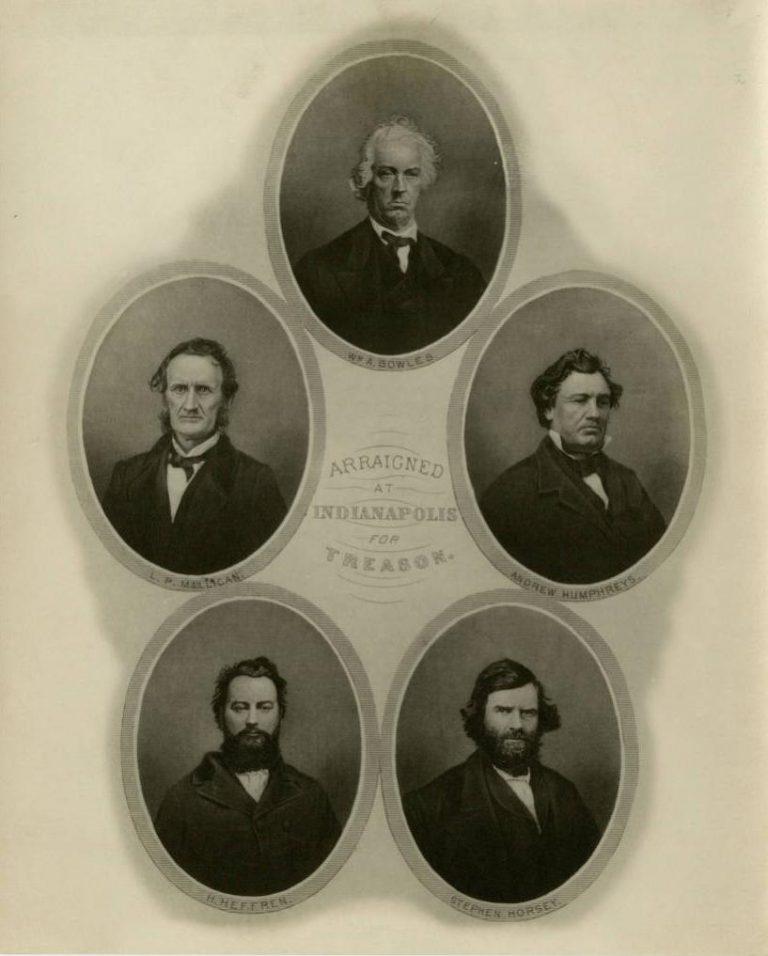
The story of Ex parte Milligan is usually told backward. It begins in a constitutional-law textbook with a civilian named Lambdin P. Milligan, a military tribunal in Indianapolis, and a Supreme Court ruling declaring that civilians could not be tried by military commission where the ordinary courts remained open. That is an important story, but it leaves out the geography that made the case possible in the first place. Before Milligan became a Supreme Court petitioner, he belonged to a political and clandestine world stretching from Indianapolis north through Grant and Huntington counties to Fort Wayne, and south into Greene, Martin and Orange counties. By 1864, federal military intelligence believed that pieces of that network were coordinating with Confederate agents, resisting the draft, acquiring weapons and discussing the liberation of Confederate prisoners held in Northern camps.


The resulting Indianapolis Treason Trials were therefore more than an argument over free speech, and they were also more complicated than the government’s wartime depiction of a single disciplined conspiracy poised to overthrow Indiana. Plans were discussed that never became uprisings. Informers and military detectives supplied crucial testimony. Political considerations were inseparable from the timing of the arrests. Yet weapons were actually seized, the clandestine orders actually existed, military intelligence actually penetrated them, and several of their senior Indiana figures were communicating across state lines. The most useful way to understand the episode is to follow the network across Indiana before following Milligan into the courtroom.
Indianapolis Was the Center, but It Was Not the Whole Network
Indianapolis occupied a peculiar position during the Civil War. It was the state capital, an important railroad hub and a major Union military center. Camp Morton, north of the center of the city, had begun as a recruiting and training ground before becoming a prison for captured Confederate soldiers. By 1864 it held thousands of prisoners. That concentration of prisoners, rail connections, arms and government offices made Indianapolis both the center of Union authority in Indiana and an obvious target for anyone contemplating a coordinated disruption of the Union war effort.
That is why Harrison Horton Dodd matters so much. Dodd was not operating from some remote rural lodge. He was an Indianapolis businessman, printer and political organizer whose firm stood at 16½ East Washington Street. By late 1863 he had become the Indiana commander of the Order of American Knights, which in 1864 became the Sons of Liberty. He traveled around Indiana organizing members and attended interstate meetings of the order. At a February 1864 gathering in New York, Clement L. Vallandigham was selected as the organization’s supreme commander while Dodd remained its Indiana grand commander.
The terminology matters because this was not simply a case of historians later grouping unrelated organizations together. Indiana historian Stephen Towne describes organizational continuity running from the wartime Knights of the Golden Circle into the Order of American Knights and then into the Sons of Liberty, although names, rituals and leadership structures changed. The movement combined ordinary antiwar politics with a secret oath-bound organization whose more militant participants discussed resistance to federal authority. How many ordinary members understood or endorsed the most ambitious plans remains disputed, but the senior organizational structure itself is well documented.
Indianapolis was consequently both political headquarters and logistical center. According to the surviving military and historical record, an informant alerted Governor Oliver P. Morton in August 1864 that weapons were being shipped to Dodd. Soldiers subsequently seized boxes at Dodd’s establishment containing hundreds of revolvers and approximately 135,000 rounds of ammunition; military authorities in New York intercepted another shipment of roughly 2,000 revolvers intended for Indianapolis. Records of the Sons of Liberty, including correspondence and organizational material, were also found.
That discovery is important because it puts something tangible underneath an otherwise murky intelligence story. There had been years of allegations concerning secret societies, deserters, armed political meetings and conspiracies. Now there were boxes of weapons, ammunition and organizational records sitting in the state capital.
Marion and Grant County Were Part of the Northern Corridor
The name Marion creates an easy confusion in this history because Indianapolis lies in Marion County, while the city of Marion lies north of Indianapolis in Grant County. Both belong in the story, but for different reasons.
Harrison Dodd himself had an unusually direct connection to Marion in Grant County. His brother, John W. Dodd, lived there and was elected Indiana auditor of state, serving from 1857 to 1861. Harrison served as his brother’s deputy after moving to Indianapolis. That does not make John Dodd part of Harrison’s later conspiracy, but it does demonstrate that Harrison’s political world had a prewar institutional connection linking Marion, Indianapolis and state government.
More important is the evidence for clandestine antiwar organization in Grant County itself. Towne cites an 1863 report from the provost marshal responsible for northeastern Indiana describing an extensive organization in Wells, Huntington, Grant, Blackford and part of Madison County prepared to resist the draft, with armed men reportedly moving in small groups. Subsequent testimony identified secret organizations operating in the region under names including the Circle of the Mighty Host, KGC, Order of American Knights and finally Sons of Liberty.
An older Grant County history also remembered Knights of the Golden Circle activity in the southeastern part of the county and reported violent clashes around Jonesboro and between Jonesboro and Fairmount. Such county histories have to be used carefully because they were often compiled decades after the events, but in this case the local tradition aligns with contemporary military reporting that Grant County belonged to a broader northeastern Indiana zone of organized draft resistance.
That changes the map considerably. Marion was not an isolated northern outpost. Grant County sat between Indianapolis and the Huntington–Fort Wayne political world in which Milligan operated.
Huntington: Milligan’s Base
Lambdin P. Milligan had moved to Huntington County in the 1840s and developed a substantial legal, business and political presence there. His ideology long preceded the Civil War. Towne’s detailed biographical study shows Milligan embracing a states’-rights constitutionalism associated with John C. Calhoun well before secession, including proslavery positions and hostility to abolitionism. Those beliefs became the framework through which he interpreted Lincoln’s attempt to suppress secession after 1861.
Milligan was therefore not simply an obscure civilian accidentally swept into a military prosecution. By November 1863 he was participating in the Order of American Knights, and witnesses later described him initiating other members and teaching secret signs and grips. Military authorities had begun watching him by this period. Towne’s reconstruction, using provost-marshal reports, military records and later trial testimony, places Milligan inside the northeastern Indiana secret-order structure rather than merely on its political fringe.
At the same time, that does not resolve every question raised during his prosecution. Membership in a secret order, bitter criticism of the administration and even knowledge of illegal activity were not automatically identical to participation in every plot attributed to the organization. That distinction would become critical once the Army decided that military officers rather than a civilian jury would determine guilt.
Fort Wayne: Where the Secret and Public Worlds Met
Fort Wayne is particularly important because it shows how difficult it was to separate ordinary Democratic opposition from clandestine activity. In mid-August 1864, Milligan addressed a large antiwar political gathering there. Contemporary accounts and later reconstructions disagree on some details of the exact date, but the event occurred immediately before the planned Indianapolis action associated with Dodd’s organization. Milligan attacked the administration’s conduct of the war and constitutional authority and spoke to a large audience at a moment when military authorities were already tracking him.
The proximity in time became powerful evidence for prosecutors. Military authorities believed senior Sons of Liberty figures were preparing an August uprising centered on freeing Confederate prisoners. According to Towne’s account of the Indianapolis conspiracy, men did gather in the capital around the proposed date, but Democratic politicians who learned of the plan helped stop it before it became an armed action. Camp Morton therefore was never stormed by the force imagined in the conspiracy.
That failed action is one of the most important facts in the whole story. There was enough organization for federal spies to penetrate it, enough communication for military authorities to identify leaders, enough logistical activity for guns to appear in Indianapolis, and enough planning for Camp Morton to become a specific objective. At the same time, the organization repeatedly failed to convert planning into sustained armed rebellion. Indiana’s secret war existed in an unstable space between rhetoric, conspiracy, preparation and aborted action.
Fort Wayne made that ambiguity visible. Milligan could stand before thousands publicly condemning the administration while privately participating in an oath-bound organization under surveillance. The prosecution would later treat those two worlds as parts of the same revolutionary project. His defense would insist that political opposition could not simply be converted into treason by military assertion.
The Southern Indiana Command
The northern corridor was only half of the Indiana structure. When military authorities began making arrests, they reached deep into southern Indiana as well.
William A. Bowles came from Orange County near French Lick. Stephen Horsey came from Martin County. Andrew Humphreys was associated with Greene County. Horace Heffren, another figure caught in the investigation, was a Democratic newspaper editor. Joseph J. Bingham headed the state Democratic organization and edited the Indiana State Sentinel. Military authorities therefore were not arresting a handful of men from one Indianapolis clique. They believed they were taking apart the senior level of a statewide organization.
This north-south spread is what makes the geography so revealing. Dodd sat in Indianapolis. Milligan supplied an important connection to Huntington and northeastern Indiana. Bowles, Horsey and Humphreys extended the organization southward. Indianapolis connected them through politics, rail transportation, state conventions, military administration and the prison population at Camp Morton.
The network therefore did not resemble a conventional army occupying continuous territory. It resembled something closer to a distributed political fraternity whose nodes were lawyers’ offices, newspaper offices, businesses, political meetings and local secret circles. That is also why federal authorities relied heavily on infiltration rather than ordinary battlefield intelligence.
The Army Builds Its Own Intelligence Network
By 1863 the Army had established detective operations aimed at clandestine antiwar organizations in Indiana and neighboring states. Detectives infiltrated meetings, cultivated informants and produced reports for military commanders and Governor Morton. One of the most significant infiltrators was Felix G. Stidger, who managed to become secretary of the Kentucky organization and gained access to Dodd and other leaders.
Stidger’s testimony later became central to the Indianapolis prosecutions. He described discussions of freeing prisoners, armed uprisings and cooperation with Confederate forces. Other defendants and insiders eventually testified for the government as well. The state’s case was therefore constructed from an unusual mixture of intercepted organizational evidence, seized weapons, political speeches, testimony from insiders and reports by military spies.
This is also where historians have disagreed. Older interpretations, especially those influenced by Frank Klement’s work, emphasized partisan exaggeration, unreliable informers and the gap between inflammatory talk and actual operational capability. More recent archival work by Towne argues that earlier scholarship discounted substantial military-intelligence documentation demonstrating real organization, illegal resistance and communication with Confederate agents. The archival evidence supports the existence of the clandestine organizations and serious plots while still leaving room to question their size, coherence and ability to execute their most ambitious schemes.
That distinction matters because it prevents the history from collapsing into either extreme. Indiana was neither on the verge of inevitably falling to a disciplined hidden army nor experiencing nothing more than a fabricated partisan scare.
The Guns Change Everything
The discovery of the arms associated with Dodd changed the political atmosphere during the late summer of 1864. Governor Morton had spent years pressing federal officials to take clandestine organizations seriously. The Army had infiltrated the Sons of Liberty. Camp Morton had been identified as a possible target. Then hundreds of revolvers and a huge quantity of ammunition appeared in Dodd’s Indianapolis orbit, while additional weapons were intercepted before reaching him.
The significance of the cache does not depend on accepting every accusation made by the prosecution. A political organization that possessed secret military titles and discussed armed resistance looked considerably different once military authorities could point to actual weapons.
Morton pushed for action. Some Army officers and officials favored using the civil courts, but Morton feared ordinary juries might acquit the accused. Federal authorities ultimately authorized military proceedings under Brevet Major General Alvin P. Hovey, commander of the Military District of Indiana.
At that moment, the secret war acquired its second half. The government had spent years arguing that clandestine civilians were behaving like soldiers. It would now respond by treating civilians as though they belonged before a military tribunal.
Dodd Goes on Trial
Hovey ordered a military commission in Indianapolis, and Dodd became its first major defendant. Proceedings opened in September 1864 in the courtroom of the federal courts and post-office building and later moved to the Indiana Supreme Court chamber. Newspapers were allowed to attend and published extensive accounts, turning what had been an intelligence operation into a public spectacle.
Dodd did not remain available for the conclusion. In early October he escaped custody from the federal building and eventually reached Canada. The commission continued without him, found him guilty and sentenced him to death. His flight naturally strengthened the government’s public case, although flight itself could not establish the truth of every charge made against the wider organization.
The Army then reached outward across the state. Soldiers arrested Milligan at his Huntington home and carried him by train to Indianapolis. Bowles, Horsey, Humphreys and other suspected leaders were also detained. Bingham and Heffren were among those initially charged but ultimately became witnesses or were released.
The statewide network had been physically collapsed into one courtroom.
The Indianapolis Treason Trial
On October 21, 1864, Milligan, Bowles, Horsey and Humphreys were brought before the military commission. The formal accusations included conspiracy against the United States, giving aid and comfort to rebels, inciting insurrection, disloyal practices and violation of the laws of war. The specifications alleged membership in the Order of American Knights or Sons of Liberty, communication with the enemy, plans to seize military stores, liberation of prisoners and resistance to the draft. Those charges can be read in the later Supreme Court record itself.
The prosecution called military detectives, infiltrators and former associates. Defense attorneys attacked the credibility of those witnesses and argued that some had effectively acted as provocateurs. The proceeding unfolded during the same autumn in which Indiana held state elections and the nation held its presidential election, making it impossible to separate the trial’s public reception completely from wartime partisan politics.
The commission nevertheless convicted the principal defendants in December. Milligan, Bowles and Horsey received death sentences; Humphreys received a lesser punishment that was subsequently modified. Lincoln approved the capital sentences, although the executions did not occur before his assassination. President Andrew Johnson later commuted the surviving death sentences to imprisonment.
This is normally where the conspiracy story disappears and the constitutional-law story begins. In reality they are the same story viewed from opposite directions.
Milligan’s Most Important Argument Had Nothing to Do With Whether He Was Innocent
Milligan did not need the Supreme Court to declare that he had never joined the Sons of Liberty or that the entire conspiracy had been invented. His decisive legal argument was narrower.
He was a civilian. Indiana had not seceded. Civil government continued operating. Federal courts were sitting in Indianapolis. A federal grand jury actually met while Milligan remained imprisoned and did not indict him. If the United States believed he had committed treason or another civilian crime, his lawyers argued, it could prosecute him in an ordinary court before an ordinary jury.
That question went directly to the jurisdiction of the military commission. The Supreme Court record states that Milligan had never belonged to the Army or Navy and was arrested at his Indiana home by military order. The government nevertheless tried him under wartime military authority.
The constitutional problem was therefore almost paradoxical. The government’s own control of Indiana weakened its justification for using a military tribunal. Indiana was sufficiently secure that civilian judges, grand juries and courts continued working. That fact became Milligan’s strongest protection.
Ex parte Milligan
Milligan petitioned the federal circuit court in Indianapolis for habeas corpus in May 1865. The judges divided on the legal questions, sending the dispute to the United States Supreme Court. The Court heard lengthy arguments in March 1866 and announced its judgment on April 3. The full opinions were delivered later that year.
The Court concluded that the military commission lacked jurisdiction to try Milligan. The controlling principle was that a civilian who was not a member of the armed forces could not be tried by a military tribunal in a loyal state where the ordinary courts remained open and capable of functioning. Suspension of habeas corpus did not automatically transfer ordinary civilian criminal jurisdiction to military commissions.
The justices agreed on the result but differed over the scope of congressional power. Justice David Davis’s majority opinion took the broader position that military rule could not replace functioning civil courts under those circumstances. Chief Justice Salmon P. Chase and three colleagues agreed that Milligan’s commission lacked authority, while taking a different view of Congress’s potential power in wartime.
Milligan was released.
But the Supreme Court did not rule that the Sons of Liberty had never existed, that Dodd had possessed no weapons, that Confederate agents had never communicated with northern conspirators or that Milligan had necessarily been innocent of every substantive accusation. It ruled that the government had tried him in the wrong kind of court. That distinction gets lost surprisingly often.
A Statewide Story Hidden Inside a Famous Court Case
Once the geography is restored, Ex parte Milligan looks different.
The trail begins not with nine Supreme Court justices in Washington but with a loose chain across Indiana. Indianapolis contained Dodd’s political headquarters, the state government, federal military intelligence, the weapons cache and Camp Morton. Grant County sat in a northern zone where contemporary officials reported organized draft resistance and where the Dodd family had political roots. Huntington was Milligan’s home base. Fort Wayne provided the large political stage upon which he publicly denounced federal war policy. Southern Indiana supplied Bowles, Horsey and Humphreys. The Army’s arrests pulled these dispersed nodes into Indianapolis and presented them to a single military commission.
That is what makes the Indiana episode larger than a conventional “Copperhead” story. The conflict took place simultaneously in newspapers, political conventions, secret lodges, railroad corridors, prisons, weapons shipments, intelligence files and courtrooms. It was political opposition at one level, clandestine organization at another, and in certain circles an attempt to construct an armed capability behind Union lines. The boundaries between those layers were precisely what the military commission struggled—and sometimes failed—to distinguish.
The irony is that Milligan’s constitutional victory did not require historians to erase that clandestine landscape. In fact, the case becomes more significant when the underlying threat is taken seriously. The Supreme Court confronted a government that had legitimate wartime security concerns, possessed evidence of actual secret organization and had uncovered real weapons, yet still concluded that constitutional limits applied because the civilian judicial system in Indiana had never ceased to function.
That is a much more interesting ending than either version of the familiar story. Milligan does not have to become an innocent martyr, and Morton does not have to become a dictator inventing enemies from nothing. Indiana really contained a clandestine political network. The government really penetrated it. Its senior figures really discussed rebellion and prisoner liberation. Weapons really arrived. The planned uprising nevertheless failed to materialize, partisan politics affected the government’s response, and the Army placed civilians before a tribunal that the Supreme Court later held lacked jurisdiction.
And that is where this installment should end, because it opens the door directly into the next one. The men went home, the war ended and the military commission disappeared—but the organizational world that had produced it did not disappear with Appomattox. Indiana emerged from the war full of veterans’ associations, oath-bound fraternities, uniformed ranks, mutual-benefit societies and insurance orders. The next question is not whether the Sons of Liberty simply changed its name after 1865; the evidence does not support that crude version. The better question is what became of the people, organizational habits, command structures, mutual-aid systems and lodge culture after clandestine wartime organization ceased to be useful.