The easiest way to get this history wrong is to begin with the Knights of the Golden Circle and throw every secretive organization that came before it into the same box. The better approach is almost the opposite. Some connections are documentary and unusually strong. Others are geographical, cultural, or organizational echoes. Once those categories are kept separate, a much bigger story becomes visible.
The Knights of the Golden Circle, Order of American Knights, and Sons of Liberty belong to the first category. Indiana historian Stephen E. Towne describes an organization that changed its outward trappings beginning in 1863: the KGC became the Order of American Knights, and in 1864 the organization again changed its name to the Sons of Liberty. Harrison H. Dodd remained at the center of the Indiana organization while Clement L. Vallandigham became its supreme commander. Whatever uncertainties remain about the precise size and military capacity of the movement, this portion of the organizational succession is not merely a similarity of names or rituals. Contemporary records and later archival work allow it to be followed from one form into another.
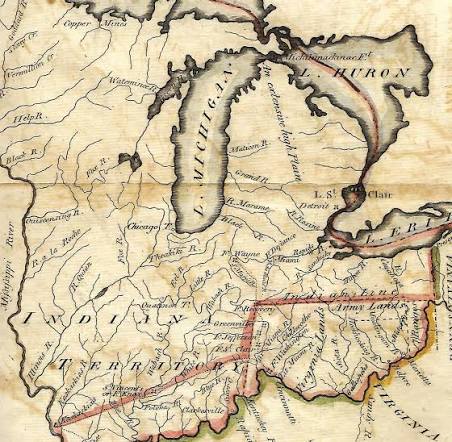
What lies beneath those three names is something older: the Northwest itself. For nearly a century before Dodd’s arrest, the country stretching from the Great Lakes through the Wabash and Ohio toward the Mississippi had repeatedly been organized, contested, and imagined as a political world of its own. Native confederacies, French and British trading systems, American territorial governments, canals, river routes, military roads and eventually railroads all tried to command the same interior geography. The Civil War conspiracy of 1864 did not descend institutionally from Tecumseh, the Danites, or John Murrell’s reputed Mystic Clan. What recurred was the problem that had made all of them possible in their very different settings: how do you organize people, information and force across a huge interior territory whose natural routes do not respect later state boundaries?


Before Indiana Was Indiana
Fort Wayne is one of the best places to begin because its significance predates almost everything else in this story. The St. Joseph and St. Mary’s rivers join there to form the Maumee, while a relatively short portage connected the Maumee watershed with waters flowing into the Wabash. The Indiana Historical Bureau describes the site as part of a waterway system joining the Great Lakes to the Mississippi Valley; by using the Maumee–Wabash portage, travelers could make a water journey approaching 2,500 miles between French Canada and Louisiana. The French built Fort Saint Philippe des Miamis there in 1722 in part to defend their fur-trading system against British encroachment.
This is more important to the later Civil War story than it might initially appear. Before canals and railroads, the rivers and portages constituted the infrastructure. They determined where trade accumulated, where forts were placed, which towns mattered, and where military forces could cross from one drainage system into another. Fort Wayne was therefore not simply an isolated fort on an Indiana map. It stood beside a hinge joining two continental systems.
The Native political world around those waterways was equally complicated. There was never one monolithic “Indian confederacy.” The Anishinaabe Council of Three Fires, for example, was an enduring alliance joining Ojibwe, Odawa and Potawatomi peoples. Other alliances formed in response to particular military and diplomatic circumstances. The coalitions often grouped under the name Northwestern Confederacy involved communities with their own governments and interests, while the Wabash Valley was especially associated with Miami, Wea, Piankashaw and neighboring peoples. Treating these alliances as one permanent organization erases exactly the local political complexity that made the region so difficult for imperial governments to control.
Tecumseh’s later project belongs in this landscape. When he met Indiana territorial governor William Henry Harrison at Vincennes in 1810 and 1811, Tecumseh spoke for a growing Indigenous confederacy associated with his brother Tenskwatawa and rejected the legitimacy of land sales made without the agreement of the Native nations collectively. Harrison’s subsequent movement into contested Wabash country culminated in the Battle of Tippecanoe in November 1811. The issue was sovereignty over land and political authority, not the secret-society politics that would emerge half a century later. Yet the geographical problem was familiar: whoever could bind together communities scattered through the interior could potentially frustrate a government trying to impose control from somewhere else.
That distinction matters. Tecumseh’s confederacy should not be made into a precursor of the KGC. Its aims were fundamentally different, and it arose from Indigenous resistance to American territorial expansion. But the history demonstrates that the Northwest had repeatedly functioned as a political space larger than Indiana, Illinois or Ohio individually. Long before somebody proposed removing those states from the Union, people were already thinking across the rivers and portages that joined them.
The Passage Through the Continent
There is also a useful correction to make to the Lewis and Clark portion of this story. Lewis and Clark did not discover or secure a literal Northwest Passage. Jefferson instructed them to search the Missouri and connecting streams for the most direct and practicable water communication with the Pacific. Their expedition helped extend American knowledge and strengthened the United States’ claims in the Pacific Northwest, but no continuous transcontinental water passage existed.
For an Indiana-centered history, the more interesting “passage” was already functioning at Fort Wayne. The Maumee–Wabash portage really did join otherwise separate watersheds. The Louisiana Purchase then enlarged the continental system to which those interior routes belonged, while Lewis and Clark pushed the American geographical imagination far beyond the Mississippi. The result was not one road to the West but a layered transportation network: water routes, portages, military roads, wagon roads, canals and eventually railroads.
Horses fit into that transformation, although they need to be handled carefully. There is no evidence that one continuous clandestine horse organization operated from the Maumee portage through the Civil War. What is visible instead is the repeated importance of mobile property. Horses could be stolen, traded, rapidly moved and converted into military mobility. A horse network followed roads and trails differently from the older canoe-and-portage system, but both depended on knowing the landscape better than authorities attempting to police it.
That becomes useful when we turn southward into the world of John A. Murrell. Murrell was not an Indiana conspirator. He operated principally in Tennessee, Arkansas and the Mississippi Valley. But the documented pieces of his criminal career include counterfeiting, slave theft and horse theft; the Encyclopedia of Arkansas notes that his brother Jeffrey was running stolen horses into Arkansas. River traffic, remote settlements, jurisdictional boundaries and movable property created an environment in which an outlaw network could survive.
The famous Mystic Clan is where history begins sliding into legend. Virgil Stewart, who helped bring Murrell to trial, claimed Murrell commanded an enormous secret criminal organization capable of coordinating activity across a large section of the country. The Encyclopedia of Arkansas describes Stewart’s resulting 1835 account as highly exaggerated and frequently fanciful. Murrell was real. Criminal associates and trafficking were real. The continental super-conspiracy attached to his name is much harder to sustain.
That is precisely why Murrell belongs in this article. He shows that Americans were already familiar, decades before the Civil War, with the idea of an invisible organization beneath the visible map: hidden members, stolen horses, counterfeit money, clandestine travel, remote meeting places and supposedly coordinated cells stretching across jurisdictions. Sometimes there was a substantial network underneath those stories. Sometimes journalism, political fear and folklore enlarged it dramatically. The historian has to distinguish the two.
The Danite Problem

The Danites present another version of the same problem. Unlike much of the Mystic Clan legend, there is substantial testimony establishing the existence of a secret, oath-bound Danite organization during the 1838 Mormon conflict in Missouri. BYU Studies’ detailed examination of the evidence notes both the abundant testimony concerning the group and the difficulty of reconstructing it because much of the evidence came from opponents of Joseph Smith and other church leaders. Meetings were guarded, members were armed, and secrecy was protected through oaths.
There is still no documentary bridge that permits us to say the Danites became the Knights of the Golden Circle. They did not. What the Danites demonstrate is that the organizational technology later associated with Civil War secret societies was already familiar on the American frontier: local cells, armed membership, passwords or secret obligations, internal discipline and the conviction that conventional civil authority either could not or would not protect the community.
The distinction is important because nineteenth-century America was full of oath-bound organizations. Some were political. Some were fraternal. Some were religious. Some were violent. Some were primarily mutual-aid associations. The mere presence of degrees, passwords or secret meetings does not establish continuity from one organization to another. What it establishes is a culture in which these techniques were widely understood and therefore available to movements with very different purposes.
By the time the Civil War began, a clandestine political society did not need to invent the idea of a lodge, initiation, grip, password or inner degree. Those forms already belonged to the social vocabulary of the period.
James Hughes Sounds the Alarm
Indiana’s documented KGC story begins becoming especially interesting in 1862. Judge James Hughes wrote Governor Oliver P. Morton on June 16 warning that an organization hostile to paying direct taxes supporting the war existed in Indiana and was “rapidly spreading throughout the State.” Morton read the letter at the Republican state convention two days later.
That letter has to be presented together with the argument over what it meant. Historian Frank L. Klement, writing decades later, considered Hughes’s warning unsupported and partisan. In his article “Carrington and the Golden Circle Legend,” Klement emphasized that Hughes supplied no evidence in the letter and argued that Morton and Republican allies amplified the Golden Circle story for political purposes.
The later historiography complicates Klement’s interpretation considerably. Stephen Towne’s archival work argues that Union intelligence was not simply chasing a Republican invention. A review in the Indiana Magazine of History describes Towne’s research as documenting a broad effort to encourage desertion, resist arrests, obstruct enlistment and conscription, and interfere with the war effort across the Old Northwest. Other scholars remain more cautious about the accuracy of some wartime intelligence reports and the extent to which scattered resistance amounted to a centrally controlled conspiracy.
That disagreement actually makes Hughes’s letter more interesting. We do not have to decide that everything Morton feared in June 1862 was already true in precisely the form he presented it. Hughes’s warning can instead be treated as an early point on a timeline. By 1864 there are far more concrete materials: infiltrators, initiation rituals, membership documents, correspondence, weapons shipments and named state officers. The Indiana State Library still catalogs contemporary Sons of Liberty initiation rituals, testimony by Horace Heffren, KGC rules and the 1864 Judge Advocate General’s report on the western conspiracy.
The story therefore changes between 1862 and 1864. What begins as an allegation becomes increasingly documentable as an organization.
KGC, OAK, Sons of Liberty
The Knights of the Golden Circle had originated before the war with an expansionist program associated with George W. L. Bickley and the proposed extension of slaveholding power into the Caribbean, Mexico and Central America. According to Towne’s Indiana Historical Bureau account, the KGC’s northern organization altered its outward form beginning in the summer of 1863. It became the Order of American Knights, then in 1864 the Sons of Liberty, while maintaining a states’-rights politics sympathetic to Southern secession and hostile to the federal prosecution of the war.
Harrison H. Dodd gives that organizational sequence a human center. Dodd had moved to Indianapolis in 1856 after his brother John W. Dodd of Marion, Grant County, won election as Indiana auditor of state. Harrison worked as his brother’s deputy and established a printing and bookbinding concern on East Washington Street. By the Civil War he had become an influential Democratic organizer despite holding no major elective office himself.
Dodd traveled throughout Indiana speaking and organizing. In late 1863, when the KGC organization was reorganized as the Order of American Knights, he became state commander. He then attended a February 1864 meeting in New York at which the organization adopted the Sons of Liberty name and Clement Vallandigham was selected as supreme commander. Dodd remained Indiana grand commander.
That sequence makes the article’s title literal. These are not three unrelated organizations that historians have accidentally confused. In the Indiana evidence assembled by Towne, they represent successive forms within a recognizable organizational movement.
The scale is harder to establish. Wartime informants produced extremely large membership estimates, including reports of roughly 100,000 members in Indiana. Those figures should not be treated as a census. Secret organizations are notoriously difficult to count, and both investigators and participants had incentives to exaggerate. The firmer evidence concerns leadership, correspondence, organization and specific actions rather than the most dramatic membership totals.
An Indiana Map, Not Just an Indianapolis Story
Dodd’s Indianapolis headquarters gives the conspiracy a center, but its geography sprawls across the state. His own family ties already reached north to Marion. A Grant County history prepared in 1937 preserved local memories of Golden Circle activity concentrated in southeastern Grant County, including an alleged confrontation at Jonesboro and another fight along Back Creek. Because that account was written more than seventy years after the events, those particular stories should be treated as local historical memory rather than contemporary proof. Still, their appearance in the county record is worth noting beside Dodd’s independently documented Marion connection.
Huntington supplies another hard point on the map. Lambdin P. Milligan was a Huntington lawyer and one of the men eventually tried at Indianapolis. Fort Wayne also appears in the political geography: a local history article drawing on Stephen Towne’s archival work places Milligan there on August 13, 1864, addressing antiwar Democrats demanding an immediate end to the conflict.
Farther south stood William A. Bowles at French Lick, while Andrew Humphreys and Stephen Horsey connected the affair to still other parts of southern Indiana. The result looks less like an Indianapolis club and more like a statewide network laid over existing political, commercial and transportation relationships.


There is a revealing infrastructural shift here. The eighteenth-century Northwest was organized around water and portage. Murrell’s world still depended heavily on horses, river traffic and poorly policed roads. Dodd’s world had railroads, commercial printing, express shipments and a dense political press. The terrain had not disappeared, but the speed at which an organization could move instructions, weapons and people had changed dramatically.
The old Northwest had become networked.
The Guns in the Printing Office
The most difficult evidence to dismiss appears in Indianapolis during the late summer of 1864. Towne’s account for the Encyclopedia of Indianapolis states that an informant alerted Morton to shipments of weapons intended for Dodd. Federal troops seized boxes in Dodd’s printing establishment marked “Stationary” that contained hundreds of revolvers and roughly 135,000 rounds of ammunition. Authorities in New York then intercepted an additional shipment of about 2,000 revolvers destined for Indianapolis. Organizational records, including correspondence and membership material, were also seized.
This is where the Sons of Liberty story separates itself most clearly from the purely legendary version of the Mystic Clan. There were physical weapons, papers and identifiable officers. The question historians debate is therefore no longer simply whether an organization existed. It is what that organization was actually capable of doing, how closely the various state groups coordinated with one another, how dependable Army informants were, and whether the enormous uprising described in some reports ever had a realistic chance of occurring.
Dodd’s reported plans included helping Confederate prisoners escape from Camp Morton in Indianapolis. He was also communicating with leaders outside Indiana and, according to Towne’s reconstruction, with Confederate agents as plans for an uprising circulated during the summer of 1864. A scheduled Indiana rising failed to occur. Dodd later attended the Democratic National Convention in Chicago while leaders of the Sons of Liberty also met there.
Camp Morton is important because prisoner liberation converted political opposition into a potentially military event. Releasing thousands of experienced Confederate soldiers behind Union lines could have created a crisis even if the civilian secret society itself possessed little battlefield capability. This helps explain why Army investigators treated rumors about the camps far more seriously than ordinary antiwar speeches.
The Northwestern Confederacy
The phrase Northwestern Confederacy was already circulating in Indiana politics before the final 1864 arrests. Morton denounced the idea that Indiana and neighboring states might separate from the United States and create a new northwestern political unit aligned economically or politically with the South. By 1864, Indiana Historical Bureau accounts connect Sons of Liberty leaders with talk of secession, weapons stockpiles and plans to release Confederate prisoners at Camp Morton.
The name is historically striking because “Northwest Confederacy” had an older resonance in the same broad landscape. That does not demonstrate that Civil War conspirators were consciously inheriting an Indigenous confederation. There is no evidence for such an organizational succession, and their political goals were radically different. What the repeated language reveals is the durability of the Northwest as an imaginable political unit — a region that could be conceptualized separately from the Atlantic states and even, under exceptional circumstances, separately from Washington.
The geography encouraged that imagination. The Ohio and Mississippi tied sections of the Midwest commercially toward the South. The Great Lakes connected them eastward and northward. The Wabash cut through Indiana toward the Ohio. Chicago connected the lakes, railroads and western interior. Fort Wayne occupied the old Maumee–Wabash hinge. Indianapolis sat inside a rapidly developing rail system. A movement working across Indiana, Illinois and Ohio did not have to invent a region from nothing; it occupied a region already knitted together by generations of transportation.
The National Park Service’s history of Camp Douglas summarizes one contemporary theory behind the 1864 plot particularly well: some conspirators believed the Northwest and South were linked by geography, agriculture, family connections and the Mississippi River and could therefore be politically detached from the eastern Union. The proposed uprising was supposed to combine disaffected Northerners with released Confederate prisoners and thereby destabilize the Union rear while its armies fought farther south.
Chicago Was the Other End of the System
Camp Douglas brought the Indiana story into Illinois. Located on Chicago’s South Side, the enormous Union facility had become a prison camp holding Confederate soldiers. The strategic appeal was obvious: liberating large numbers of prisoners could transform a clandestine political plot into an armed force almost instantly. Contemporary and later accounts disagree about how close the Chicago conspiracy came to execution, and historians have continued debating how much of the alarm reflected genuine planning versus exaggeration by investigators and informants.


The important point is that Confederate operations from Canada were real, even when particular plots collapsed or proved impractical. Confederate agents were operating across the border and exploring raids, prisoner releases and cooperation with Northern sympathizers. The Chicago plans were postponed during the Democratic convention, while authorities continued infiltrating suspect organizations. Later arrests around Camp Douglas added another layer to what newspapers called the Northwest or Chicago conspiracy.
In other words, Canada, Chicago and Indianapolis should be drawn on the same organizational map. This was no longer the Old Northwest of canoe routes and French forts, yet it retained an old geographical characteristic: its northern and southern waterways and transportation systems opened in several directions simultaneously. The same interior position that had once made Fort Wayne valuable to French, British, Native and American powers now made the broader Midwest a difficult domestic-security problem during a civil war.
The Counter-Network
Morton’s government and the Union Army responded by constructing another network over the top of the clandestine one. Army detectives infiltrated the secret societies, informants reported conversations and movements, correspondence was examined, local residents supplied intelligence, and officers attempted to distinguish ordinary political opposition from active resistance and conspiracy. Towne’s work emphasizes how improvised this system initially was. State governments did not possess modern investigative agencies, and there was no FBI; military commanders relied on combinations of detectives, provost marshals, informants and cooperative civilians.
This is where Henry B. Carrington becomes as significant organizationally as Dodd. Carrington and Morton were trying to map a network that by definition did not publish an honest membership directory. Their evidence therefore arrived unevenly: intercepted letters, spies inside meetings, confiscated ritual documents, testimony from defectors, rumors reported by neighbors and physical seizures such as Dodd’s weapons.
That intelligence system created its own danger. Surveillance could reveal real conspiratorial activity, but it could also absorb partisan accusation, personal grudges and unreliable reports. Civil War Indiana was simultaneously a war zone’s rear area and an intensely partisan electoral environment. Any history that treats every Army intelligence report as unquestionably accurate becomes as misleading as one that assumes every report was fabricated.
Stephen Towne’s research is particularly useful because it reconstructs the machinery of that surveillance system instead of simply repeating its conclusions. This short PBS segment features Towne explaining how Union authorities built domestic intelligence networks during the war.
James Hughes reappears at this stage in an especially interesting way. His 1862 warning to Morton had helped place the Golden Circle allegation into Indiana politics. By 1864 Hughes was serving as a major general in the Indiana Legion’s Second Division. The documentary trail therefore places him not merely among those warning about clandestine organization early in the war but later within the state military apparatus used to enforce Union authority.
That does not demonstrate a hidden plan running continuously from his 1862 letter through every later arrest. It does show how quickly the categories of politician, judge, militia commander and intelligence source could overlap in wartime Indiana.
Arrests, Dodd’s Escape and the Indianapolis Treason Trials
The state moved against the organization’s leadership in the late summer and autumn of 1864. Those arrested or prosecuted included Bowles, Milligan, Humphreys, Horsey, Heffren and others. Dodd himself was arrested after returning from Chicago and placed before a military commission. He then escaped from confinement through an upstairs window and made his way to Canada. The commission proceeded without him, convicted him and sentenced him to death in absentia.
The trials produced a remarkable body of testimony because the secret organization was suddenly being described in public. Initiations, officers, military schemes, alleged membership, correspondence and informants all became part of a judicial proceeding conducted under military authority. It is one reason the Indiana affair can be reconstructed in far greater detail than something like Murrell’s Mystic Clan. The state itself inadvertently created an archive of the organization it was attempting to destroy.
Yet the procedure created another problem. Indiana’s civilian courts were functioning. Milligan and the other defendants were civilians. Their conviction by military commission therefore raised a constitutional question that ultimately became more historically consequential than the secret society itself.
In Ex parte Milligan, decided in 1866, the Supreme Court held that civilians could not be subjected to military trial where ordinary civil courts remained open. The decision did not mean the Sons of Liberty had never existed or that every allegation introduced at the Indianapolis trials was false. It meant that the government had used an impermissible tribunal to try civilians in a place where civil judicial institutions were still functioning.
That distinction is crucial. There can simultaneously be a real conspiracy and an unconstitutional method of prosecuting alleged conspirators.
Marion, Huntington, Fort Wayne, French Lick, Indianapolis, Chicago
Seen geographically, the story now looks very different from the familiar image of a few mysterious men meeting in an Indianapolis back room. Dodd had family and political connections to Marion. Milligan anchored Huntington and appeared in Fort Wayne. Bowles connected the movement to French Lick and southern Indiana. Indianapolis held Dodd’s printing concern, political headquarters, weapons and Camp Morton. Chicago offered a national political convention, a Sons of Liberty gathering and the enormous prisoner population at Camp Douglas. Canada supplied refuge for Dodd and operating space for Confederate agents.
These locations form a corridor more than a cluster.
And that brings the older history back into focus. Fort Wayne mattered before statehood because it joined watersheds. The Wabash mattered because it connected northern Indiana to the Ohio-Mississippi system. Illinois and Indiana were pieces of an Old Northwest that had been governed together before becoming individual states. By 1864 railroads and telegraphs had partially replaced rivers and portages as the high-speed infrastructure, but political organization still moved through the same broad interior.
The surface technology changed. The strategic geography remained.
What the Mystic Clan and Danites Actually Add
Murrell and the Danites therefore belong near the beginning of this history, but they should never be used as missing links in a fictional lineage. Murrell’s documented outlaw world demonstrates how horses, counterfeit currency, river traffic and jurisdictional boundaries could sustain clandestine activity. The enormous Mystic Clan described by Virgil Stewart shows how quickly a real network could become a national conspiracy legend.
The Danites demonstrate something different: a real, secret, oath-bound body emerging from an intense frontier political and religious conflict. Their existence shows that secrecy, initiation and paramilitary association were already available organizational forms in the American interior well before the Civil War.
The KGC/OAK/Sons of Liberty then shows a third variation. Here the surviving evidence permits a stronger organizational reconstruction, particularly from 1863 onward. The Civil War organization had identifiable state leadership, interstate meetings, ritual material, correspondence, weapons and contacts that Army investigators associated with Confederate operations.
Putting the three phenomena beside each other is useful. Claiming they were secretly one organization is not.
How Much of the Northwest Conspiracy Was Real?
This remains the most difficult question, and historians have changed their minds about it more than once. Frank Klement’s influential work argued that Republican officials and military authorities magnified secret-society threats and used conspiracy stories for partisan purposes. His treatment of James Hughes’s 1862 letter is a good example: Klement saw an unsupported accusation being turned into political ammunition.
Later scholarship pushed back. Towne’s extensive archival work concluded that significant clandestine resistance did exist in the Old Northwest and that Army surveillance uncovered genuine efforts to encourage desertion, obstruct the draft and, at the more extreme edge, cooperate with Confederate agents. A review in the American Historical Review notes both the considerable evidence Towne assembled and the fact that these events remain imperfectly understood.
There is no reason to flatten the debate. Some wartime membership estimates were almost certainly unreliable. Numerous announced uprisings never occurred. Some informants exaggerated. Morton had obvious political incentives in 1864, and the Indiana Historical Bureau’s own political history notes that he publicized the plot at an advantageous moment in an election year. At the same time, Dodd’s organization, arms shipments, records, interstate leadership contacts and the Confederate effort to exploit Northern unrest cannot simply be dismissed as inventions.
The most defensible picture lies between the old extremes. There was a real clandestine organization. It developed schemes for armed resistance. Confederate agents attempted to exploit it. Union intelligence penetrated it. Its paper strength and actual ability to mobilize thousands of armed men were not the same thing.
That difference between organization and capacity may be the most important distinction in the whole story.
The Older Name Was the Northwest
The Civil War organization had three successive names in only a short period: Knights of the Golden Circle, Order of American Knights, Sons of Liberty. Those names tell us something about secrecy, adaptation and the need to keep reorganizing under pressure. Harrison Dodd provides the clearest Indiana thread through all three.
But Indiana’s clandestine history becomes much more intelligible when it is placed inside the older geography. Long before Dodd, the Wabash and Maumee formed part of a continental corridor. Fort Wayne had been fought over because control there meant access between watersheds. Indigenous nations repeatedly built alliances across boundaries that later became states. French, British and American regimes tried to redirect the same trade. The Louisiana Purchase enlarged the western system. Roads followed trails, canals followed waterways, and railroads eventually overlaid both.
Then came the Civil War, and the old interior acquired a new political meaning.
The proposed Northwestern Confederacy of the 1860s was not a resurrection of Tecumseh’s confederacy, the Council of Three Fires, Murrell’s Mystic Clan or the Danites. It belonged to an entirely different conflict and, in the Sons of Liberty leadership, to a movement sympathetic to Southern secession and hostile to the Union war effort. But it arose in a landscape where people had been organizing across state-sized boundaries for generations.
That is what makes the Indiana story larger than a catalog of nineteenth-century secret societies. The recurring object was control of the interior network itself: its roads, rivers, horses, prisoners, weapons, newspapers, rail lines, political loyalties and information. Every period used different machinery.
In the eighteenth century the critical hinge was a portage.
By the 1830s it could be the river landing, horse trail and counterfeit circuit.
By 1864 it was the printing office, railroad depot, prisoner camp, telegraph line and arms shipment.
The three documented names at the center of the Civil War story were KGC, OAK and Sons of Liberty. The older name beneath their map was simply the Northwest.