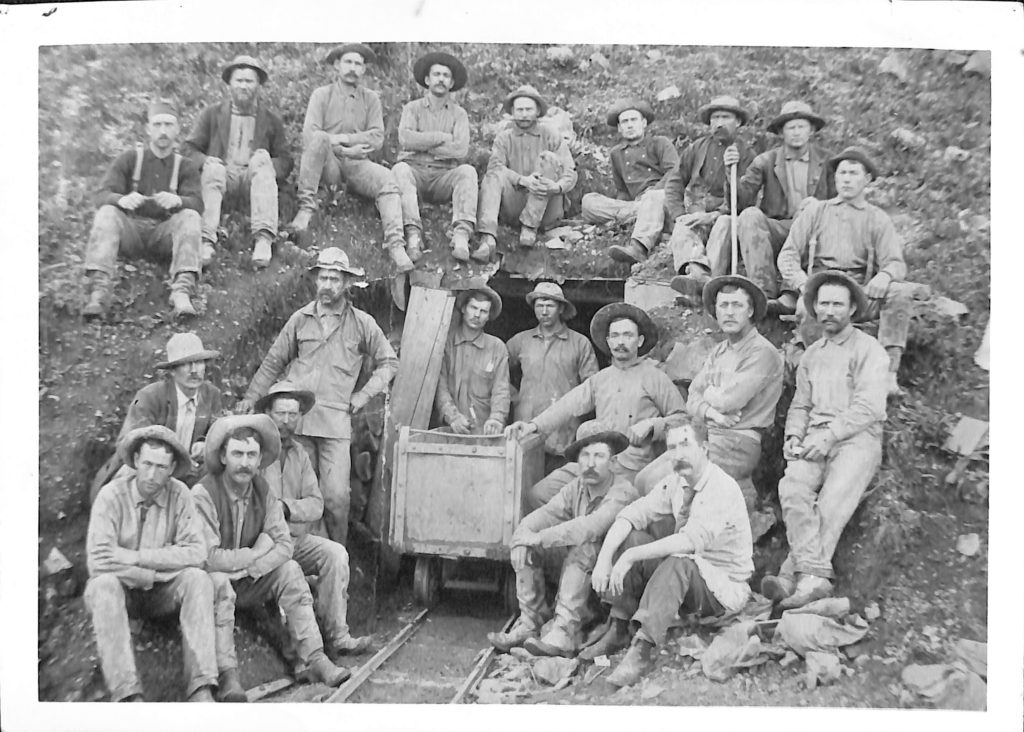
An Ohio-born mining man with valuable property in Arizona’s Cerbat district, working in a landscape already threaded with Wabash capital, Hughes mining connections, railroad money and the wreckage of the Bullfrog boom. Then there are the other Honeywells, the balloonist in St. Louis and the industrialist in Wabash. At first they look like one family story. The records say it’s more complicated than that.

Mark N. Honeywell is unsettling mostly because he’s so easy to miss.
Search the Honeywell name and nearly everything leads to Mark Charles Honeywell of Wabash, Indiana: plumbing, hot-water heating, the Honeywell Heating Specialty Company, automatic controls, and eventually the industrial giant that still carries his name. Search early American aviation and you get Harry Eugene Honeywell, the St. Louis balloonist who made hundreds of ascents and raced internationally in his balloon Uncle Sam.
The third man is buried in the Arizona papers. On September 28, 1912, the Mohave County Miner noted that “M. N. Honeywell, owner of valuable mining property at Cerbat,” had been in Kingman (Library of Congress). It’s the kind of notice that normally vanishes into a century of microfilm, but it tells us something right away. The local mining paper didn’t treat him as a prospector passing through. It treated him as the owner of valuable property in one of Arizona’s oldest mineral districts.
Ten years later, the Mohave County death index lists M. N. Honeywell, born in Ohio, as dying in the county on September 16, 1922. It gives no cause of death and no parents. A burial record identifies him as Mark N. Honeywell, born in 1858, which makes him about sixty-four (Genealogy Trails).
What drew me to him was a hunch: that a western mining man’s quiet death might trace back to money lost in the Nevada Bullfrog boom, and to Wabash-connected capital that went into it. I’ll say up front that nothing I’ve found shows that. What I found instead is a set of names and institutions around him that is worth laying out carefully, along with a list of the records that could settle it either way.
Cerbat, Late in the Game
Cerbat was an old camp by 1912. Gold and silver strikes there went back to the territorial era, and it had once been the county seat, tied by roads and stage lines to Mineral Park, Hardyville and later Kingman. By the time the Miner mentions Honeywell, the settlement was fading.
That timing is what makes him interesting. He isn’t a forgotten figure from the 1870s silver rush. He is still attached to Cerbat property in the twentieth century, when the old camps were being consolidated, abandoned, reopened or folded into larger mining interests, and the death index keeps him in Mohave County until 1922.
What I haven’t found matters as much. I have not found a newspaper story saying he was killed, a coroner’s verdict suggesting violence, a lawsuit tying his death to Bullfrog, or a stock certificate with his name on it. So the honest version of the question isn’t whether Mark Honeywell was murdered over Bullfrog. It is whether an Ohio-born Honeywell who owned mining property in Arizona can be tied, through financial records, to the Wabash-connected money that went into the Bullfrog boom at the same time.
Sorting Out the Honeywells
The obvious first move was Harry Eugene Honeywell. He was one of the country’s important early balloonists; a congressional tribute later called him the “dean of American balloonists,” credited with more than 600 flights and more than 25,000 miles aloft (Congressional Record). During the Oregon balloon race of 1914, he and his aide were struck by lightning three times in one night before they were forced down (Oregon Historical Society). In 1911 Katherine Stinson rode in one of his exhibition balloons in Kansas City, an experience later credited with pushing her toward aviation (Alabama Heritage).
A mining man with a son in the sky would make a tidy story. It doesn’t hold. FamilySearch has Harry born September 9, 1871, to William Honeywell and Caroline Smith (FamilySearch), and Mark N., born in 1858, would have been thirteen. Harry belongs to a separate Honeywell branch unless genealogy proves otherwise. That is useful in its own right, because it stops the Honeywells from being merged just because the names fit.
Mark C. Honeywell of Wabash is a separate man again. He built the Honeywell Heating Specialty Company around automatic heating, and the business later merged into Minneapolis-Honeywell and the lineage of today’s corporation. Mark N. belongs to the mining world of Mohave County; Mark C. belongs to Wabash and the new business of automatic regulation. The three Honeywells work in mining, ballooning and controls, and that makes a striking pattern. But it’s a pattern of three separate biographies, and it’s a reason to do the genealogy, not a substitute for it.
One version of the story that circulates pairs Mark C.’s fate with his wife Olive’s death at Boca Chita Key. Olive’s death was real. The National Park Service says Honeywell bought the key in 1937 and began developing it as a private retreat, that Olive died in 1939 from injuries in a fall there, and that he stopped further development and sold the property in 1945 (National Park Service). But Mark C. lived another quarter century. The chronology doesn’t support a paired Honeywell death, and the point of this investigation is to find what is actually strange, not to manufacture strangeness where the record already explains itself.
A modern footnote belongs here too, labeled as exactly that. Honeywell Aerospace has a facility at the Kingman airport (UK Civil Aviation Authority approvals list), in the same town whose paper recorded M. N. Honeywell’s Cerbat holdings a century earlier. There is no evidence that one has anything to do with the other; corporate Honeywell reached aerospace through twentieth-century mergers, not through any mine. It is a coincidence until somebody shows otherwise.
The Road West: Hunnewell, Ford and Hughes
The reason an obscure Arizona Honeywell caught my eye starts decades earlier, with a similar name. As I laid out in Before Jesse James, H. H. Hunnewell was a Boston railroad financier who came out of Welles & Co. in Paris and in 1873 sat beside John W. Brooks as trustee of a $30 million Chicago, Burlington & Quincy mortgage. Michigan Central, where Brooks and Hunnewell operated, had put $500,000 into James Brooks’s New Albany & Salem Railroad in Indiana, where J. B. Ford worked the river side of the same junction.
By 1880 Hunnewell’s railroad interests had reached the southern edge of Kansas, almost to Indian Territory, and the terminus took his name. The county history is unusually explicit about how the town was made. The railroad bought a 400-acre townsite, a $50,000 town company was formed with railroad and cattle money, and the line arrived on June 16, 1880. The first building put up that day belonged to Ford & Leonard (Cutler’s History of Kansas).
That Ford was E. M. Ford, and no family tie to J. B. Ford of New Albany has been established. But Ford & Leonard weren’t random shopkeepers. In nearby Burden they had already joined a railroad-oriented town company alongside the railroad’s chief engineer, and their stores sold exactly what a railroad-made farm town needed. Then, when Hunnewell organized its government in 1881, J. A. Hughes became its first mayor. Ford and Hughes aren’t names read back into Hunnewell’s story after the fact. They are in the town’s own record.
Hughes in Mohave County
The Mohave County Miner was founded at Mineral Park in 1882 by Anson H. Smith, a miner turned publisher. A year later Smith married Nellie Hughes, whom the Library of Congress history of the paper identifies as the daughter of Smith’s mining partner (Library of Congress). That is the same paper that, three decades later, records M. N. Honeywell’s property at Cerbat.
Nothing yet ties Nellie’s father to J. A. Hughes of Hunnewell, and I don’t want to build that bridge before the records do. But the recurrence is more specific than a common surname turning up in two states. It is a Hughes in the government of a railroad-made Kansas town, and then a Hughes inside the mining partnership behind one of Mohave County’s principal papers, the paper that later names Honeywell as a substantial Cerbat owner.
I’ve come to think this may be the most useful thread in the whole case, more useful than trying to join the three Honeywells. Identifying Nellie Hughes’s father could settle a surprising amount. If he ties to other Hughes mining ventures, to Indiana, to Kansas or to any of the transportation interests traced here, the scattered names start to become a network. If he doesn’t, one tempting surname recurrence drops out. Either answer improves the history.
Wabash Money Reaches Bullfrog

At almost the same time Mark N. Honeywell was working Arizona mining country, money from the Wabash valley was going into Nevada’s Bullfrog boom. The investor was Frederick Hinde Zimmerman of Mount Carmel, Illinois. His family land on the lower Wabash River included the Grand Rapids Dam and Hanging Rock, and he had banking and real-estate interests before he moved heavily into western mines. From about August 1905 he was a co-owner of a company with a name worth taking literally: the Wabash Bull-Frog Mines Company, which his biography places in both Nevada and Arizona (Wikipedia).
Two details there need care. The first is geography. Zimmerman’s Wabash is Wabash County, Illinois, on the lower river, a couple of hundred miles from Mark C. Honeywell’s city of Wabash, Indiana. Both sit in the Wabash corridor I’ve been tracing, but they are different places, and the company’s name most likely points to the Illinois valley its backers came from. The second is Arizona. If the company really held property in Arizona as well as Nevada, then Wabash-connected mining money wasn’t only a couple of hundred miles away in Bullfrog. It was in Mark N. Honeywell’s territory. The company’s incorporation papers should say where.
Bullfrog itself started with Frank “Shorty” Harris and Ernest Cross’s strike in 1904. Rhyolite appeared almost overnight, capital poured in, and promoters turned out companies, subdivisions and stock offerings at extraordinary speed, riding the speculative climate Goldfield and Tonopah had already created. Some of the mines were real. Some promotions were wildly optimistic. Some crossed into territory that investors at the time called deceptive.
Bullfrog Really Did Burn Investors

In November 1906, notices ran in papers across the country about the Bullfrog Rush Mining Company. Nevada governor John Sparks, company treasurer L. M. Sullivan and consulting engineer John D. Campbell publicly repudiated claims that the mine held $6 million in blocked-out ore, calling the statement unauthorized and “absolutely and unqualifiedly false.” Their own tests put the lower workings at roughly 60 cents to a dollar a ton (Evening Star). The company had been marketed at about $825,000, and the men on its own board were telling the public the ground didn’t justify it. The Sullivan organization even offered buyers credit for their shares so the money could be moved into its other promotions, which mining commentators at the time called highly unusual (Goldfield Gossip).
None of that shows the Wabash Bull-Frog company was fraudulent, that Mark N. Honeywell invested in Bullfrog, or that anyone lost money that had anything to do with his death. What it shows is the environment. Bullfrog could produce big paper fortunes, inflated claims, collapsed valuations and angry investors. If Wabash capital went into that district, the next question is concrete: who subscribed?
That’s where the company’s shareholder books, articles of incorporation, assessment notices and creditor records matter more than another narrative history of Rhyolite. If Honeywell turns up as a shareholder, there is a direct financial line between Wabash money and his western mining. If he turns up as a creditor, a seller of claims, a promoter, an engineer or an assignee, that’s more interesting still. If he never turns up, the overlap is geographic and chronological rather than financial, and the theory has to go somewhere else. Mining promotions produced mountains of paper, from incorporation filings and stock ledgers to deeds, claim transfers, mortgages, lawsuits and probate files. Money leaves tracks.
So Who Was Mark N. Honeywell?
For now, the answer is frustratingly thin. He was born in Ohio around 1858. He was established enough in Mohave County mining that the principal local paper called him the owner of valuable Cerbat property. He stayed in the Kingman–Cerbat world into the twentieth century and died in the county on September 16, 1922. He was not, on current genealogy, the father of Harry Honeywell, he should not be confused with Mark C. Honeywell of Wabash, and nothing yet shows that his death was violent or tied to mining losses.
That might sound like the mystery has shrunk. I think it has improved, because an easy story has been swapped for a real historical problem, and that problem is the network around him. Follow it from New Albany, where James Brooks built north and J. B. Ford worked south; through Michigan Central, where another Brooks sat beside Hunnewell; to Hunnewell, Kansas, where Ford & Leonard built the first store and J. A. Hughes became the first mayor; to Mohave County, where a Hughes daughter married the founder of the mining paper; and to Bullfrog, where Wabash-valley money arrived just as the district’s promoters were being forced to disown their own ore claims. Mark N. Honeywell sits at the end of that road.
None of it shows that these people belonged to one organization. What it does is say where to look: the Wabash Bull-Frog incorporation papers and stock ledger, Mark N. Honeywell’s probate and his Cerbat deeds and claims, the identity of Nellie Hughes’s father, the Ford & Leonard genealogy, Zimmerman’s business correspondence, and the Honeywell family trees for Ohio, Missouri and Indiana. If Honeywell lost money in Bullfrog, there should be a transaction. If someone owed him money, there should be a note, a judgment or a probate entry. If his death was suspicious, there should be a death certificate, a coroner’s record or a newspaper story that says more than the index does. And if the Honeywell families really connect, their trees should meet somewhere well before mines, balloons and thermostats.
Some of these recurrences will turn out to be coincidence, and some may not. Until the paper turns up, Mark N. Honeywell remains what the Mohave County Miner made him: an ordinary-looking western mining man who only becomes strange once you draw the roads around him.