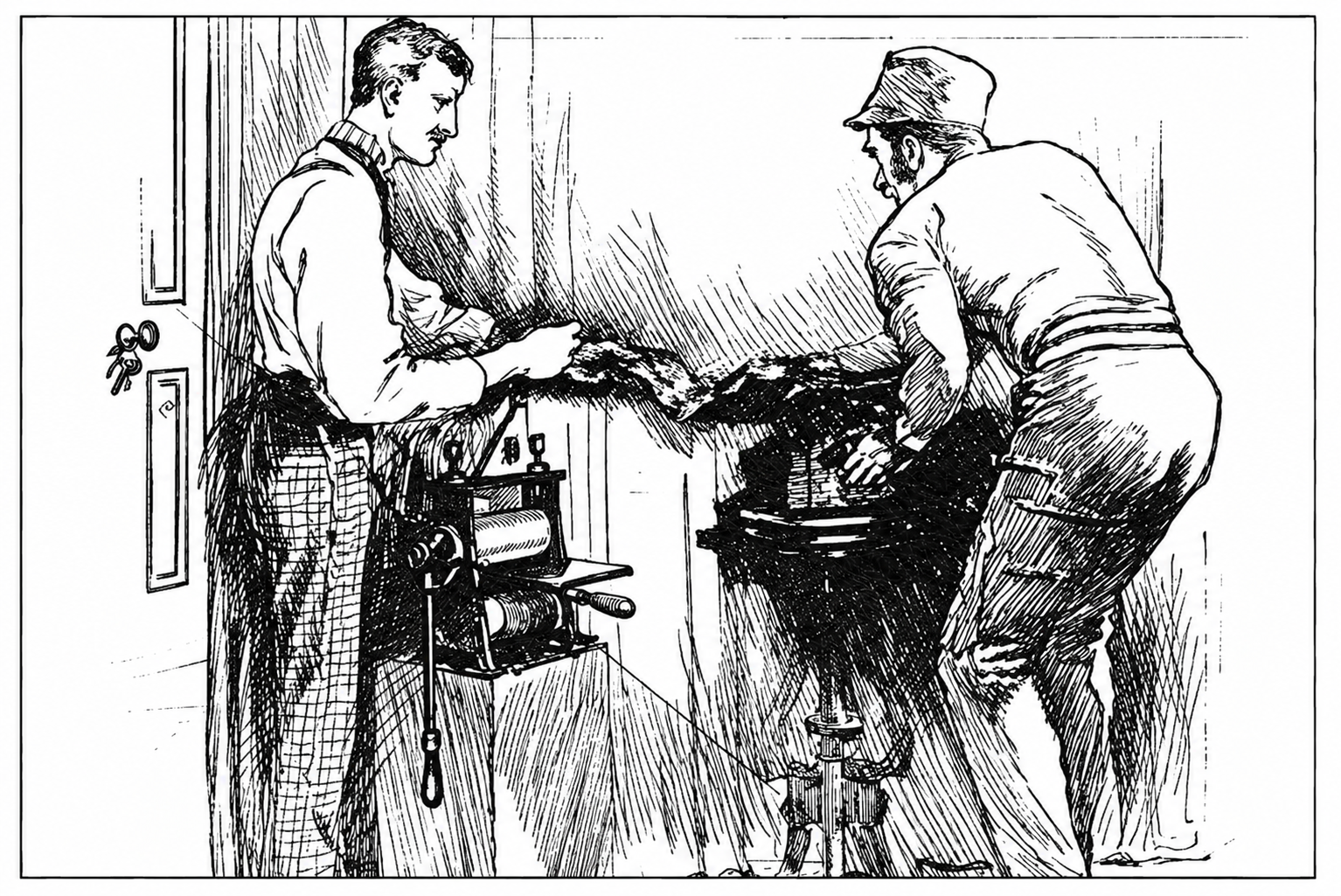
The counterfeiting press did not come from one shop. According to the 1877 history of St. Joseph County, its separate pieces were ordered from blacksmiths in Lima, Sturgis, Freedom, Burr Oak, and White Pigeon. Each man saw a job. No single man had to see the machine.
That division of knowledge is the opening image for this history. In the older commercial world, information traveled in pieces: a hotel keeper heard a confession, a smith recognized a fitting, a postmaster knew a route, a merchant knew a customer, and a stable hand knew a horse. The emerging detective office reversed the arrangement. It gathered fragments in one place, compared them, paid people to pursue them, and sent the result back out as an accusation, an arrest, or a confidential report.
The central question is not simply when professional detection began. It is who could obtain protection from that market—and who could be made its object.
The post office is the room this story keeps returning to. John Comstock served as a postmaster before local memory credited him with organizing a private detective committee at Liberty Mills. Pinkerton’s 1855 railroad contract protected his federal commission as a special mail agent. Joseph Moran Thompson entered the United States postal service after a career that passed through war, commerce, and marriage into the Ford family. Anthony Comstock became a special postal agent in 1873 and used the mail as both investigative territory and instrument of enforcement. Across six decades, postal authority joined local knowledge to movement over distance.
This is not a story of one secret order handing its keys to Pinkerton. It is a story of convergence. Merchants’ committees, statutory regulator companies, compromised informants, railroad managers, postal agents, military officers, and private patrons developed ways to buy information and make it count. Sometimes the same person moved between those systems. More often the systems learned the same lesson: mobility created uncertainty, and uncertainty created a market for trusted intermediaries.
The Store at Liberty Mills
Thieves carried away a reported thousand dollars’ worth of goods from John Comstock’s store at Liberty Mills. Comstock, his relatives, and business associates answered by forming what the county history called a private detective service. Within a year, that history claimed, the committee knew the names of more than two hundred people in a criminal network stretching across northern Indiana.
Comstock already possessed the practical equipment of an investigator. His grist and saw mills drew customers into town. His store connected goods to credit. His tannery, wool works, distillery, and livestock business produced a wide field of employees and trading partners. He promoted roads because his enterprises depended on movement, and his failed projects mattered alongside the one that succeeded: the Huntington–Liberty Mills plank road, accepted in 1851 and completed in 1854.
He also carried public authority. The county history records service as postmaster, probate judge, county commissioner, and state representative. Those were separate offices, but they placed correspondence, estates, property, and reputation inside the same circle of acquaintance. A man who came to have grain ground or collect a letter could encounter someone who also knew local debts, family connections, and the legal standing of property.
The post office matters here as infrastructure, not as a claim of secret surveillance. Mail fixed names and destinations to regular routes. Mills, stores, inns, locks, blacksmith shops, and post offices did similar social work: they made movement pause. A committee could turn the knowledge accumulated at those stops into an assignment. That conversion—from what neighbors happened to know into information deliberately collected against named suspects—is the event the Comstock story preserves.
The committee reportedly secured convictions for the store burglary, horse theft, and counterfeiting, while other men forfeited bond, died before trial, or left the country. The list mixes investigation with prosecution and reputation with flight. What survives most clearly is the community’s memory of a prosperous merchant assembling a family-centered intelligence service before the Pinkerton name had become the national label for such work.
The property being defended sat within a recent colonial transformation. Liberty Mills stood in the Miami homeland. Federal and state authority had redistributed land through treaty, purchase, coercion, and the 1846 removal, while some Miami people remained under exemptions and other arrangements. The new committees did not protect “property” in the abstract. They enforced claims created within that political settlement.
The first detective office in this story was not an office at all. It was a commercial circle that decided to remember together.
The Rope and the Statute
In July 1858 the regulators brought John Wilson before a committee at Avilla. M. H. Mott wrote that prisoners understood their alternatives as “a free and full confession, or an introduction to the rope.” Even witnesses with no specific charge, he said, turned pale and trembled before the committee.
“A free and full confession, or an introduction to the rope.”M. H. MOTT, HISTORY OF THE REGULATORS, 1859
Six years earlier, Indiana had given private apprehension companies a lawful form. The act of March 9, 1852 allowed ten to one hundred citizens to incorporate for detecting and arresting horse thieves and other felons. County commissioners approved the articles. Membership changes went into the county record. Companies could receive donations, assess members, compensate officers, and call on peace officers. While making arrests, members received the rights and privileges of constables.

Mott’s book shows the statutory company growing into something more ambitious. At Kendallville in March 1858, delegates created a central organization, elected officers, assessed subordinate companies, appointed a detective committee, and offered rewards. Local subscriptions could now pay an investigator to cross county or state lines. The companies were not merely posses assembled after a theft. They were building a standing market for information.
Miles C. Payne revealed how that market could reverse a man’s role. Arrested with others in January 1858, Payne disclosed knowledge of horse theft and counterfeit money across several states. The regulators promised him personal safety and employed him as a detective. Mott credited Payne and Dr. J. S. Lavering with arrests that reached the federal court at Indianapolis. He also admitted that Payne’s disclosures were never written down.
The bargain was plain: safety in exchange for access. Payne knew people, routes, refuges, and the circulation of counterfeit money because he had participated in them. That made him useful and difficult to trust. Mott later accused him of accepting a bribe and deserting during a court term. The same source that praised his boldness as a detective condemned his mobility once another patron may have bought it.
The regulators were already confronting the central problem of professional intelligence: the best-placed source was often the least governable one.
John Freeman’s 1853 ordeal shows the other side of private mobilization. A fraudulent claimant had the free Black Indianapolis property owner arrested as a fugitive from slavery. Freeman spent nine weeks in custody while lawyers, witnesses, money, and community organization were assembled to prove his identity. When the claim collapsed, Black residents marked his release at Masonic Hall. The documented use of that hall does not turn his defense into a lodge operation. It shows a community gathering resources quickly enough to defeat an official wrong.
Comstock sought public protection for a merchant’s goods. Freeman sought protection from a legal process aimed at his body. Both cases depended on networks capable of producing credible information, but the law met them with radically different presumptions. The new investigative market did not simply increase society’s power to know. It distributed that power unevenly.
The Railroad Buys a Detective
For two years, trains on the Michigan Central passed through Leoni under attack. Engines left the track. Shots struck around the engine house. Night service stopped. When the resulting conspiracy case came to trial in 1851, prosecutor James A. Van Dyke did not deny that the railroad had hired spies. He defended the decision in open court.
“The only effectual means were to employ men who might gain the confidence of that community.”JAMES A. VAN DYKE, RAILROAD CONSPIRACY ARGUMENT, 1851
Van Dyke praised Darius Clark’s public standing, then addressed the more troubling agents—men the defense called “graduates of State Prison.” Respectability, he argued, could defeat an undercover assignment. The railroad needed people whom suspects would accept as kindred spirits, people who could become what he called repositories of concealed crime. Here was a corporate defense of compromised knowledge four years before the famous multi-railroad contract with Pinkerton.
That timing matters. John W. Brooks, James F. Joy, Clark, Van Dyke, and the Michigan Central already occupied a market for railroad intelligence. Pinkerton did not invent every method later associated with his name. His advantage was organization: he gathered methods, clients, assistants, correspondence, and travel privileges into a durable office.
The agreement of February 1, 1855 made that consolidation visible. Several railroads guaranteed money toward a “Police Agency” headquartered in Chicago but operating in neighboring states. Pinkerton & Co. would keep correspondence and information at the central office, hold company communications in confidence, maintain experienced assistants, and procure specialists for emergencies. Clients designated representatives through whom orders and reports would pass. Their representatives were expected to share intelligence affecting one another’s safety.
The contract also supplied mobility. Pinkerton and designated assistants received season passes on participating lines and blank passes for operational use. Two or more railroads could combine an investigation when the same gang appeared to be attacking them. The rail network was becoming an information network, and the detective office sat at the switch.
Postal authority remained inside the bargain. The agreement anticipated that the Post Office Department would continue to commission Pinkerton as a special mail agent and placed departmental calls beside railroad calls in the order of business. The document therefore refuses a tidy career break between federal service and private detective work. The clients overlapped, and so did the routes. Pinkerton’s territory as described in the contract’s setting reached Illinois, Indiana, Michigan, Wisconsin, and Iowa—the same broad theater through which stolen horses, counterfeit notes, mail, passengers, and informants moved.
The contract reached inward as well as outward. Pinkerton was to report information about railroad employees’ “habits or associations.” The companies were not only buying pursuit after a loss. They were buying continuing knowledge about their own workforce. Common financing, confidential reporting, free movement, and a central archive turned investigation into a standing service.
The railroad did not merely hire a detective. Several railroads bought the capacity to remember as one.
Latta’s Hotel
E. W. Pendleton kept following the border counterfeiters after twelve of his horses were poisoned. At his hotel in Sturgis, a McDougall confessed. Pendleton then moved in daylight on Latta’s hotel at Freedom, along the Chicago Road. The seizure yielded a reported $25,000 in counterfeit notes and the equipment used to print them—except for dies carried across the Indiana line.
Then the separate blacksmith commissions came back together. Pendleton obtained identification of the press parts made at five shops and connected them to the older Latta. The precaution that had concealed the machine during manufacture became the evidentiary chain that exposed it.
The arrest also produced the clearest Pinkerton claim in the northern Indiana material. The account distinguishes the elder Latta from his son, N. B. Latta. The father offered his farm as bail and later fled. The son was discharged after representations about his employment were made to the examining magistrate.
“Had been working up the case when arrested.”HISTORY OF ST. JOSEPH COUNTY, MICHIGAN, 1877
The sentence before those words is decisive: the representations that N. B. Latta was one of Pinkerton’s detectives were “substantiated to that official’s satisfaction.” That is stronger than a suspect merely announcing an affiliation. A judicial officer accepted some showing of agency. It is also narrower than proof that every act attributed to Latta was authorized, or that the same relationship continued through his later Wisconsin prosecution.

The father’s bail produced another conversion. After he absconded, the 240-acre farm passed to the county and was used for the poor farm. The county historian questioned whether the proceeds should instead have gone to the school fund. An operation against false paper ended by moving real land into public administration.
The case joins the local and corporate systems without proving a wholesale merger. Pendleton worked through a hotel confession, smiths’ identifications, a cross-border pursuit, and a magistrate. N. B. Latta’s accepted Pinkerton role placed a Chicago detective connection inside that scene. The regulators’ later seizure of the fleeing McDougall placed Indiana’s private enforcement on its other edge. Different authorities met in the same case because the network crossed their borders.
Bone Latta’s later Wisconsin record—arrest in 1871, sentence in 1872, presidential pardon in 1877—belongs to a second episode. It keeps the question of protection alive, but it cannot be folded backward into a permanent license. The 1857 account proves a recognized agency explanation at one hearing. It does not turn every later charge into an undercover operation.
The War Market
On June 16, 1862, Judge James Hughes warned Governor Oliver P. Morton about a secret movement in Indiana. Within days, the letter had entered Republican convention politics and the columns of the Indianapolis Daily Journal. Intelligence moved from private warning to partisan evidence before the public could test the organization Hughes described.
The Civil War multiplied buyers for intelligence. Morton’s government, army officers, railroad managers, party organizations, federal prosecutors, and opposition networks all wanted access to meetings, correspondence, weapons, and loyalties. Earlier commercial and professional ties supplied introductions. Comstock, a Whig turned Republican, was remembered as contributing private resources to Morton’s wartime government. Calvin Cowgill moved from John U. Pettit’s Wabash law practice into quartermaster service and then, at Morton’s request according to the county history, into the provost marshal’s office.
Pinkerton’s route into federal work was more direct. His railroad relationship with George B. McClellan preceded his military intelligence service. Samuel M. Felton’s railroad security commission led to the Baltimore investigation and the operation surrounding Abraham Lincoln’s passage through the city in February 1861. A service built to protect transport infrastructure had acquired a presidential and then military client.

Indiana built another apparatus around Henry B. Carrington and Felix Grundy Stidger. Stidger entered the leadership circle of the Order of American Knights and Sons of Liberty, attended internal proceedings, and reported outward to Union authorities. His later memoir defended his own conduct, but its method is recognizable: obtain admission, cultivate officers, collect names and plans, and let an external patron decide how the information would be used.
The resulting investigations found meetings, weapons, oaths, and political resistance. They also created incentives to magnify membership and military capacity. A real cache did not prove every estimate of armed men; partisan exaggeration did not make every clandestine meeting imaginary. The power lay in converting selected information into arrest and jurisdiction.
Lambdin P. Milligan’s case tested that conversion. Arrested in October 1864, tried by a military commission, and sentenced to death, he won a Supreme Court ruling in 1866 that the commission lacked jurisdiction over a civilian where the ordinary courts remained open. The Court did not settle every historical allegation surrounding the Sons of Liberty. It drew a line between possessing incriminating intelligence and possessing lawful power to try a man before a particular tribunal.
Wabash’s Odd Fellows lodge, Ebronah Encampment, and the professional circle around Pettit and Cowgill created repeated contact among men who also held civil, military, and railroad office. The encampment moved between Lagro and Wabash as its membership balance shifted: Lagro in 1857, Wabash in 1860, Lagro in 1865, then Wabash permanently in 1867. That is evidence of a living regional organization, not by itself a sequence of covert headquarters.
Shared ritual is likewise not a genealogy. Masons, Odd Fellows, Sons of Malta, wartime political orders, and the Knights of Pythias used degrees, passwords, obligations, and private rooms, but they had different dates and institutions. The Knights of Pythias began in 1864 and cannot explain an 1851 committee. Milton Wright’s later anti-secret-society campaign shows that contemporaries contested such loyalties; it does not connect every Wright in the Wabash trade to his church dispute. A lodge becomes operational evidence when a roster, payment, meeting, or introduction shows what its members did.
James Hughes of Indiana and George Wurtz Hughes of Maryland belong on the same board only with a line between them. George’s railroad and militia offices made him part of Baltimore’s world of transport and force. James carried a warning into Indiana politics. No record examined here makes them the same man, relatives, or Pinkerton partners. Their juxtaposition is useful because it identifies two institutional positions from which information could acquire official weight.
Afterlives
In November 1875, the Lagro firm of Todd & Wright accepted a customer’s hogs for shipment to Buffalo. George W. Wright accompanied them, sold them, and disappeared with the money. His partners stayed home. Years later, the Indiana Supreme Court held them liable because Wright had acted within the apparent business of the firm.
The case reduced an old problem to partnership law. The traveling agent possessed access because the firm supplied it. When he converted that access into private gain, the people who had made him credible could not simply call him a stranger. Detectives faced the same risk with informants; railroads faced it with employees; governments faced it with spies. Distance increased the value of an intermediary and the damage he could do.
Government learned to buy records as well as testimony. The Columbus Delano papers contain a file on the United States’ 1872 purchase of Confederate archives, including a copy of Jacob Thompson’s 1864 report to Judah P. Benjamin. Defeated intelligence could be consolidated after the organization that produced it had lost power. The archive itself became an asset.
Postal office returned as a career. Joseph Moran Thompson—merchant, Union officer, Ford son-in-law, and failed manufacturer—entered federal postal service in 1878 and remained until December 28, 1886. James Ford said he recorded Thompson’s account almost in his own words. Thompson described his removal as patronage, not discipline.
“To give place to a Democrat, who knows nothing about the business.”JOSEPH MORAN THOMPSON, RECOLLECTION PRINTED BY JAMES FORD, 1890
The sentence exposes the political foundation under an apparently technical service. Experience mattered, but appointment and removal still traveled through party authority. Thompson’s path from commerce through military administration to the mails did not make every stage an intelligence job. It did show how recommendations, wartime standing, and family position could carry a man between private and federal systems.
At Lagro in 1885, James Kerr was found dead at the lock from which he had supplied the canal trade. Two newspaper accounts disagreed about the hour his body was discovered. Both brought Coroner John C. Zimmerman into the commercial landscape as the official responsible for examining the death. The disagreement is small and instructive: even a public event entered the record in more than one time.
John Comstock’s name also acquired a later afterlife. A 1907 family genealogy placed the Liberty Mills postmaster and Anthony Comstock on branches descending from the same seventeenth-century ancestor, which would make them fifth cousins. The early parentage is labeled presumptive inside the genealogy, and no correspondence or employment link between the two men has appeared. The institutional comparison is firmer than the family bridge.
Anthony Comstock’s work began in metropolitan print commerce rather than a robbed Indiana store. YMCA supporters and wealthy patrons financed investigations; the New York Society for the Suppression of Vice gave the campaign a private corporate body; federal law enlarged its reach. His 1873 appointment as a special postal agent turned the mail into a field of inspection. Booksellers, publishers, contraceptive suppliers, and recipients of reproductive information could now become the objects of a privately promoted definition of disorder backed by federal authority.

The two Comstocks therefore frame a transformation without proving a succession. John’s remembered committee protected a merchant’s property by gathering neighborhood knowledge. Anthony’s organization sought to police what strangers could send one another through a national system. In both cases, private supporters defined a danger, financed detection, and sought official force. The post office linked identity to distance and made a local report actionable elsewhere.
By then, the Treasury Secret Service had entered the counterfeiting field in 1865, and the Department of Justice created its own investigative force in 1908. Federal bureaus did not erase the older arrangements. They accumulated what the older world produced: names from merchants, testimony from insiders, travel supplied by carriers, appointments distributed through politics, and files acquired from allies or enemies.
The central office’s great invention was not secrecy. It was collection.
The older Indiana systems were not simply absorbed into Pinkerton as a single combine. Something more consequential happened. Their techniques became purchasable, portable, and repeatable. A merchant’s committee, a regulator company, a railroad bureau, a postal commission, and a military intelligence office could all turn partial knowledge into coercive power. The lasting question is the one visible at Liberty Mills, in Freeman’s cell, at Latta’s hotel, and before Milligan’s tribunal: who could obtain protection from that market, and who could be made its object?