n December 1681, a Pueblo man named Pedro Naranjo told Spanish interrogators what had happened after the revolt in New Mexico. Po’pay had ordered people to go down to the rivers and wash themselves and their clothes with amole, a local root. The washing would take away the names, water, and oil they had received in baptism. Bells were to be broken, Christian images burned, and the ceremonial rooms rebuilt. Naranjo’s account survives in the records of a Spanish expedition that had come to take the country back.
One of the images the colonists eventually brought back to Santa Fe was a small wooden Virgin. She had been carried south when the Spanish fled in 1680. Diego de Vargas returned her to the town as he reestablished Spanish rule in the 1690s. He also carried a banner of Our Lady of Remedies in his campaign. In late medieval Castile the Virgin had been invoked in wars against Muslims. In New Mexico she took the field against people whose ceremonies and sacred places belonged to a different world. The statue came to be known as La Conquistadora.

Some of the things Spain brought to America had been learned from the Muslim societies of Iberia. Others had been developed in the course of fighting, governing, and trying to convert them. The architecture and the vocabulary of irrigation came across alongside military devotions and rules for subduing a frontier. Meanwhile, Muslim and Jewish people crossed the Atlantic under circumstances that imperial authorities could only partly control. Some arrived as traders and refugees. Others were carried as captives. The paths meet in places where a church, fort, or court changed hands and someone had to decide what the people already there could keep.
The name Santa Fe itself recalls the place outside Granada where Ferdinand and Isabella made their siege camp. In April 1492 they signed Columbus’s capitulations there. New Mexico’s capital bore the same name a little over a century later. The Granada connection is plausible, though the decision to use the name survives more clearly than Pedro de Peralta’s reasons for choosing it. On another Caribbean shore, Columbus used mezquita to describe the shape of a Cuban hill. Cortés later used the same word for Indigenous temples. Bernal Díaz remembered the Spaniards calling a town on the coast Gran Cairo. The comparisons show what the newcomers already had in their heads when they tried to describe a city they had never seen.
By 1501 the Spanish Crown was instructing Nicolás de Ovando to keep Jews, Moors, and certain recent converts out of the Indies. The same instructions allowed some enslaved Black people raised under Christians to go. The distinctions were difficult to maintain once expeditions began moving. In 1528 a man from Azemmour on the Moroccan coast landed with the Narváez expedition in Florida. His Spanish companions called him Esteban or Estevanico. He was enslaved by Andrés Dorantes and survived the destruction of the expedition with three other men. Their survival depended on Indigenous people who sheltered, fed, held, traded with, or guided them. Estevanico became an intermediary on the journey west. In 1539 he went ahead of another Spanish expedition and reached the Zuni country around Hawikuh, where he was killed. His own religious practice is uncertain. His route puts a Moroccan man in direct contact with Indigenous communities from the Gulf Coast to the Southwest within the first half century of Spanish colonization.

Across the continent there is another trace in the English settlement at Roanoke. Joachim Gans, a Jewish metallurgist from Prague, went out with the expedition in 1585 to evaluate ores. He returned with Francis Drake’s fleet and later faced questioning in Bristol about his refusal to affirm Christian doctrine. Drake’s fleet also carried people described as Turks and Moors during its Caribbean campaign. What became of all those passengers at the time of the fleet’s stop off Roanoke remains uncertain. Gans’s presence can be followed through an occupation, a voyage, and a court record. For the others, even the place where they went ashore is a question.
The frontier garrison carried its own history. The Spanish Crown held presidios at Melilla and at Mers el-Kébir and Oran on the North African coast. In New Spain, the long war against the Chichimecas made the presidio a principal instrument for controlling routes and protecting settlements. The North African garrisons make a strong comparison for the American forts. The transfer of legal argument is clearer still. In disputes over whether Indigenous captives could be enslaved, Karoline P. Cook found officials invoking precedents from Granada and the treatment of the Moriscos. People who had never been subjects of Granada’s rulers found their freedom debated under rules developed in Granada’s conquest and aftermath.
At Cholula, the Franciscan complex of San Gabriel included a vast chapel for instructing and assembling Indigenous worshippers. In its developed form the Capilla de Naturales has seven rows of seven bays. Seen from within, the repeated arches and supports recall the prayer hall at Córdoba, the great mosque taken into Christian use as a cathedral. A map made at Cholula in 1581 places the Franciscan complex within the Indigenous city. It also depicts the ancient pyramid. The two buildings belong to the same map and to separate histories of construction. The history of the chapel can be read alongside the history of the city whose people were expected to fill it.

Indigenous building traditions had their own long chronologies. At Hovenweep the Ancestral Pueblo people had already built stone towers and multistory structures in the thirteenth century. Their dates put them in the same broad era as the medieval irrigation charters of Valencia. The continent already had engineers, towns, and ceremonial landscapes of its own when Iberian building forms reached it.

In New Mexico the inheritance was also acted out. In 1598 Juan de Oñate’s expedition staged a drama on reaching the Rio Grande and later mounted a spectacle of Moors and Christians. The festival had its roots in Iberian stories of conquest and conversion. In time New Mexico developed a mounted pageant of its own, Los Comanches, with an American people in the opposing role. The pageant and the laws of the frontier came out of different institutions, but both made the old Iberian conflict available as a way of depicting a new one.
Spain was policing the ancestry of its own colonists while it tried to convert the people it encountered. Eight years before Oñate, Gaspar Castaño de Sosa led an unauthorized party out of northern New Spain and into Pueblo country. He had served under Luis de Carvajal, whose family was prosecuted for Judaizing. Castaño’s expedition went without a priest. His possible converso background and the part the prosecutions may have played in his departure belong to the interpretation of the case. His unauthorized march and conviction belong to the record.
In 1661 Fray Alonso de Posada was taking testimony for the Inquisition in New Mexico. In his capacity as a Franciscan superior he also banned Pueblo dances and ordered sacred objects seized. Governor Bernardo López de Mendizábal and his wife, Teresa de Aguilera, were sent to the Inquisition’s prison in Mexico City, where she faced suspicion of observing Jewish rites. Indigenous people generally fell outside the formal jurisdiction of that tribunal and were subject to other forms of church discipline. One man could help suppress Pueblo ceremony and collect evidence against a Spanish governor’s household because he held authority in both settings. The people who washed in the rivers in 1680 had lived through years of those interventions.
The Iberian expulsions also put people into the service of Spain’s rivals. Samuel Pallache, a Jewish envoy from Fez in the service of the Saadi sultan Zidan, helped negotiate the Dutch agreement with Morocco in 1610. Across the water, Morisco exiles from Hornachos established themselves at Salé, where corsair crews included Europeans as well as North Africans. A man recorded as Anthony Jansen van Salee was in New Netherland in the 1630s. The connection between his name and Salé is visible in the records. The often-repeated identification of his father as the Dutch corsair Jan Janszoon remains less secure.
The Dutch West India Company gave Sephardic merchants room to organize a congregation in Recife during the Dutch occupation of northeastern Brazil. That arrangement depended on a colonial government in a sugar economy built on slavery. It also depended on a military position the Dutch could lose. In January 1654 the Portuguese attacked the pentagonal fort called Frederik Hendrik, or Cinco Pontas, threatening access to fresh water. The Dutch capitulated. A group of twenty-three Jewish refugees reached New Amsterdam later that year, part of the dispersal set in motion by the loss of Dutch Brazil. In Recife the congregation’s building passed into other hands. When excavators worked through successive floors centuries later, they found the ritual bath that helped identify the site of Kahal Zur Israel.

Elsewhere, the privileges lasted longer. At Jodensavanne in Suriname, a Sephardic community built a synagogue, maintained cemeteries, and exercised unusual communal authority under first English and then Dutch rule. Its privileges coexisted with plantation slavery. The border between French Louisiana and Spanish Texas offers a different kind of local arrangement. At Los Adaes, the capital of Spanish Texas for much of the eighteenth century stood close to French Natchitoches, in a country of Caddo communities. Spanish settlers depended on commerce with their French neighbors even when the trade was forbidden. When the Crown closed the post, some residents eventually resettled at Nacogdoches and carried on trading. Decades later Bonapartist veterans briefly tried to establish Champ d’Asile on the Trinity River. The two episodes belong to different periods. They both show why a flag on a map tells only part of the story of who could supply a settlement, settle there, or keep it going.

Among the people who built the French colony in Louisiana were Africans who came from places with their own long histories of Islamic learning. Early ships in 1719 brought captives embarked at Ouidah, in present-day Benin. Later French voyages brought many from Senegambia. Their arrival belongs to a longer history of imperial anxiety about the people slave traders brought across. After the Christmas uprising on Hispaniola in 1521, authorities issued new slave ordinances. Spanish restrictions later singled out people classified as Gelofes, a name associated with Wolof origins. The categories used by officials changed as the traffic expanded. The people who came through it carried languages, beliefs, and skills the statutes could barely describe.
Farther east, people escaped slavery in the English Carolinas by making for Spanish Florida. Francisco Menéndez, a Mandinga man who had fled the English colonies, petitioned for freedom under the Spanish Crown and became the militia captain at Fort Mose in 1738. Spain offered sanctuary on terms that included Catholic allegiance and service. A British account from the war identified Menéndez as the captain of a company that included Indigenous, Black, and mixed-race men. He was captured at sea and again had to contend with enslavement. In 1763, when Spain ceded Florida to Britain, the families of Mose left for Cuba. The fort had given them a place to defend their freedom. Keeping it required a government willing to recognize their claim.

On Sapelo Island in Georgia, Bilali Muhammad left thirteen handwritten pages in Arabic on Islamic belief, ablution, and prayer. The text draws on a work by Ibn Abi Zayd al-Qayrawani, a tenth-century jurist of Kairouan. His Maliki school was also influential in Islamic Iberia. Bilali knew it through West Africa, where he had been educated before he was enslaved. His manuscript belongs to a separate route from the one that brought Iberian church architecture into the Americas. He could write down the rules of prayer from a curriculum older than any Spanish mission in the country.
In 1831, while enslaved in North Carolina, Omar ibn Said began his own account in Arabic with Al-Mulk, the Qur’anic chapter on divine sovereignty. He placed his birthplace in Futa Toro, in the Senegal River region whose historical communities extended across the modern Senegal–Mauritania border. His account and Bilali’s pages are different kinds of documents. One man used the language in which he had studied law and religion to set down his life. The other recorded what a person was supposed to do before standing in prayer.

The founding generation had its own encounter with Islamic law. Thomas Jefferson bought George Sale’s English Qur’an while studying law in Williamsburg. John Adams’s collection contains an American edition printed in 1806. In London in 1786 both men heard the envoy of Tripoli invoke the Qur’an in defending captures at sea. They had already begun a separate negotiation with Morocco. The way they pursued it shows how much of the early republic’s foreign policy depended on relationships the French and Spanish crowns had built before American independence.
France’s commercial treaty with the United States, signed in Paris in 1778, committed Louis XVI to use his influence with Morocco, Algiers, Tunis, and Tripoli on behalf of American shipping. France knew the Moroccan court. The Comte de Breugnon had taken part in operations against Moroccan ports, then negotiated a French treaty with Sultan Muhammad III in 1767. A decade later he sailed with d’Estaing’s fleet in the American war and fought in the Caribbean. Benjamin Franklin, a signatory of the American treaty with France, also became a leading member of the Paris lodge Les Neuf Sœurs under the Grand Orient. The treaty negotiations can be followed through the correspondence of commissioners and ministers. Franklin’s lodge membership places him in another Parisian institution whose role in the negotiation remains open.

Thomas Barclay left Paris in 1786 with French support. In Madrid, the Spanish minister Floridablanca supplied introductions. In Marrakesh, Muhammad III proposed that Morocco’s treaty with Spain serve as a model. Isaac Cardoza Nunes translated the resulting agreement into English. Jefferson signed the American instrument in Paris on January 1, 1787, and Adams signed it in London on January 25. Article 10 promised help getting sailors home if they were wrecked near Wad Nun on the Atlantic edge of southern Morocco. Article 21 addressed what would happen if an American and a Moroccan came to blows. In a case of killing or wounding, the law of the country would apply, with the consul assisting and equal justice promised.

The other treaty worth reading alongside it is the agreement the United States had made with the Delaware Nation at Fort Pitt in 1778. It provided for judges or juries from both parties in trials involving offenses against the other. It even contemplated a Delaware-led state with representation in Congress, if the parties agreed and Congress approved. The two treaties were made for different purposes. Read together, they catch the republic at a moment when the practical terms of sovereignty were still being written down. The makeup of a jury and the authority of a consul were matters for negotiation.
Four men in South Carolina made use of that opening in 1790. Francis, Daniel, Hammond, and Samuel petitioned on behalf of themselves and their wives, Fatima, Flora, Sarah, and Clarinda. They said that they had been taken captive in Africa, entrusted to a captain on a promise that they would be redeemed, and sold in South Carolina instead. They had since purchased their freedom. Now they wanted to know which court would hear a case against them if they were ever accused of a crime. As free subjects of a ruler allied with the United States, they argued that they should be entitled to trial by a lawful jury. The South Carolina House agreed that free subjects of the Moroccan ruler fell outside the statute under which they feared being tried.
The terms of the Moroccan treaty became personal for the Adams family after the brig Commerce wrecked off the Saharan coast in 1815. James Riley and several of his crew were enslaved before being ransomed through William Willshire at Mogador. Back in America, Riley sent John Adams his account and asked for help settling the expenses of the American consul who had received him in Tangier. Adams read the book and forwarded the request to his son, then secretary of state. Riley later surveyed the Maumee–Wabash canal route and named Willshire, Ohio, after the man who helped ransom him. His book reached readers in Indiana, among them the young Abraham Lincoln according to accounts of Lincoln’s early reading.
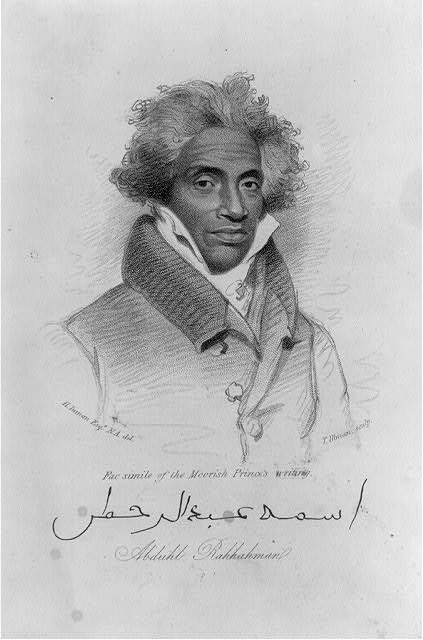
In 1828 the Adams administration took up the case of a man whose writing had crossed the same ocean in the other direction. Abdul Rahman Ibrahima Sori had been enslaved near Natchez for about forty years. An Arabic passage he wrote made its way through American officials to Tangier. The people transmitting it took him for a Moroccan. He was from Futa Jallon, in present-day Guinea. The Moroccan sultan intervened and John Quincy Adams and Henry Clay helped arrange his release. In his diary entry for May 15, 1828, Adams describes the case and calls him a Moor. Earlier on the same page he records planting thirty-six Tangier orange seeds. The entry has the man and the fruit entering Washington under the name of a place, each by a route the diary only partly explains.

Along Delaware Bay the word had a different history. In 1855 Levin Sockum was prosecuted for selling ammunition to Isaiah Harmon of the Indian River community. The outcome turned on whether Harmon fell within a racial restriction on the sale. The Sussex County community had also been called Moors, but the name carried a different force there from the one it carried in the South Carolina petition. Farther north, at Cheswold, people identified their community as Indigenous and told different stories about how outsiders came to call them Moors. Delaware’s modern recognition law for the Lenape Indian Tribe of Delaware records that state documents once used the letter M for their race. The older Chesapeake story of shipwrecked or transplanted Moors remains a tradition of disputed origin. At the same time an Arabic-literate Muslim named Ayuba Suleiman Diallo really did pass through the Chesapeake in the 1730s. Accounts place his recapture in different jurisdictions. His Arabic letter helped secure his release, as Ibrahima’s writing did almost a century later.
The Lenape story also went west. After the United States secured a cession of Delaware lands in Indiana in 1818, Kikthawenund, or William Anderson, led his people through further removals. Oliver Cowdery met the Delaware chief and council on the western frontier in 1831 and told them about the Book of Mormon. The missionaries read Indigenous history through a story of Israelite descent. Decades later an Indianapolis reformer used the biblical name Ishmael for a network of poor families, and in the twentieth century Hugo Leaming proposed a Muslim origin for them. The records establish the migrations and the acts of naming. They leave the proposed genealogy open.
Between the Fort Pitt agreement and the encounter with Cowdery came Johnson v. M’Intosh, the 1823 decision that limited who could acquire title directly from Indigenous nations. John Marshall described a European system in which discovery gave the claiming sovereign the exclusive right to acquire Indigenous land. Its older Atlantic context included instruments such as Romanus Pontifex, which confirmed Portuguese claims and privileges along the African coast in the fifteenth century. In a single generation Americans could speak of a Delaware-led state, adjudicate land under a doctrine derived from European discovery, and negotiate the removal of Delaware communities that had once held lands in Indiana. The promises in the first treaty read differently once the later records are laid beside them.
In the nineteenth century there is a documented case of a French lodge doing the kind of work people sometimes ascribe to Franklin’s. The Algerian emir Abd el-Kader, a Sufi who had led resistance to the French conquest, was released from captivity by Louis-Napoléon. In Damascus in 1860 he protected Christians during sectarian violence. The Paris lodge Henri IV subsequently arranged for Les Pyramides in Alexandria to initiate him in 1864. The French lodge published a record of the occasion. The man who had fought France in Algeria could become the object of a French public honor and a member of one of its fraternal circles. The episode has names, dates, and proceedings of its own.

Americans also used the East as a language for organizing their own associations. Lew Wallace, the Indiana author of Ben-Hur, wrote a novel about the conquest of Mexico before he governed New Mexico and served as American minister to the Ottoman Empire. In The Fair God his Alvarado talks admiringly about the warriors and songs of Moorish Spain, then seizes on the prospect of an attack on a temple of Huitzilopochtli. Later Wallace wrote a novel about the fall of Constantinople. A fraternal benefit society in Crawfordsville borrowed the name and characters of Ben-Hur with his blessing. Indianapolis eventually had its own minarets on the Murat Shrine. In 1920s Chicago, Noble Drew Ali’s Moorish Science Temple used some of the same public forms, including fezzes and processions, to assert a Moorish identity for Black Americans. By then the word that had appeared in treaties, statutes, and courtrooms was also one people could choose for themselves.
In the Southwest an older inheritance can still be found in the vocabulary of water. Acequia comes from the Arabic al-sāqiya, with the article assimilated before the first consonant. In New Mexico it can name the ditch or the association that manages it. Pueblo communities were already farming and irrigating before the Spanish came. The colonial systems brought Iberian practices into a country with its own knowledge of water. New Mexico eventually recognized community acequias as political subdivisions. The commissioners and the mayordomo have business to conduct whenever the ditch needs repair or the flow has to be divided.
San Antonio offers a way to see the transfer at the scale of one person. Canary Island families arrived in 1731 to establish the civil settlement of San Fernando de Béxar. Some came from Lanzarote, an island with a substantial Morisco population in earlier generations. The family-by-family ancestry of the settlers is still a question for the parish and Inquisition records. The irrigation records give a named case now. Antonio Rodríguez of Gran Canaria understood the work, and the Franciscans enlisted him to supervise construction on the Concepción acequia. At the municipal San Pedro ditch, settlers drew lots for their turns. Indigenous labor helped build the city’s channels. The law, the practical knowledge, and the labor could come from different people and all end up in the same ditch.

An older charter shows what an order of knights could acquire in a conquered agricultural district. In 1246 James I of Aragon transferred Montcada, near Valencia, to the medieval Order of the Temple. The agreement called for the estate to be delivered free of its existing inhabitants. Two years later the Templars allotted houses, gardens, and forty jovadas of irrigated land to named settlers. They took one-third of the irrigated harvest and one-fifth of the dryland harvest. The charter names grain, grapes, dried figs, and olives, along with other trees whose species it leaves unspecified. The order reserved mills, ovens, and baths and had first claim when a holding went up for sale. It also promised to defend the settlers and their possessions as its own.
Montcada lay in a district whose irrigation had developed under Muslim rule. The order held the local estate; the Royal Acequia served a wider set of landholders. In 1268 the king granted the canal to those whose lands it served. A petition in 1424 invoked a customary division in which villages received water in proportion to their irrigated acreage. The conquest put land under new lords. The dimensions of that land could still determine what came through a canal that predated them.
The California story begins with another old set of irrigation works. The Franciscan mission at San Gabriel stood in Tongva country, and Indigenous people dug and worked the mission fields under coercive conditions. The church associated with the Córdoba-born friar Antonio Cruzado has capped buttresses compared with the ones at Córdoba’s cathedral. Near Monterey, the stone church at Carmel preserves another Iberian architectural echo. The names and forms reached the Pacific under Spain. By September 1786, the year Barclay negotiated in Marrakesh, Louis XVI’s expedition under La Pérouse was calling at Monterey. The expedition sailed on to Macao, the waters off Korea, the strait between Hokkaido and Sakhalin, and Russian Kamchatka. Paris had interests on both sides of the globe. The missions the French visitors encountered were already part of a Spanish system on Indigenous ground.
San Gabriel had a documented sweet-orange orchard in the early nineteenth century. Sour oranges had reached the Mediterranean in the Islamic period; sweet oranges came later by other trading routes. The Washington navel that took off in Southern California came through Bahia, Brazil. Tangerines have another route in their name. Tangier was a shipping point for a fruit of Asian ancestry. John Quincy Adams’s diary records seeds under the name Tangier Orange and leaves their variety and supplier open. There is a French grower in the California story too. Jean-Louis Vignes, from the Bordeaux region, planted one of Los Angeles’s early orange groves and belonged to Los Angeles Lodge No. 42. That lodge later helped organize Pasadena’s first Masonic lodge.

The men who founded the San Gabriel Orange Grove Association bought part of Rancho San Pascual after it had passed from Mexican to American jurisdiction. One of the sellers, John S. Griffin, had come to California as an army surgeon with Kearny’s dragoons. The colonists met in January 1874 to choose their allotments. Benjamin Eaton directed the work on their water supply. In August the association appointed Jabez Banbury, a Union veteran from the Fifth Iowa, to issue permits and distribute water. Like the officer who tended a ditch in the old pueblo of Los Angeles, he was known as the zanjero. Los Angeles would eventually replace its old distribution system, the Zanja Madre, in the era of William Mulholland. In Pasadena the first order of business was to get a line from Devil’s Gate to the reservoir and from there to the lots.

The association divided the land but held important water rights together. William T. Clapp chose sixty acres in the original allotment and later held shares in the west-side water company. Sherman Washburn bought property in the neighboring Lake Vineyard development and became the west-side company’s first treasurer. Harvey W. Magee served as secretary of the company on the east side. When the companies fought over Devil’s Gate, the eventual settlement gave the east side seven-tenths of the spring water and the west side three-tenths. The shares also fixed what each company owed for the upkeep of the works.

In 1891 Clapp, Washburn, and Magee all appear among the first members of Pasadena’s Masonic Knights Templar commandery. Washburn was its first treasurer too. The commandery came after the allotments and the early water disputes. A later order using the Temple name, the Ordo Templi Orientis, would occupy a house at 1003 South Orange Grove Boulevard in the 1940s. The records give Pasadena a genuine history of fraternal ties among the people who developed the district. Its water companies explain how those people acquired and defended the supply. At Montcada a military order had promised defense in the settlement charter itself. Its canal and Pasadena’s pipes answered a practical question that survives a change of government or ownership. Once a parcel was marked on a map, how much water could its owner actually get?

Hiram Reid’s early history of Pasadena records what happened before the colony’s pipe was ready. Most families hauled water up from the Arroyo. Albert O. Bristol had obtained permission from Benjamin Wilson to tap an older ditch where it came out on the mesa. He cut a furrow from there to his place. Reid thought the arrangement had determined which lot Bristol chose. A few years later, when the orchards began bearing and Pasadena sent fruit to the fair in Los Angeles, it built its display into a pyramid of oranges, lemons, and limes. The families who had carried water up the ravine had stayed long enough to see what the land could produce.