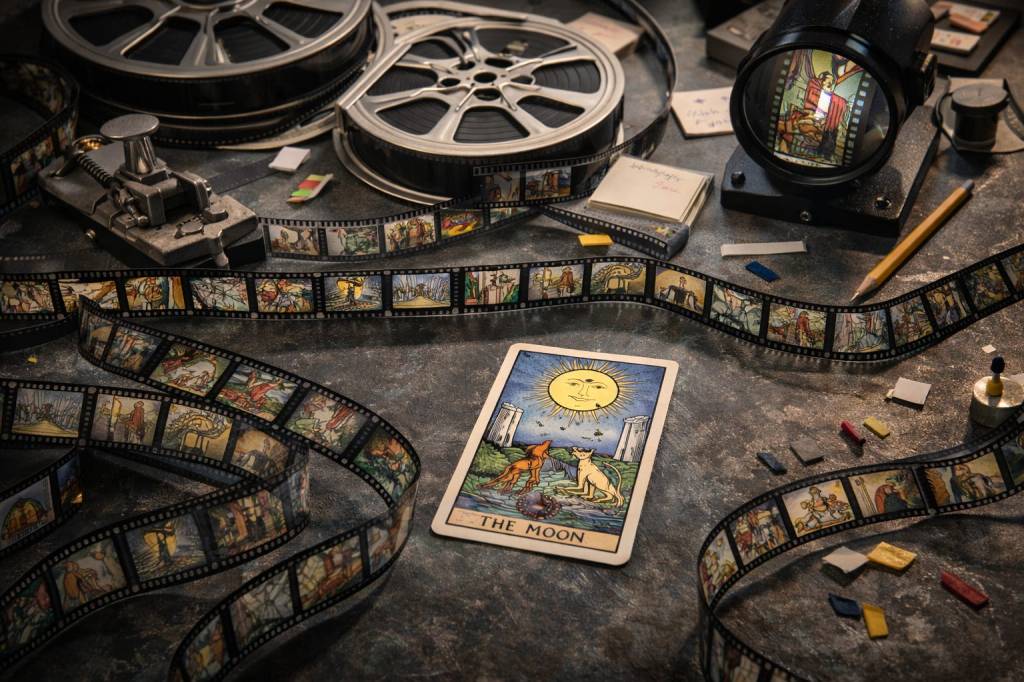

At some point, tarot stopped being confined to physical cards.
This isn’t meant as a poetic claim—it’s a structural one. Tarot originated as a tangible interface, but the function it served eventually outgrew the physical object. What persisted was not the deck itself, but the underlying action: the draw.
The term draw is unusual because it operates as both a verb and a noun. You draw a card, and you experience a draw. Something pulls you forward even as you make a choice. The selection moves in both directions—you choose, and you are chosen. This grammatical ambiguity is not incidental; it reflects the core mechanism of the practice.
Long before tarot, similar ambiguity appeared in early methods of scrying. In Greek antiquity, drawing a line was not symbolic in the modern sense. The line did not merely represent a boundary—it established one. The act and the outcome were inseparable. The line was both the process and the product.
This distinction is important because tarot operates according to the same logic. A card is not a literal message about the future. It is a marker—an index—indicating your current position within a dynamic field of potential outcomes.
Tarot does not predict.
It identifies your location.
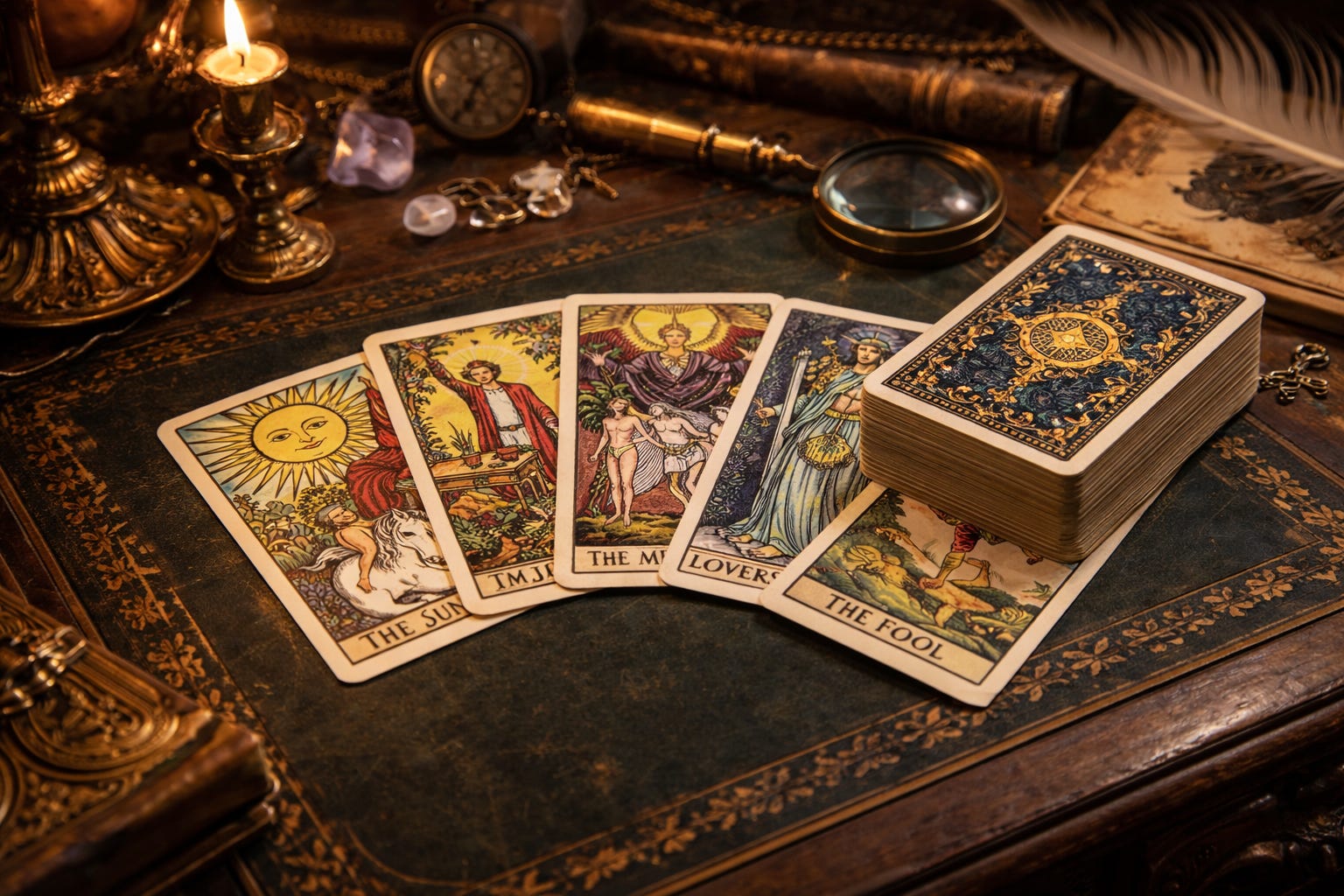
The Cascade
If reality were truly fixed, tarot would have no practical value. It functions precisely because reality behaves less like a linear timeline and more like a branching cascade—a structure defined by choices, emerging outcomes, and unrealized alternatives. Each decision generates a spread of adjacent possibilities. Most of these paths collapse without notice, but some produce enduring effects. What we call “fate” is often just the residue of earlier selections—paths reinforced through repetition until they harden into structure.
This is why the mirror metaphor persists. When two mirrors face one another, they do not create depth; they generate recursion. No original image remains intact. What survives is repetition with variation—a sequence, not a source. The self you recognize is not a static identity but an accumulated pattern of previous reflections.
Each tarot draw represents a single cross-section of that recursive structure. It isolates one moment within the larger flow, signaling: this is the configuration you are engaging right now. It is a diagnostic snapshot—a freeze-frame inside a continuously shifting architecture.
Not fate.
Orientation.
And orientation matters because agency depends on it. You cannot intervene in a system you cannot locate yourself within. Tarot’s value is not in telling you what will occur, but in clarifying the terrain you are already moving through.
This also explains why tarot retains meaning even for people who do not believe in it. The system never depended on belief as its power source. Its effectiveness comes from the act itself—the structured interruption that exposes your position within a volatile field and forces a moment of recognition before the cascade continues.
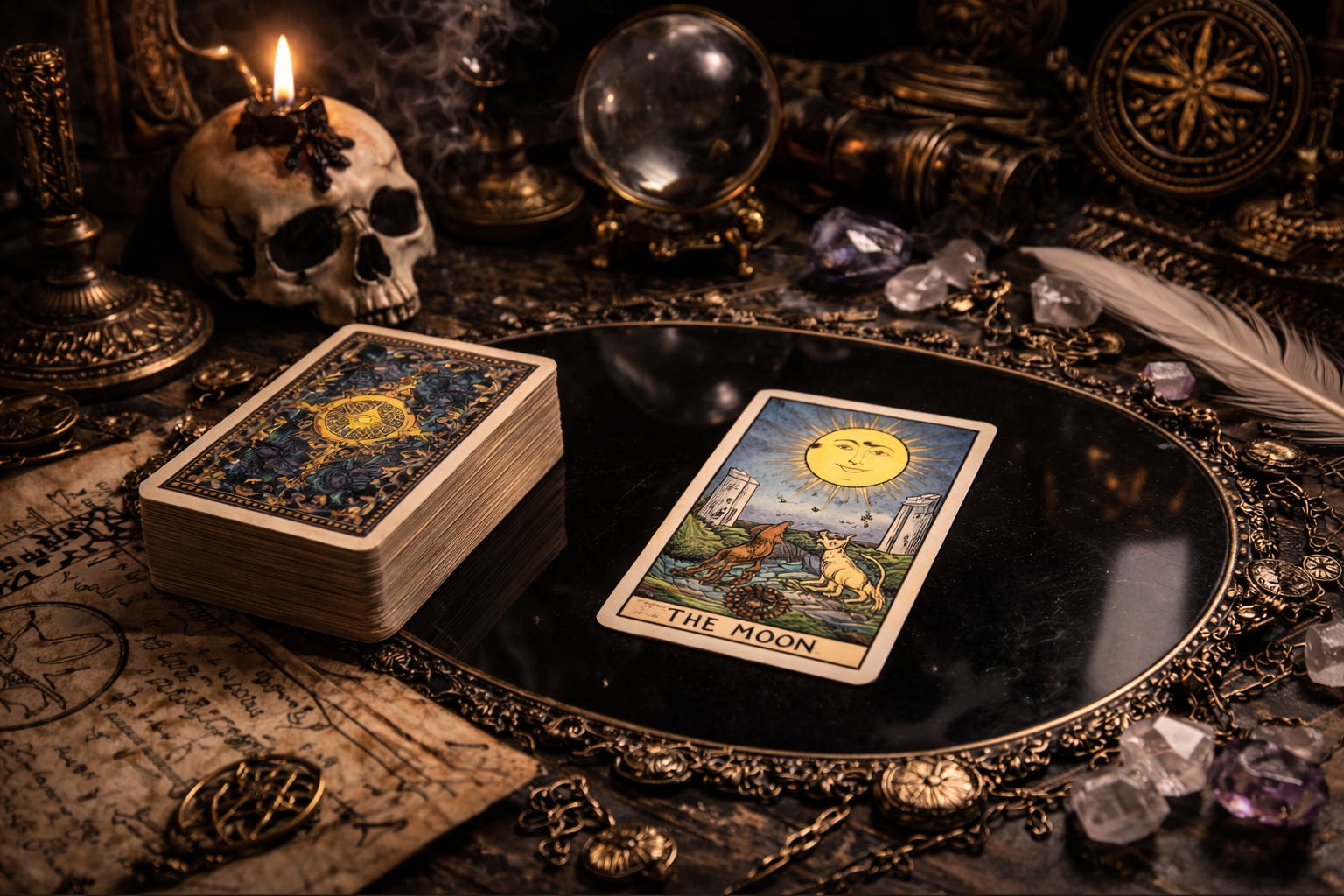
Cinema as Industrialized Tarot
When Hollywood emerges, a structural shift occurs. Archetypes cease to exist solely within mythic or religious frameworks and begin to circulate through mechanical reproduction—mass‑distributed, standardized, and embedded in the developing language of cinema. This transition marks the moment when narrative symbolism becomes industrialized. Meaning is no longer transmitted through lineage, ritual, or oral tradition; it is manufactured, duplicated, and projected across the nation.
Cinema does more than tell stories. It scales and automates the interpretive function that tarot once served in intimate, ritualized contexts. Hollywood builds a nationwide semantic machine capable of broadcasting archetypes with mathematical precision.
Every frame functions as a draw—a discrete selection within a near‑infinite field of narrative possibilities. Every cut operates as a decision—a forced collapse of branching paths. Every scene captures one configuration of reality while discarding countless others that could have existed but never will.
Once this mechanism becomes visible, films become difficult not to read as extended tarot spreads. The grammar is identical; only the medium has changed.
A character crossing a threshold is still the Fool beginning a journey. A figure manipulating perception remains the Magician shaping outcomes through intention and illusion. A sudden narrative rupture is still the Wheel turning—forcing reorientation.
The cards did not vanish. They were absorbed into cinematic grammar and redistributed through the apparatus of mass culture.
Films like Giant or The Misfits were not merely entertainment products. They functioned as public divinations—cultural readings encoded with real anxieties about shifting power structures, gender roles, the frontier myth, the collapse of old identities, and the emergence of new ones. Hollywood, knowingly or not, became the interpreter of a nation in transition.
In The Misfits, Marilyn Monroe is not simply acting. She is performing an archetype already inscribed onto her life: the luminous figure caught between worlds, unable to fully remain in either. Like Dorothy entering Oz, she steps into a symbolic landscape governed by altered rules—Vegas as an American dream-state where identity mutates, illusions crystallize, and the self becomes divisible. The narrative reads her as much as she reads it.
Life imitates myth. Myth imitates cinema. Cinema returns life to itself sharpened, codified, and redistributed.
This recursive loop is the cascade.
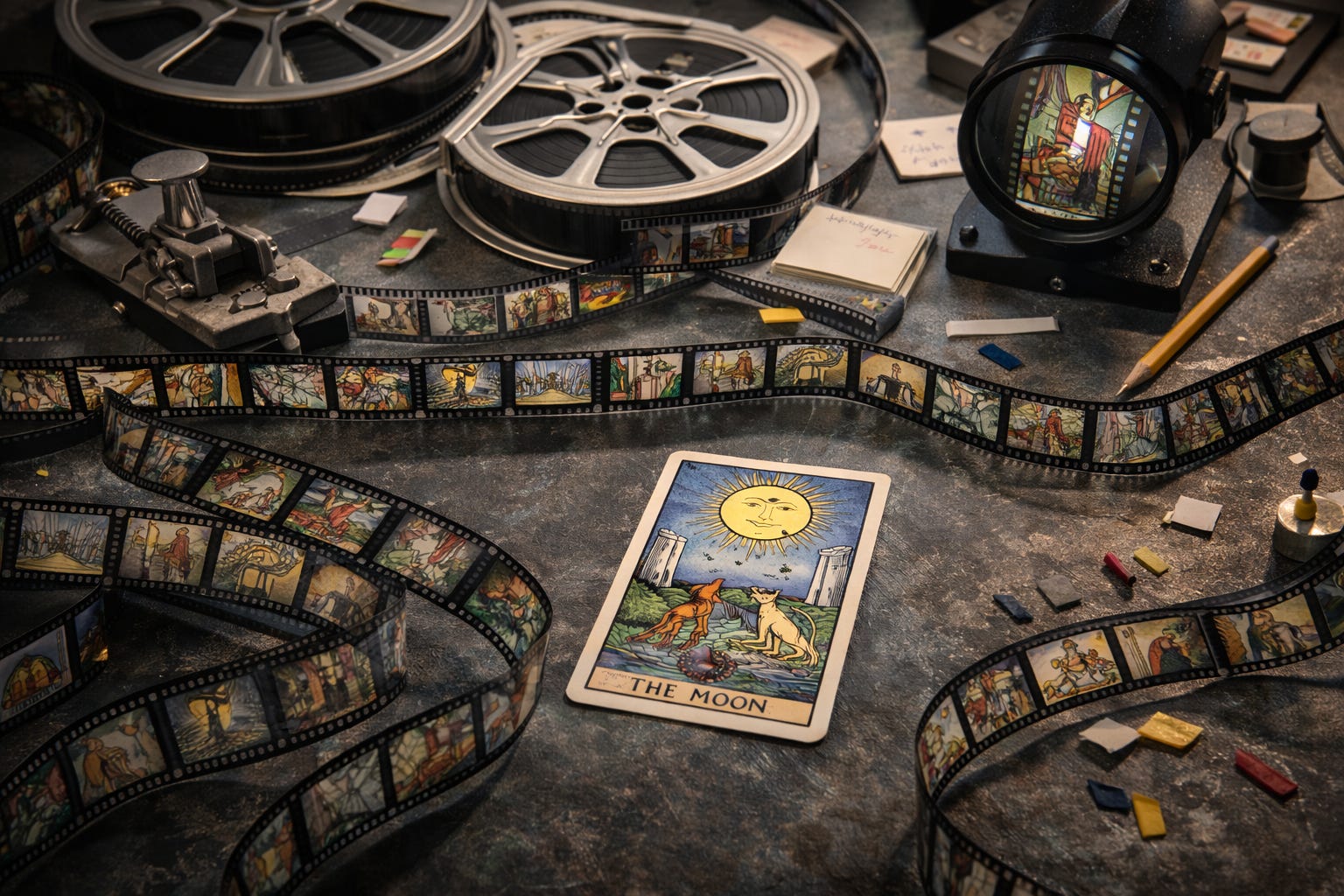
The Draw as Index, Not Oracle
This is where modern misunderstandings of tarot break down. Tarot is not effective because it grants access to hidden or supernatural knowledge. It is effective because it provides a structured method for compressing overwhelming complexity into a form that can be interpreted, contextualized, and acted upon. In other words, tarot is not a window into the metaphysical. It is a tool for managing information density.
Reality is too expansive—too layered, too multivalent—to perceive in its full simultaneity. Every moment contains far more possibility than the mind can process. A tarot draw reduces that immensity to a single readable slice. The same principle governs a photograph, a film frame, or a Polaroid: each freezes a fragment of dynamic reality, transforming an unfolding process into a discrete, analyzable unit.
The Polaroid is an especially precise analogy because it occupies a liminal state. The moment has already been captured—”drawn”—yet its meaning is still in the midst of development. The image clarifies gradually, revealing structure over time. Interpretation is not instant; it arrives as the frame stabilizes. Tarot functions the same way: meaning emerges only after the draw settles within the context of the reader’s lived experience.
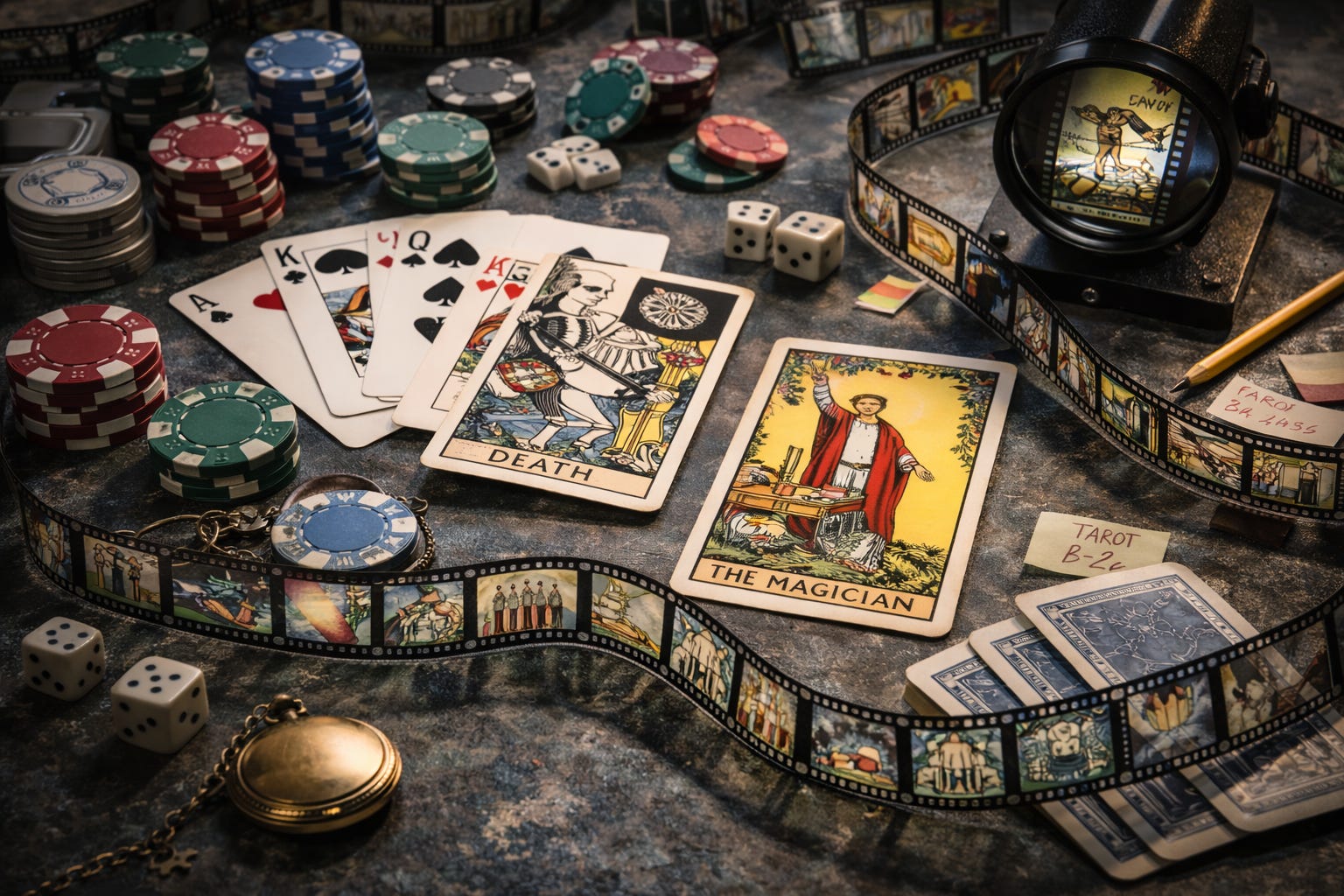
Poker demonstrates this mechanism in mathematical form. The rules are transparent. The probabilities are calculable. Yet the draw remains decisive because it shifts your position within the game’s evolving landscape. What becomes rational, risky, or impossible is determined not by the universe but by the configuration established in that instant. The draw does not predict the outcome—it defines the conditions under which strategy becomes possible.
Tarot operates according to the same logic. It is poker played against reality itself, using symbolic rather than numerical information to reveal your current position within a continuously changing system.
Tarot After the Deck
Even something as mundane as Microsoft Solitaire illustrates the underlying structure at work. The game is a closed system governed by randomized distribution, and the majority of deals cannot be won. A few are solvable—but only if the player recognizes patterns of flow rather than attempting to force outcomes. Mastery depends on reading the system, not overpowering it.
This is a useful model for understanding how reality behaves.
You are not meant to exert total control over it. You are meant to interpret it—locating openings, constraints, and trajectories as they emerge.
Tarot, cinema, gambling, and myth all operate as training grounds for this intuition. They cultivate pattern recognition without requiring formal explanation. They teach individuals to navigate probability, contingency, and shifting conditions rather than resist them.
Viewed through this lens, the physical tarot deck becomes optional. The archetypes have already migrated into broader cultural forms.
They manifest in films, photographs, rituals, advertisements, political theater, celebrity narratives—any domain where reality slows just enough to become legible.
The universe does not communicate in linear statements. It communicates in cuts—discrete frames of experience stitched together into meaning.
A tarot card is simply a frame that learned how to remain still.
And when you draw one, you are not asking what will happen. You are posing a much older question—one that predates cards, cinema, or any formal system of divination:
Where am I located right now within the cascade of unfolding possibilities?
Because once you know your position, the next move is no longer mysterious. It becomes inevitable, intelligible, and already on its way toward you. Orientation is the first form of power.
 Unnameable Media
Leave a comment