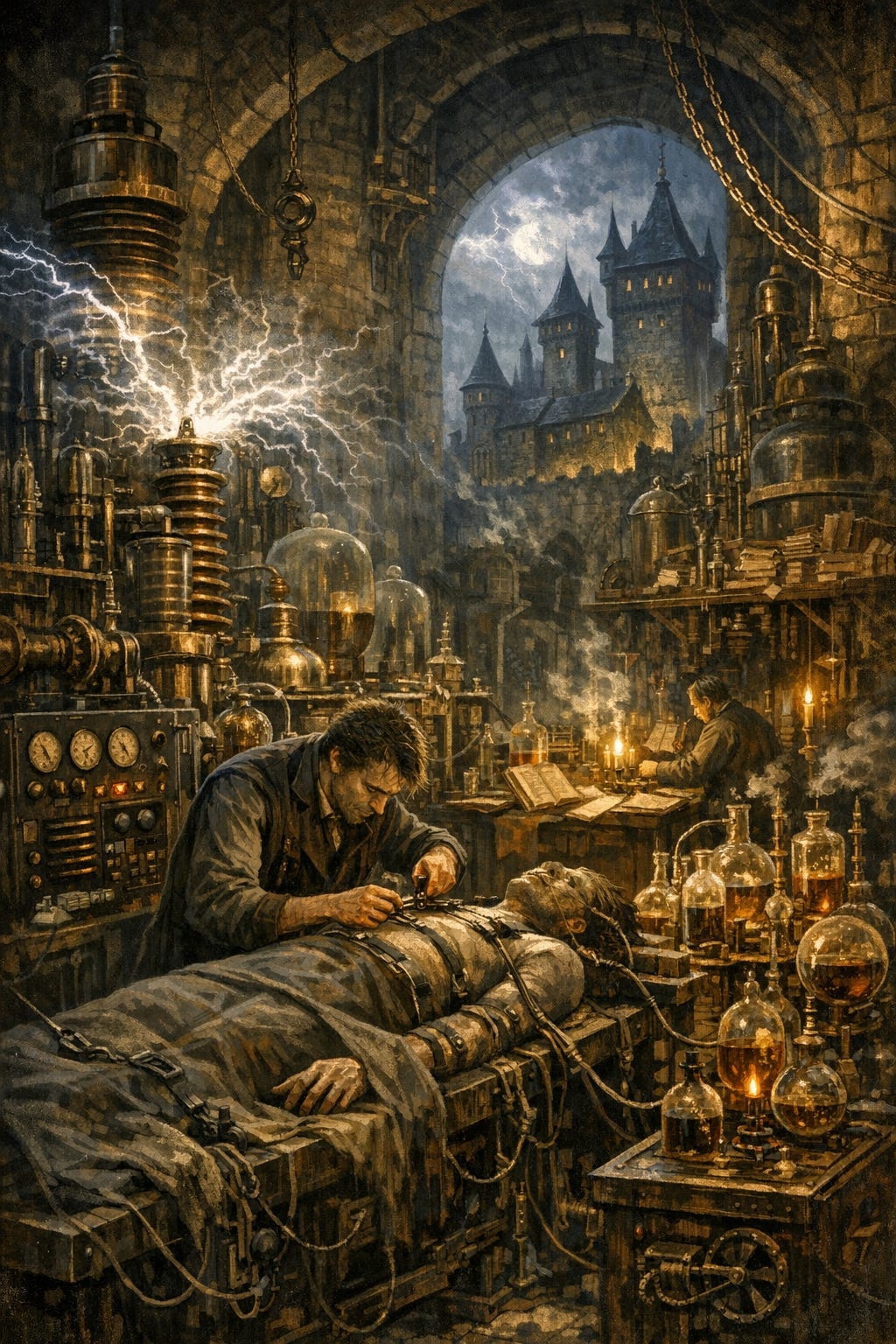
The enduring significance of Frankenstein does not lie in its depiction of life assembled from death, but in the institutional relocation of that act. Shelley situates creation not within a sanctuary but within a workshop—a space governed by instruments, procedures, calibration, and repeatability rather than sacrament or revelation. What is radical is not animation itself but jurisdiction: the claim that life, once the exclusive province of divine mediation, may be assembled, tested, corrected, and stabilized through technique. The laboratory-castle—bristling with towers, coils, conductors, fluid reservoirs, and synchronized mechanisms—should not be dismissed as gothic excess or Romantic imagination. It operates as a compressed historical archive, encoding a real transition in European knowledge systems: the migration of epistemic authority from theology to applied craft, from clerical interpretation to artisanal precision, financial underwriting, and engineered process.
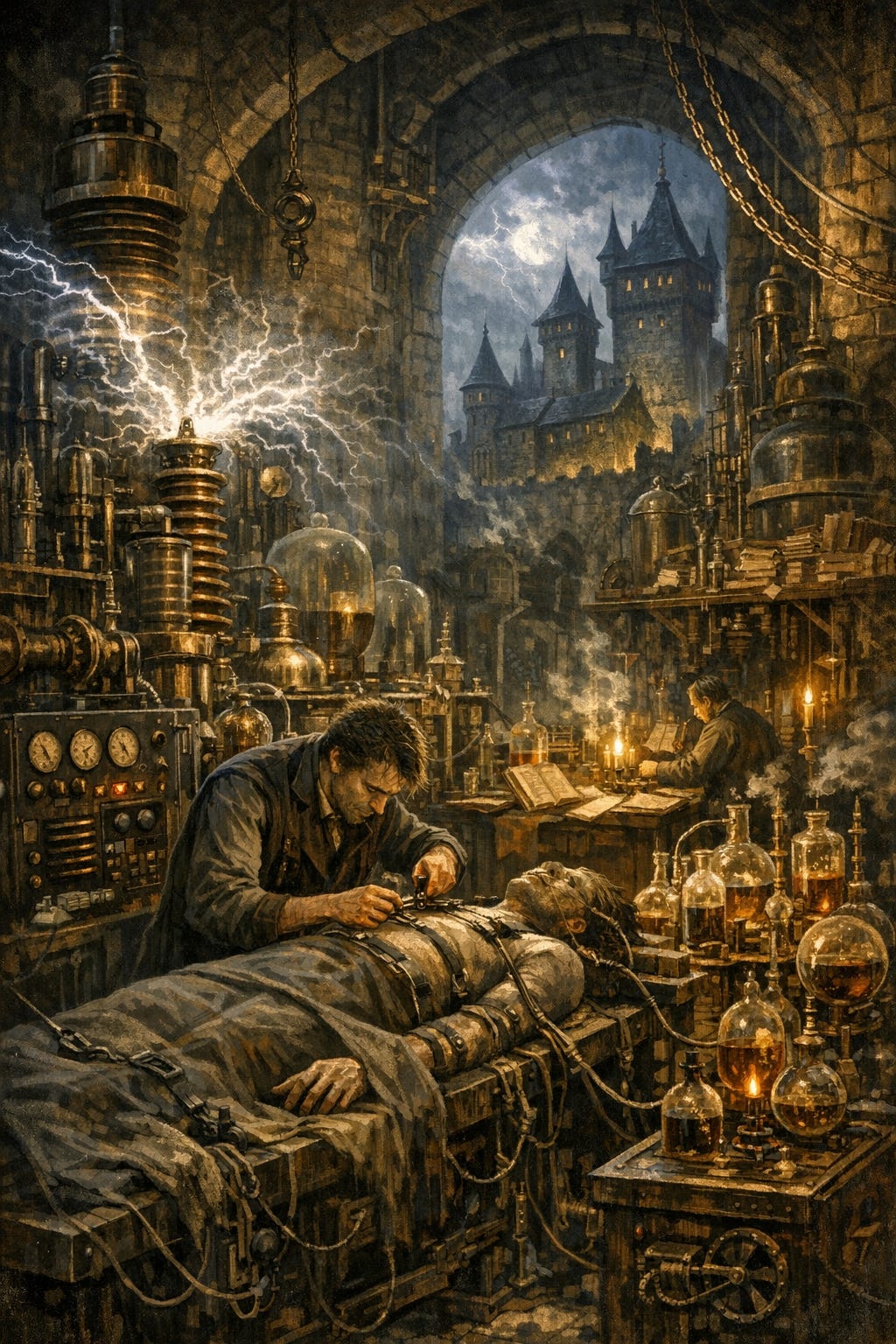
This relocation of authority was neither abstract nor evenly distributed. It clustered in specific geographic and institutional environments, most notably across Central Europe—Swiss, Bohemian, Austrian, and adjacent regions—where political fragmentation, negotiated neutrality, entrenched craft guilds, aristocratic patronage, and traditions of mechanical exactitude converged. These were societies already accustomed to separating power from spectacle and authority from proclamation, embedding control instead in devices, schedules, and procedures. Read against this background, Frankenstein is not a parable warning against scientific ambition or moral transgression. It is an allegory of custodial power: a meditation on who is permitted to assemble bodies, knowledge, temporal sequence, and social order; how that permission is institutionally secured; and by what technical, legal, and symbolic constraints such authority is legitimized and maintained.
From Anatomy Theater to Opera Theater
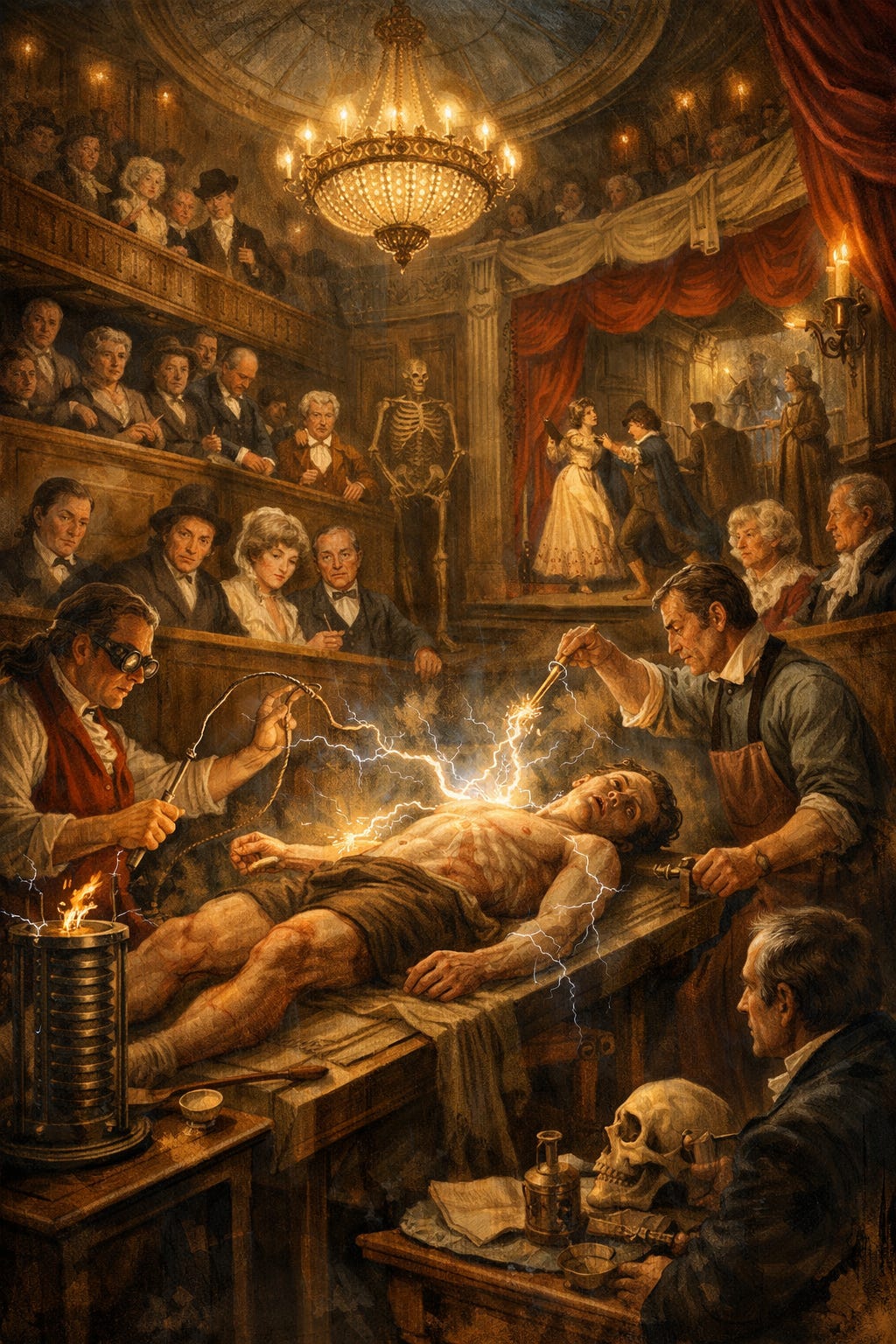
The boundary between operating theater and opera house has always been porous, because both were technologies of attention long before they were disciplines. In the late eighteenth and early nineteenth centuries, public scientific demonstration routinely collapsed into staged spectacle: inquiry unfolded before audiences trained not merely to assess outcomes, but to witness process. The anatomy theater was designed as much for visibility as for instruction; elevation, lighting, and circulation mattered because persuasion mattered. Galvanic demonstrations—associated first with Luigi Galvani and later amplified by Giovanni Aldini—made this convergence explicit. Electrical current applied to animal and human cadavers produced convulsions that resembled animation, not as metaphor but as physiological effect. Limbs flexed, jaws tightened, faces grimaced. What appeared to be life returned was, in fact, a legible system responding to stimulus.
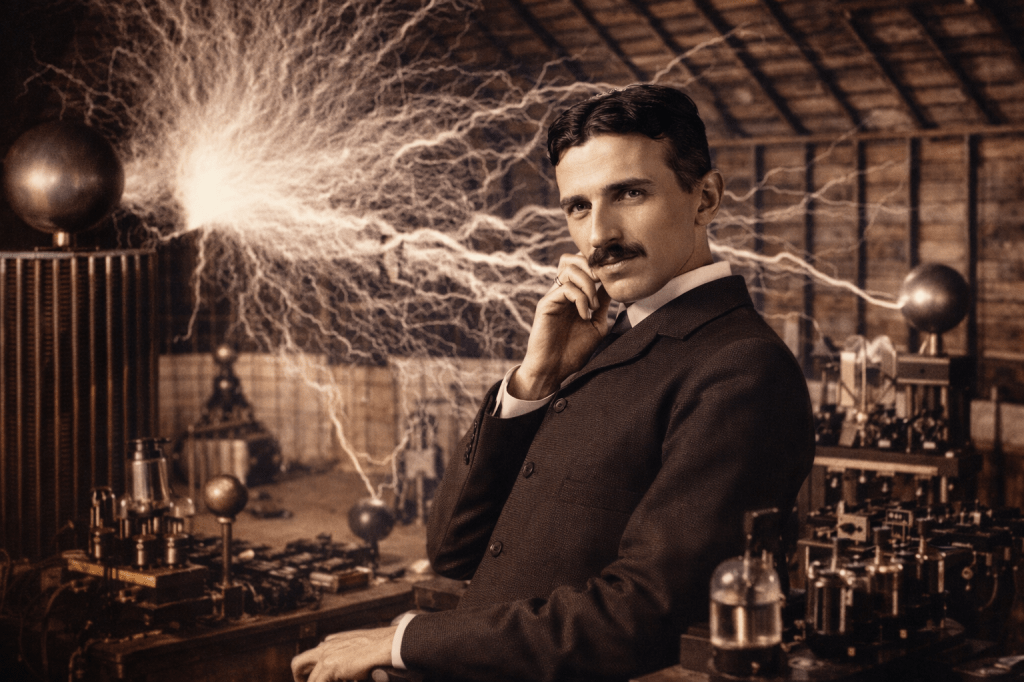
These events were neither marginal curiosities nor clandestine trials. They were deliberately public performances staged before physicians, magistrates, aristocrats, and lay spectators, often in venues adjacent to—or indistinguishable from—spaces of entertainment. Their function was pedagogical, but also political: to demonstrate that vitality could be elicited, modulated, and reproduced under controlled conditions. Electricity here did not signify transcendence; it signified access. It rendered the body experimentally open, available to technique rather than theology.
Mary Shelley did not invent the conceit of reanimation; she inherited a culture already comfortable treating the body as an array of conductive pathways and responsive mechanisms. Within contemporary anatomical discourse, nerves were increasingly described in terms of flow, transmission, and continuity, while muscle was framed as actuator rather than mystery. Electricity circulated as a generalized animating principle—not a metaphysical anomaly, but a transferable capacity. This vocabulary collapsed the distinction between organism and apparatus. The translation from physiology to machinery was therefore not speculative or transgressive; it was conceptually foreclosed. By the time Frankenstein was written, the question was no longer whether life could be staged, but who controlled the stage.
Prosthetics, Circuits, and the Mechanical Body
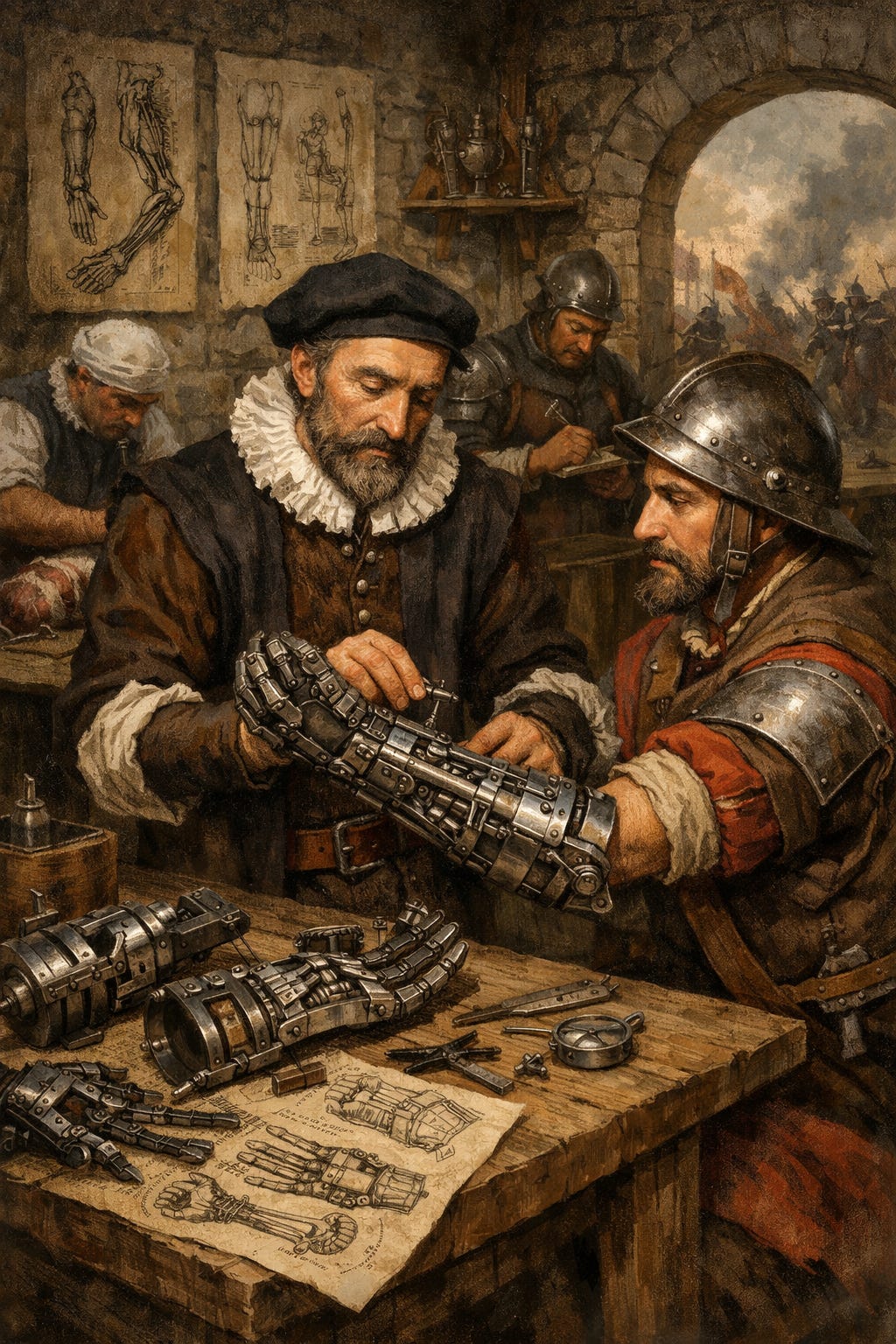
Long before Frankenstein, surgeons such as Ambroise Paré were designing articulated mechanical prosthetics—hands equipped with springs, ratchets, locking mechanisms, and geared joints capable of controlled, repeatable motion. These were not ad hoc contrivances for concealment, but deliberately engineered systems developed within the context of military surgery, where amputation, repair, and reintegration of the wounded body were matters of state capacity rather than individual care. Prosthetics emerged here not as symbolic substitutes for loss, but as functional interfaces between flesh, metal, and force, calibrated through direct observation of stress, leverage, and material fatigue.
Their existence signals that the body had already undergone analytic decomposition well before the nineteenth century. Musculature was translated into force vectors, joints into rotational constraints, tendons into tensile elements, and balance into distributed load. The human form was no longer approached as an indivisible organism endowed with irreducible vitality, but as a reparable, modular assembly whose components could be isolated, substituted, recalibrated, and—crucially—standardized. Injury became a problem of engineering continuity rather than metaphysical rupture.
Once nerves could be reconceptualized as conductive pathways and muscles as actuators responsive to stimulus, the passage from surgery to proto-robotics ceased to be speculative or philosophically transgressive. It became an issue of scaling existing logics of control. What Frankenstein dramatizes, therefore, is not an isolated act of intellectual hubris, but the moment at which centuries of dispersed craft knowledge—accumulated across battlefields, workshops, anatomical theaters, and prosthetists’ benches—are consolidated within the laboratory as a unified experimental regime. Creation here is not invention ex nihilo, but integration: the assembly of life according to procedures already proven on the broken body.
The Tower, the Storm, and Stored Power
Frankenstein’s tower—described as harvesting lightning, charging vats, and storing latent force—is frequently dismissed as gothic exaggeration. Yet early electrical research was not metaphorically but materially dependent on precisely these practices. Eighteenth‑century experimenters engaged extensively with atmospheric electricity, constructing elevated conductors, insulated platforms, and Leyden jars functioning as saltwater capacitors to capture, store, and modulate charge. Electrical inquiry was inseparable from architecture: height, isolation, and exposure were experimental variables, not stylistic choices. In mountainous and storm‑prone regions, towers maximized contact with volatile atmospheric conditions, allowing electricity to be observed, accumulated, and released with a degree of regularity otherwise unattainable.
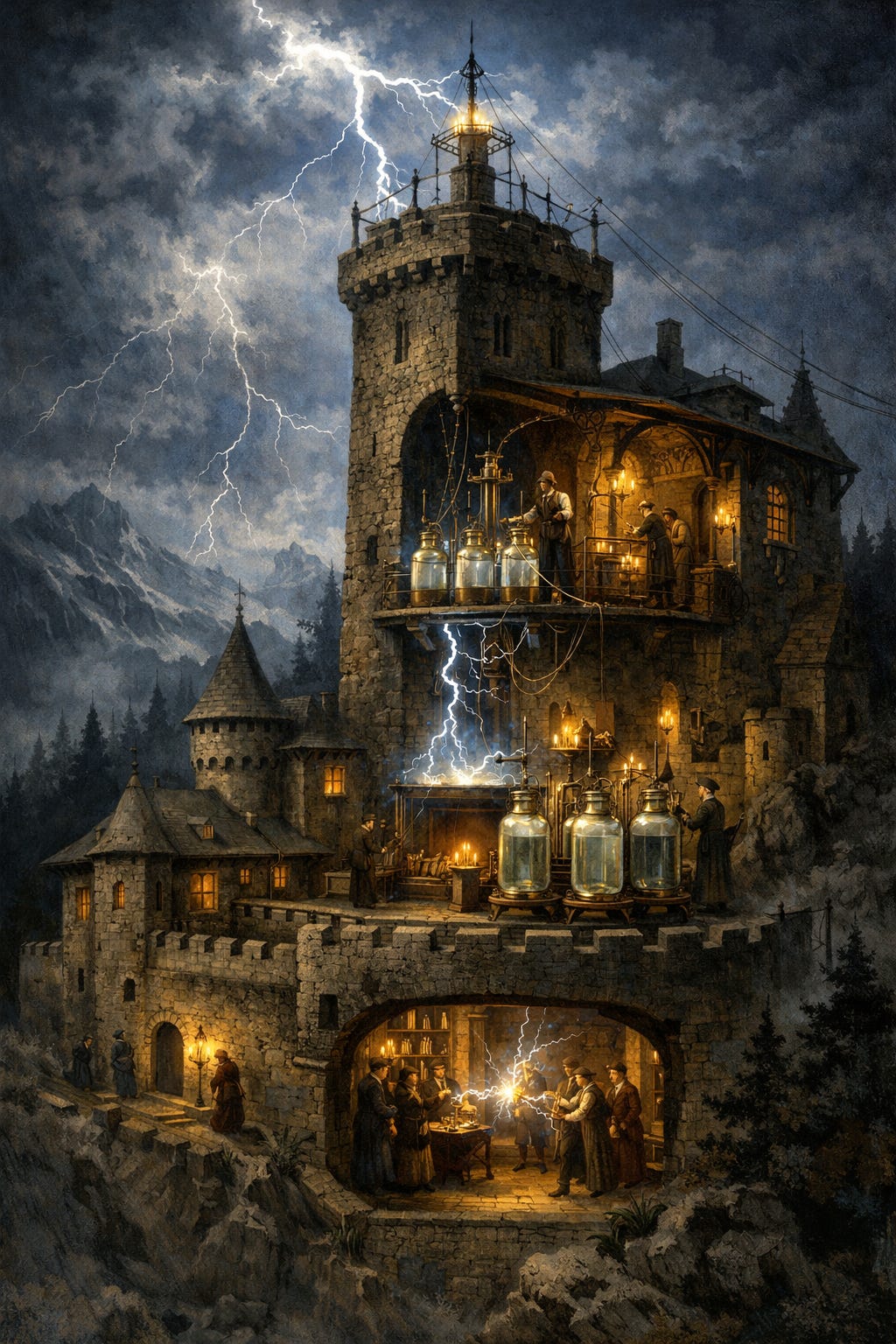
Crucially, these structures were not embedded within universities or civic institutions. They were attached to estates, private laboratories, and aristocratic compounds—jurisdictionally ambiguous spaces operating beyond direct ecclesiastical authority while remaining firmly embedded within elite patronage networks. Such sites offered a convergence of secrecy, capital, and protection, enabling experimental practices that could bypass theological arbitration and public scrutiny alike. The laboratory‑castle thus functioned as an infrastructural analogue to the monastery: disciplined, secluded, rule‑bound—but reoriented toward technique rather than doctrine. Authority did not disappear; it changed custodians. What had once been guarded through vows and scripture was now secured through insulation, timing, and controlled discharge. The tower marks not fantasy, but the architectural crystallization of technical custody.
Switzerland and the Precision of Custody
If Germany is associated with engines and heavy industry, Switzerland is associated with locks, timing, and custody—technologies not of production but of control. Swiss watchmaking did not emerge from decorative impulse or bourgeois ornamentation; it arose from an obsessive concern with precision, synchronization, and reliability under conditions of isolation and neutrality. A mechanical watch is not merely an instrument of convenience but a portable cosmology: it compresses celestial cycles, astronomical regularities, and social coordination into gears, escapements, tolerances, and regulated delay. Time is miniaturized, stabilized, and made sovereign.
The same logic governs Swiss vault architecture. Timed locks, sequential access mechanisms, compartmentalization, and redundant fail‑safes encode law into metal. Authority here is procedural rather than personal. A timed vault does not respond to force, persuasion, or urgency; it responds only to sequence. Compliance is irrelevant if the interval has not elapsed. You may enter—but not yet. Power is exercised not through prohibition, but through delay.

This mechanical logic mirrors older esoteric initiation systems with striking fidelity: knowledge is gated, access is sequential, advancement is irreversible, and no single participant possesses the whole. Custody is distributed across time rather than concentrated in individuals. Switzerland’s political neutrality should be understood in this same register. It is not the absence of power but its disciplined containment—a custodial posture refined through centuries of demonstrating that restraint, reliability, and temporal control can inspire more trust than overt domination. Switzerland became indispensable not because it refused power, but because it mastered the conditions under which power could safely be withheld.
Astronomical Clocks and Mechanical Cosmology
The Prague Astronomical Clock stands as a public declaration of this worldview, not as ornament but as epistemic claim embedded in civic stone and metal. By mechanically encoding zodiacal cycles, solar time, lunar phases, and planetary motion, it renders cosmology legible, calculable, and—critically—municipally owned. This is not devotional time but administered time. The clock does not merely mark hours; it asserts that the city possesses the technical competence to locate itself within a rationalized cosmic order. Authority here is no longer derived from revelation or priestly interpretation. It is produced through mechanism. Time is not disclosed by heaven—it is computed by gearwork.
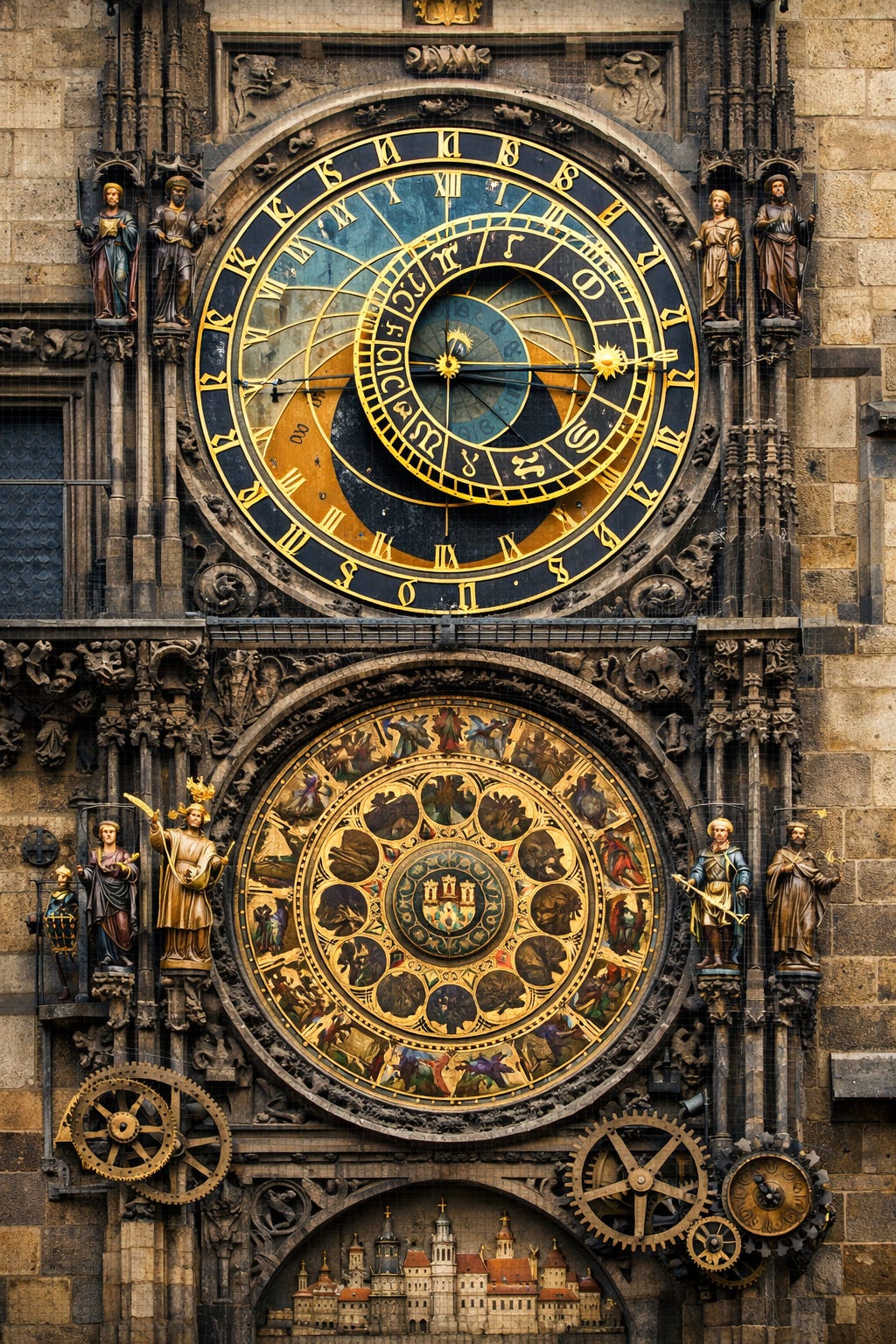
This matters because astronomical clocks were instruments of synchronization as much as cosmology. They aligned labor, ritual, markets, and governance to a shared temporal regime, binding disparate bodies to a single mechanical reference. Public time disciplined populations without force, normalizing obedience to sequence rather than command. Once installed, the clock did not need to persuade; it only needed to continue running.
Private workshops extended this logic beyond civic display into quieter, more coercive regimes of control. If an above‑ground clock tower could publicly encode the heavens, subterranean mechanisms could encode access, delay, exclusion, and permission. Chronometry migrated from description to enforcement. Timed locks, delayed releases, and sequential mechanisms translated temporal order into jurisdiction. One could comply perfectly and still be denied entry—simply because the hour had not yet arrived. Time thus became not merely an instrument of measurement, but a medium of governance, structuring who may enter, when action may occur, and how authority is exercised without visible command.
Occult Craft and the Migration of Esotericism
Esoteric traditions do not disappear with the decline of the institutions that once housed them; they undergo institutional displacement. When the Church’s monopoly over cosmology, metaphysics, and epistemic legitimacy began to fracture, bodies of symbolic and technical knowledge did not dissolve into secular rationality. They were redistributed into guilds, workshops, and fraternal lodges that preserved secrecy, hierarchy, and controlled transmission under the guise of craft. Watchmaking, instrument construction, surveying, cryptography, and vault engineering required silence, prolonged apprenticeship, graded access, and procedural fidelity—organizational forms that replicated initiatory discipline without invoking overt theology. What had once been cloistered behind vows was now embedded in technique.
Switzerland’s political and cultural fragmentation made it uniquely hospitable to this migration. Cantonal sovereignty, linguistic plurality, and negotiated neutrality prevented any single doctrinal authority from asserting total epistemic control. As a result, Rosicrucian, Hermetic, Masonic, alchemical, and proto‑scientific lineages could overlap, recombine, and persist without being forced into doctrinal uniformity. Precision and secrecy were not contradictory values but mutually reinforcing imperatives. Exactitude demanded discretion; discretion demanded trust; trust demanded closed systems of transmission. Esoteric knowledge survived not by resisting rationalization, but by mastering it.
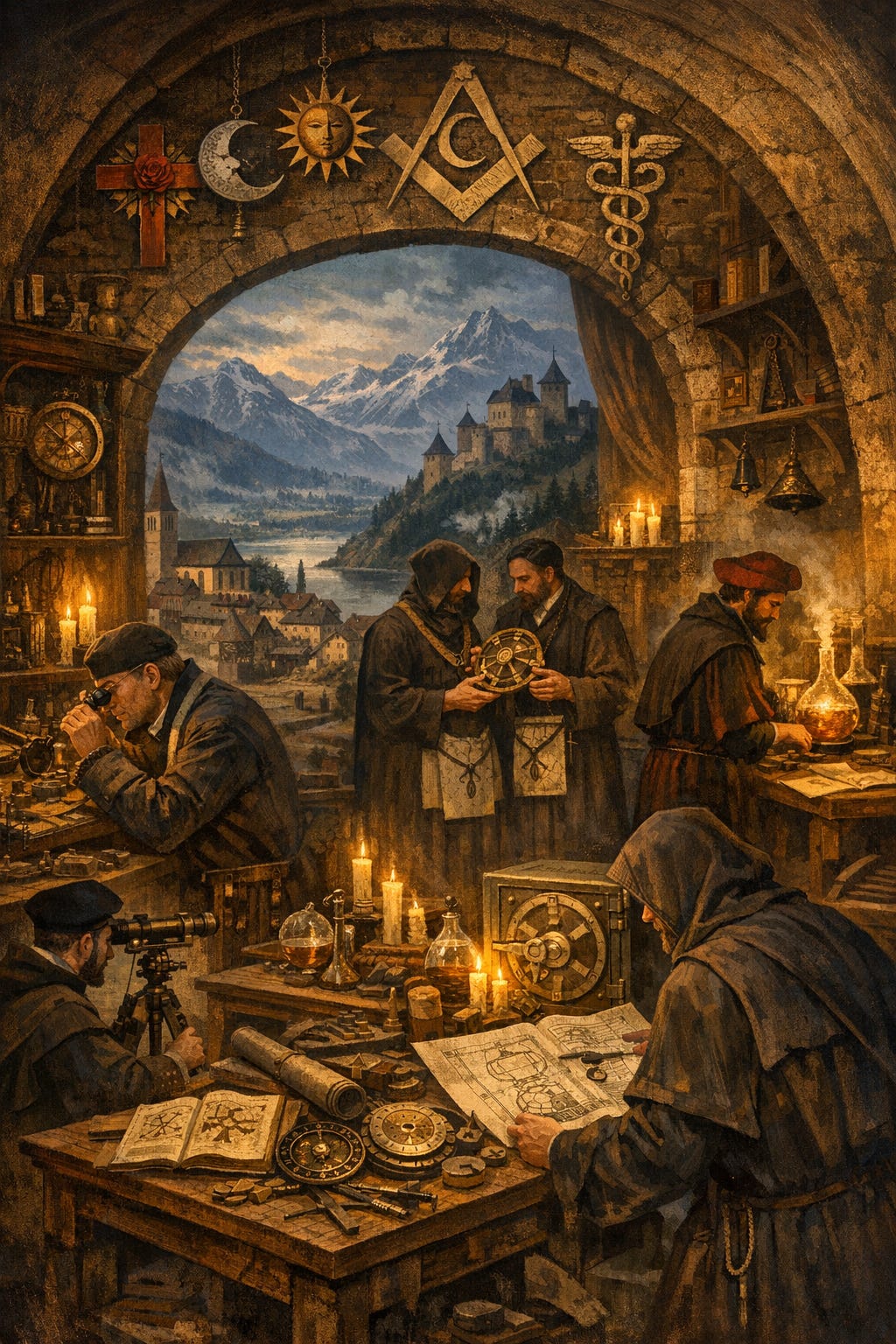
What changed, therefore, was not the architecture of transmission but its surface vocabulary. Alchemy was formalized as chemistry; astrology reorganized as astronomy; magic recoded as engineering. Yet the deeper structure—the graded progression, ritualized discipline, custodial secrecy, compartmentalization, and reverence for hidden order—remained intact. Esotericism was not abolished by technical rationality; it was submerged within it, continuing to operate beneath the language of neutrality, efficiency, and precision.
Security as Clockwork
This same logic extended to security itself. Rather than static defense or territorial fortification, Swiss-style custodial systems favored rotation, movement, and managed uncertainty. Guards were not walls; they were gears within a larger mechanism. Patrols overlapped, schedules were deliberately offset, observers monitored observers, and no position remained occupied long enough to become predictable. Security emerged from motion and timing rather than mass or intimidation. Mapping the system was made intentionally difficult—not because information was hidden, but because it was never stable.
The Swiss Guard embodies this principle in concentrated form. Beneath the ceremonial uniforms lies a security architecture organized around rotation, redundancy, and temporal sequencing. The Vatican does not require battlefield dominance; it requires continuity. As a repository of archives, persons, rituals, and lineage, it demands custodial protection rather than overt force. The appearance of spectacle masks a system whose true strength lies in procedural timing and distributed responsibility.
Within this model, the protected asset may be a vault, a person, a document, or a body of knowledge. Couriers function as moving components rather than messengers; watchers, schedulers, and auditors form higher-order rings of oversight. No single actor holds the whole system. Security is achieved not through fear or visibility, but through temporal orchestration—through knowing when rather than confronting where.
This logic scales outward. Standardized time zones transformed trade, rail, and empire by synchronizing distant actors to shared temporal regimes. Control over time became control over movement, response, attribution, and liability. To miss the train was not a moral failure but a temporal one. In the contemporary moment, this logic has shifted again—from time zones to timelines.
Algorithms now perform the same custodial function that mechanical schedules once did. They rotate attention, gate access, stagger visibility, and enforce sequence. To be “out of sync” is to lose relevance, meaning, or agency. Updating a feed is the modern equivalent of adjusting a watch; latency becomes exclusion. The anxiety that runs through Frankenstein, Men in Black, Fallout, and similar narratives is therefore not fear of machines, but fear of discovering oneself as a component in a mechanism that does not hate us—it simply keeps time.
The Monster as Encoded Subject
The tragedy of Frankenstein’s creature is not its violence, but its isolation after encoding. Once brought to life, it is immediately subjected to language, classification, and narrative—forced to inhabit a symbolic order it did not choose. Language here functions as an operating system. To impose myth, taxonomy, and moral grammar onto another being is to install a recursive program: creation, fall, catastrophe, reset. The story of Noah is not invoked as theology but as protocol—a reboot script embedded deep within Western narrative infrastructure.
Once the subject acquires language, it enters the loop. Speech grants participation, but at the cost of enclosure. History becomes restartable because domestication, hierarchy, and obedience can always be reinstalled through narrative form. The creature’s loneliness is not social; it is systemic. It is alone because it has been made legible.
Custodians of the Operating System
Frankenstein’s castle, the Swiss watch, the timed vault, the astronomical clock, the rotating guard, and the modern algorithm are not disparate artifacts. They are successive implementations of a single doctrine: custody through timing. Across centuries, authority migrates away from visible domination toward procedural sequence. Power no longer needs to issue commands, inspire belief, or enforce obedience through spectacle. It needs only to regulate order, delay, and synchronization.
The figures who manage this regime—the men in black, the technicians, the administrators, the analysts—are not enforcers. They are custodians. The lab coat replaces the monastic robe; the suit replaces the lab coat. The outward symbols change, but the function remains constant. They guard thresholds rather than territories: thresholds of knowledge, of access, of legitimacy, of continuity.
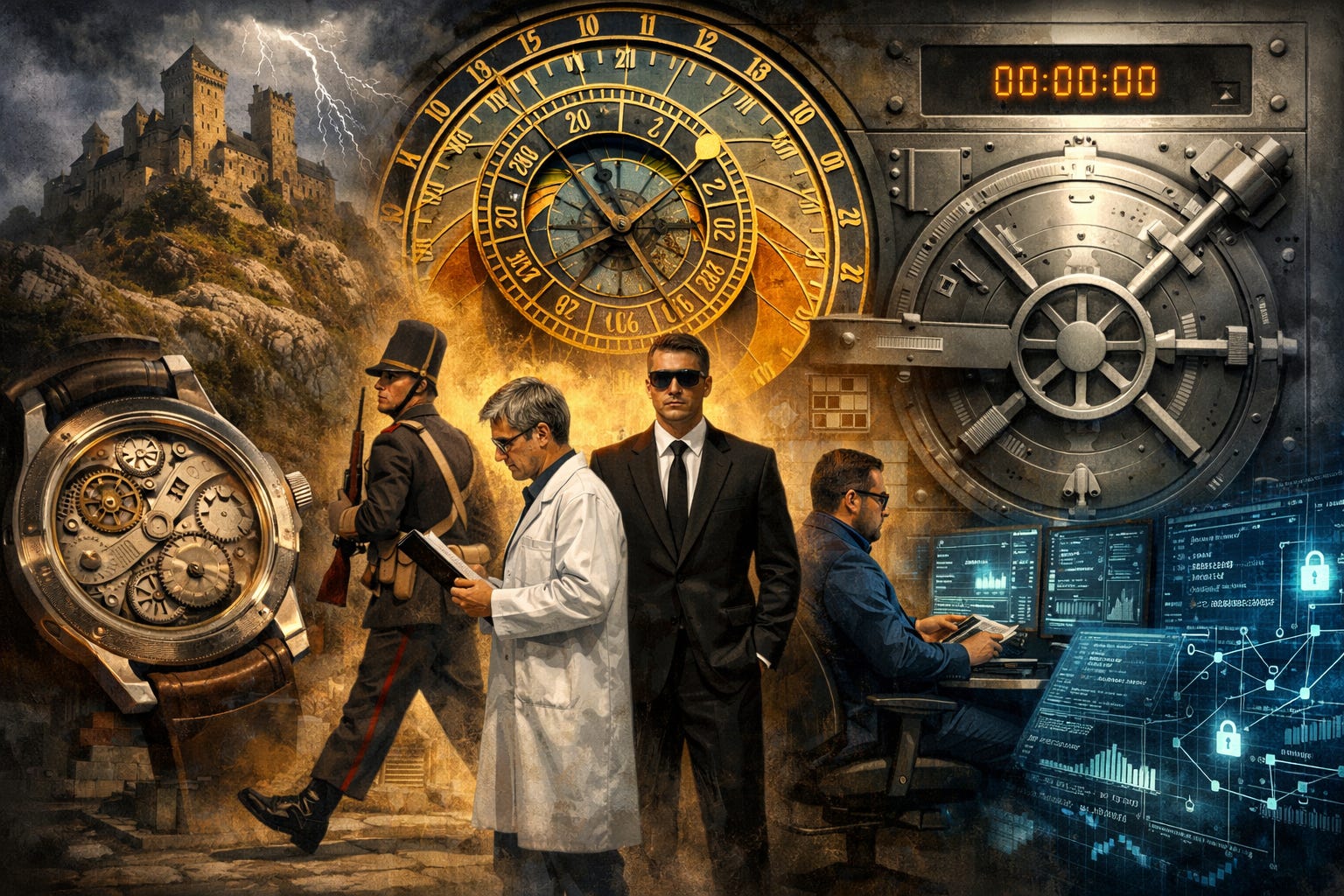
Read this way, Frankenstein is not a cautionary tale about scientific excess. It is a historical record of a handoff: from gods to clocks, from priests to engineers, from mythic authority to mechanical sequence. Once time itself becomes programmable—once delay, access, and synchronization can be automated—the central political question is no longer who commands. It is who controls the operating system, and more precisely, who sets the schedule.

 Unnameable Media
Leave a comment