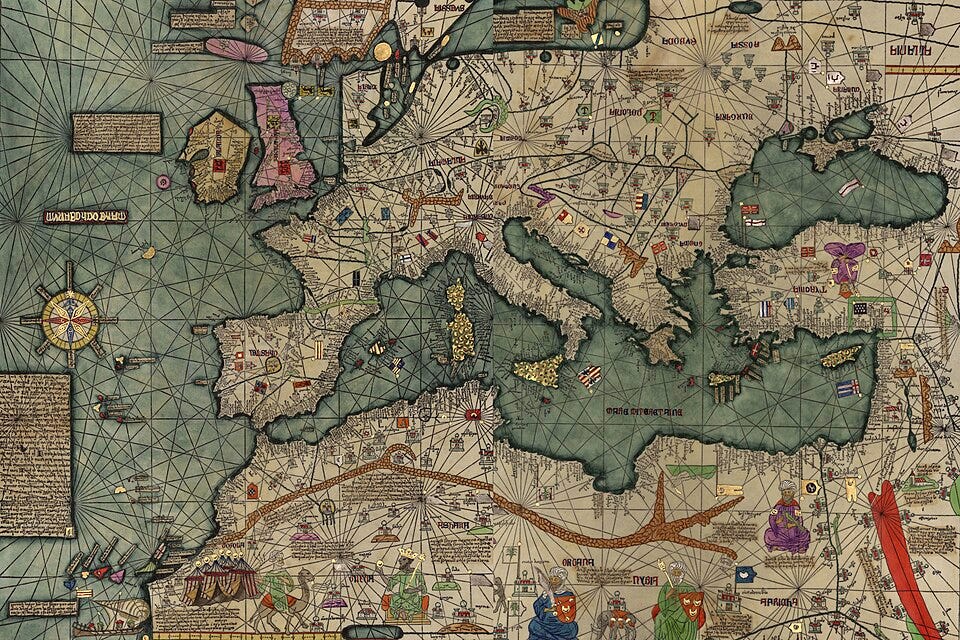

The Catalan Atlas is conventionally classified as one of the great achievements of medieval cartography, yet this designation significantly understates both its function and its intellectual ambition. The Atlas is neither a neutral geographic representation nor a purely navigational instrument intended solely for maritime use. Rather, it operates as a synthetic visual schema: a deliberately compressed articulation of political authority, juridical legitimacy, technological capability, and patterns of economic and cultural circulation within the late medieval Mediterranean world. Its makers assumed an informed audience—one already conversant in the symbolic grammar of power—and therefore encoded meaning visually rather than discursively.
In contemporary analytical terms, the Atlas functions less as a map than as a graphical interface or systems diagram. Information is communicated through chromatic hierarchy, iconographic repetition, spatial emphasis, and selective elaboration. Scale is subordinated to significance; geography is reorganized according to relevance rather than distance. What is emphasized is not where places are located, but how they function within a broader civilizational network.
When approached through this framework, three elements emerge with particular coherence and explanatory force: gold, purple, and technology—especially techniques of wind and energy capture. These elements are not ornamental embellishments nor vestiges of artistic excess. They operate as deliberate semiotic markers within an intelligible visual language, signaling circulation, legitimacy, and survivability across time rather than merely describing terrain.
Gold as Circulation, Not Extraction
Gold recurs throughout the Atlas in a highly patterned and rhetorically deliberate manner: islands are rendered in gold leaf, rulers are adorned with gold armbands, and banners terminate in carefully gilded finials. A naïve or strictly literal reading might interpret these visual cues as indicators of local mineral abundance. Such an interpretation, however, collapses almost immediately under historical scrutiny. Many of the regions emphasized in gold were not, in fact, significant sites of gold extraction. The use of gold here follows the semiotic logic of medieval illumination and courtly manuscript culture, not the evidentiary conventions of modern cartography or economic geology.

Within this visual economy, gold operates as a signal of importance, legitimacy, and integration into elite circulation systems. It marks places and political actors that are intelligible within transregional structures of power—nodes through which wealth may flow, pause, transform, and be redeployed. These are not static repositories but dynamic interfaces. The Mediterranean islands most frequently emphasized—Corsica, Sardinia, Sicily, Cyprus, and Malta—did not function as centralized bullion vaults comparable to modern state treasuries. Rather, they served as strategic custodial zones: semi-secure environments in which grain surpluses, credit instruments, ecclesiastical wealth, mercantile records, and naval logistics could be safeguarded during periods of political volatility.
Seen in this light, gold on the Atlas should not be read as a claim about what is extracted from a given territory. It is a claim about what can endure there. Gold signifies the capacity of wealth—understood broadly as material goods, symbolic capital, and institutional memory—to persist, circulate, and reconstitute itself across moments of rupture.
This distinction is analytically decisive. The Catalan Atlas is not primarily concerned with cataloguing resources or describing terrain. Its deeper preoccupation is with durability, continuity, and systemic resilience: with identifying those locations within the Mediterranean world where value, authority, and memory can survive the inevitable disruptions of war, regime change, and time itself.
Flagpoles, Finials, and Visual Sovereignty
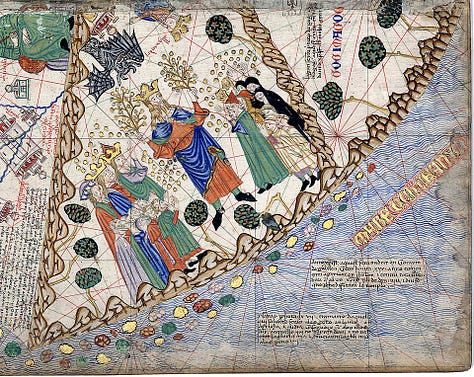
The gold-tipped flagpoles distributed across the Atlas further consolidate this interpretive framework and make its systemic logic explicit. These finials are not fanciful embellishments or artistic flourishes added for visual balance. Gilded or gold spheres were established components of medieval civic, royal, and ecclesiastical standards, where they functioned as material signifiers of jurisdiction, office, and sanctioned authority. They marked not merely who ruled, but where rule was recognized as operative. Within the Atlas, these same symbols are deployed with comparable precision: they denote recognized sovereignty, not decorative excess.
Each gold-capped banner identifies a ruler or polity whose authority is legible within the political and economic system the map encodes. This distinction is critical. The Atlas does not adjudicate legitimacy in a moral or ideological sense; it documents functionality. It records who is acknowledged, who can transact, who can issue orders that will be honored beyond local boundaries. In this way, the finials operate analogously to credentials, seals, or letters of authorization—visual attestations of access embedded directly into the cartographic field.
Seen from this perspective, the map behaves less like an illustration and more like an administrative instrument. Ornamentation is not the operative category. These symbols function as protocol: a visual grammar that governs inclusion and exclusion, recognition and omission, participation and irrelevance. To be marked by a gold-capped banner is not to be celebrated, but to be counted—to exist within the system as something that can act, circulate, and endure.

Purple Britain and the Memory of Empire
If gold marks circulation, purple marks memory—specifically, the persistence of imperial legitimacy beyond the administrative lifespan of empire itself.
The most consequential chromatic decision in the Atlas is the saturation of the island of Britain in purple. Within the medieval visual and political imagination, purple is never incidental. It is costly to produce, tightly controlled, and densely overdetermined. Its material history alone explains much of its symbolic force. True purple dye was derived from murex sea snails, harvested in vast quantities along the eastern Mediterranean and North African coasts. Tens of thousands of shells were required to produce a single garment, and the process left behind distinctive shell mounds that still mark ancient production sites. Purple, therefore, was not merely rare—it was visibly, infrastructurally rare, inseparable from maritime extraction, long-distance trade, and imperial logistics.
By the fourteenth century, purple bore the accumulated symbolic weight of Roman imperial tradition, in which it functioned not merely as a color but as a juridical signifier inseparable from imperium—the right to command, adjudicate, and endure. Roman law tightly regulated its use; to wear purple without sanction was to make a claim upon sovereignty itself. The color thus condensed material scarcity, legal authority, and historical continuity into a single visual register.
Crucially, Britain at this historical moment is not a Roman province, nor has it been for centuries. Yet it is rendered as though it continues to occupy a position within Rome’s symbolic and ideological afterimage. The purple wash does not assert that Britain is Roman in any administrative or political sense. Rather, it asserts that Britain remains embedded within Rome’s residual memory structure: a space where imperial authority once operated and whose legitimacy continues to echo long after formal governance has withdrawn.

This reading accords closely with Rome’s own experience of Britain—not as a productive core of the empire, but as a significant periphery: an edge territory invested with ritual meaning, mythic resonance, and symbolic potency disproportionate to its economic output. Britain’s purple, therefore, does not denote rule. It denotes remembrance—the survival of imperial meaning in the absence of imperial control. Purple lingers where empire once touched and never fully let go.
Caesar, Gaul, and the Overwrite of a Competing System
To understand why this distinction matters, it is necessary to return to the Gallic campaigns of Julius Caesar and to reconsider their function beyond the conventional narrative of territorial expansion. Caesar’s wars in Gaul were not merely episodes of military conquest; they were deliberate acts of civilizational overwrite. What Rome confronted was not a formless or archaic periphery awaiting rational administration, but a set of internally coherent societies—tribal, guild-oriented, and spatially encoded—that organized authority through oral jurisprudence, ritualized landscapes, seasonal assemblies, and distributed networks of obligation rather than through centralized bureaucratic command.

These systems were legible to those who lived within them and opaque to those who did not. Power was embedded in place rather than capital, in practice rather than statute. Law was remembered, not archived; authority was enacted, not issued. Megalithic complexes, route-markers, river crossings, and cultivated clearings functioned as juridical infrastructure. What later observers would dismiss as folklore or superstition constituted, in reality, a durable governance model optimized for continuity across generations rather than for rapid territorial expansion.
Material and symbolic survivals—ogham inscriptions, megalithic architectures such as Stonehenge, vernacular cosmologies later preserved as fairy lore, and the mytho-genealogical traditions that crystallize around the Merovingians—should therefore not be treated as isolated curiosities or romantic anachronisms. They represent low-resolution residues of a non-Roman organizational paradigm: one that privileged nodal connectivity over imperial capitals, landscape memory over written decree, and continuity of practice over formal codification.
Rome succeeded in defeating this system militarily, but eradication was neither complete nor possible. Instead, Roman power engaged in a process of selective translation. Elements that could be abstracted—roads, tribute flows, military recruitment—were absorbed and rendered legible to imperial administration. What could not be translated was displaced, marginalized, or driven underground. Spatial law was replaced with territorial jurisdiction; ritual obligation with written statute; lived memory with archival record.
What endured did so not through preservation, but through mutation. The older system survived in altered form: concealed within guild structures, encoded in mythic narrative, embedded in technical practice, and carried forward through technologies that remained indispensable. The Gallic wars thus mark not the disappearance of a world, but its forced reconfiguration—an overwrite that succeeded politically while leaving the deeper operating system partially intact.
Purple Before Empire: Captured Prestige
Purple’s significance substantially predates its juridical codification under Augustus, extending deep into the pre-Roman Mediterranean world where color, material, and authority were inseparable. Long before it crystallized into imperial branding, purple functioned as a prestige signifier embedded within maritime trade networks—most notably those developed by Phoenician and eastern Mediterranean systems whose reach, technical sophistication, and symbolic coherence preceded Roman political hegemony by centuries. The authority encoded in purple did not originate in Rome. Rome appropriated and monopolized an already operative symbolic economy, one whose power derived from material scarcity, specialized extraction regimes, artisanal secrecy, and the logistical demands of long-distance sea-based circulation.

The production of true purple dye required the harvesting of murex sea snails in enormous quantities, the coordination of coastal labor, and access to trade routes capable of distributing an exceptionally high-value, low-volume commodity. Purple thus condensed maritime dominance, labor control, and surplus capacity into a single visual signal. To possess purple was not merely to display wealth, but to demonstrate command over the systems that made such wealth possible.
When Augustus formalized imperial purple, he did not invent its meaning so much as arrest its mobility. What had once circulated fluidly among elite maritime networks was bound to the juridical and administrative apparatus of the Roman state. Purple was transformed from a transregional marker of elite circulation into a tightly regulated emblem of sovereign authority, its use circumscribed by law and backed by coercive power. The color’s earlier cosmopolitan function was narrowed into an imperial monopoly.
The appearance of purple over Britain in the Catalan Atlas reflects precisely this layered and contested inheritance. Britain is not rendered purple because it exercises imperial power. It is rendered purple because it remembers—and continues to be remembered by—a prior regime of authority whose symbolic residue remains operative despite the withdrawal of formal governance. The color marks Britain as a site where imperial meaning once adhered and never fully dissolved.
This memory does not dissipate with political rupture. It resurfaces in Arthurian traditions that encode sovereignty as destiny rather than administration; in forms of Celtic kingship that deliberately blur myth, land, and lineage; and later in Merovingian genealogical claims that fuse sacral legitimacy with dynastic continuity. Britain never becomes fully continental because it persists as a symbolic margin: a liminal territory where imperial memory survives independently of imperial administration, and where authority continues to be imagined long after empire itself has receded.
Language Outpaces Stone: Phoenicia and the True Mediterranean Power
A persistent distortion within European historical consciousness lies in the disproportionate privileging of Greco‑Roman monumental architecture over the less immediately visible, yet ultimately more expansive, influence of Phoenician and North African systems. Stone monuments dominate both archaeological remains and popular imagination precisely because they endure physically and present themselves as unambiguous evidence of power. Yet this durability is misleading. Language outpaces architecture in both velocity and reach. The alphabet—not marble, not concrete—constituted the Mediterranean world’s most consequential and enduring imperial technology.
Where architecture fixes authority to place, writing mobilizes it. Phoenician‑derived scripts circulated along maritime routes with a flexibility and transmissibility that stone‑bound urban forms could never replicate. Writing traveled with merchants, sailors, accountants, and intermediaries, embedding itself within contracts, cargo manifests, ritual formulae, and legal memory rather than territorial permanence. In this sense, literacy functioned as a portable infrastructure: a system capable of reproducing order wherever trade could land.
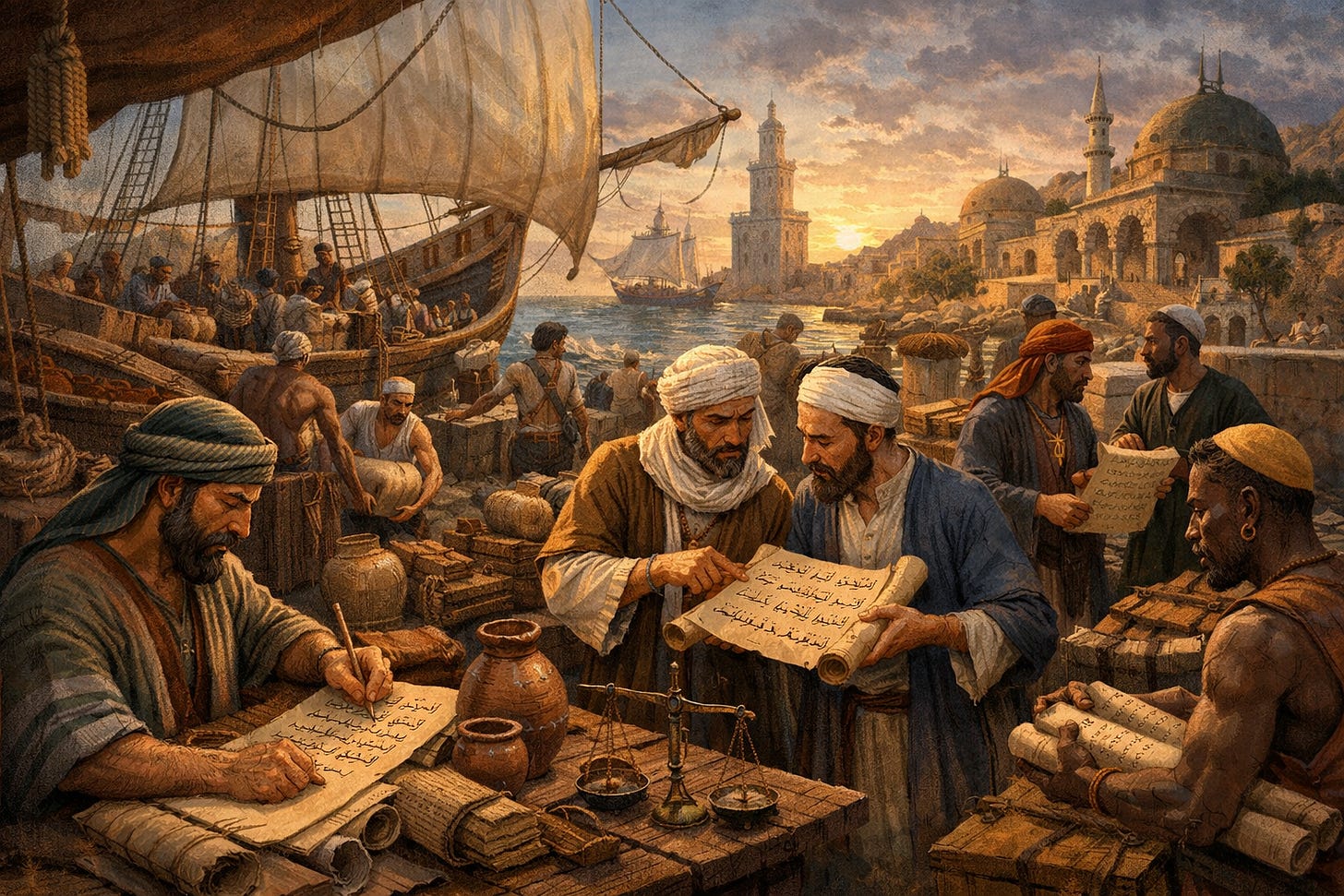
As a result, seafaring cultures—rather than monumental capitals—became the primary vectors of long‑term civilizational continuity. Northern Africa, particularly its coastal zones, operated as a deeply syncretic intellectual substrate in which Berber, Phoenician, Jewish, Islamic, and later Christian traditions interpenetrated, hybridized, and re‑encoded one another across centuries. This substrate was not peripheral to Mediterranean history; it was the medium through which that history was transmitted.
The Catalan Atlas retains subtle but unmistakable traces of this cosmopolitan foundation. Its emphasis on ports, islands, routes, and nodal connectivity reflects a world organized less by territorial monumentality than by circulation, inscription, and exchange. That later European historiography systematically minimizes or obscures this lineage is not accidental. Monumental stone flatters empire; portable language empowers networks. The Atlas preserves the latter at a moment just before the former becomes dominant.
Windmills, Amsterdam, and Survivor Technology
Moving northward, this same structural logic becomes legible in the Low Countries, and with particular clarity in Amsterdam. The windmill—so often reduced to a picturesque emblem of rural life or national kitsch—is more accurately understood as energy infrastructure in its most sophisticated pre‑industrial form. A windmill is not a single machine but an integrated system: it captures wind, regulates water tables, drives mechanical production, drains land, powers sawmills and grain processing, and stabilizes commercial throughput. In short, it converts an unstable natural force into predictable surplus.
Its appearance signals not innovation ex nihilo but the survival, adaptation, and intensification of older maritime and nodal logics that long predate the modern state. Windmills emerge precisely where circulation mattered more than territory, where managing flow—of water, goods, ships, and labor—was a matter of survival. They are technologies of negotiation with environment, not domination of it.
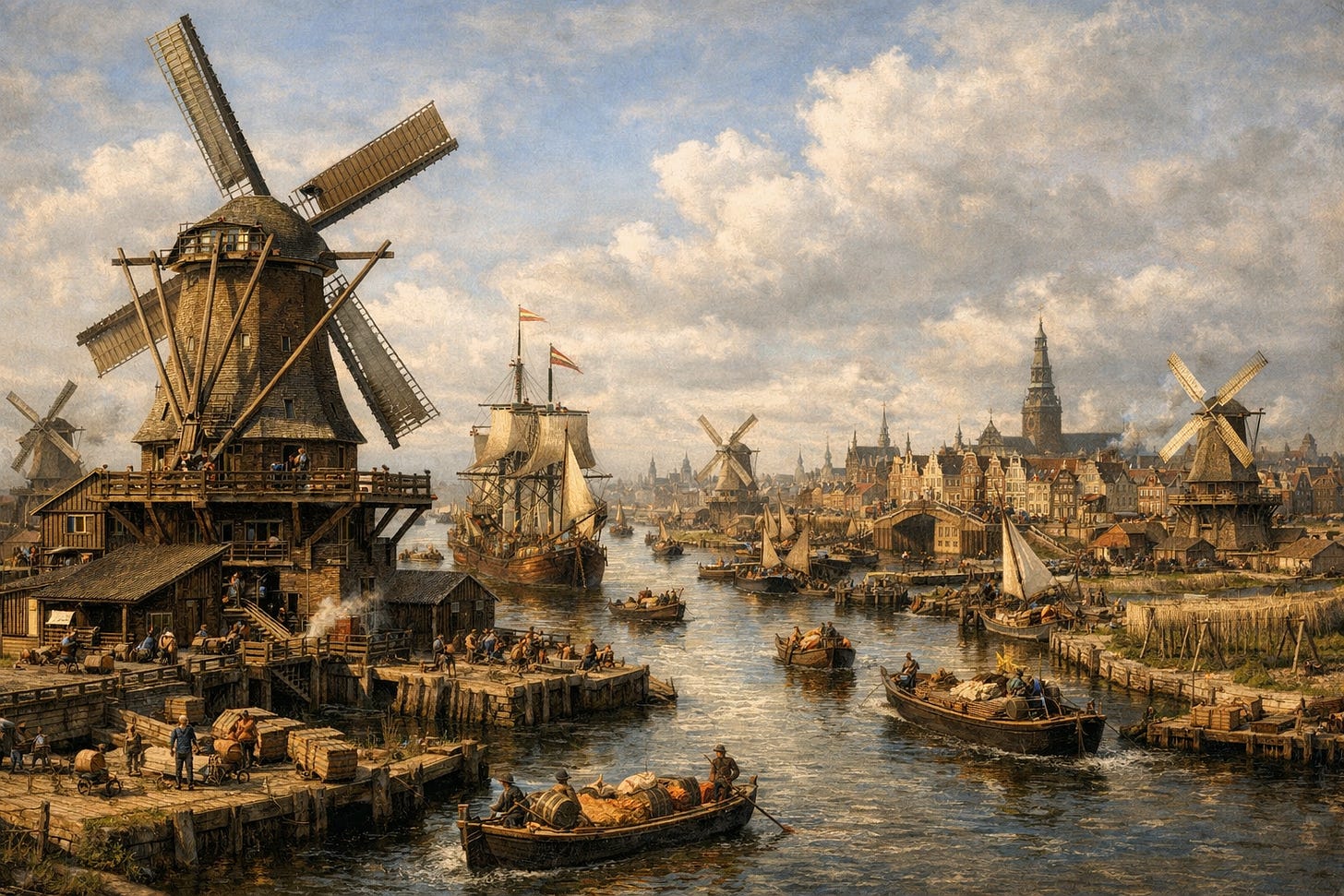
Amsterdam did not invent these systems; it inherited them and rendered them brutally efficient. Long before the consolidation of centralized territorial states, the Low Countries functioned as networked environments organized around circulation, mediation, and technical interoperability rather than bounded sovereignty. Dikes, canals, locks, and mills formed a single operational ecology. In this respect, just as Rome appropriated and immobilized purple, later polities learned to appropriate wind—transforming an ambient, diffuse force into durable institutional advantage.
What survives conquest or systemic rupture is rarely a people’s self‑story or political form. Those are rewritten quickly. What endures is indispensable technique: methods of energy capture, regimes of water management, hemp cultivation for rope and sailcloth, standardized measures, and the logistical intelligence required to keep ships moving and markets supplied. These techniques persist because they cannot be discarded without collapse.
Windmills, then, are not charming relics. They are historical continuities made visible—mechanized memory. They form the silent substrate through which civilizational function is carried forward even as flags change, laws are rewritten, and empires imagine themselves new.
Gold, Purple, and Wind as a Unified System
Taken together, the visual language of the Catalan Atlas resolves into a coherent analytical framework that articulates civilizational function rather than geographic description:
- Gold signifies circulation, custodianship, and the capacity of value to survive political disruption
- Purple signifies residual legitimacy, imperial memory, and the persistence of authority beyond formal governance
- Wind technology signifies adaptive continuity—the survival of indispensable technique across regime change and systemic rupture
Within this framework, chromatic and technical emphasis is never incidental. Britain appears purple not because it rules, but because it remains saturated with the memory of a world Rome sought to overwrite and never entirely erased. Mediterranean islands appear gold because they constitute environments in which wealth—material, symbolic, and institutional—can be preserved, translated, and reactivated. Amsterdam matters because it retains the knowledge of how to operate within these inherited systems, transforming circulation, memory, and technique into durable advantage.
The Atlas is therefore not primarily descriptive. It does not aim to locate places in space so much as to situate them within a functional order. What it reveals is how civilization continues to operate—quietly, symbolically, and beneath the surface of official historiography. In this sense, the Catalan Atlas should not be read as a relic of a vanished world, but as a diagnostic image of a system that never fully disappeared and, in many respects, never stopped working.
Medicine, Ritual, and Logistical Intelligence
When the most sensational interpretive claims are set aside, what remains is not provocation but ancient medical anthropology—the study of how societies embedded healing, prevention, and bodily maintenance into ritual life because survival demanded it. Early Jewish and Mediterranean subcultures were not mystically inclined medical anomalies; they were populations operating under environmental, maritime, and demographic pressures that required reliable, repeatable techniques of care.
Practices such as circumcision are instructive in this regard. They imply not symbolic violence but institutionalized wound management: antisepsis, controlled incision, oils, poultices, bandaging, and aftercare. A society that normalizes such practices necessarily develops practical medical competence distributed across households, specialists, and communal authority figures. Within this context, individuals later remembered as healers need not be interpreted as thaumaturges or miracle-workers. They are better understood as specialists operating within a ritualized medical subculture, where knowledge of the body was transmitted through practice rather than theory.
This reframing has significant interpretive consequences. Symbolic language surrounding marking, anointing, and purification does not signal scandal or transgression; it encodes procedural medicine. Healing knowledge was not marginal or secretive. It was central, embodied, and widely disseminated, embedded in daily life and collective ritual rather than confined to elite institutions.
Seen from this perspective, the recurring pairing of honey and cannabis is best understood not primarily through pharmacology, but through logistics. Together, they form a coherent pre‑industrial support stack. Honey functioned as a potent antibacterial agent, preservative, caloric resource, and source of wax for seals, storage, lighting, and record‑keeping. Hemp supplied rope, sailcloth, textiles, bandage material, oils, and mild analgesics. These materials underwrote mobility, maritime trade, medical treatment, and administrative continuity.
Groups organized around such resources are not cultic formations. They are field‑capable logistical units—mobile, resilient, and self‑supporting. Their material practices explain the persistence of healing narratives, anointing rites, and balm symbolism without recourse to esoteric excess. What later theology mythologized, these societies operationalized. Medicine, ritual, and logistics were not separate domains; they were a single integrated system oriented toward endurance.
Perception, Authority, and Prestige
The final layer of the system becomes visible when attention shifts from institutions to bodies. Purple compounds—whether dyes, oils, or resins—were not inert symbols but materially active substances. They frequently incorporated marine and botanical ingredients capable of subtly altering sensation, inflammation, circulation, and perception. These effects do not require hallucination or ecstatic excess to be historically meaningful. Shifts in light sensitivity, pain modulation, wound response, and focused awareness are sufficient to ground the long‑standing symbolic association between anointing, sight, and authority.
In this framework, authority is not merely proclaimed or inscribed; it is embodied. It is experienced through controlled, scarce substances whose effects are tangible and repeatable. Prestige adheres not only to the sign but to the sensation—to the felt difference between those who have access to regulated materials and those who do not. The body itself becomes a site where legitimacy is registered and reproduced.
This logic is not unique to Mediterranean societies. Comparable patterns appear across steppe and tribal worlds, including among Scythian groups, whose use of plant toxins, venoms, and psychoactive preparations reflects pragmatic pharmacology rather than mysticism. Such knowledge systems are inherently distributed rather than centralized. They reside in technique, practice, and transmission rather than in fixed institutions, and they migrate readily when political forms collapse or are overwritten.
The pattern is consistent across the historical record. Populations are displaced, narratives are rewritten, and sovereignties dissolve. What persists is technique: methods of healing, preparation, intoxication, preservation, and control that remain indispensable regardless of who governs. These practices survive precisely because they solve recurring problems of endurance.
Seen in this light, the interpretive model advanced here requires neither hidden doctrines nor scandalous reversals. It rests on a more parsimonious and defensible claim: that certain early Jewish–Mediterranean traditions were materially grounded, medicinally informed, and logistically coherent, and that their later theological elaboration obscured their original functional logic.
This claim aligns not only with anthropology, ancient medicine, trade history, and semiotics, but also with the visual grammar of the Catalan Atlas itself. Gold, purple, wind, and medicine are not separate themes but expressions of a single operating system concerned with circulation, legitimacy, continuity, and embodied authority. Nothing in this model depends on provocation to persuade. The system explains itself—and, once seen, is difficult to unsee.



 Unnameable Media
Leave a comment