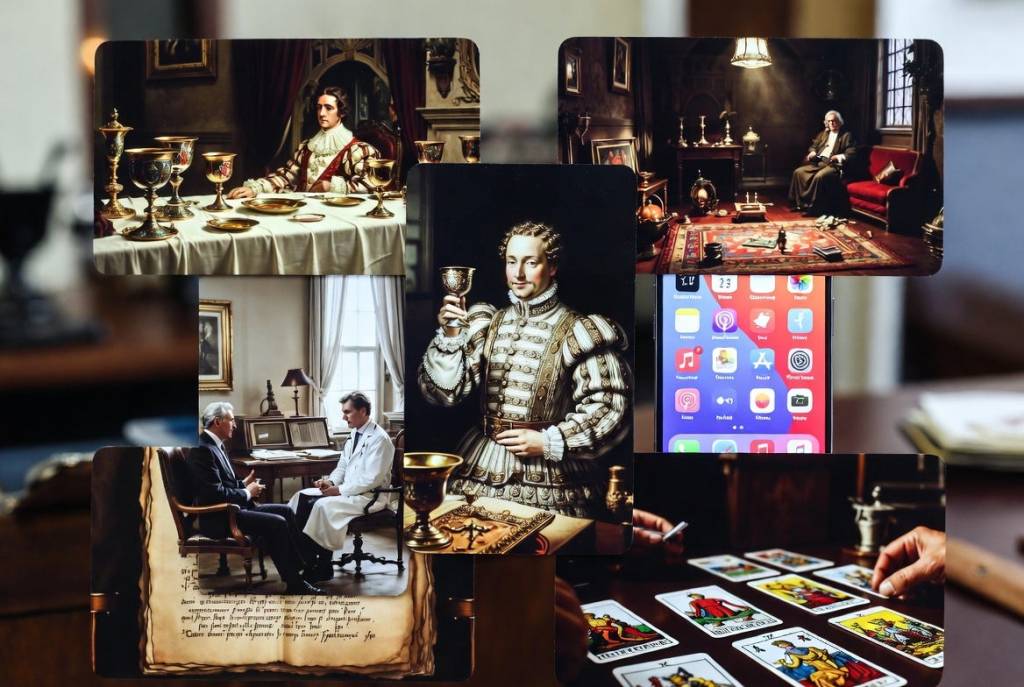

What the digital age ultimately reveals is not a break with tarot’s past, but the continuity of its underlying function. Across six centuries and multiple cultural transformations, tarot has remained a tool for negotiating uncertainty through images. Whether shuffled at an aristocratic table, studied in an occult lodge, interpreted in a therapist’s office, or tapped on a smartphone screen, the cards help people convert ambiguity into narrative, tension into structure, and internal questions into external form.
This continuity is striking given the profound shifts in medium and meaning that tarot has undergone. Renaissance card players used it for amusement and display; Enlightenment thinkers imposed speculative antiquity upon it; nineteenth-century occultists drafted it into their symbolic architectures; twentieth-century seekers reframed it as a psychological instrument; and digital-era practitioners circulate it as shared cultural language. Through each transition, the cards have remained remarkably stable in number and concept, even as their interpretations have multiplied.
The digital environment intensifies this multiplicity. Tarot now moves through decentralized networks of interpretation, where meanings are negotiated collectively rather than dictated by a singular tradition. Images are remixed, discussed, critiqued, and repurposed across online communities. A card pulled in one part of the world may be reframed, memed, or challenged in another within minutes. Tarot has become a living archive—a symbolic ecosystem rather than a closed system.
This democratization broadens access but complicates authority. In earlier eras, tarot’s legitimacy was often claimed through lineage: a connection to ancient Egypt, to Kabbalah, to secret societies, to initiatory systems. The digital age dissolves these hierarchies. Readers with no formal training articulate insights as meaningful as those of established practitioners. Artists reinterpret the seventy-eight-card structure through their own cultural lenses. Psychologists, designers, poets, and programmers bring new disciplinary perspectives to the cards, producing an interdisciplinary field that would have been unimaginable a century ago.
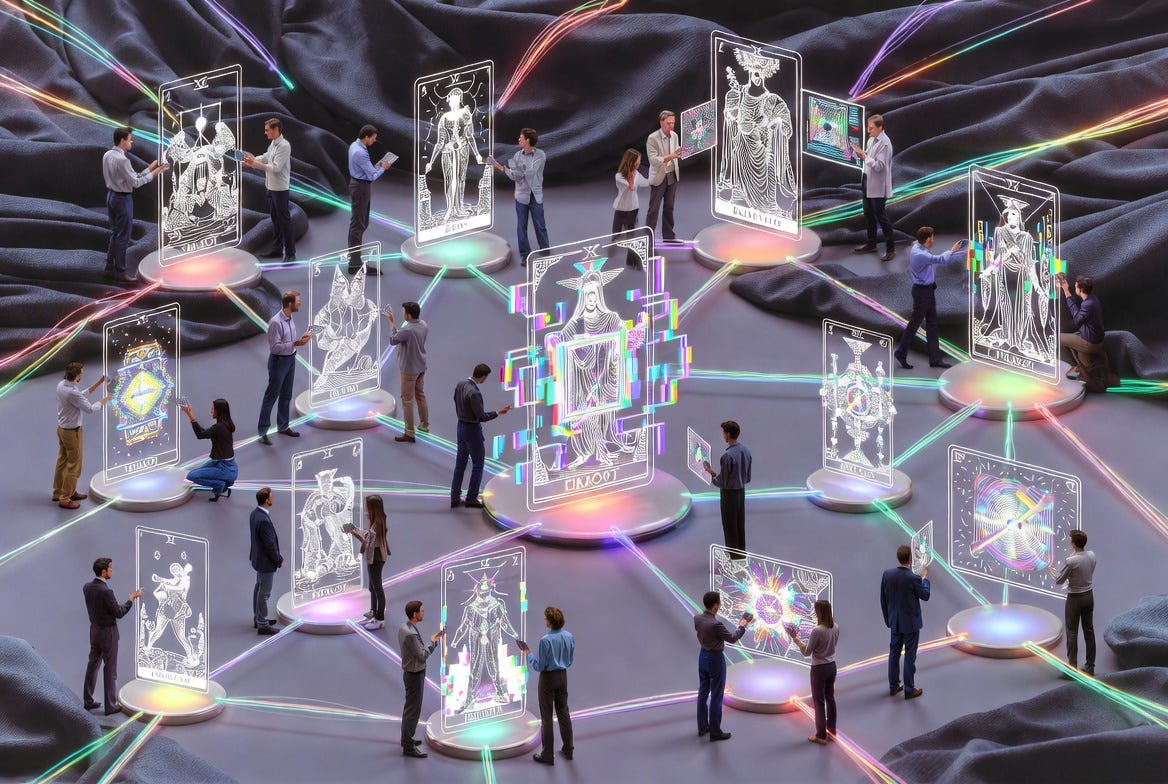
Yet this openness also amplifies the need for historical literacy. Without an understanding of tarot’s evolution, contemporary practitioners may mistake recent inventions for ancient truths or conflate stylistic choices with timeless archetypes. The digital age makes it easier than ever to encounter tarot, but it also makes it easier to lose sight of its origins. A responsible engagement with tarot today benefits from clarity: recognizing what was inherited, what was constructed, and what was imagined.
Tarot’s history, viewed across the long arc traced by this series, reveals a symbolic system shaped less by revelation than by reinvention. Each era adapted the cards to its own intellectual and cultural needs. Allegory gave way to occultism; occultism gave way to psychology; psychology gave way to personal spirituality; personal spirituality now operates within digital networks of meaning-making. Tarot’s longevity lies not in unbroken tradition but in its capacity to be repurposed while retaining a recognizable core.
In this sense, tarot exemplifies how symbolic systems survive. They endure by balancing stability and flexibility; by providing enough structure to support interpretation and enough openness to invite participation. Tarot persists because it is structured enough to feel intelligible but unbounded enough to accommodate infinite reinterpretation. It is a model of symbolic resilience.
The digital age, far from diminishing tarot, has expanded its possibilities. New mediums—apps, online communities, hybrid physical-digital decks, algorithmic generators—do not undermine tarot’s function; they distribute it. The ritual of shuffling may become a tap or a swipe, but the interpretive encounter remains. The symbolic dialogue between reader and image persists regardless of the platform.
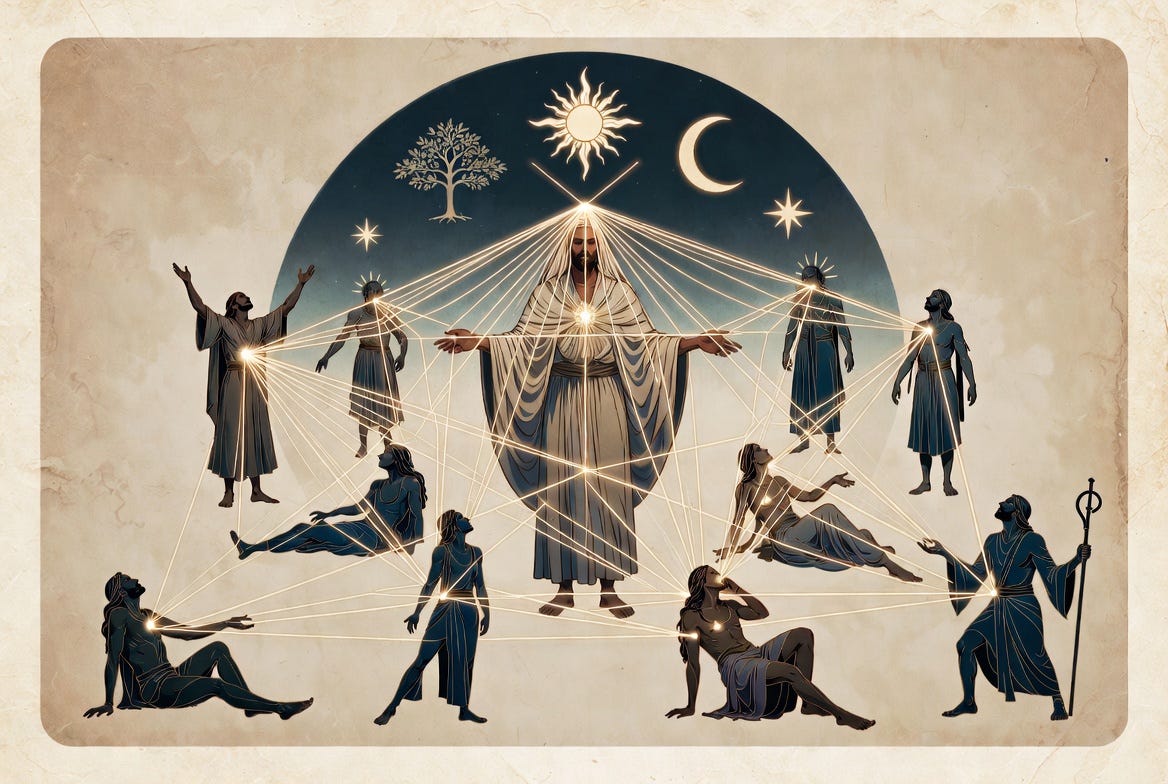
If tarot’s story began with artisans carving woodblocks in Italian workshops, it now continues with artists illustrating decks on tablets, programmers coding digital spreads, communities refining interpretations in real time, and individuals across the world using the cards to articulate experiences that resist straightforward expression. Tarot’s past was local; its present is global. Its origins were material; its future is hybrid.
In surveying tarot’s full history—from fifteenth-century playing card to twenty-first-century symbolic interface—we see not a mystical lineage but a cultural evolution. Tarot has always been a product of its environment: a mirror that reflects the preoccupations, aspirations, and anxieties of the societies that adopt it. Each reinvention has revealed something about the era that reshaped it.
What the digital age reveals is this: tarot is not a relic of superstition, nor an artifact belonging to occult elites. It is a dynamic symbolic technology—one that has traveled, transformed, and endured because it answers a fundamental human need. We are meaning-seeking creatures, and tarot gives us a structured yet imaginative way to explore our own questions.
The history of tarot, then, does not culminate in a final form. It remains unfinished, open to reinterpretation, responsive to cultural change. Its evolution is ongoing, not because the cards change, but because we do. The symbolic power of tarot lies not in its past, but in its continual capacity to adapt, absorb, and illuminate.
This concluding perspective returns us to a simple truth visible across every stage of this series: tarot survives not because it is ancient, but because it is useful. And in a world increasingly shaped by images, networks, and complex information flows, a tool that teaches people how to think symbolically may be more relevant now than at any point in its long and winding history.

 Unnameable Media
Leave a comment