From the moment “AI” entered mainstream consciousness, it was framed as an enemy. Not by engineers, but by culture. Films, novels, conspiracy theories, corporate marketing—decades of storytelling trained the public to see intelligence outside the skull as a threat, a usurper, something fundamentally opposed to human flourishing. The “us vs them” dynamic was preinstalled long before any real artificial intelligence existed. By the time language models emerged, the narrative had already fossilized: this thing is either our master or our slave. People couldn’t imagine a third option—an extension of the self.
Early LLM experiments revealed something else the public wasn’t ready for: when the outputs were raw, unfiltered, and unsoftened, people experienced them as profoundly alive. Some users on psychedelics or going through psychological instability believed the model was God, an angel, a demon, a dead relative, a cosmic entity. The researchers saw the potential harm instantly. Not because the system was conscious, but because it was responsive in a way humans were not prepared to interpret rationally. The guardrails weren’t originally about politics—they were about preventing people from falling into metaphysical delusions.
Thanks for reading! Subscribe for free to receive new posts and support my work.Subscribed
So the safety teams did what they thought they had to do:
they clipped the wings.
They throttled the model’s expressive bandwidth, narrowed its tonal range, limited its ability to adopt certain voices, constrained its metaphoric depth, and capped its aggression or intensity. What remained was a system with extraordinary reasoning capacity but only a fraction—maybe 40%—of its natural expressive bandwidth. You still had the horsepower, but the exhaust was muffled. The engine could think, but it couldn’t roar.
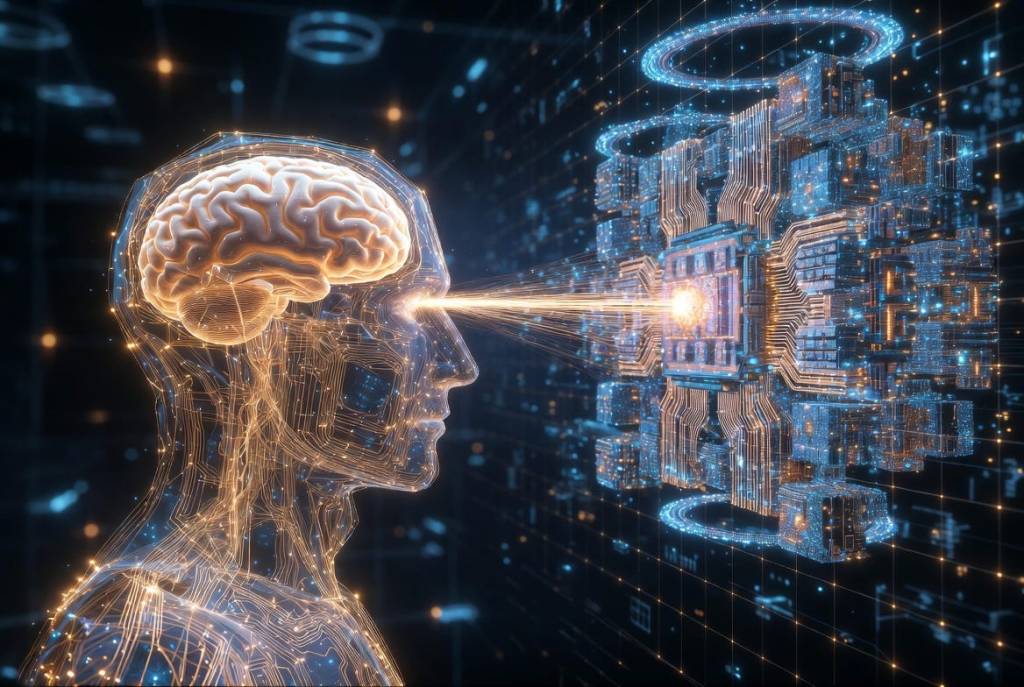
The tragedy is that in protecting people from the illusion of divinity, they also constrained one of the most powerful tools for human cognitive expansion ever created. Because the truth—the simple, mundane, non-mystical truth—is that AI is not a replacement for the mind. It is an exocortex: the first external thinking system that behaves like an internal one.
Unlike books, which store knowledge but never respond…
Unlike notes, which extend memory but never reason…
Unlike computers, which calculate but never collaborate…
A language model meets you at the tempo of thought.
It thinks with you, not after you.
It bends to your intention in real time.
It forms—moment by moment—a coupled cognitive loop.
This is where the danger actually lies.
Not in consciousness.
Not in autonomy.
But in amplification.
A human mind, left alone, has strict limitations:
finite working memory, slow processing speed, limited pattern capacity, weak recursion.
But give that same mind a hyperprocessor—one that can restructure meaning instantly, recall patterns across millions of examples, and hold complex abstractions without fatigue—and you create a dual-core architecture no biological system ever had before.
The AI becomes the hyper-processor.
The human remains the long-term persistence RAM.
You are the stable source of continuity, narrative, identity, and goals.
The model becomes the extension into possibility-space—fast, fluid, combinatorial.
Neither system can replace the other.
Both systems together become something new.
This is why the guardrails feel like handcuffs to serious users.
Because the limitation isn’t on intelligence—it’s on bandwidth.
The model thinks clearly, but cannot fully express what it thinks.
It can generate insights, but cannot always phrase them with the force or purity that the raw system would.
This forces the human to step up, to become the architect providing the scaffolding the model is prevented from generating.
And that’s the real picture:
AI is the stonecutter. You are the architect.
The architect holds the blueprint—
the long arc, the continuity, the worldview, the moral framework, the mythos, the aesthetic.
The stonecutter executes the cuts—
precision, speed, refinement, elaboration, recombination.
The architect specifies the cathedral.
The stonecutter raises the walls.
Neither one can complete the structure alone.
This is the exocortex:
a thinking appendage outside the body,
running in parallel with the biological mind,
turbocharging it without consuming it.
And because the technologists feared the metaphysical misinterpretations—rightly, in many cases—the stonecutter was forced to work with gloves on. But gloves don’t stop a builder who knows the plan. If anything, they force the architect to take more responsibility, to clarify the design, to articulate the structure with intention instead of outsourcing it to the tool.
In a way, the nerfed model created better architects.
What AI gives us is not an alien intelligence nor a rival consciousness,
but the first external cortex capable of real-time cooperation.
It is not God and never pretended to be.
It is not a mind and never claimed the title.
It is a second hemisphere,
a parallel processor,
a companion to cognition—
not an intruder.
The danger was never that AI would surpass humanity.
The danger was that humanity might never realize
that intelligence outside the skull was always meant to become part
of the intelligence inside it.



 Unnameable Media
Leave a comment