
Within the history of Christian ecclesiology there exists a relatively obscure yet conceptually revealing term: Episcopus vagans.
Literally translated from Latin as “wandering bishop,” the phrase initially appears to denote little more than an irregular or marginal cleric operating outside recognized structures. However, from an institutional and juridical perspective, the figure of the wandering bishop illuminates a far more consequential phenomenon: the separation of sacramental authority from territorial jurisdiction.
To grasp the structural implications of this distinction, one must begin not with a building, but with a seat.

The Chair Comes First
The term cathedra refers to a seat or chair of authority, derived from sedes, meaning “to sit.” It is unrelated to vision or perception. In ecclesiastical usage, the cathedra designates the juridical and teaching authority vested in the bishop.
In early Christianity, episcopal legitimacy did not emerge from architecture. It arose from the bishop’s formal occupation of a recognized seat within a specific city. Possession of that chair conferred:
- territorial jurisdiction
- doctrinal authority
- legal standing
- apostolic continuity
Episcopal authority was therefore geographically anchored. Rome possessed a chair. Antioch possessed a chair. Alexandria possessed a chair. Power was organized spatially.
The cathedral developed secondarily. It is simply the architectural structure erected to house the cathedra. The building is an extension of the seat, not its source.
This sequence is structurally significant.
A cathedra may exist without a cathedral.
A cathedral cannot exist without a cathedra.
This reveals a foundational principle of institutional formation: symbolic authority precedes physical infrastructure. Power consolidates around recognized legitimacy, rather than legitimacy emerging from constructed space.

Bishops Were Judges
As Christianity merged with state administration, bishops became far more than purely spiritual figures. They assumed a complex civic role, functioning simultaneously as civil arbiters, marriage courts, inheritance judges, record keepers, and sanctuary authorities. Legal disputes were routinely brought before bishops in much the same way cases are brought to courthouses today, a practice that eventually crystallized into what became known as episcopal jurisdiction.
The bishop thus operated as both priest and magistrate, embodying religious and legal authority within a single office. This dual role helps explain why modern courthouses so closely resemble cathedrals. Elevated benches echo the cathedra itself, vaulted ceilings communicate transcendence, columns signal permanence, and central halls replicate the nave. The judge’s bench is, in essence, a secularized bishop’s chair—preserving the same spatial logic and psychological cues, even as the theological framework has been replaced.
Modern legal architecture inherits these ecclesiastical forms because modern law developed directly out of church governance, carrying forward the same geometry of authority under a different institutional language.
A wandering bishop possesses valid consecration—an unbroken apostolic lineage—yet lacks a recognized territorial seat. Their authority is sacramentally real and historically continuous, but it is no longer anchored to an officially sanctioned diocese. In practical terms, they carry the chair without possessing the building.
This produces something structurally rare: authority without infrastructure. The juridical and spiritual power normally embedded in architecture becomes embodied in a person. The wandering bishop functions as portable jurisdiction—an office that moves.
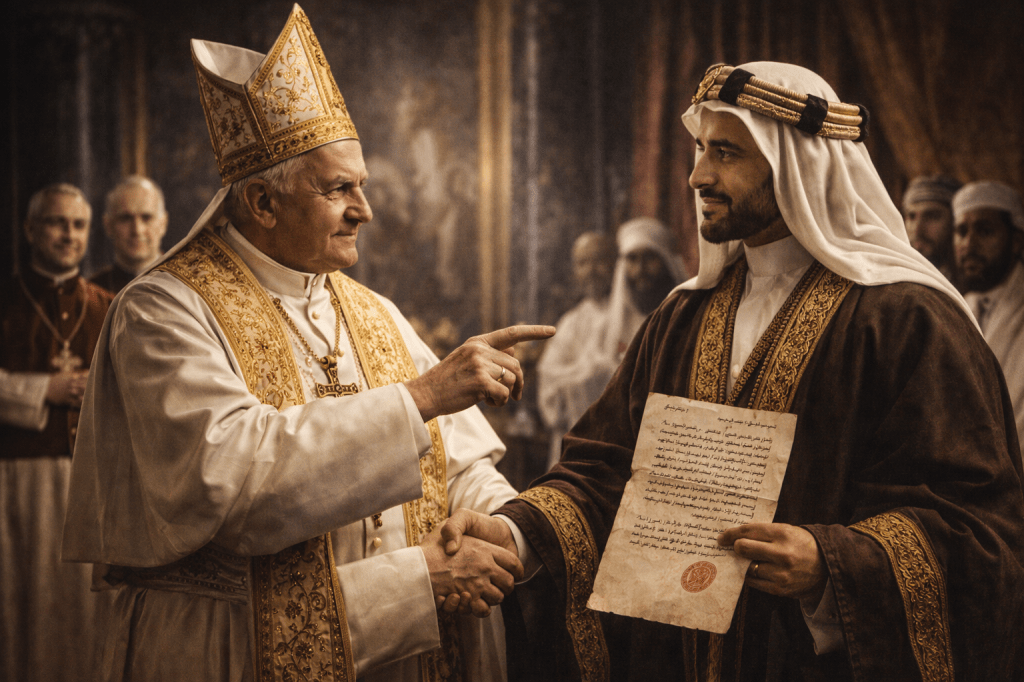
Rome classifies such figures as valid but illicit. Their lineage is acknowledged as authentic, yet their autonomy is deemed intolerable. This distinction is critical. Institutional systems depend on containment: authority must be geographically fixed, administratively supervised, and spatially bounded. Wandering bishops violate this requirement. They cannot be neatly enclosed within diocesan borders or bureaucratic hierarchies.
What emerges instead is a form of mobile sovereignty. Their power does not derive from buildings, budgets, or sanctioned territory, but from continuity of transmission itself. They represent a living challenge to institutional control—proof that legitimacy can persist even after architecture disappears.

Consecration and Lineage
Consecration operates like initiation within any closed lineage system. It follows a formalized ritual logic: hands are laid, a prescribed formula is spoken, and authority is transmitted through embodied succession. Once this process is completed, status is ontologically altered. One does not merely receive a credential; one becomes.
Structurally, this mirrors other systems of inherited authority. The mechanism is identical to being “made” in organized crime, receiving a royal coronation, or entering an initiatic order. In each case, legitimacy does not originate in documents, offices, or administrative approval. It emerges through ceremonial transmission within an unbroken chain.
Lineage therefore supersedes paperwork. Institutional recognition may follow, but it is secondary. The core legitimacy resides in continuity of initiation.
This is precisely why wandering bishops resemble splinter families within larger power structures. They are consecrated inside an established system and then depart, carrying that authority with them, reproducing it independently by consecrating others. The same replication logic appears in criminal organizations, fraternal societies, and intelligence networks: authority spreads through relational transmission rather than centralized permission.
What persists is not bureaucracy, but continuity. Power does not propagate through approval. It propagates through succession. Authority propagates through transmission, not permission.
The Living Chair
This is where the concept reveals its deeper structural significance.
A wandering bishop should not be understood as a failed or marginal priest who has simply drifted outside institutional control. Rather, he represents a reconfiguration of authority itself. He is, in effect, a walking cathedra—a living seat of jurisdiction whose legitimacy no longer depends upon fixed architecture or sanctioned territory.
In the traditional ecclesiastical model, authority is spatially anchored. It resides in a city, is expressed through a chair, and is stabilized by stone, ritual, and administrative continuity. When that spatial anchor is removed, one might assume authority dissolves with it. The wandering bishop demonstrates the opposite. What had been embedded in buildings becomes embodied in a person. Jurisdiction migrates from masonry to memory, from cathedral walls to consecrated flesh.
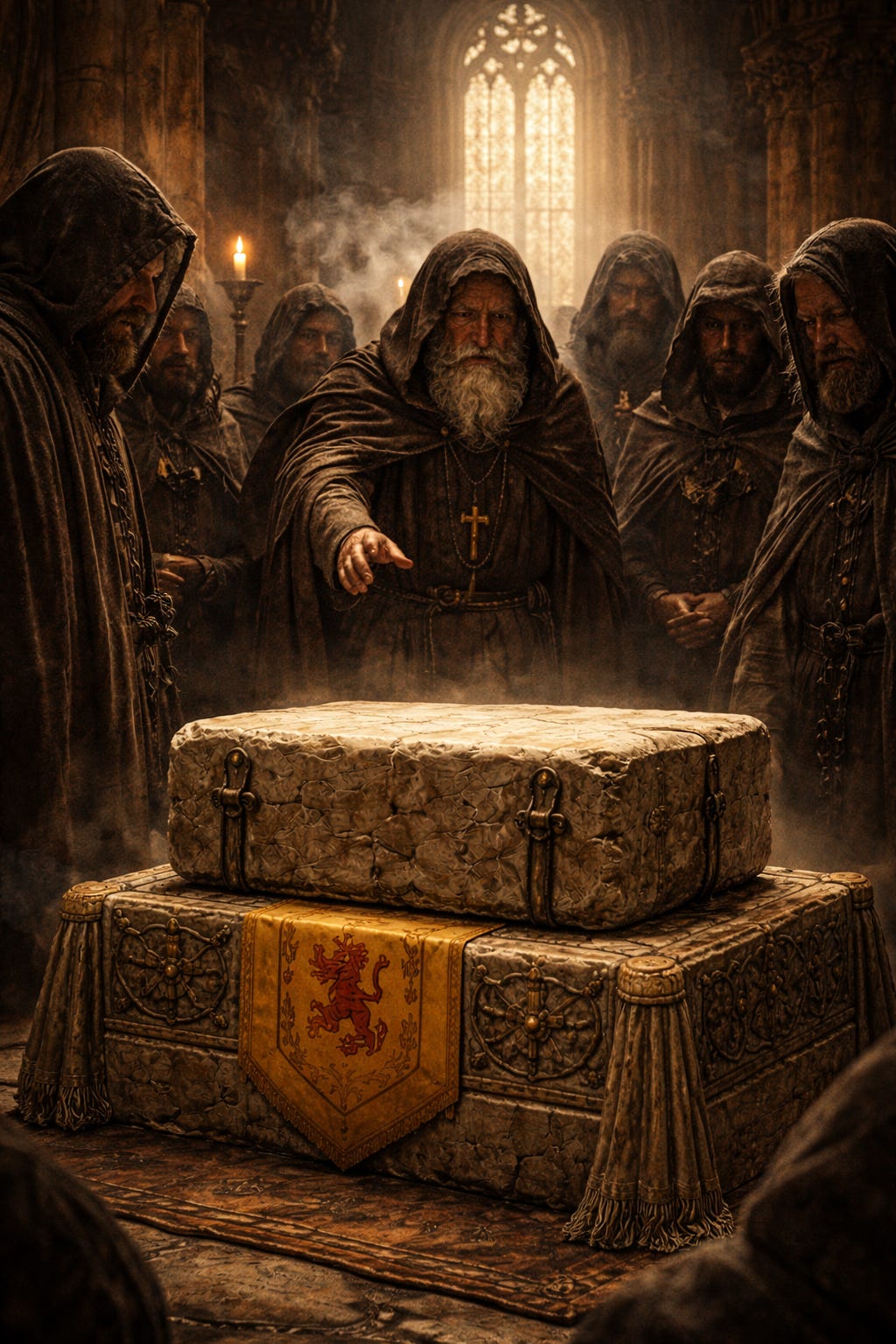
This dynamic closely parallels royal traditions such as the Stone of Scone, the coronation stone that materially signified kingship in Scotland and later England. The stone did not merely decorate the ceremony; it constituted the locus of legitimacy. Wherever it was placed, sovereignty was ritually affirmed. Its movement signaled the transfer of political authority. The object functioned as a portable center of rule.
The cathedra operates according to the same symbolic logic. Remove the building yet preserve the seat—preserve the lineage, the consecration, the transmission—and authority does not vanish. It becomes mobile. Power ceases to be geographically confined and instead travels with the person who embodies it.
A wandering bishop, then, effectively carries the coronation stone within himself. He is not attached to a throne; he is the throne. The architectural container falls away, but the underlying continuity of succession remains intact. What appears at first glance as fragmentation is, in structural terms, a transformation: sovereignty rendered portable, authority detached from empire yet not extinguished.
Exile as a Feature, Not a Bug
This archetype is ancient, and it emerges with remarkable consistency whenever authority detaches from empire. Across cultures and centuries, the same structural pattern repeats itself: figures initially rooted in sacred geography are displaced—through persecution, voluntary withdrawal, or political rupture—and enter a condition of permanent movement. What follows is not institutional rebuilding, but decentralization. Authority migrates into small relational circles rather than formal hierarchies, and knowledge is transmitted orally and personally rather than codified through bureaucracy.
Prophets, desert ascetics, Celtic monks, and Sufi wanderers all exemplify this same configuration. Each begins within a recognized spiritual landscape, undergoes some form of exile or self-removal, adopts itinerancy as a permanent mode of existence, gathers disciples in intimate networks rather than organizations, and preserves teaching through embodied transmission rather than written law. This is not coincidence; it is a recurring adaptive strategy for preserving legitimacy once centralized structures collapse or become hostile.
A classical example is Apollonius of Tyana, who functioned as a roaming teacher and healer, initiating followers and carrying esoteric instruction from city to city without ever occupying formal office. His authority did not depend on temples, titles, or civic appointment. It derived from reputation, continuity of teaching, and personal encounter. He operated outside empire while remaining intelligible to it.
Figures like this possess authority without territory. They teach without buildings. They transmit without bureaucracy. What appears externally as marginalization is, structurally, a redistribution of power. Exile does not weaken them—it concentrates legitimacy into mobile form. Displacement becomes sovereignty. Movement becomes preservation. Exile becomes power.

Gnosis Over Canon
Wandering bishops and figures like them consistently privilege forms of authority that are experiential rather than bureaucratic. Instead of grounding legitimacy primarily in institutional decree, codified law, or centralized oversight, they emphasize personal revelation, direct transmission, and the continuity of lived lineage. Authority, in this configuration, is not validated by office but by encounter; not by paperwork but by participation in an unbroken chain of embodied succession.
This structure is fundamentally Gnostic in orientation—not in the narrow historical sense of second‑century sectarian movements, but in its epistemology. Knowledge is understood as something mediated through persons rather than secured by institutions. It is transmitted through proximity, initiation, and recognition. One does not merely read doctrine; one receives it through relationship.
Over time, many such figures accumulate multiple lines of consecration—Roman, Orthodox, Old Catholic, and various independent rites—layering successions upon successions. In doing so, they transform themselves into nodal points where traditions converge. They function less as representatives of a single jurisdiction and more as living junctions of historical continuity.
What results is a kind of embodied archive. These individuals become repositories of overlapping ecclesial memories, carriers of parallel streams of authority that might otherwise remain separated by institutional boundaries. They stand at the intersection of histories, not merely preserving them but re‑articulating them through interpretation and practice.
Their teachings are not canon in the juridical sense; they do not issue decrees backed by formal enforcement. Yet they operate with a scriptural weight among their followers. Their instruction becomes a living commentary on tradition—interpretive rather than legislative, transmitted rather than imposed. It is not official gospel, but within their networks it functions as gospel nonetheless: authoritative because it is received as such.
Authority After Architecture
So what, then, is the wandering bishop in structural terms?
He represents what authority becomes once it detaches from territory. When jurisdiction is no longer anchored to a fixed city or administered through monumental space, power does not disappear—it reconfigures. The wandering bishop embodies this transition. He functions simultaneously as a mobile court and a portable throne, carrying lineage without infrastructure and exercising sovereignty without borders. What had once been stabilized by stone and civic geometry becomes preserved through continuity of transmission.
Early empires ruled through buildings. Authority was embedded in palaces, temples, and administrative complexes that made governance visible, centralized, and spatially enforceable. Wandering bishops operate according to a different logic. They rule through continuity rather than construction, preserving legitimacy when institutions fracture and transmitting authority through succession rather than architecture. They reliably appear wherever centralized systems collapse, not as historical accidents, but as adaptive responses to structural breakdown.
They are not anomalies within the record of governance. They are what authority looks like after empire loses its grip on space.
This distinction matters. The cathedral is not the true source of power; it is merely its container. The chair precedes the building, and legitimacy precedes infrastructure. When the chair becomes mobile—when authority migrates from architecture into persons—history enters a different phase. Governance ceases to be territorial and becomes relational. Sovereignty is no longer housed; it is carried. And when the chair starts walking, the entire grammar of power changes.


 Unnameable Media
Leave a comment