

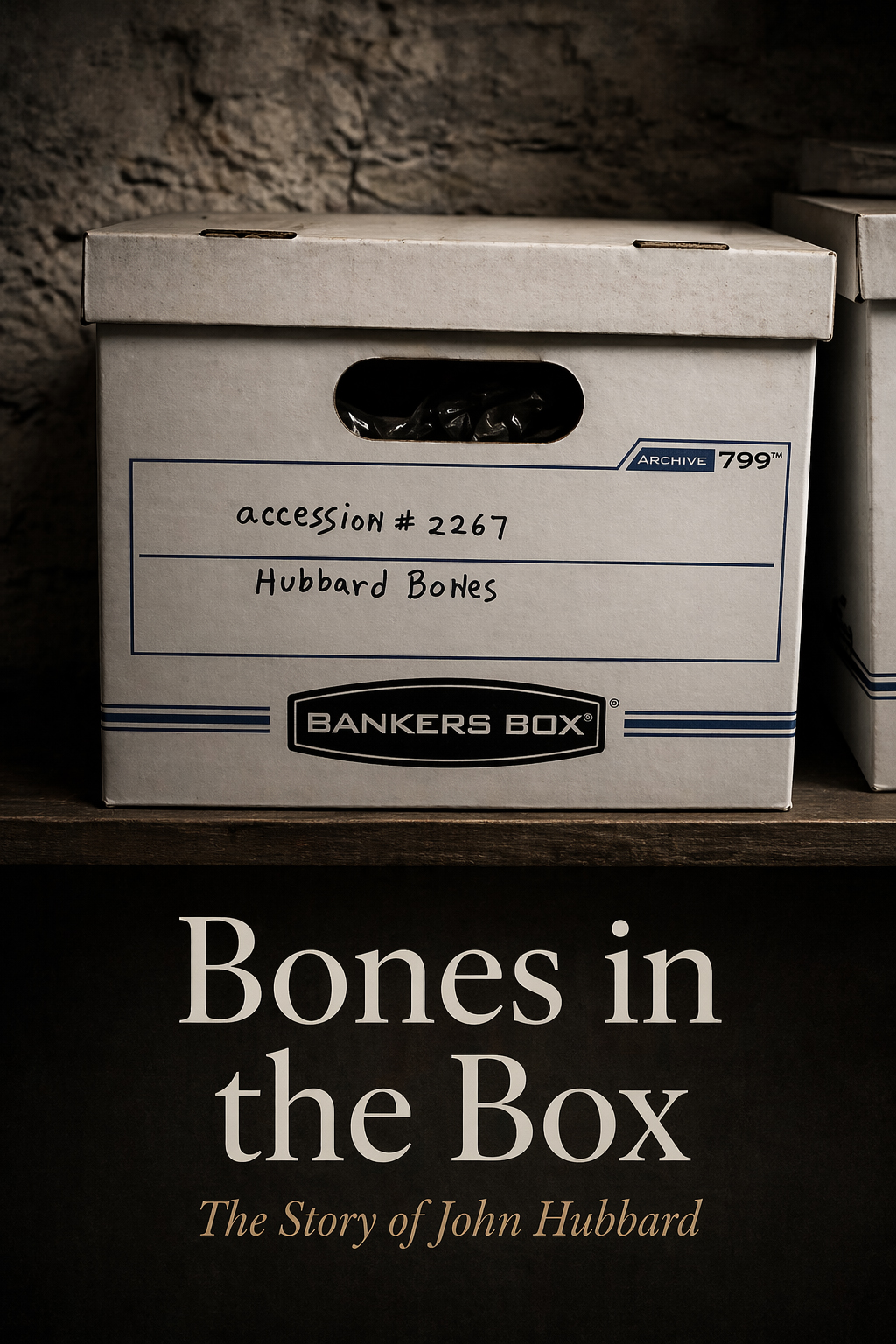

There is a room in the basement of the Wabash County Historical Museum where human bones are kept in boxes.
That sentence sounds like local folklore. It sounds like the kind of thing people repeat because it is strange, grim, and easy to remember. But in Wabash, Indiana, the story is not merely folklore. It is attached to one of the darkest events in Wabash County history: the 1854 murder of Aaron French, his wife, their five children, and an Irish canal laborer named Edward Boyle.
The man hanged for those murders was John Hubbard.
The legend says the bones in the museum basement may be his.
The problem is that the record does not cleanly agree.
That is where Bones in the Box: The Legend of John Hubbard begins.
This book is not written as true-crime entertainment. It is not a campfire retelling, and it is not a polished version of the old county story. It is an evidence file. It takes the Hubbard case back to the original sources: the 1855 Wabash Gazette discovery article, the Indiana State Sentinel execution synopsis, the later county histories, the cemetery records, the museum narrative, the Find-a-Grave dispute, the Quaker genealogies, the Brooks Cemetery record, and the physical remains that still have not been publicly identified by forensic testing.
The result is not a simple answer.
It is something more disturbing: a fracture.
On one side is the official story. Hubbard was arrested, tried, convicted, hanged on the courthouse square in December 1855, and buried under legal supervision at the Poor Farm Cemetery. In that version, the county did what it was supposed to do. The law acted. The body was buried. The case was closed.
On the other side is the local legend that refuses to die. In that version, Hubbard’s body did not stay buried. Doctors allegedly fought over it in the rain. His corpse was taken for dissection. His skeleton passed through medical offices, schoolrooms, and finally into the museum world. Somewhere along the way, the bones became part of Wabash County’s hidden inheritance.
Then comes the third version: that the bones are not Hubbard at all, but belong to another man, possibly a Civil War-era medical skeleton later misidentified by local memory.
That is not a small disagreement. That is the whole case coming apart.

The murder itself has always been told in simplified form: a poor family, a violent boarder, stolen clothing, a shoe hammer, a cellar grave. But Bones in the Box argues that this stripped-down version is too small for what actually happened.
The French family did not disappear in some empty wilderness. They were living near Keller’s Station, inside a watched canal neighborhood in Noble Township. The cabin stood on land owned by Isaac Keller. The Wabash & Erie Canal ran through the same corridor. The railroad was arriving. Canal laborers, horse traders, Quaker families, local doctors, landlords, and old pioneer lines all moved through the same tight geography.
That matters.
Because when the French family vanished in October 1854, the neighbors were not ignorant of them. They knew the family. They knew Aaron French was sick. They knew there had been talk of the family leaving for a milder climate. They knew Hubbard remained in the cabin afterward. They noticed things. Clothing. Smell. Explanations that shifted from Illinois to Iowa.
And yet the floor was not opened until after Edward Boyle’s body surfaced in the drained canal months later.
That is one of the hardest parts of the story. The county did not discover the crime because everyone was alert. It discovered the crime because the canal gave back the body.
Only then did the French family come out from under the floor.

One of the most important pieces of the book is the way it restores the surrounding families and institutions that later versions pushed into the background.
The Brooks family cemetery, once located near Richvalley, was eventually plowed over. The French family, because their deaths anchored the murder legend, remained commemorated. But the Brooks dead — tied into the same neighborhood world of Keller’s Station — were allowed to disappear from the landscape. That contrast is not just cemetery trivia. It is a clue to how civic memory works. Some dead become symbols. Others are cleared away.
The same is true of the Hubbard name.
Modern summaries often call John Hubbard a Canadian canal worker, a useful label because it makes him seem unattached, foreign to the local fabric, and easy to remove from the deeper Wabash story. But the manuscript presses a harder question: what if the Hubbard matter was not so cleanly outside the county’s own family and Quaker networks?
There was another John Hubbard in Wabash County. A Quaker-associated John Hubbard. A Deep River, Guilford County, North Carolina line. A Hubbard connected by marriage to the Coffin family, the same broad Quaker world associated with Levi Coffin and the Underground Railroad migration into Indiana.
The book does not pretend this proves the two John Hubbards were the same man. It does something more responsible and more unsettling: it refuses to close the question just because the county story would be easier if the condemned man remained a disposable outsider.
Then there is Sallie Hubbard.
After serving years in prison, a woman named Sallie Hubbard appears as the first inmate transferred into the Indiana Reformatory Institution for Women and Girls in 1873, under a board led by Quaker reformer Rhoda Coffin. That detail does not end the argument. It widens it. It suggests that the Hubbard case did not simply end at the gallows. It continued through reform networks, prison administration, family lines, institutional custody, and the management of reputation.
That is the real subject of Bones in the Box.
Not merely murder.
Custody.
Who had custody of the story?
Who had custody of the body?
Who had custody of the documents?
Who had custody of the dead?
The book’s central demand is simple: the bones should be examined by a qualified forensic anthropologist, identified as far as possible, and buried with dignity.
That demand matters whether the bones are Hubbard’s or not.
If they are Hubbard’s, then the old legend contains more truth than the official burial story allows.
If they are not Hubbard’s, then Wabash County still has an unidentified human being sitting in boxes, caught inside a story that may not even belong to him.
Either way, the answer cannot be another century of ambiguity.
The old version of the John Hubbard story gave Wabash a villain. It gave the county a courthouse hanging, a murder weapon, a death mask, a set of handcuffs, and a basement rumor. But Bones in the Box asks whether that version was too convenient. It asks what got edited out when the case became heritage. It asks why the physical remains were preserved but not resolved. It asks why the story keeps changing depending on who is telling it.
Most of all, it asks the one question that should have been answered a long time ago:
Who is in the box?
And until that question is answered, the John Hubbard case is not closed.
Leave a Reply