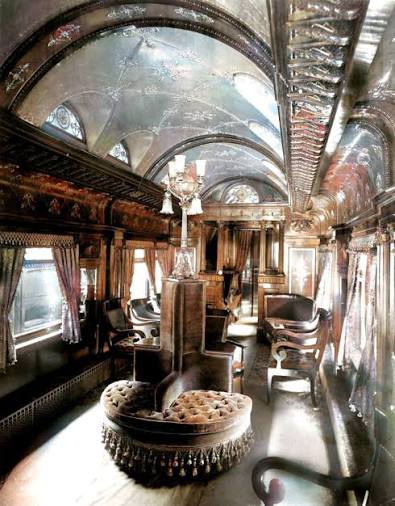
In the late nineteenth century, an American traveler could buy a ticket from one railroad and then spend the night inside a railcar belonging to an entirely different corporation. The man taking his coat was employed by that corporation. So was the conductor responsible for the sleeping car. The linens, food, furniture, rules of service and even the name painted onto the car came from the same company.
That company was Pullman.
George Pullman did not invent the sleeping car, and the Pullman Company was not itself one of America’s great trunk railroads. Its more important innovation was organizational. Pullman created a privately administered environment that could be attached to somebody else’s railroad and carried across state lines. The Smithsonian’s Pullman archive describes the model plainly: Pullman leased sleeping cars to railroads while supplying the porters, conductors, dining personnel, food and linens required to operate them.
That distinction changes the way the Pullman story looks. The company did not merely manufacture railroad cars. It created a standardized corporate interior that could travel through many different jurisdictions while retaining the Pullman name, Pullman employees and Pullman service.
In that sense, the famous company town south of Chicago was only half of George Pullman’s experiment.
The other half moved.
George Pullman and an 1877 depiction of dining aboard a Pullman car. The company’s product was increasingly not simply a carriage, but an entire managed environment.
A Hotel That Could Cross a State Line
Pullman’s first important sleeper, the Pioneer, appeared during the Civil War era. The National Park Service dates its construction to 1864 and notes that the car received enormous public exposure when it became associated with Abraham Lincoln’s funeral journey to Springfield after the president’s assassination. Pullman subsequently organized the Pullman Palace Car Company in 1867.
The Lincoln association is worth remembering because it established Pullman at almost exactly the moment the United States was emerging from civil war and consolidating a truly national transportation system. Railroads were connecting cities faster than older municipal and state institutions could coordinate them. A businessman might leave one jurisdiction after dinner, sleep through several others and wake hundreds of miles away.

Pullman recognized that this movement created a new kind of market. Passengers no longer needed only transportation; they needed temporary domestic space while moving.
In 1867 Pullman introduced what the National Park Service calls his first “hotel on wheels,” complete with sleeping accommodations, food and elaborate service. Pullman cars eventually incorporated dining rooms, parlors, observation spaces, heating, lighting, improved brakes and enclosed vestibules that allowed passengers and employees to pass safely between moving cars.
The phrase hotel on wheels is more important than it sounds. Hotels administer temporary populations. They assign rooms, control access, keep accounts, provide food, store property, employ servants and create rules for behavior inside a privately managed space.
Pullman had discovered how to make such a space mobile.
The Corporation That Rode on Other People’s Railroads
By 1877, the Pullman company was operating roughly 460 luxury passenger cars, staffed by company conductors and African American porters. It expanded not by constructing an independent transcontinental railroad but by placing Pullman equipment on existing railroads.
That made Pullman unusually modern.
Think of the distinction between a railroad and Pullman in contemporary terms. The railroad owned the physical route. Pullman supplied a branded service layer sitting on top of the route. A passenger could travel over different railroad companies while remaining inside an environment whose furniture, service expectations and employees belonged to Pullman.
The railroad supplied the road.
Pullman supplied the experience of inhabiting it.
The company even gave its cars names rather than merely numbers, according to Smithsonian records, deliberately giving individual cars personalities and using geographic names to promote destinations.
This meant that the Pullman brand could become more familiar to an interstate traveler than some of the railroads actually pulling the car.
It was a remarkable inversion. Infrastructure normally belongs to a place: a factory in a city, a hotel on a street, a courthouse inside a county. Pullman’s most important infrastructure belonged to a network.
And once Pullman had learned to construct a controlled environment that traveled through the country, George Pullman attempted something even more ambitious.
He built a town according to the same philosophy.
The Sleeping Car Stops Moving
Beginning around 1880, Pullman purchased approximately 4,000 acres near Lake Calumet south of Chicago. Architect Solon Spencer Beman and landscape architect Nathan Barrett designed a planned industrial community surrounding the company’s enormous manufacturing complex. Houses, shops, parks, a hotel, theater, library and other facilities were incorporated into the plan.
The surviving photographs are striking because Pullman does not resemble the stereotypical nineteenth-century industrial settlement. Streets were landscaped. Brick housing replaced many of the improvised wooden tenements common to rapidly industrializing cities. There were alleys for trash collection, parks, modern utilities and carefully differentiated housing for workers of different incomes and status.


4
Pullman housing, the Hotel Florence and the planned town surrounding the works. The beauty of the place was part of the corporate program, not incidental decoration.
There was a serious social philosophy behind the architecture. Pullman believed orderly surroundings could produce orderly workers. The town offered cleaner housing and amenities than many industrial neighborhoods, but the corporation retained extraordinary influence over the environment in which its employees lived.
Pullman owned the homes. The company charged rents intended to produce a six-percent return on its investment. Certain activities were restricted inside the town, while nearby neighborhoods offered things that Pullman itself did not: saloons, denomination-specific churches and, crucially, private property ownership.
Contemporary critics immediately recognized the problem. Richard T. Ely’s influential 1885 examination of Pullman argued that the supposedly benevolent system also deprived workers of ordinary control over their domestic surroundings. The National Park Service likewise preserves an 1888 Chicago Tribune criticism describing the contrast between the town’s attractive exterior and the “surveillance” and authority experienced by residents inside it.
The argument was therefore never simply that Pullman was a miserable place to live. That would miss what made the experiment historically important.
Pullman was attractive because control had been designed into it.
The company had attempted to solve urban disorder, labor conflict, sanitation and worker instability by designing an entire environment around corporate production.
A Company Town That Looked Almost Like a State
It would be inaccurate to say Pullman was literally an independent government. Illinois law still applied, public courts still existed, and ultimately those public institutions would place limits on the company.
Yet the town performed an unusual number of functions normally associated with municipal life. The employer was simultaneously landlord, planner and provider of large parts of the physical and social environment. The company determined which buildings existed, how workers rented them and what kinds of businesses and activities were allowed within the settlement.
The sleeping car worked according to a related logic.
Inside the car, passengers encountered Pullman employees, Pullman furnishings and Pullman service while traveling over another company’s railroad. Inside the town, workers encountered Pullman housing, Pullman buildings and Pullman’s social vision while technically remaining ordinary citizens of Illinois.
The car was a privately managed interior moving through public geography.
The town was the stationary version.
That is why the Pullman State is useful as a historical concept, provided it is understood as an analogy rather than a claim of literal sovereignty. Pullman reveals how much governing power a corporation can acquire simply by controlling the infrastructure through which people live and move.
Then Came 1893
For a brief moment the Pullman experiment appeared spectacularly successful. Thousands of visitors came to inspect the model community, particularly during Chicago’s World’s Columbian Exposition of 1893, when Pullman itself became one of the region’s attractions.
Then the economy collapsed.
The Panic of 1893 hit the railroad industry especially hard. Orders declined, Pullman laid off workers and reduced wages. The central grievance was devastatingly simple: the company cut wages but did not correspondingly reduce the rents its employees owed for company-owned housing.
The same system that had seemed efficient during prosperity suddenly revealed its danger during contraction.
If the company paid your wage and another landlord charged your rent, losing income was one problem.
If the company paying your wage was also your landlord, the problem became circular.
Workers struck at the Pullman works on May 11, 1894. What began as an industrial dispute in one company town soon became something vastly larger because Pullman was not confined to Pullman.
Its cars were everywhere.
The Boycott Revealed the Hidden Network
The American Railway Union, led by Eugene V. Debs, eventually backed a nationwide boycott in which union railroad workers refused to handle trains carrying Pullman cars. Because Pullman equipment had become integrated into rail service across the country, a dispute over wages and rents in one Chicago neighborhood could now interfere with transportation hundreds or thousands of miles away.
That fact alone reveals the real scale of George Pullman’s creation.
The factory was local.
The network was national.
The General Managers’ Association, representing twenty-four railroads with Chicago terminals, coordinated the railroads’ response. According to the National Park Service, railroad managers also attached Pullman cars to trains carrying U.S. mail, making interference with those trains a federal issue as well as a labor dispute.
Federal courts issued an injunction against boycott activities, and President Grover Cleveland’s administration dispatched federal troops despite the objections of Illinois governor John Peter Altgeld. Violence intensified in and around Chicago rail yards, workers were killed and injured, and the boycott collapsed during July.

The conflict therefore passed through several layers of authority with extraordinary speed: worker, company, union, railroad association, federal court, U.S. mail and finally the Army.
What had begun with rent payments in company housing became a national confrontation because Pullman’s private system had been threaded through the country’s transportation infrastructure.
That is the moment when the Pullman story becomes much larger than a labor-history episode.
The Railroad Corridor Was a Different Kind of Geography
Nineteenth-century America still appeared on political maps as a collection of states and counties. Railroads were simultaneously creating another geography that did not care nearly as much about those boundaries.
Chicago, Detroit, Toledo, Fort Wayne, Lafayette, Indianapolis, Terre Haute, St. Louis and Kansas City mattered because lines, passengers, freight, mail, express shipments and information passed through them.
A railroad timetable was therefore a different kind of map.
And Pullman lived on that map.
The company’s cars could move from one carrier to another while the Pullman service environment continued inside them. That made the sleeping-car company part of a larger family of interstate businesses—express companies, telegraph companies and private security agencies—that existed because Americans were increasingly operating across jurisdictions faster than local institutions could follow.
The Pinkerton National Detective Agency emerged from precisely this world. Library of Congress records note that Pinkerton frequently worked for railroad companies such as the Illinois Central; after the Civil War, the firm expanded into railway crime investigations and later became notorious for its involvement in labor disputes.
Again, the point is not that Pinkerton secretly controlled Pullman. There is no need to invent a unified conspiracy.
The more interesting reality is that railroad capitalism generated an entire ecosystem of private institutions capable of operating nationally before much of government operated nationally in everyday practice.
Transportation companies moved people.
Express companies moved valuables.
Telegraph companies moved information.
Detective agencies pursued people across jurisdictions.
Pullman administered the place where travelers slept between them.
Indianapolis Was Already Built for This World
This is where Indiana becomes far more important than it first appears.
Indianapolis had opened what the Indiana Historical Society describes as the nation’s first union station in 1853. The idea was itself an institutional innovation: instead of requiring every railroad entering a city to maintain a completely separate passenger terminal, competing companies could share one central interchange. A much larger Romanesque Revival Union Station replaced the original facility in 1888.
By the early 1880s, fifteen railroads were using the Indianapolis Union Depot system, and congestion had become severe enough to justify the enormous replacement station. The city was becoming less an endpoint than a switching mechanism between competing transportation systems.

Indianapolis Union Station and an 1878 Wabash-system map. Indiana sat inside the dense Midwestern rail web linking Chicago, Detroit, Toledo, Indianapolis, St. Louis and points farther west.
The Wabash system belonged squarely to this environment. An 1888 Wabash advertisement promoted through service connecting cities including Chicago, Detroit, Fort Wayne, Indianapolis, Cincinnati, St. Louis and Kansas City and specifically advertised Pullman Palace, Wagner and Woodruff sleeping cars alongside dining and reclining-chair service.
Another surviving account, Nine Thousand Miles on a Pullman Train, describes a Pullman excursion departing Indianapolis, passing through Terre Haute, crossing the Wabash River and continuing toward St. Louis. The episode is mundane, which is exactly why it matters: by the 1890s a Pullman interior could simply pass through Indiana as part of ordinary long-distance life.
The Pullman Strike consequently did not remain a Chicago event. The Indiana Historical Society preserves records of special meetings of the Central Association of Railroad Officers held in Indianapolis on July 5 and 6, 1894, containing reports from central Indiana railroad officials about how the strike was affecting their operations.
That is a much stronger way to understand the Wabash and Indianapolis material than treating them as peripheral to Chicago.
They were part of the same machine.
The Man in the White Jacket
There was another population that understood the Pullman system from the inside better than almost anybody.
The porters.
Pullman relied heavily on African American men for sleeping-car service, initially drawing significantly from formerly enslaved men. The company eventually became one of the country’s largest employers of African Americans, while railroad employment itself remained rigidly divided by race and occupation.
A porter did far more than carry a suitcase. He converted seats into beds, handled bedding, assisted passengers, responded to requests and maintained the interior environment that made the Pullman brand valuable. The polished wood, curtains and brass fixtures mattered, but their luxury depended upon human labor.


That produced another contradiction inside Pullman’s private world. White passengers could experience the sleeping car as an unusually refined environment while the Black workers responsible for creating that experience faced low wages, dependence on tips, long hours and institutional discrimination.
In 1925, porters organized the Brotherhood of Sleeping Car Porters under A. Philip Randolph. After a twelve-year struggle, the organization reached a collective bargaining agreement with Pullman in 1937, a landmark in both Black labor history and the emerging national civil-rights movement.
The significance goes beyond labor history. Pullman’s national network inadvertently created a national class of highly mobile Black workers who carried newspapers, news, stories and political information between communities. The system built to standardize corporate service also helped produce workers capable of organizing across enormous distances.
The network worked in both directions.
The Lincoln Circle Closes
There is an almost impossibly neat historical loop buried inside the Pullman story.
Pullman’s Pioneer acquired national attention through the funeral journey of Abraham Lincoln in 1865. More than three decades later, Abraham Lincoln’s only surviving son, Robert Todd Lincoln, became one of the most important executives in the Pullman Company.
After serving as Secretary of War and later as U.S. minister to Britain, Robert Lincoln became Pullman’s general counsel. When George Pullman died in 1897, Lincoln became acting president; he served as company president from 1901 to 1911 and later as chairman of the board.


There is no reason to treat that sequence as mysterious. Chicago business circles were interconnected, Robert Lincoln was a highly successful lawyer and public official, and his corporate career is thoroughly documented.
Yet symbolically the sequence is extraordinary.
The father helped make Pullman’s sleeping car famous in death.
The son eventually ran the company.
More importantly, Robert Lincoln took over just as public institutions were beginning to dismantle the most extreme part of George Pullman’s experiment.
The State Pushes Back
In October 1898, the Illinois Supreme Court ordered the Pullman Company to dispose of its nonindustrial landholdings. Most of the town eventually passed out of company ownership, with residents receiving opportunities to purchase property.
This is perhaps the clearest demonstration that the Pullman State was never actually sovereign.
Public law could reach it.
The company’s attempt to combine employer, manufacturer, landlord and community planner inside a single corporate structure had encountered a boundary. Pullman could continue building and operating railcars, but the company’s direct experiment in owning the town around its workers was coming apart.
What survived was arguably the more important half of the model.
The network.
The Town Failed. The Platform Survived.
Pullman continued operating on an enormous scale through the twentieth century. A federal antitrust case eventually forced a separation between Pullman’s manufacturing and sleeping-car operating businesses, and in 1947 the operating unit was transferred to a consortium of fifty-nine railroads.
By then the basic idea Pullman had helped normalize was everywhere.
A traveler could inhabit a branded corporate environment stretched across geography. One corporation did not necessarily need to own the road beneath it. It needed agreements, standardized equipment, trained employees and access to the network.
That should sound familiar after looking at Hilton and TWA.
Pullman is an earlier version of the same conceptual problem.
How do you create a standardized environment for somebody who is moving?
The sleeping car solved it for the railroad age.
The international hotel and airline solved it for the Jet Age.
Computer reservation systems eventually solved the information problem.
Today’s digital platforms solve the coordination problem at a still larger scale.
What Pullman Really Built
George Pullman is usually remembered through two stories that are taught separately.
One is a transportation story about luxurious sleeping cars.
The other is a labor story about an authoritarian company town and the catastrophic strike of 1894.
They make considerably more sense when treated as one story.
Pullman’s true specialty was managed space.
He built a moving managed space for passengers and a stationary managed space for workers. In both cases, architecture, service, behavior and economic relationships were organized through a corporation. One traveled over a national rail network; the other stood beside the factory that manufactured the network’s cars.
The Panic of 1893 exposed the vulnerability of the town.
The strike of 1894 exposed the power of the network.
The boycott demonstrated that a labor dispute in a few square miles of Chicago could become a national emergency because Pullman cars had been woven into railroads across the United States. Federal intervention then demonstrated something equally important: once privately controlled infrastructure becomes important enough to national movement, the boundary between corporate administration and public power becomes difficult to maintain.
And Indiana makes that story particularly visible. Indianapolis’s Union Station centralized competing railroads into one physical node. The Wabash and other carriers connected it to Chicago, Detroit, St. Louis and the wider country. Pullman cars passed through those systems carrying passengers who could sleep inside essentially the same corporate environment regardless of whose locomotive happened to be pulling them.
That is why Pullman should not be understood merely as a railroad-car manufacturer.
For several decades, the company operated something stranger.
It owned houses without being a city.
It employed a national service workforce without owning the railroads beneath them.
It ran hotels that moved.
It standardized interiors across jurisdictions.
And when the workers who built those interiors stopped working in 1894, transportation across much of the United States began to seize up.
The town of Pullman eventually lost its corporate government.
The idea of governing people through the infrastructure they depend upon proved much harder to kill.