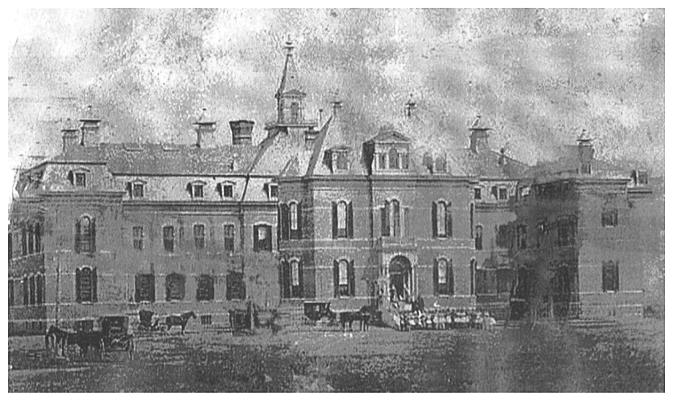
When Indiana opened its pioneering separate state prison for women in Indianapolis in 1873, seventeen prisoners were transferred from the old state prison at Jeffersonville. The first woman through the door was Sallie Hubbard. She had already spent seventeen years behind bars for her role in the Wabash County case that ended with seven members of the French family beneath a cabin floor and John Hubbard on the gallows.

On October 8, 1873, Indiana opened the doors of the Indiana Reformatory Institution for Women and Girls in Indianapolis. The institution represented something unusual in American corrections: female prisoners would no longer simply occupy a segregated corner of a state prison designed and staffed primarily for men. Indiana was creating a separate state institution built specifically around women and girls. Seventeen women were transferred from the State Prison South at Jeffersonville on opening day.
The first prisoner admitted was a woman whose name belonged to a much older Indiana story.
Sallie Hubbard.
Eighteen years earlier, John Hubbard had been hanged on the courthouse square in Wabash after being convicted in the deaths of Aaron French, his wife, and their five children. Sallie had survived the case. John went to the gallows; she went into the Indiana prison system.
Then, seventeen years later, the Hubbard story unexpectedly arrived at the beginning of an entirely new chapter in American institutional history.
The first prisoner in Indiana’s new women’s reformatory came out of the French family murder case.
That fact appears almost like an historical coincidence until the larger network surrounding Sallie’s transfer is examined.
Because waiting on the other side of the prison gates was another name already hovering around the Hubbard story.
Coffin.
The Woman in Shackles
A later account of the institution’s opening, drawn from the life of prison reformer Rhoda M. Coffin, describes Sallie Hubbard entering the new building under heavy restraint. The account calls her the first prisoner to enter and says she had spent seventeen years at Jeffersonville. Prison officials reportedly regarded her as exceptionally difficult to manage.
The transfer became part of the founding mythology of the new prison.
Sarah J. Smith, the institution’s first superintendent and herself a Quaker reformer, was presented with Hubbard by the sheriff and deputies. In the reform account, Smith ordered that the restraints be removed and received her into the new institution as a woman rather than simply as a dangerous body transported from one prison to another. Later retellings portray Hubbard eventually becoming a well-behaved prisoner within the new regime.
It is a powerful scene.
It is also a revealing one.
By 1873, Sallie Hubbard was no longer simply the wife of the man Wabash had hanged. She had become useful to another story: the story reformers were telling about what a women’s prison should be.
The old institution delivered a supposedly violent, heavily shackled female convict.
The new institution removed the chains.
The symbolism was almost perfect.
What tends to disappear from that scene is the complicated history that had brought Sallie Hubbard there in the first place.
What Happened at Keller’s Station
The French family had not been strangers passing through Indiana.
That matters because one of the later reform-era accounts of Sallie’s arrival at the women’s prison described the victims as a family traveling west who had merely stopped with the Hubbards for the night.
The surviving Wabash evidence tells a very different story.
Aaron French had lived around Keller’s Station for roughly six or seven years before the murders. He was poor and sick, and his family occupied a cabin on land belonging to Isaac Keller. The household consisted of Aaron, his wife, and five children. Contemporary neighbors estimated everything the family owned at no more than about fifty dollars.
The Hubbards were the newcomers.
John Hubbard arrived at Keller’s Station with his wife—identified variously in the surviving record as Sarah or Sallie—and a son. They lodged with the French family. Other canal workers boarded there as well, including Edward Boyle.
By October 1854 the French family had vanished. Their neighbors already knew that Aaron’s failing health had prompted discussion of leaving for a milder climate, so the disappearance had an explanation built into it. Months passed before the truth beneath the cabin emerged.
In April 1855, the floor was opened.
Seven members of the French household were found underneath.
The crime became one of the defining violent events in Wabash County history. John Hubbard was eventually convicted and hanged. Sallie Hubbard was sentenced to imprisonment.
Yet by the time the prison-reform literature retold her story in connection with the founding of the women’s reformatory, Keller’s Station had already been simplified. The settled French family had become travelers. The lodging arrangement had effectively been reversed. A complicated local crime had become a compact moral biography suitable for explaining the notorious woman entering the new prison.
That transformation is important.
It demonstrates how quickly institutional history can overwrite local history even when both concern the same person.
Why Indiana Built a Prison for Women
Sallie had spent her prison years in a system that reformers increasingly considered unacceptable for female prisoners.
Rhoda Coffin became one of the central figures in changing it.
Born Rhoda Johnson in Ohio in 1826, she entered Indiana’s Quaker world as a young woman and eventually settled in Richmond with her husband, Charles Coffin. Her work expanded from religious and charitable activity into prison reform. Indiana sources credit Rhoda and Charles Coffin with investigating prison conditions and encountering reports of severe mistreatment of incarcerated women, including physical and sexual abuse. Rhoda subsequently became an advocate for a separate institution for women and for greater female authority over female prisoners.

The Indiana legislature authorized the new institution in 1869. It finally opened in Indianapolis in October 1873 under the name Indiana Reformatory Institution for Women and Girls. The first seventeen adult prisoners came from Jeffersonville. Sarah J. Smith became superintendent, while Coffin remained deeply involved in the institution’s reform movement and governance.
The modern Indiana Department of Correction describes the Indiana Women’s Prison as the oldest and first adult correctional facility for women in the United States. Historians commonly describe the 1873 institution more precisely as the first separate state prison for women, an important distinction because other religious and charitable institutions for confined women existed by then.
Whatever terminology is used, Indiana was attempting something consequential.
And Sallie Hubbard was prisoner number one.
The Coffin Name Returns
This is where the story becomes especially interesting in the context of Bones in the Box.
Rhoda Coffin’s presence would mean little by itself. Coffin was a common enough Quaker surname, and a shared surname is not proof of a close family relationship.
But the Hubbard case already contains a separate Coffin connection.
As explored in the previous article in this series, another John Hubbard appears in the Wabash County genealogical record at almost exactly the same time as the condemned John Hubbard. This second John Hubbard was born in Guilford County, North Carolina, in 1796 and married Abigail Coffin at Deep River Monthly Meeting in 1822. He belonged to the large Quaker migration stream that carried families from North Carolina into Indiana.
That does not establish that the condemned Hubbard and the Matlock Cemetery Hubbard were the same person.
The surviving records contain serious contradictions, including different claimed birthplaces and incompatible death dates.
But it means the Hubbard name is already embedded in a Coffin-associated Quaker network before Sallie enters prison history.
Then, seventeen years after the hanging, a woman named Sallie Hubbard emerges from Jeffersonville as the first prisoner admitted into a groundbreaking institution created through the work of Indiana Quaker reformers prominently including Rhoda Coffin.
The manuscript behind Bones in the Box emphasizes the connection cautiously. Its point is not that the recurrence of the Coffin name solves the Hubbard identity problem. Its point is that the Hubbard affair did not disappear after the execution. It continued through family lines, Quaker institutions, prison reform, burial grounds and later custodians of the story.
That is considerably more interesting than treating December 1855 as the ending.
Jeffersonville Was Part of the Story Too
Before the Indianapolis reformatory opened, female felons in Indiana were confined within the state’s existing prison system. State records confirm that the women transferred in 1873 came from State Prison South at Jeffersonville, where women had been kept in a separate section of a primarily male institution.
For Sallie Hubbard, that meant approximately seventeen years inside Jeffersonville.
The reform literature later described her as a “terror” there, language worth treating carefully. Modern scholarship on the early Indiana women’s prison has emphasized that descriptions produced by prison administrators cannot simply be separated from the conditions prisoners endured. Research by the Indiana Women’s Prison History Project has revisited the violence, exploitation and gendered assumptions that shaped nineteenth-century incarceration, complicating older narratives in which benevolent reformers simply rescued disorderly women from a bad system.
That complication matters for Sallie.
The historical record has repeatedly assigned her roles according to the institution telling the story.
In Wabash, she became the murderer’s wife.
At Jeffersonville, she became a difficult prisoner.
In the founding story of the Indianapolis reformatory, she became the shackled woman whose reception demonstrated the humanity of the new female administration.
Every version may preserve something real.
None should automatically be mistaken for the whole person.
A Different Kind of Prison
The Indiana institution attempted to distinguish itself from older penitentiary models by emphasizing reform as well as punishment. Women were assigned work such as sewing, knitting and laundry, while the administration attempted to create a more domestic environment that nineteenth-century reformers believed could reshape female behavior.
That model carried its own assumptions about gender, morality, labor and obedience. A woman could be considered “reformed” partly by learning the domestic behaviors that middle-class reformers considered appropriate to womanhood.
The institution was therefore progressive in one sense and deeply paternalistic in another.
Women were being removed from confinement under male prison officers, an important response to documented abuse. At the same time, the solution was not freedom. It was a new system of female incarceration organized around a particular idea of respectable womanhood.
The famous scene involving Sallie Hubbard captures that tension perfectly.
The shackles come off.
The prison door remains closed.
Rhoda Coffin’s Reform Did Not End in 1873
The opening of the institution was not the end of Coffin’s campaign.
Internal problems soon emerged, and Coffin continued pressing for greater female control of the prison. After investigation and further legislation, the state reorganized governance in 1877 around an all-female board. Coffin became its president. Her advocacy eventually made her a nationally recognized figure in prison reform, and she spoke and wrote extensively about the treatment of incarcerated women.
The prison itself survived long beyond the nineteenth century. Its name, governance and population changed repeatedly, and the adult and juvenile sections were eventually separated. Indiana’s state archives preserve inmate registers beginning with the institution’s opening in 1873, along with other records that can include commitment documents, prisoner packets and biographical information.
That archive begins with seventeen women arriving from Jeffersonville.
At the front of them was Sallie Hubbard.
The Strange Afterlife of a Murder Case
The conventional John Hubbard story ends neatly.
The French family is murdered.
The bodies are discovered.
Hubbard is tried.
Hubbard is hanged.
The county moves on.
But very little about the surviving record actually behaves that way.
The bones traditionally identified as Hubbard’s acquire their own disputed history.
Another John Hubbard appears in the same county’s Quaker genealogy.
The condemned man’s wife survives him by decades inside the Indiana prison system.
And when Indiana opens a pioneering institution for incarcerated women, Sallie Hubbard becomes its first prisoner.
The case has moved from a cabin at Keller’s Station to the Wabash courthouse, from the gallows into the state penitentiary, and finally into the national history of prison reform.
Even the retelling changes along the way. By the time Sallie’s story is being used to explain the women’s prison, the French family has been transformed from longtime residents of Keller’s Station into westward travelers who happened to stop for the night.
That small alteration tells us something important.
Institutions do not merely preserve stories.
They reshape them.
A county remembers a murderer one way. A prison remembers his wife another. A reformer needs a symbolic first prisoner. A museum inherits bones. A genealogist inherits family records. Each custodian receives only part of the event, and each produces another version of what happened.
That is the larger territory explored in Bones in the Box: The Legend of John Hubbard. The book begins with the French family murders but follows the evidence far beyond the crime itself—into the disputed identity of John Hubbard, the fate of his body, the Quaker and Coffin networks running through Indiana, forgotten burial grounds, and the institutions that inherited pieces of the story long after everyone who witnessed the crime was dead.
Sallie Hubbard’s arrival in Indianapolis in 1873 is one of those pieces.
The rope had gone slack almost eighteen years earlier.
The Hubbard story was still moving.
Read Bones in the Box: The Legend of John Hubbard on Amazon