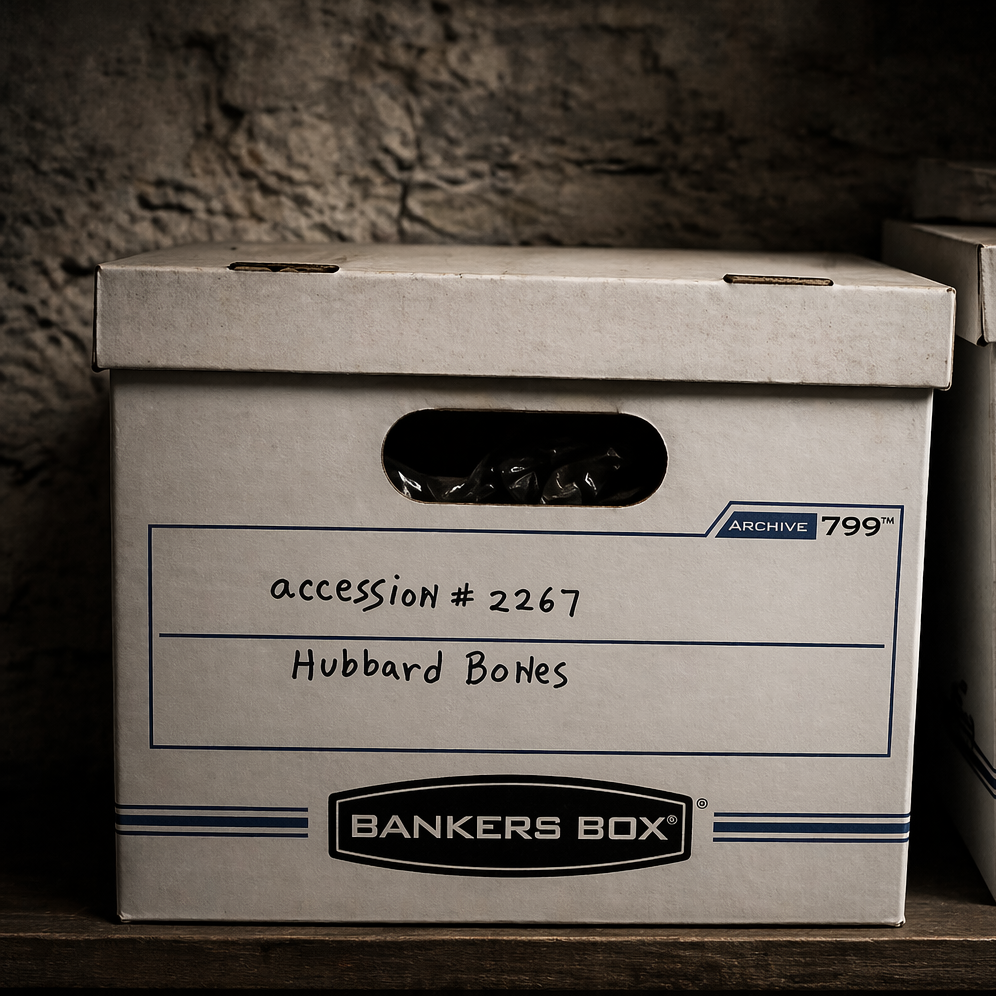
In a basement in Wabash, Indiana, human remains sit in cardboard boxes. For generations they were identified with one of the most notorious murder cases in the county’s history. Today, even the institution holding them stops short of saying whose bones they actually are.


There is an uncomfortable difference between preserving a story and preserving a body.
At the Wabash County Historical Museum in northern Indiana, the distinction is unusually literal. Among the institution’s holdings are human skeletal remains kept away from ordinary public display. For much of their known history, those bones have been associated with John Hubbard, the man hanged at Wabash on December 13, 1855, after being convicted in one of the darkest criminal cases in nineteenth-century Indiana.
The museum still possesses objects connected to the Hubbard story: handcuffs and a key, the lock from his cell, newspaper material surrounding the execution, and a plaster representation of his head. Yet the bones themselves occupy a much stranger position. In 2021, museum archivist TJ Honeycutt told WPTA that they could not be confirmed as Hubbard’s “with absolute certainty.” He also explained that displaying human remains was outside the museum’s current mission and that the institution did not want to further sensationalize the old killer story.
That is where a local legend becomes something considerably more difficult.
Because if those bones are not John Hubbard’s, whose are they?
And if they are Hubbard’s, how did a man supposedly given a proper burial after his execution eventually end up reduced to a skeleton that passed through doctors, schools, closets, and finally a museum basement?
Those questions form the opening problem of my book, Bones in the Box: The Legend of John Hubbard. The book brings together the surviving primary sources, the legend as generations of Wabash residents received it, and the county record as it presently stands. Those three things do not fit together nearly as cleanly as the familiar story suggests.
Eight Dead at Keller’s Station
To understand why anyone believed the skeleton belonged to Hubbard, the story has to return to 1854.
Aaron French was living with his wife and five children near Keller’s Station, west of Wabash, in a small cabin on land owned by Isaac Keller. The family was poor. Aaron was ill, and neighbors understood that the Frenches were preparing to leave the area in hope that a different climate might improve his health.
Then the family disappeared.
That disappearance initially possessed a ready explanation. The neighbors already expected the Frenches to leave. In a rural community where migration was common, absence did not necessarily mean catastrophe. The explanation was already waiting before anyone needed it.
John Hubbard, his wife, and their son had been staying with the Frenches. After the French family vanished, the Hubbards remained associated with the cabin. Another boarder, a canal worker named Edward Boyle, also disappeared.
Eventually Boyle’s death drew official attention back toward Hubbard. Investigators returned to the property, and in April 1855 a coroner’s jury opened the floor of the cabin.
Underneath were seven bodies.
Aaron French, his wife, and their five children had been concealed beneath the place where ordinary domestic life had apparently continued after their deaths. Contemporary reporting put the family’s possessions at no more than about fifty dollars and presented robbery as the apparent motive. The scale of the violence, however, sat awkwardly beside that explanation: an entire family killed, seven bodies hidden beneath a floor, another man dead separately, and months of concealment afterward.
Hubbard was tried, convicted, and sentenced to hang.
The execution would not be the end of his story. It may instead have been the beginning of the problem now sitting in those boxes.
A Body “Decently Buried”
The clean version is simple.
Hubbard was executed on the Wabash courthouse square on December 13, 1855. He was then buried. The 1914 History of Wabash County stated that his body was “decently buried,” while also preserving the remarkable qualification that it was later said to have been disinterred “in the interest of science.”
That little phrase opens a door into nineteenth-century medicine that is difficult to close.
Human cadavers were enormously valuable to physicians teaching anatomy. Legal access to bodies was limited, and the nineteenth-century history of American medicine is full of grave robbing, unauthorized dissection, disputed possession of corpses, and uneasy relationships between doctors and local authorities.
The Hubbard legend places Wabash directly inside that world.
According to the version that survived locally, two Wabash physicians—Dr. James Ford and the younger Dr. James L. Dicken—wanted Hubbard’s corpse for anatomical study. Another group of doctors was said to have wanted it as well. In the most dramatic telling, competing parties descended on the burial site during a rainy night, the body was removed, and shots were exchanged during the struggle over who would possess it.
The story then becomes stranger rather than clearer.
Hubbard’s body was supposedly taken back into Wabash and dissected. Later recollections placed his skeleton in medical settings and eventually in educational use. A 1954 newspaper account, according to the museum’s present interpretation, connected the bones with Wabash High School. The 2021 WPTA report likewise noted that the remains were believed to have been used there for teaching.
If that chain is substantially correct, a condemned man’s body ceased being a buried human being and became an anatomical object.
And that object survived.
The Skeleton Gets a Second Life
This is where the story becomes difficult to dismiss as nineteenth-century folklore.
The museum does, in fact, have bones.
The surviving tradition is not merely that Hubbard’s grave was robbed. The tradition describes what happened afterward. The skeleton was retained, moved, used and remembered. One later recorded version traced it through medical possession, a school and long storage before its eventual arrival at the museum.
The manuscript underlying Bones in the Box begins here for a reason. The physical remains are the point at which folklore runs into custody. A ghost story requires only repetition. A skeleton requires an explanation.
The museum publicly acknowledges the uncertainty. The bones exist, but their identity has not been conclusively established. The museum’s cautious language leaves open the very question that generations of retelling often treated as settled.
That uncertainty produces two radically different histories.
In one, the old Wabash story is substantially true. Hubbard was buried after the execution, his corpse was later obtained by physicians, his body was anatomized, and his skeleton survived long enough to enter local educational and museum collections.
In the other, the bones never belonged to Hubbard at all.
The Man Called Oscar
A competing account preserved by a Hubbard-Coffin family researcher offers an almost point-by-point rejection of the grave-robbing story.
Under that version, Hubbard was properly buried at the county Poor Farm and remained there. The skeleton later associated with him supposedly belonged instead to a Civil War-era man identified as Oscar, whose body came into the possession of Dr. James Ford for anatomical instruction. Ford allegedly prepared the skeleton, retained it, and the remains subsequently passed into educational use.
This counter-story is important because it does more than suggest that somebody made a mistake. It replaces nearly every major element of the traditional Hubbard narrative.
No stolen Hubbard corpse.
No competing doctors fighting over his body.
No Hubbard skeleton.
No anatomical afterlife of the condemned man.
Instead, there is another dead man whose remains acquired the wrong identity somewhere during the long journey between nineteenth-century medicine and twentieth-century local history.
The trouble is that simply substituting Oscar for Hubbard does not solve the larger problem.
It creates another one.
Who was Oscar?
Where is the documentation establishing that the skeleton belonged to him?
At what point was the identification made?
How securely can the remains be traced from Dr. Ford to the later institutions said to have possessed them?
Most importantly, what physical examination has conclusively established either identification?
The available public story does not contain a published DNA result establishing Hubbard. It does not contain a publicly established forensic identification of Oscar. What survives instead is a human skeleton surrounded by competing chains of memory.
That is not resolution.
It is disputed custody.
The Head Upstairs and the Bones Downstairs
One of the strangest elements of the entire affair is that Hubbard survives in another physical form.
The museum possesses a plaster representation of his head. The 1914 county history specifically records that a plaster cast of Hubbard’s head and shoulders was long preserved by Dr. James Ford. The modern museum describes its displayed bust more cautiously, saying it was created from drawings and descriptions by people who saw Hubbard.
Those different descriptions matter.
They demonstrate how easily an object can remain while its provenance changes around it.
A thing sits on a shelf for generations. The people who originally handled it die. Labels are rewritten. Oral accounts become catalog descriptions. A family version contradicts an institutional version. A newspaper repeats one identification while another source repeats another.
Eventually the object appears stable because the object itself has survived.
Its story may be far less stable.
That is exactly the problem presented by the bones.
Wabash Never Completely Let John Hubbard Go
The execution itself became one of Wabash County’s defining nineteenth-century events. Hubbard was hanged on the courthouse square before a crowd that contemporary and later accounts remembered as enormous. The local newspaper opposed the execution strongly enough to publish the warning “Do not come to Wabash,” while a Peru newspaper characterized the affair as Wabash descending into barbarism. The 1914 county history would later describe the hanging as the county’s first and only execution.
Even the courthouse associated with that memory disappeared. The courthouse standing in Wabash today is not the building before which Hubbard died; the earlier courthouse was destroyed by fire in 1870, and the present structure dates to the late 1870s.
The city changed.
The courthouse changed.
The canal declined.
The railroad took over.
The cabin disappeared.
The people who witnessed the murders, trial and execution died.
Yet the material remnants kept moving forward.
A lock.
A key.
Handcuffs.
A plaster head.
Newspaper clippings.
And a box containing the bones of somebody.
This Is No Longer Just a John Hubbard Story
The easiest treatment of the Hubbard case is to turn it into a nineteenth-century horror story: a family slaughtered, a murderer hanged, doctors fighting for his corpse, and his skeleton eventually deposited in a museum.
That version is memorable.
It may even contain substantial truth.
But the presence of actual human remains changes the burden of the story.
If the skeleton is Hubbard’s, then some version of his post-execution anatomical history occurred despite the cleaner burial narrative. If it belongs to Oscar, then another human being spent generations being displayed, stored or described under the identity of an executed murderer. If neither identification is correct, then the problem becomes larger still.
Whatever name belongs to the bones, they belonged first to a person.
That is why Bones in the Box is not written as true-crime entertainment. The book describes itself instead as an evidence file, a reconstruction and, in a very real sense, a custody dispute with the past. Its central argument is that the remains should not be treated merely as relics of a profitable local legend, because the disagreement over their identity is itself part of the history that has to be confronted.
The unanswered question in Wabash is therefore much simpler than the sprawling legend that surrounds it.
There are bones in the box.
Whose bones are they?
Bones in the Box: The Legend of John Hubbard follows that question backward through the French family murders, the 1855 newspapers, Hubbard’s execution, the physicians who handled the story afterward, conflicting burial accounts, genealogy, Quaker networks, forgotten cemeteries and more than a century of local attempts to explain what survived.
Read Bones in the Box on Amazon