The official congressional record gives us three nineteenth-century Democrats named Hughes: one associated with Missouri, one with Indiana, and one with Maryland. Read their biographies separately and each life looks ordinary enough. Put the three files on the same table, however, and the chronology begins to behave very differently.
The Biographical Directory of the United States Congress contains thousands of individual lives arranged exactly as a reference system should arrange them: one person, one entry, one sequence of offices. The House describes the directory as a continuing biographical record of the people who have served in Congress since the founding era.
Buried inside that enormous catalog are three entries that form the starting point of HUGHES: One Man, Three Names.
James Madison Hughes represented Missouri in the Twenty-eighth Congress from 1843 to 1845. James Hughes represented Indiana in the Thirty-fifth Congress from 1857 to 1859. George Wurtz Hughes represented Maryland in the Thirty-sixth Congress from 1859 to 1861. All three are recorded as Democrats, and the congressional directory treats them as three entirely separate men.
That is the established record, and any attempt to challenge it has to begin there.
The argument developed in HUGHES is not that three men shared a surname and therefore must have been one person. Hughes was hardly a rare name, and nineteenth-century America produced plenty of lawyers, soldiers, engineers, merchants and Democrats whose careers crossed state lines. The problem arises only after the biographies are placed side by side. West Point, the Mexican War, Maryland, law, federal service, engineering, border-state Democratic politics, one-term congressional careers and unusually convenient transitions begin appearing around the same structural points. The manuscript presents this explicitly as a working revisionist theory, not as a settled identification.
The question is therefore narrower and more interesting than simply asking whether an official directory is “wrong.”
What happens when three biographies that have always been researched separately are forced to account for one another?
The First Hughes Appears in Missouri
James Madison Hughes is the earliest congressional figure in the sequence.

Share
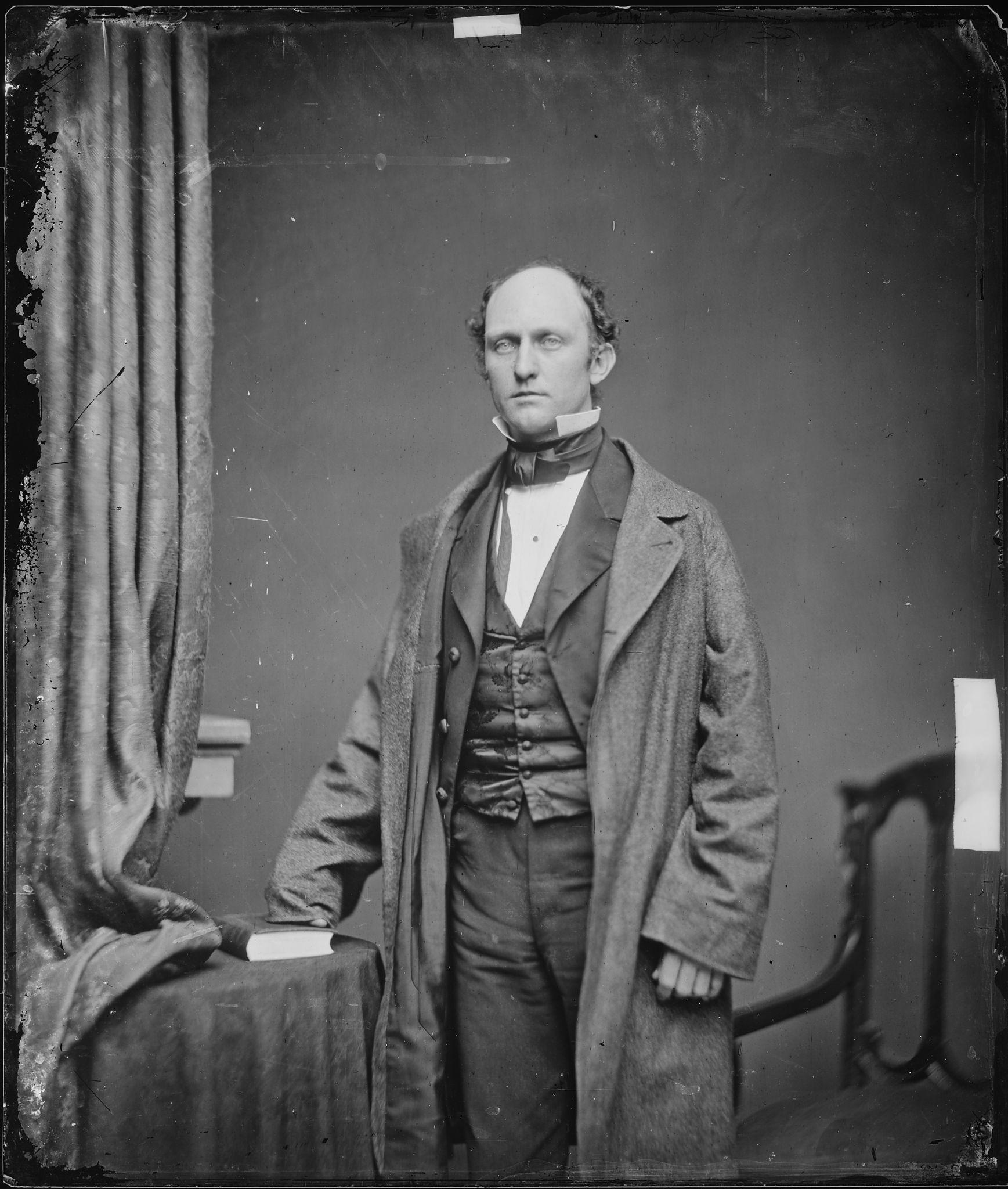
The portrait reproduced above appears in the HUGHES manuscript with the Missouri biography. The accepted congressional record identifies James Madison Hughes as a Kentucky-born lawyer who established himself at Liberty in Clay County, Missouri, where he practiced law, pursued mercantile business and served in the state legislature before his election to Congress. He represented Missouri for one term, from March 4, 1843, through March 3, 1845. He later moved to St. Louis, entered banking and died at Jefferson City on February 26, 1861.
Taken by itself, the biography is entirely plausible. A man born in Kentucky moves into Missouri, practices law, enters trade and politics, serves one term in Washington, and eventually becomes a banker in St. Louis.
The book becomes interested in him because the label “Missouri congressman” conceals how mobile that life already was.
He was not born in Missouri. His Kentucky origins placed him inside the older Upper South migration stream moving west from Virginia and the Chesapeake world. Liberty was not an isolated frontier village but a legal and commercial center sitting beside some of the most politically explosive events in antebellum Missouri. The state label describes where Hughes represented voters. It does not fully describe the networks through which he moved.
That distinction becomes increasingly important once the second Hughes enters the record.
Then There Is James Hughes of Indiana
The next man is supposed to belong to a different state, a different generation and a different biography.

Share
James Hughes was born on November 24, 1823. The House lists his birthplace as Baltimore County, Maryland, not Indiana. He studied at Indiana University, entered the bar in 1842, practiced law in Indiana, served during the Mexican War, became judge of Indiana’s Sixth Judicial Circuit and simultaneously taught law at Indiana University. He was elected to Congress as a Democrat and served from March 4, 1857, through March 3, 1859.
Already the simple state labels begin to break down.
The Missouri Hughes was Kentucky-born.
The Indiana Hughes was Maryland-born.
James Hughes built an unmistakably Hoosier public career, but his biography did not begin there. Nor did it end there.
After Congress, President James Buchanan appointed him to the United States Court of Claims. He subsequently returned to Indiana politics, worked as a cotton agent for the Treasury Department after the Civil War, and eventually resumed legal practice. When he died on October 21, 1873, both the House and Indiana University sources place his death back in Maryland, although his remains were returned to Bloomington for burial at Rose Hill Cemetery.
That does not make James Hughes secretly somebody else.
It does establish something more basic: the man remembered as the Indiana Hughes had a Maryland beginning and a Maryland ending.
The Indiana identity occupied the middle.
Then Comes March 1859
This is where the chronology becomes difficult to read casually.
James Hughes of Indiana’s congressional term ended on March 3, 1859.
George Wurtz Hughes of Maryland’s congressional term began on March 4, 1859.
There is nothing inherently impossible about that. Congressional terms were scheduled that way. An Indiana Democrat could leave the House on March 3 while an unrelated Maryland Democrat named Hughes entered on March 4.
The transition becomes interesting because it is not standing alone.
The manuscript treats the handoff as one of the central hinges in the larger Hughes problem: one public Hughes leaves the House and another enters immediately afterward.
And then the third biography opens.
George Wurtz Hughes of Maryland
George Wurtz Hughes is the most heavily documented figure of the three.

Share
The surviving portrait is dramatically better than the tiny reproduced images through which many nineteenth-century officeholders are remembered. The manuscript identifies it with the National Archives record for George W. Hughes, and a public-domain National Archives image is independently preserved online.
The House says George Wurtz Hughes was born in Elmira, New York, in 1806. He attended West Point, became a civil engineer, served as a captain in the Corps of Topographical Engineers, fought in the Mexican-American War, reached colonel in volunteer service, resigned from the regular Army in 1851, became president of the Northern Central Railroad and eventually entered Congress from Maryland in 1859.
This is not the biography of a conventional local politician.
It is a career built around movement.
West Point.
Canals.
Surveying.
Washington.
Federal engineering.
Europe.
Mexico.
Railroads.
Maryland military organization.
Congress.
The manuscript follows George through New York canal work, federal surveys around Washington, his appointment to the Topographical Engineers, a War Department mission to Europe, the Mexican War and later infrastructure projects.
The House’s own bibliography reinforces how technical the career was. Hughes published on coal fields, railroad surveys, Dutch hydraulic works, Mexican military operations and infrastructure.
Yet this “Maryland” Hughes was born in New York.
The geographical pattern now looks like this: Missouri’s Hughes was born in Kentucky. Indiana’s Hughes was born in Maryland and died there. Maryland’s Hughes was born in New York and migrated into the Maryland political and family world.
The state names are real.
They are also less useful than they first appear.
What If the State Labels Are Hiding the Problem?
Modern research encourages us to think of identity as continuous.
A person has a stable legal name. Government databases speak to one another. Birth records, schools, military service, employment and death can generally be assembled into a single recognizable file.
That was not how nineteenth-century America operated.
The HUGHES manuscript describes a country stitched together through courts, newspapers, canals, railroads, political organizations, military appointments, private correspondence and family introductions. Records remained highly local. A person might appear in one jurisdiction through a law practice, somewhere else under a military title and in another place through an elected office.
That does not prove anyone maintained multiple identities.
It explains why a composite identity would be historically possible in the first place.
A congressional biography is also not a birth certificate compiled while its subject is standing in front of the clerk. The House itself explains that the Biographical Directory developed through successive reference works and continues to be updated as new information becomes available.
That makes the directory enormously valuable.
It also means its entries are historical constructions assembled from earlier records.
HUGHES asks whether three such constructions have inherited a separation that researchers rarely had reason to challenge.
Look at the Careers Instead of the Names
Once the state headings are removed, a different pattern becomes visible.
James Madison Hughes combines law, commerce, Democratic politics and a single term in Congress.
James Hughes combines law, military service, the judiciary, legal education, Democratic politics, a single term in Congress, federal judicial office and later Treasury work.
George Wurtz Hughes combines West Point, engineering, federal service, military command, Democratic politics and a single term in Congress.
The careers are certainly not identical.
They do, however, keep touching the same kinds of institutions.
The three men also do something unusually convenient when viewed chronologically: they appear in national politics in separate bursts.
James Madison Hughes serves one term in the 1840s.
James Hughes serves one term in the late 1850s.
George Wurtz Hughes enters immediately afterward.
Under the accepted record, that sequence is coincidence.
Under the theory examined in HUGHES, it becomes something that has to be tested rather than merely noticed.
The Military Record Makes the Problem Stranger
Military history creates another asymmetry.
George Wurtz Hughes has the strong military file.
His career contains West Point, the Topographical Engineers, identifiable ranks, the Mexican War and a large technical paper trail. The official House biography includes enough detail to reconstruct major portions of that career.
James Hughes of Indiana has the weak version.
The House says that he “served in the Mexican War.” Indiana University’s archival biography says the same thing in slightly expanded form, but neither source supplies anything resembling the extensive military biography attached to George.
The manuscript identifies another, even stranger wrinkle: some biographical material associates James Hughes with attendance at West Point as well, but without the normal supporting details of appointment, class, commission, resignation or cadet history. The George Wurtz Hughes file, meanwhile, possesses a clear West Point chronology.
That is not something this first article needs to resolve.
It is the subject of the next one.
But it illustrates exactly why the Hughes theory developed in the first place.
One biography contains an enormous institutional trail.
Another appears to possess shadows of the same credentials.
Even the Portraits Became Part of the Problem
The images in the manuscript make the question harder to ignore because the three lives are no longer just lines of text in a directory.
They have faces.
The James Hughes image preserved by Indiana University’s law-school archive and the much larger National Archives portrait associated with George Wurtz Hughes become especially important because the men occupy adjacent congressional terms. The manuscript later devotes an entire section to what it calls the “photographic anomaly.”
That visual question should be approached carefully. Similar nineteenth-century hairstyles, collars, poses, photographic reproduction and aging can easily produce misleading impressions. A face is not proof of identity simply because two portraits resemble one another.
But portraits are physical evidence capable of being tested.
Original images have provenance.
Negatives have histories.
Facial proportions can be compared.
Dates can be checked.
The photograph does not have to settle the theory by itself to become a useful part of the investigation.
That will be the third article in this series.
The Endings Are Just as Strange as the Beginnings
The three lives also conclude in three very different places.
James Madison Hughes died in Jefferson City, Missouri, on February 26, 1861, only days before Abraham Lincoln’s inauguration, and was buried in St. Louis.
George Wurtz Hughes died at West River, Maryland, in 1870, after his career had ended inside the Maryland political and family world into which he had married and moved.
James Hughes of Indiana died in Maryland in 1873 and was taken back to Bloomington for burial.
Again, no one fact proves anything.
That is one of the most important constraints of this entire project.
A politician can die outside the state he represented. A Maryland-born man can build a life in Indiana. Two unrelated men can attend West Point. Several Hugheses can serve in Congress. Military veterans can enter law and politics. Men can resemble one another in old photographs.
Every individual coincidence has an ordinary explanation.
The argument begins only when those explanations have to be purchased repeatedly.
The manuscript describes the problem in precisely those terms: a handful of coincidences can be tolerated, but when they begin gathering around the “load-bearing beams” of the biographies, the arrangement itself deserves investigation.
This Is a Testable Historical Theory
The most useful aspect of the Hughes argument is that it does not have to remain a story built from resemblance.
There are records capable of hurting it.
That matters.
A second independently documented West Point cadet named James Hughes would strengthen the three-man explanation.
Military rolls could establish two simultaneous military careers.
Original congressional photographs could establish that the Indiana and Maryland portraits unquestionably depict different people.
Congressional attendance records could place one Hughes in the House while another appears somewhere physically incompatible.
Court of Claims records could create exactly the same problem.
Signatures, land records, family papers, military correspondence and household records could produce independent biographies that stop converging when examined at sufficient resolution.
The book openly acknowledges one particularly serious difficulty: there is a period in which George Wurtz Hughes’s congressional service and James Hughes’s Court of Claims career appear to overlap. Rather than bury that contradiction, the manuscript calls it the central pressure test and states that the composite theory should not survive if the evidence cannot survive that chapter.
That is where the theory becomes more interesting than a collection of coincidences.
It can fail.
Three Men in Three Drawers
The safest way to read the history is also the easiest.
Search James Madison Hughes.
Read the Missouri biography.
Close it.
Search James Hughes.
Read the Indiana biography.
Close it.
Search George Wurtz Hughes.
Read the Maryland biography.
Close it.
Nothing especially disturbing happens.
The problem begins when all three remain open.
Then the Missouri congressman turns out to have been born in Kentucky. The Indiana congressman turns out to have been born in Maryland and to have died there. The Maryland congressman turns out to have been born in New York. One Hughes leaves Congress immediately before another enters. Military service appears in multiple biographies. West Point appears in an unexpectedly unstable way. Engineering, law, federal patronage and border-state Democratic politics repeatedly cross the same terrain.
The manuscript describes these not as three biographies expanding outward from three clean origins, but as public records repeatedly circling a common center.
Maybe the conventional explanation survives all of that.
Maybe there really were three men whose careers happened to create an extraordinary pattern.
But that conclusion should come after the records have been crossed against one another, not merely because nineteenth-century clerks placed the names in different drawers.
That is the investigation at the center of HUGHES: One Man, Three Names.
And the next place to test it is West Point, because James Hughes of Indiana appears to have inherited one of the most prestigious credentials in nineteenth-century America without leaving behind the sort of cadet record that credential should normally produce.
That is where the paper trail gets considerably stranger.
Read HUGHES: One Man, Three Names on Amazon