Historical identity usually lives in words: names, dates, offices, census entries, military records and obituaries. The Hughes problem is unusual because one of its most important tests may be sitting in plain sight inside three photographic archives. If the portraits belong to three different men, the conventional record gains powerful support. If two institutions have preserved the same face under different Hughes names, the problem changes completely.
The central argument of HUGHES: One Man, Three Names begins with three men whom the historical record treats separately: James Madison Hughes of Missouri, James Hughes of Indiana, and George Wurtz Hughes of Maryland. The manuscript devotes an entire chapter to what it calls “The Photographic Anomaly,” because this is one of the rare parts of the theory that can potentially be tested with something more immediate than chronology or institutional coincidence.
Most of the Hughes case requires reconstruction. One has to compare congressional terms, West Point claims, Mexican War records, Maryland geography, legal careers, federal appointments and the movement of the three biographies through different states.
A photograph is different.
A photograph gives the archive a face.
That does not mean two old portraits that look similar prove two historical figures were the same person. Nineteenth-century clothing, hairstyles, posing conventions and photographic processes can create remarkable superficial similarities. But photographs also contain anatomical information that names and biographies do not: ears, hairline, orbital shape, nose, jaw, mouth, facial proportions and other features that can be compared.
In the Hughes case, the surviving images deserve much more attention than they have received.
The Indiana Hughes
James Hughes represented Indiana in the Thirty-fifth Congress from March 4, 1857, through March 3, 1859. The current House biography identifies him as a Maryland-born lawyer who became an Indiana circuit judge, professor of law at Indiana University, congressman and later judge of the Court of Claims.
Indiana University’s Maurer School of Law preserves this portrait with its former-faculty record for James Hughes:

That image is important because Indiana University has an independent institutional reason to remember Hughes. He taught law there from 1853 through 1856 while also serving on the Sixth Judicial Circuit. The university’s archive is therefore preserving one of its own former professors, rather than merely presenting an illustration of a distant congressman.
But there is another portrait associated with James Hughes that is even more important.
The Library of Congress preserves McClees’ Gallery of Photographic Portraits of the Senators, Representatives & Delegates of the Thirty-fifth Congress, created in Washington in 1859. The collection was photographed by Julian Vannerson and documents the congressional class in which James Hughes served. The Library dates the gallery to 1859 and identifies it as a collection of congressional portraits and autographs.
Within that collection is an item catalogued as “James Hughes, Representative from Indiana, Thirty-fifth Congress.” The portrait appears on page 243 of the McClees volume and is attributed to Vannerson in 1859. The catalog description says the title was derived by Library staff from the name supplied in the book’s index.
That last detail matters.
The face and the name have an archival relationship.
But they are still two different things.
Then Look at George Wurtz Hughes
George Wurtz Hughes represented Maryland in the Thirty-sixth Congress.
His term began on March 4, 1859.
James Hughes of Indiana’s term had ended the previous day. The House identifies George as a New York-born West Point-trained engineer who served in the Mexican War, became president of the Northern Central Railroad and represented Maryland as a Democrat from 1859 through 1861.
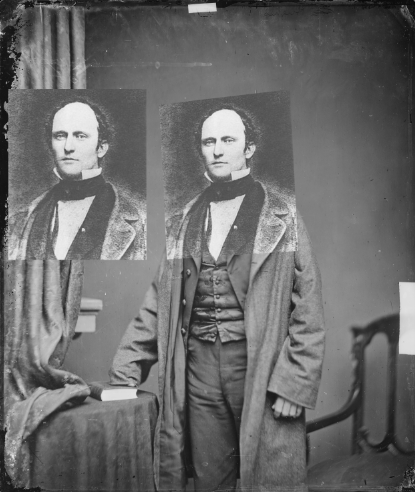
This is the surviving portrait associated with George Wurtz Hughes:

The photograph is dramatically better than the small reproductions through which many nineteenth-century politicians are now encountered. The sitter is standing rather than presented only as a head-and-shoulders figure. His face is relatively clear, his ears are visible, the hairline can be examined, and the proportions of the head can be compared against other images.
This matters because we are not comparing a portrait of James Hughes as a young lawyer in 1842 with a portrait of George Hughes as an elderly man decades later.
The relevant congressional images belong to essentially the same moment.
James’s McClees portrait is dated 1859. George entered the succeeding Congress in March 1859. James’s congressional service and George’s congressional service touch at the boundary between the Thirty-fifth and Thirty-sixth Congresses.
If the two men were independent historical people, this should be an unusually good period in which to distinguish them visually.
Put the Images Together
Here is an illustrative comparison assembled from the surviving institutional portraits:

This comparison is not a forensic identification. It should not be treated as one.
That distinction is essential.
A researcher looking at these portraits casually can notice similarities. The high forehead, receding hairline, placement of the remaining hair around the temples, long facial shape, relatively narrow mouth, eye placement and general shape of the jaw immediately invite comparison.
But “they look alike to me” is not a historical method.
The useful question is whether those apparent similarities survive rigorous examination of the original images.
That requires going underneath the reproductions.
The Library of Congress Image Has Something the Others Do Not
The McClees portrait is especially valuable because it belongs to a contemporary congressional portrait project rather than a later biographical illustration.
The Library of Congress describes the McClees gallery as a photographic collection of the Thirty-fifth Congress created in Washington in 1859. It includes photographic portraits and autographs of members, and the James Hughes image is specifically associated with the Indiana representative in that collection.
That creates several different layers of evidence.
There is the photograph itself.
There is its physical position in the McClees volume.
There is the book’s original index.
There is the associated signature.
There is the modern Library of Congress catalog description.
Those pieces should be examined separately.
If the signature is unquestionably James Hughes’s and was attached contemporaneously to his portrait, that would be valuable evidence for the attribution.
But even then, a researcher should ask whether the signature and photograph were originally produced together or later mounted together as part of the gallery’s construction.
The Library’s catalog contains another crucial detail: its modern title for the James Hughes item was devised by Library staff from the name in the book’s index.
That does not make the identification unreliable.
It tells us exactly where to investigate.
The identity of the sitter ultimately depends upon the provenance of the original McClees page rather than merely upon today’s digital caption.
The Indiana University Portrait Creates a Second Test
Now return to the small Indiana University image.
The university’s biographical entry firmly identifies this man as James Hughes, the Maryland-born Indiana lawyer and former law professor. The archive records his birth in 1823, his admission to the bar in 1842, his Mexican War service, his judgeship, congressional service and later federal career.
What the public webpage does not immediately tell us is the full photographic provenance of the image.
Where did Indiana University obtain it?
Is the university displaying an original nineteenth-century photograph?
A copy?
An engraving?
A photographic reproduction from a later history?
A crop from another institutional image?
When was the name “James Hughes” first attached to this particular face?
Those questions may sound pedantic until one remembers how nineteenth-century portraits move.
An image can be reproduced in a county history. A later historian can copy it. Another institution can scan that reproduction. Cropping can remove the original mount and inscription. Eventually the digital image appears to be an independent portrait even when it derives from a photograph held somewhere else.
That is why three URLs do not necessarily equal three original photographs.
This Is a Provenance Problem Before It Is a Facial-Recognition Problem
The fastest way to mishandle this question would be to run the pictures through an automated face matcher and announce a percentage.
That should come later, if at all.
The first job is archival provenance.
For each image, we need to know what the physical object actually is.
Is it an original photographic print?
What process was used?
What dimensions does it have?
Is anything written on the reverse?
Is there an original mount?
Does the mount contain a contemporary name?
Is the attribution written in nineteenth-century ink or supplied on a twentieth-century catalog card?
Was the portrait donated by a Hughes descendant?
Did it enter an archive through a congressional collection?
Is Indiana University’s version a copy of the Library of Congress image?
Does George’s portrait belong to the same photographer or studio environment?
Only once those questions are answered does facial comparison become truly powerful.
That is precisely why the photographic problem is different from simply observing that two men look alike.
The archive may contain the history of the label as well as the history of the face.
The Timing Makes the Test Unusually Good
There is another reason these images matter.
George Wurtz Hughes and James Hughes of Indiana were not politicians separated by generations. Their congressional careers were adjacent.
James served through March 3, 1859.
George began serving March 4.
The current House directory continues to maintain them as separate men with separate biographies, different birth years and different public careers.
That means an authentic 1859 portrait of James and a roughly contemporary portrait of George ought to present one of the easiest possible visual checks on the theory developed in HUGHES.
If James was born in 1823, he would have been about thirty-five in early 1859.
George, born in 1806, would have been fifty-two.
That is a seventeen-year difference.
Two authentic contemporary photographs ought to show it.
A thirty-five-year-old man and a fifty-two-year-old man can certainly resemble one another, particularly if related, but they should not normally be difficult to distinguish as separate individuals when the photographs are sufficiently good.
So the birth-year difference turns the photographic evidence into something more than an interesting illustration.
It becomes a test.
There Are Three Possible Outcomes
A rigorous archival comparison does not have to produce the dramatic answer.
One possibility is that the originals prove completely distinct. Different faces, stable contemporary labels, independent photographic provenance and no indication that any portrait has migrated between identities would strengthen the standard three-man record.
A second possibility is less dramatic but still historically important: the portraits depict different people, but one of the later institutional images has been misidentified or copied from the wrong source. In that case, we would have discovered an archival attribution error without establishing a composite identity.
The third possibility is the one that makes the photographs so consequential.
If two institutional records genuinely preserve the same sitter under different Hughes names, or if supposedly independent images turn out to derive from the same original photograph, then at least one biography has inherited the wrong face.
That would be concrete evidence that the historical filing system has already crossed the identities once.
It would not automatically prove every claim in HUGHES.
But it would transform the investigation.
Why a Misidentified Portrait Would Matter So Much
Historical databases are often treated as though each field reinforces every other field.
A name accompanies a birth date.
The name accompanies a biography.
The biography accompanies a portrait.
The presence of the portrait makes the biography feel more tangible.
Eventually all of those elements appear to confirm one another.
But they may all descend from the same attribution.
Suppose an editor assembling an institutional history in 1910 obtained a portrait labeled “Hughes.” That image then entered a university archive under James Hughes. A later researcher digitized it. A modern biography incorporated the digitized portrait.
One nineteenth-century attribution could become four twenty-first-century “sources.”
The number of websites displaying the image would tell us almost nothing about the number of independent identifications.
That is why provenance matters more than repetition.
The photograph has to be followed backward until we reach the earliest secure connection between sitter and name.
George’s Image Gives Us a Much Better Physical Reference
The George Wurtz Hughes portrait is particularly useful because it preserves much more of the sitter than the small cropped image used for James.

The ears matter.
So does the hairline.
The bridge and tip of the nose matter.
The relationship between eye line and ear placement matters.
The chin, lower lip and corners of the mouth matter.
With sufficiently high-resolution scans, even small asymmetries can become useful.
A competent comparison would normalize head angle and scale, then compare fixed anatomical landmarks while accounting for lens differences, pose and aging.
Clothing can provide a separate check.
So can backdrop, chair, curtain, table and photographic process.
If two portraits were created in the same Washington studio, similarities in those objects might establish common photographic origin without establishing common identity.
If an Indiana University crop turns out to be literally cut from the George Hughes photograph, however, the issue is entirely different.
That is why examination has to move from face to photograph and from photograph to archive.
The Photograph Could Hurt the Theory Just as Easily
This is important because HUGHES is strongest when its tests are capable of producing an inconvenient answer.
The conventional historical record says James Hughes and George Wurtz Hughes were separate men. The House continues to maintain separate entries: James, born in 1823, represented Indiana in the Thirty-fifth Congress; George, born in 1806, represented Maryland in the Thirty-sixth.
If the original McClees photograph of James Hughes can be proven through contemporary mounting, indexing and signature evidence to depict a man unmistakably different from George, that would be significant evidence against the Maryland–Indiana convergence.
That result should be welcomed rather than avoided.
The purpose of the photographic test is not to find a clever way to declare the faces identical.
It is to make the theory answer to something physical.
This May Be the Easiest Hughes Question to Resolve
Many of the mysteries surrounding these biographies require difficult archival work.
The West Point problem may require academy appointment records.
The Mexican War material requires military rosters.
The Court of Claims overlap requires case files, minutes and participation records.
Family geography may require correspondence scattered among multiple repositories.
The photographic question is comparatively straightforward.
The images already exist.
The Library of Congress has digitized the McClees congressional portrait collection, created in Washington in 1859.
Indiana University publicly displays the portrait it associates with its former professor James Hughes.
George Wurtz Hughes has a surviving high-quality nineteenth-century portrait attached to his historical identity, while the House record independently fixes his congressional service immediately after James’s.
The first stage therefore requires no hidden diary and no newly discovered trunk in an attic.
It requires the existing pictures to be treated as archival objects instead of decoration.
The Face Is Not the Answer Yet
It is difficult to look at these pictures without forming an impression.
That impression is not the conclusion.
The conclusion must come from provenance, original image comparison and, only after those are established, careful physical analysis.
But the existence of that test changes the nature of the Hughes question.
A historical theory built entirely from coincidences can always drift toward interpretation. A portrait can force matters back toward evidence.
Either there are two securely identified men in these images or there is an attribution problem somewhere in the record.
That is why the photographic anomaly occupies such an important place in HUGHES: One Man, Three Names.
The official history gives us James Hughes of Indiana and George Wurtz Hughes of Maryland.
The archives give us their faces.
Now those two forms of evidence need to meet.
Because if two historical identities have inherited the same face, the question is no longer merely why their biographies look so much alike.
The question becomes how one man’s photograph entered two histories.
Read HUGHES: One Man, Three Names on Amazon