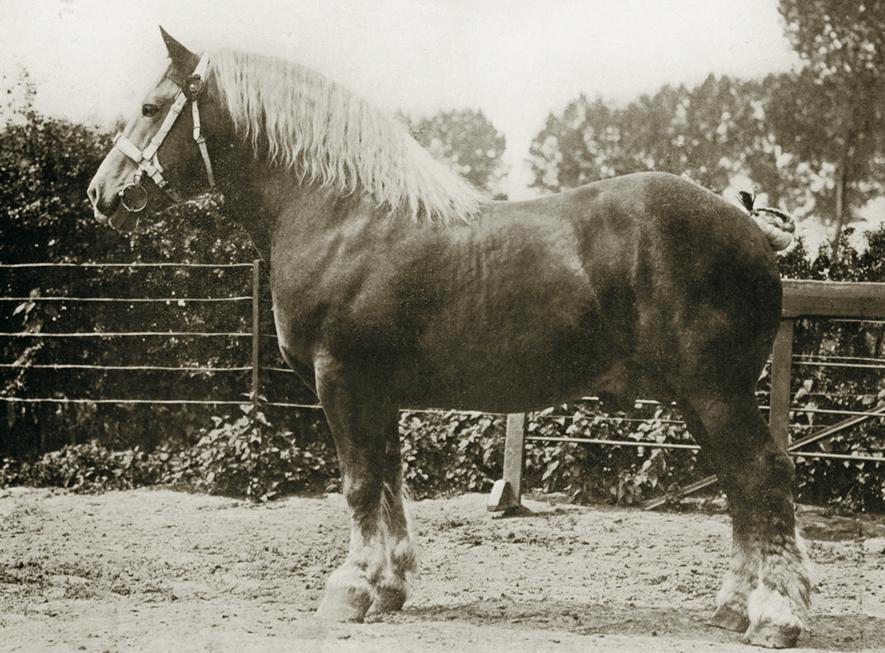
The rise of Indiana’s pharmaceutical industry makes more sense when it is placed beside two older industries that at first seem to have almost nothing to do with medicine: hemp and horses. During the nineteenth century, American hemp was being inspected, graded, strength-tested, and purchased for naval cordage. A few decades later, businessmen in Wabash, Indiana, were importing Belgian draft horses, recording their pedigrees, registering their descendants, and creating a national institution intended to guarantee that an animal sold as a Belgian actually possessed the lineage claimed for it. Then, in the early twentieth century, Eli Lilly and Company built an experimental farm and biological laboratory complex where medicinal plants were cultivated for potency and horses were maintained as part of antitoxin production.
There is no evidence that these were three departments of some hidden unified enterprise, and there is no documentation showing that Lilly’s antitoxin horses came from the Wabash Importing Company. The historical connection is more useful than that. These industries reveal a succession of systems devoted to the same basic industrial problem: how do you turn something living and naturally variable into a commodity whose identity, quality, and performance can be certified?
Hemp had to possess the proper fiber strength. An imported Belgian horse had to possess the proper pedigree. A medicinal plant had to possess the expected potency. A serum-producing horse had to be maintained under controlled biological conditions. What changed over the nineteenth century was the institution doing the certifying.

Before the Drug Farm, There Was the Ropewalk
Hemp’s early American importance had relatively little to do with intoxication. For governments and navies, hemp was strategic material. Sailing ships consumed enormous quantities of cordage, and weak rope could become a matter of life and death aboard a vessel. The U.S. Navy consequently developed an intense interest not simply in acquiring hemp but in determining whether American hemp could equal high-grade imported material.
The Navy’s own nineteenth-century reports make the quality problem unusually clear. In 1831 the Secretary of the Navy complained that poor cordage could result from fraud or defects in the hemp, the manufacture, or the tar and warned that such defects could endanger ships and crews. The language is striking because the Navy was already confronting the problem that would later dominate pharmaceutical manufacturing: the name of the commodity was not enough. Someone had to establish whether the material actually met a performance standard.
By 1843 Congress had funded agencies in Kentucky and Missouri to purchase American hemp for naval use. The Kentucky agent was sent to the federal ropewalk at the Charlestown Navy Yard specifically to learn what kind of water-rotted hemp the Navy required and how its strength should be tested. Two years later the Navy advertised for hundreds of tons of hemp and required it to meet the quality of Riga Rein, a respected imported reference material. Agents at Louisville and St. Louis were supplied with samples and equipment so western producers could assess hemp before paying to ship it all the way east.
This was agricultural standardization before anyone used modern pharmaceutical language for it. Growers produced the crop, but federal inspectors evaluated strength and preparation. A known foreign product functioned as the reference standard, while American producers tried to match it. The Navy even envisioned western ropewalks that would allow the United States not merely to grow American hemp but to manufacture its own naval cordage.


The Charlestown ropewalk is useful to picture because it shows how an agricultural plant entered an industrial system. Hemp arrived as biological material and left as carefully manufactured rope. The ropewalk itself stretched more than a thousand feet because the manufacture of long naval lines required extraordinary physical space. By the twentieth century it had become a mechanized production plant, but its basic purpose descended from an older requirement: take variable fiber and create dependable cordage.
That is the first part of the story. The American state had learned that natural materials acquired industrial value only after somebody established standards for them.
Then Indiana Began Importing Belgian Power
Move forward several decades and inland to Wabash, Indiana. The material being imported was no longer hemp. It was horsepower in the most literal sense.
According to the National Register documentation for the surviving Teague Barn, Harmon Wolf, Nathan Meyer, and Abraham Strauss formed the Wabash Importing Company in 1884 with the purpose of importing and breeding animals for agricultural use, particularly Belgian draft horses. The partners made regular trips to Belgium to purchase horses, shipped the animals to the United States, and moved them by rail to company stables located near the tracks in Wabash. In 1888 the businessmen purchased the 256-acre Teague farm southwest of the city, using its substantial barn as part of their breeding operation.
Belgian draft horses were valuable because they represented concentrated agricultural and transport power. Before widespread motor trucks and tractors, an exceptionally large, strong, tractable horse could move loads that smaller farm animals could not. The value of a good imported stallion also extended far beyond the animal itself because its descendants could transmit desirable traits across an entire breeding population.


That created a problem remarkably similar to the hemp problem. A seller could claim that a horse was Belgian, but how was an American buyer supposed to know that the animal was what the seller said it was? The horse could not carry its European farm, breeder, and ancestry around with it. Once it crossed the Atlantic and moved through American rail yards, the identity of the animal increasingly depended upon documentation.
Wabash became important because its businessmen helped construct exactly that documentary system.
Wabash Builds a Registry
On February 25, 1887, Harmon Wolf, Abraham Straus, Nathan Meyer, and attorney James D. Conner Jr. organized the American Association of Importers and Breeders of Belgian Draft Horses in Wabash. The organization later became the Belgian Draft Horse Corporation of America. Its stated purpose was to maintain records of imported horses, their descriptions, their genealogies, and their descendants so that the purity of the breed could be preserved and certified in the United States.
This is more significant than it first appears. The Wabash organization was creating an institutional answer to the problem of biological identity. A horse’s value could now be supported by a registry entry, a recorded pedigree, and a certificate of transfer. Instead of asking a buyer to trust the appearance of the animal or the word of a dealer, the association created a chain of documentary custody.
By 1905 the association was publishing the National Register of Belgian Draft Horses, an American stud book produced in Wabash. Its indexed entries recorded imported horses, breeders, ancestry, locations, dates, and identifying characteristics. Wabash therefore became a national documentary center for an imported European breed.


The old Teague Barn still survives southwest of Wabash and is listed on the National Register of Historic Places as the Teague Barn–Wabash Importing Company Farm Stable. Its National Register nomination explicitly describes the Wabash Importing Company’s use of the property and the firm’s practice of traveling to Belgium, importing draft horses, moving them through rail-connected city stables, and breeding them on the farm.
That barn represents something larger than horse breeding. It is physical evidence that late-nineteenth-century Indiana participated directly in an international biological-import business.
Belgium to Wabash
The Belgian connection is important because it involved more than purchasing generic farm animals. Wabash businessmen were importing a particular European biological lineage and then building an American institution around the preservation of that lineage.
The process required several layers of control. Someone had to select horses in Belgium, verify that the animals possessed acceptable documentation, arrange transatlantic transport, move the animals inland by railroad, breed them, identify the offspring, record transfers, and maintain genealogical continuity. The value of the horse became inseparable from the reliability of the records surrounding it.
A registry was therefore a kind of nineteenth-century quality-control laboratory made out of paper.
That is why James D. Conner Jr.’s role matters. Conner was not simply another horse breeder. He became the long-serving secretary of the association, helping maintain an institutional system that translated European pedigrees into American legal and commercial documentation. Wabash City Schools’ historical recognition of Conner notes his role in organizing the Belgian association and records that he was later made a Knight of the Belgian Order of the Crown.
There is an obvious danger in making too much of this Belgian connection. Nothing presently demonstrates that Eli Lilly later purchased the biological plant’s antitoxin horses from Wolf, Meyer, Straus, Conner, or the Wabash registry. That would require evidence we do not have.
The useful observation is different: Indiana had already developed sophisticated institutions for importing, identifying, breeding, recording, and commercializing European animals before Eli Lilly created its biological complex.
At Almost the Same Time, Pharmacy Was Facing the Same Problem
While Wabash businessmen were building a registry around Belgian horses, pharmaceutical companies were trying to solve comparable problems with medicinal plants. A plant sold under a particular name did not necessarily possess uniform physiological potency. Its activity depended upon variety, soil, climate, harvesting, storage, age, and processing.
This was exactly the problem behind the Cannabis Americana effort discussed in the previous article. Imported cannabis could vary dramatically, encouraging companies such as Parke-Davis and Eli Lilly to experiment with American cultivation and physiological standardization. But cannabis was only one example. Lilly confronted the same basic issue with plants such as digitalis, henbane, and belladonna.
By the early twentieth century the company’s response was remarkably agricultural: grow the medicine yourself.
The Science History Institute preserves pages from Lilly’s circa-1919 Hand Book of Pharmacy and Therapeutics showing the company’s experimental farm. One set of photographs depicts henbane at different stages of development and workers harvesting digitalis. Another shows belladonna being moved from a greenhouse into open cultivation. The Institute explains that Lilly operated the farm in an effort to propagate medicinal plants whose potency could equal plants imported from Europe.
That description creates a remarkable parallel with the Belgian horse story. Wabash imported European breeding stock and tried to preserve desirable biological qualities through controlled lineage. Lilly worked with medicinal plants and tried to reproduce desirable biological potency through controlled cultivation.
The commodity was different, but the industrial question was familiar.
From Pedigree to Potency
A Belgian stud book and a pharmaceutical assay obviously are not the same thing. One tracks ancestry while the other attempts to measure biological effect. Yet both arise because living things vary.
A machine part manufactured to a fixed specification can theoretically be reproduced identically. A horse, hemp stalk, cannabis plant, foxglove, or bacteriological culture cannot. Industrial systems dealing with biology therefore require additional mechanisms for controlling variation.
The horse breeder uses pedigree, selection, registration, and controlled mating. The plant researcher uses propagation, cultivation, selection, extraction, and testing. A biological-products manufacturer adds sanitation, animal management, laboratory cultures, testing procedures, and carefully documented production.
Taken together, these industries show something important happening in the Midwest around the turn of the century: agriculture was becoming experimental, documentary, and scientific at the same time that medicine was becoming industrial.
Greenfield Changes the Scale
Eli Lilly’s biggest step into that biological world came just outside Greenfield, Indiana. The company’s biological laboratory complex was constructed in 1913 and began producing immunizing biological products in 1914. The surviving National Register nomination describes the facility as a “Model Biological Laboratory” built for the production of antitoxins, sera, vaccines, toxoids, and related biological products.
An aerial photograph preserved by the Indiana Historical Society shows how different this campus was from Lilly’s original urban operation. Low Mission-style laboratory buildings sit amid open farmland, with specialized structures and broad grounds stretching outward around them. The facility looks almost as much like an agricultural institution as a pharmaceutical factory.


The postcard view of the entrance makes the same point. The sign calls the site the Lilly Biological Laboratories and Drug Farm. That name captures the hybrid nature of the institution. It was simultaneously laboratory, farm, animal facility, and pharmaceutical plant.
This was medicine entering the landscape.
The Horses Inside the Laboratory
The most visually startling part of the Greenfield operation is the horse stable. Lilly’s 1919 handbook contains a page titled “Stables at the Biological Plant” showing employees grooming a horse, bleeding a horse, and rows of animals housed in individual stalls. The Science History Institute identifies these as horses used in the production of diphtheria antitoxin.
The National Register nomination provides the physical scale. Two wings projecting from the main laboratory buildings were constructed as animal stables, and each wing could accommodate roughly thirty-five to forty horses. The nomination emphasized their sanitary design and noted that Lilly’s antitoxin horses were carefully groomed, while mechanized litter carriers removed waste to a fly-proof shed. Hay, grain, and animal-care supplies were stored on the upper floors.
These details matter because they change what a pharmaceutical laboratory looks like. The animal was not merely brought into a laboratory occasionally for an experiment. The stable itself had become part of the pharmaceutical plant.
The horse needed food, housing, hygiene, monitoring, handling, and veterinary care because the condition of the animal affected the biological process the company was trying to control.
A Horse Could Become Part of the Medicine
Antitoxin production was one of the technologies that made the pharmaceutical horse so important. Large animals could be deliberately exposed under controlled conditions so that their immune systems produced antibodies, after which blood was collected and the antibody-containing serum processed for therapeutic use. Lilly’s Greenfield operation produced biological products aimed at diseases including diphtheria, tetanus, scarlet fever, rabies, smallpox, typhus, and others during the site’s history.
The horse had therefore moved through three different economic identities in little more than a generation. On an ordinary farm it supplied traction. At Wabash it could become imported breeding capital whose genealogy determined value. At Greenfield the animal could become an element inside a biological manufacturing process.
That transition is enormous.
It also shows why the old distinction between “farm” and “laboratory” becomes increasingly difficult to maintain in this period. The pharmaceutical company needed barns because the animal was part of the laboratory apparatus. It needed fields because the medicinal plant was part of the laboratory apparatus. It needed greenhouses because propagation was part of pharmaceutical development.
The Belgian Horse Connection — What We Can and Cannot Say
This is where the Belgian import story becomes tempting, so it is worth being precise.
Wabash unquestionably became an American center for imported Belgian draft horses. The Wabash Importing Company was established in the 1880s; its principals traveled to Belgium; horses were shipped back to Indiana; a farm and rail-connected stable system supported the operation; and the resulting breed association established a national registry headquartered in Wabash.
Lilly unquestionably maintained a large pharmaceutical horse population at its Greenfield biological plant beginning in the following generation. Its stables were deliberately engineered for health, sanitation, feeding, and biological production.
What has not surfaced is documentation identifying Lilly’s antitoxin horses specifically as Belgian draft horses or connecting their purchase to the Wabash Importing Company. Until a Lilly animal ledger, purchase record, stud record, or correspondence establishes that link, the responsible way to present it is as a regional historical parallel rather than a direct supply chain.
That still leaves an excellent story.
Indiana first becomes a place where imported European horsepower is selected, registered, and biologically reproduced. It then becomes a place where horses are maintained within an enormous controlled medical-production system. Those two operations need not share the same horses to demonstrate a transformation in how the state managed animal biology.
The Same Logic Appears in the Drug Fields
The medicinal plant images make the comparison even stronger. Lilly’s belladonna photographs show plants being moved from greenhouse beds into larger-scale field cultivation. The digitalis and henbane photographs show crops in organized rows with workers and horse-drawn equipment moving through them.

The goal, according to the Science History Institute, was to produce American-grown drug plants with potency comparable to the imported European material on which pharmaceutical companies had previously depended.
That language sounds surprisingly similar to the Navy’s nineteenth-century hemp program. The Navy had compared American hemp with high-grade imported Riga material. Lilly later compared domestically propagated medicinal plants with imported European drug plants.
The specific science had changed enormously, but the industrial ambition was recognizable: make the American biological product equal to or better than the foreign reference product, then control its production domestically.
Hemp, Horses, Cannabis, Belladonna
Seen this way, cannabis no longer looks like an isolated oddity in Lilly’s early history. It belongs inside a larger biological economy.
Hemp shows the older American state learning to test plant strength because rope could fail. Belgian breeding shows Indiana businessmen learning to document animal lineage because buyers needed reliable biological identity. Cannabis Americana shows pharmaceutical manufacturers attempting to cultivate domestic cannabis because imported medicinal material could vary in potency. Belladonna, digitalis, and henbane show Lilly applying experimental cultivation to other medicines. Antitoxin production shows the same company bringing horses into a controlled biological-manufacturing system.
These are distinct histories, but they share a common architecture: importation, comparison, selection, documentation, controlled reproduction, testing, and certification.
That is a much richer way to understand the emergence of the pharmaceutical Midwest than simply saying that Indiana happened to become home to a large drug company.
Wabash Was Not Peripheral to This Story
Wabash can look peripheral when pharmaceutical history is told entirely from Indianapolis, Detroit, New York, or Philadelphia. The Belgian horse industry suggests otherwise.
The Wabash Importing Company operated in an environment made possible by the railroad and by Indiana’s agricultural economy. European animals could arrive at Atlantic ports, cross the United States by rail, enter the Wabash stables, move onto the breeding farm, and eventually spread genetically through American agriculture.
The registry transformed Wabash into something even more important than a sales point. It became an information center.
When the National Register of Belgian Draft Horses was published from Wabash, the town was participating in a national system for determining biological authenticity. The animal might physically stand in Iowa, Illinois, Ohio, Missouri, or elsewhere, but its identity could still depend upon a registry maintained in Indiana.
That is an important conceptual shift. Industrial power was beginning to reside not only in possession of the organism but in possession of the records that authenticated the organism.
The Certificate, the Assay, and the Label
The horse certificate, naval hemp inspection, and pharmaceutical label performed different jobs, but they all solved versions of the same trust problem.
A Navy inspector certified that hemp met the required standard.
A Belgian horse registry certified that an animal descended from recorded stock.
A pharmaceutical manufacturer certified that a bottle contained a preparation meeting an established specification.
These systems allowed strangers separated by hundreds or thousands of miles to transact without personally inspecting the entire history of the commodity.
The certificate carried the horse’s pedigree.
The inspection carried the hemp’s quality.
The pharmaceutical label carried the manufacturer’s guarantee.
Modern industrial society depended increasingly upon these documentary proxies for trust.
Why the Belgian Stable Belongs Beside the Lilly Stable
The surviving Teague Barn and the surviving photographs of Lilly’s biological plant make a particularly powerful visual pair.
One housed animals that represented imported European agricultural genetics. The other housed animals incorporated into biological medicine. At Wabash, animal quality was protected through breeding records and pedigrees. At Greenfield, animal condition was protected through sanitary architecture, feeding systems, veterinary supervision, and laboratory procedures.
The two facilities were separated by geography, purpose, ownership, and a generation of technological change. Yet together they show an Indiana economy becoming extraordinarily comfortable with the idea that living organisms could be managed systematically.
The barn was becoming an instrument.
From Agricultural Indiana to Pharmaceutical Indiana
It is tempting to imagine the pharmaceutical industry arriving as something fundamentally separate from nineteenth-century agriculture. In reality, early pharmaceutical manufacturing remained deeply dependent upon agriculture and animal husbandry.
Medicines came from fields.
Antibodies came from animals.
Plant potency depended upon cultivation.
Animal health depended upon stable design.
Consistency depended upon recordkeeping.
The agricultural and pharmaceutical worlds therefore overlapped much more heavily than later industrial imagery suggests.
That helps explain why a place such as central Indiana could support the transition so effectively. The region already possessed farms, railroads, livestock expertise, feed systems, barns, agricultural markets, and a commercial culture comfortable with moving biological commodities over large distances. Pharmaceutical research did not replace that agricultural infrastructure. In many cases it absorbed and reorganized it.
An Indiana System of Controlled Biology
The story begins with hemp because hemp makes the underlying problem visible in its simplest form. Nature produces variation, but industry demands specifications. The Navy therefore inspected hemp and tested strength.
The Wabash horse trade added heredity to the problem. A valuable animal did not simply have to look right; its lineage had to be preserved and certified. The registry solved that problem through genealogy and documentation.
Pharmaceutical manufacturing added physiological activity. A medicinal plant did not simply have to possess the proper botanical name; it had to possess the expected potency. A serum animal did not merely have to be a horse; it had to be managed as part of a controlled biological process.
Each stage pushed institutions further inside the organism.
First they inspected the product.
Then they recorded the lineage.
Then they controlled cultivation and breeding.
Finally they attempted to control biological function itself.
That is one way to understand the progression from hemp rope to Belgian horse registries to the Lilly biological laboratories without pretending that the three were secretly one business.
The Barn Before the Laboratory
The old pharmaceutical world preserved in these photographs has almost disappeared. Modern drug manufacturing is imagined through clean rooms, stainless steel, molecules, robotics, computers, and biotechnology. The early industry had a far more physical landscape.
It had hemp fields.
It had ropewalks.
It had imported stallions arriving by rail.
It had stud books.
It had greenhouses.
It had belladonna and digitalis fields.
It had horse stalls.
It had hay lofts.
It had serum rooms and laboratory cultures.
The boundary between agriculture and medicine was porous because biology itself was the raw material.
4
Seen together, the images create a different origin story for Indiana pharmaceuticals. Eli Lilly did not emerge in a state untouched by biological industry. It emerged in a region already accustomed to grading crops, importing livestock, keeping pedigrees, moving animals by rail, experimenting with breeding, and converting agricultural organisms into standardized commercial products.
The laboratory inherited more from the barn than pharmaceutical history usually admits.
What Indiana Was Really Building
The most interesting continuity here is not cannabis, hemp, Belgium, or even horses by themselves. It is the creation of institutions capable of making claims about living things and having those claims trusted at a distance.
The Navy said this hemp meets the standard.
The Wabash registry said this horse possesses this lineage.
Lilly said this plant has been propagated for pharmaceutical potency.
The biological laboratory said this animal has been maintained under conditions appropriate for producing a standardized medical product.
Once that system existed, the organism could move into national commerce with an institutional identity attached to it.
That is what the certificate, registry, assay, and pharmaceutical label had in common.
Indiana became exceptionally good at building the infrastructure behind those claims.
From Wabash to Greenfield
The distance between Wabash’s Belgian horse operation and Lilly’s Greenfield biological plant is not particularly large on a map, but historically it spans a major transformation.
At Wabash in the 1880s, businessmen imported European draft animals and created an American registry around them. At Greenfield three decades later, a pharmaceutical corporation maintained dozens of horses in sanitary wings attached directly to laboratories while medicinal plants grew on an experimental drug farm nearby.
The first operation was primarily concerned with what the animal was.
The second was increasingly concerned with what the organism could reliably produce.
That shift—from pedigree to biological output—is one of the clearest markers of the emerging twentieth-century pharmaceutical world.
The horse had moved from agricultural power to registered genetic asset to laboratory participant.
The plant had moved from field crop to inspected commodity to standardized medicine.
And Indiana sat directly in the middle of both transformations.
The Hidden Agricultural Foundation of Big Pharma
That is why the history of Eli Lilly looks different when the Belgian horse business and the older hemp economy are placed beside it. The pharmaceutical industry did not materialize fully formed out of chemistry. It grew from an older world in which governments, farmers, breeders, pharmacists, and manufacturers were already learning how to control biological variation.
The Navy’s hemp inspectors, Wabash’s stud-book keepers, Lilly’s medicinal-plant farmers, and Greenfield’s stable attendants were all working on different versions of the same industrial problem.
Nature does not manufacture identical units.
Industry wants identical units.
The institutions built between those two facts became modern quality control.
That is the deeper connection between the ropewalk, the Wabash horse barn, the Cannabis Americana bottle, the experimental drug farm, and the Lilly antitoxin stable. None of them has to be forced into a secret corporate lineage to belong to the same history.
They show the transformation of the Midwest from a place that produced living commodities into a place that increasingly measured, documented, bred, tested, and standardized them.
And once that system moved from the barn and field into medicine, Indiana was already on its way toward becoming one of the centers of the American pharmaceutical industry.