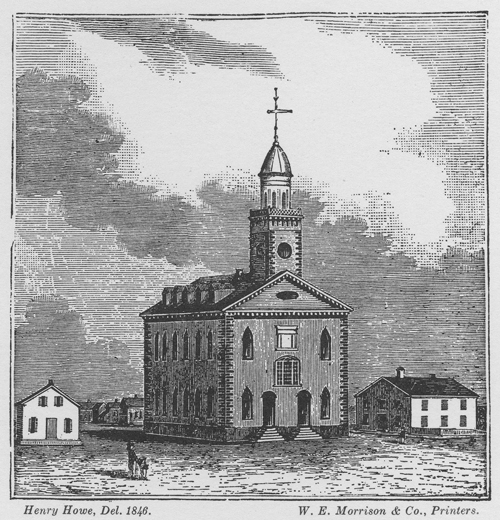
In the autumn of 1836, the fields around Kirtland were acquiring a second existence as city lots. A farm could still produce a crop while its owner imagined the streets, houses, shops, and incoming families that would make the ground worth several times its purchase price. The temple had been dedicated in March, an extraordinary building for a small Ohio settlement, and the gathering of converts gave further construction an apparently dependable future. Newcomers needed homes, land, tools, cloth, and provisions; established residents needed customers; merchants needed the means to replenish their shelves. Much of this activity proceeded on credit, with a signature supplying what a purse could not. The wealth seemed substantial because people could point to it. There stood the temple, there lay the farms, there were the goods in the stores. The difficulty came when someone wanted payment in something that could leave Kirtland and satisfy a creditor elsewhere. That difficulty reached across an expanding religious movement. Church leaders were buying property, supporting printing, arranging migration, and maintaining connections with settlements in Missouri, where violence and displacement had already destroyed valuable assets. Their undertakings produced a dense accumulation of obligations: a merchant’s bill in New York, a mortgage in Ohio, money needed by travelers, a contribution promised for distant land. The same men appeared repeatedly as religious officers, business partners, borrowers, endorsers, and trustees. A failure in one account could therefore disturb several others. By the beginning of 1837, Kirtland’s leaders were attempting to add a bank to this arrangement, giving their community the power to issue paper that would purchase things immediately against resources expected to become available later.
What, exactly, was Kirtland trying to become? Its ambitions exceeded those of a congregation purchasing a meetinghouse. Religious gathering was creating a town, and the town needed institutions capable of making that gathering economically possible. The troublesome word kingdom becomes useful here because it draws attention to the machinery beneath the aspiration: property, accounts, stores, presses, transport, administration, and the capacity to assemble people over considerable distances. Understanding that machinery also requires following an older expectation into Kirtland, one in which wealth lay concealed and the person who knew where to find it possessed an advantage unavailable through ordinary labor.

Joseph Smith’s early treasure seeking belonged to an American countryside crowded with stories about buried money, lost mines, and valuable objects hidden by earlier inhabitants. Spanish treasure supplied a particularly attractive explanation for why riches might be present without their owners being visible. Seer stones and divining practices offered ways to identify such deposits; agreements among searchers determined who would work and how the proceeds would be divided. The supernatural claims were distinctive, but the organization of expectation was familiar. A mine, a proposed canal, and a tract bought ahead of settlement all required people to commit present resources to wealth whose eventual realization remained uncertain. Treasure seeking intensified that uncertainty while promising an unusually abrupt escape from it. In late 1825, Josiah Stowell employed Smith in a search for a supposed Spanish silver mine near the Susquehanna River in Pennsylvania. Smith acknowledged this employment in his later history, while describing his efforts to persuade Stowell to abandon the excavation. The episode also brought him before a New York magistrate in March 1826 on a disorderly-person complaint. Surviving fee records establish legal proceedings; the fuller accounts of the examination were published later and differ in important respects. Stowell, the man supposedly being deceived, supported Smith. An agreement attributed to the treasure company, dated November 1825, describes shares in anticipated discoveries, although its original is lost and its text survives through publication in 1880. It can illuminate the arrangement without being mistaken for an independently preserved contract.
These searches treated the landscape as a repository of unrealized assets. Knowledge could disclose them, cooperation could recover them, and an agreed division could turn discovery into private wealth. Smith’s subsequent religious claims gave buried records a purpose quite different from the payment of a treasure company’s shareholders, but the earlier economic imagination did not vanish at conversion or ordination. In the summer of 1836, with the movement firmly established in Ohio and its leaders concerned about debt, the prospect of money hidden in a New England house again became relevant.
Smith traveled east with Hyrum Smith, Sidney Rigdon, and Oliver Cowdery, arriving in Salem, Massachusetts, on August 5. They rented accommodation on Union Street, preached, and visited the surrounding country. The detailed treasure story comes principally from Ebenezer Robinson, writing in 1889 about information he said he had received from Smith’s brother Don Carlos. According to Robinson, a church member named Burgess had reported money concealed in the cellar of a house formerly belonging to a widow. Burgess supposedly believed himself the only surviving person who knew its location. This is a recollection at a considerable distance, and its chain of transmission matters. An earlier, hostile reference by James Colin Brewster in 1843 also associated an eastern journey with a rented house and buried money, although he placed it in Boston. Two documents from August 1836 make it impossible to dismiss the whole affair as a late invention. On August 17, the four travelers signed a promise to pay Jonathan Burgess $100, with interest, one year later. The surviving note establishes a financial relationship with a man of that name; it does not establish a fee for locating treasure. Nor can Jonathan Burgess be securely identified with every Burgess named in the later accounts. Two days afterward, Smith wrote Emma that they had found the house after Brother Burjece’s departure. It was occupied, and obtaining it by purchase or rental would require patience. He hoped that this might be accomplished within months. The letter supplies neither the house’s address nor an account of anything recovered from it. Their Union Street lodging and the house they hoped to obtain should consequently remain separate properties unless further evidence joins them.

The revelation dated August 6, now Doctrine and Covenants 111, occupies the space between those records and the later explanation. It opens by acknowledging the travelers’ follies, promises treasure and people in Salem for Zion’s benefit, addresses their debts, and directs them to make acquaintances. Its language accommodates both material resources and converts, without allowing the money to be removed from the problem that brought them there. The earliest surviving manuscript copies were made later, another distinction worth retaining. No recovery of cellar treasure is documented, and no reliable identification of the target house has emerged. What survives is a religious leadership seeking financial relief, discussing access to a particular building, borrowing still more money, and receiving a revelation that placed the journey within a continuing divine purpose.
The return to Kirtland brought those expectations back into a much more extensive world of enforceable paper. Its foundation was Newel K. Whitney’s mercantile business. Whitney and Sidney Gilbert had formed their partnership before either became a Mormon; their commercial experience and established credit were assets the movement could use. In 1832, the United Firm brought designated mercantile and publishing enterprises under the joint direction of a small group of church leaders. Whitney managed the Ohio storehouse, Gilbert the Missouri operation, while publishing responsibilities involved William W. Phelps, Cowdery, and Frederick G. Williams. This arrangement coordinated particular businesses and their obligations. It never absorbed every Saint’s property or every privately owned Mormon store into one comprehensive communal treasury. The commercial circuit began with goods obtained from eastern wholesalers, frequently on time. Those goods acquired a higher retail value after transport to Ohio, but a sale entered in a customer’s account did not necessarily provide the money needed when the wholesale bill matured. Donations, loans, repayments, and transfers among the associated enterprises helped bridge the intervals. A promissory note fixed a future obligation; an endorsement could make another person responsible for it; a draft directed payment through a third party. The store could support a traveling church officer or advance money to a printing operation, leaving an internal balance that still depended upon someone eventually supplying usable funds. Religious administration extended this circuit across settlements without abolishing the ordinary merchant’s problem of collecting from customers before creditors collected from him.
Whitney’s statement of April 18, 1834, puts figures against the arrangement. His firm owed about $8,000 and needed at least $4,000 for approaching payments. A New York purchasing trip the previous autumn had added more than $4,400 in obligations. Property carried its own schedule: the former Peter French farm involved two outstanding payments of $1,500 each. On the same sheet Whitney authorized Smith to borrow between $1,000 and $8,000 in the firm’s name. Printing had also drawn upon Whitney’s credit. After the Independence press was destroyed in 1833, Cowdery’s eastern purchasing trip cost $630.15, including $190.60 for a press and $360.21 for type. A newspaper could gather readers, disseminate instructions, and earn subscription revenue, but someone first had to finance the equipment that made those advantages possible. An internal settlement five days later canceled $3,635.35 owed to Whitney’s firm by associated individuals and the publishing business. Smith’s balance was $1,151.31; Rigdon’s, $777.98; F. G. Williams & Co.’s, $584.14. Forgiving those internal balances redistributed burdens within the organization. It did not discharge what Whitney owed outside merchants. Missouri sharpened the distinction: the destruction of the printing office and the expulsion from Jackson County removed property and earning capacity while leaving debts behind. The United Firm was divided into separate Ohio and Missouri arrangements in April 1834. Its dissolution left an enduring lesson in how effectively shared enterprise could move resources, and how quickly personal guarantees could transmit a loss from one undertaking into another.

That same spring, the movement was preparing an armed expedition from Ohio toward Missouri, then called the Camp of Israel and subsequently remembered as Zion’s Camp. Roughly two hundred men, accompanied by some women and children, needed food, transport, equipment, and money over hundreds of miles. Frederick G. Williams served as paymaster, handling common funds rather than a conventional military payroll. Participants pooled money, companies received disbursements, and horses, harnesses, and wagons entered the accounting alongside cash. The surviving general account records $100 received from Boston, $66.37 from the New Portage congregation, and $29.68 from a Kirtland contribution. Small sums from scattered communities became provisions for an organized body on the road. The expedition’s intended restoration of the Missouri Saints to their lands was never accomplished, and cholera made the enterprise a terrible human ordeal. Orson Hyde’s subsequent accounting attributed $1,068.44 in cash and property to Smith’s side of the expedition’s finances, offset by $424.16 remaining, for a net contribution of $644.28. That net included $61.84 for wear on wagons and harnesses. The funds drew partly upon Martin Harris, Book of Mormon sales, and newspaper subscriptions; the records leave questions about reimbursement and the handling of particular assets. They nevertheless reveal an administration capable of gathering resources through religious relationships, carrying them across state lines, and reconciling accounts afterward. Even the division of the remaining common fund survives: $233.70, with an allocation of approximately $1.16 per participant. The organization could mobilize a distant constituency and an armed traveling company before it possessed a bank capable of financing either one.

By 1836, the gathering at Kirtland was demanding a larger answer. Surviving transactions place Smith’s autumn land purchases at roughly 440 acres. Some purchases were intended to provide ground for incoming Saints, whose arrival would in turn help justify the purchases. The circle was economically powerful while it continued turning. A tract acquired on credit could be divided, sold in smaller pieces, and used to support other obligations; rising prices increased its apparent security. Contemporary church editor Warren Cowdery described startling increases in real-estate prices and men of little previous substance buying thousands of dollars’ worth of property. These were observations of a boom, rather than a modern statistical index, but the excitement is unmistakable. The expanding city existed simultaneously in buildings, deeds, obligations, and projected sales.
Parley P. Pratt supplied the more painful view in a letter to Smith dated May 23, 1837. He complained about three lots sold to him for $2,000 and about an obligation Smith had, according to Pratt, already used to obtain money from the bank. Pratt accused Smith and Rigdon of leading the people into destructive speculation. The letter survives in an 1838 printing and a later transcription published in 1888; its original and the deeds identifying the precise lots are missing. His accusation does not establish every element of the transaction as he understood it. It does show how a member could discover that an expected future increase in land value had become a present debt affecting his family, his guarantors, and his confidence in the men who led his church.
A local bank promised to ease several pressures at once. It could issue notes to borrowers, purchase or discount obligations, and exchange its paper for the currencies of other institutions. Its notes would provide a medium of payment within the gathering community and, if accepted elsewhere, greater purchasing power beyond it. On November 2, 1836, the Safety Society’s stockholders adopted a constitution providing for thirty-two directors and elected Rigdon president and Smith cashier. The proposed capital was $4 million, divided into 80,000 shares of $50 each. This was an enormous aspiration for a community bank, not a statement that four million dollars had been collected. The title cashier also conceals responsibility from modern readers: Smith was an executive officer of the institution, rather than simply the man serving customers at a counter.
The stock ledger supplies the distance between the aspiration and the receipts. The usual first installment worked out to twenty-six and one-quarter cents on a fifty-dollar share, allowing an investor to subscribe for $5,000 in stock with a payment of $26.25. Even that small initial requirement was not always met. Smith subscribed for 3,000 shares and initially paid $1,342.69; numerous smaller subscribers supplied much less, and several accounts contain no recorded payment. More than a hundred investors had provided nearly $12,000 by the beginning of January. Crucially, the ledger’s cash entries could include other banks’ paper as well as gold and silver. They cannot simply be relabeled a specie reserve. The participants included ordinary members and women as well as prominent men, spreading exposure through households whose capacity to absorb losses was often slight.
Faith entered the banking room explicitly. On January 6, Wilford Woodruff recorded Smith saying that he had received divine direction concerning the Society and that obedience to the commandments given that morning would bring a favorable outcome. Woodruff added his own prayer for the institution’s protection and extraordinary growth. For him, the success of this financial business belonged among the things for which a prayer could properly be offered. Such confidence could encourage investment while exposing religious authority to the consequences of ordinary commercial failure.
Authorization proved another scarce asset. Orson Hyde was charged with pursuing an Ohio charter, while Cowdery obtained the means to print the notes. Banking politics were unfavorable: the legislature had become increasingly reluctant to create banks, and the 1836–1837 session produced no new bank charters. The sole documented legislative proposal for Kirtland came on February 10, 1837, when Democratic senator Samuel Medary offered to include it as a branch in a proposed state banking arrangement, with capital of $300,000. It lost, eleven votes to twenty-four; Geauga senator Ralph Granger voted against it. The record does not support confidently narrating an earlier formal rejection simply because later histories assumed one. Religious hostility mattered in Kirtland’s affairs, but the wider legislative resistance prevents explaining this vote entirely as a special prohibition against Mormon money.
The Society had already reorganized on January 2, before that recorded defeat, as the Kirtland Safety Society Anti-Banking Company. Its new articles presented a firm engaged in agriculture, mechanical arts, and merchandising; managers replaced directors, and the officers became treasurer and secretary. Members bound themselves to redeem its notes. The experiment relied upon the freedom to form a private association while attempting to escape restrictions upon unchartered banking. Ohio’s 1816 law imposed penalties on unauthorized note issuers; an 1824 provision denying enforcement of certain unchartered-bank obligations contributed to disagreement over the legal position. Renaming the enterprise did not resolve its essential exposure. A joint-stock association could own assets and transact business without thereby receiving a legislative privilege to conduct a bank.
The monetary world in which these decisions made sense requires some reconstruction. Americans did not carry a uniform federal paper currency for everyday purchases. A state-chartered bank’s note was a promise by that institution to pay the stated amount, ordinarily in specie on demand. Its usefulness depended upon confidence that the promise would be honored, the distance to the issuing bank, and the discount another institution demanded to accept it. Merchants’ drafts and individual promissory notes could also transfer claims and support purchases, although their terms and circulation differed. An authentic obligation could consequently buy less than its printed face value without being a forgery. A three-dollar bill was an ordinary denomination; the joke came later. Unauthorized banking concerned the issuer’s legal authority. Wildcat banking described a range of precarious or abusive practices, sometimes undertaken by institutions that possessed perfectly authentic charters. Counterfeiting introduced another problem: someone might imitate an existing bank’s notes, alter a genuine bill’s denomination or bank name, or invent paper purporting to come from a fictitious institution. Counterfeit coin was a separate manufacture, requiring deceptive metal and workmanship rather than a false engraved promise. Period usage could also sweep the deceptive passing of worthless bank paper into the broader counterfeit business. The categories overlapped in public suspicion without becoming interchangeable. The Safety Society’s own signed notes were genuine issues of an unauthorized institution, carrying an increasingly doubtful promise. Calling them counterfeit from the outset erases the mechanism that made their rise and failure possible.
Their manufacture was itself an ordinary commercial transaction. Underwood, Bald, Spencer & Hufty, an established engraving concern operating in New York and Philadelphia, produced the plates in late 1836. Cowdery apparently arranged the order through New York and collected the finished work through Philadelphia. The firm’s subsequent lawsuit over a $1,450 note, probably covering plates and printing, provides a material reminder that money manufacture required credit too. The bills used elaborate lettering, ornamental borders, pastoral scenes, and images of transport to make an Ohio promise recognizable as money. On the dollar, a sheep shearer worked above the promise of payment, with steam transport at the sides. Officers signed them; clerks entered dates, serial numbers, and payees. Engraving supplied familiarity and resistance to imitation, while the signatures assigned responsibility for redemption. Reorganization arrived after BANK had already been engraved. On the earliest low-denomination issues, small hand-stamped additions converted the name into ANTI-BANK-ING CO.; stamps also canceled the old officers’ titles. The result was sufficiently awkward to become a controversy of its own. On January 18, the Cleveland Weekly Gazette complained that a hurried recipient might see the conspicuous word Bank and overlook the small qualifications. Surviving notes establish that the additions were real, but they were applied only briefly, apparently being abandoned in the first days of January. A specimen bearing them should not be taken as the universal appearance of every Kirtland bill. The company’s paper had acquired an argument about its legal identity directly on its face.

The notes entered circulation through loans and exchanges beginning between January 4 and 7. On February 1, even the hostile Cleveland Weekly Gazette estimated the issue at probably no more than $40,000. Parrish would later claim at least $150,000 had circulated, against no more than $6,000 in specie, while accusing Smith of exaggerating both the coin and the credit available. These conflicting statements describe different moments through antagonistic accounts; they cannot supply a reliable reserve ratio for the institution’s entire life. Accepting them meant trusting a financial arrangement whose capital consisted largely of promises still to be paid, whose reserve included other paper, and whose participants possessed substantial resources that could not be turned instantly into coin. Land helped support confidence in the enterprise, and the members’ redemption commitment extended beyond the little stock installment each had paid. Nevertheless, a buyer for a farm had to be found before its value could satisfy a noteholder at the banking room. The imagined city could make land valuable; it could not make that value immediately portable. A guarantee supported by property exposed the guarantor without necessarily solving the institution’s liquidity problem.
The founders sought a wider market for their money. An agreement on January 14 authorized Akron lawyer David Cartter to handle up to $30,000 in notes for a commission of one and a half percent. March arrangements allocated $1,000 to J. W. Briggs at Painesville and promised Ovid Pinney and Stephen Phillips $40,000 for a four-year operation in Beaver County, Pennsylvania. Those contractual limits record intended capacity; they cannot all be added together as proven circulation. The Bank of Monroe in Michigan offered another possible connection to chartered finance. Kirtland’s leaders dealt with its officers, and Cowdery became its vice president and a director in February. These were identifiable institutional relationships across the Great Lakes economy, rather than evidence of a concealed counterfeiting organization. The precise ambitions for the Monroe connection remain uncertain, and the Michigan institution’s own difficulties prevented a dependable rescue. Its suspension of payments should also be distinguished from permanent closure: Monroe continued a reduced existence after 1837.
Confidence was already breaking locally. Critical newspapers warned readers away from the paper, while the Painesville Republican cautiously suggested that adequate specie would make the enterprise useful in a tight money market. The Cleveland Weekly Advertiser defended the Society against what it regarded as persecution. Later recollections credited Grandison Newell, a determined opponent, with collecting its bills and presenting them for coin. Those accounts fit the vulnerability of a lightly funded institution but cannot measure the withdrawals as an audited record would. Heavy redemption demands, refusal by neighboring institutions to accept the paper, and reports of closure all operated against the Society during January. Its troubles preceded the national banking panic by months, although its lending and stock transactions did not cease at the first newspaper announcement of failure.
In February, Samuel Rounds initiated actions under the 1816 banking statute against Smith, Rigdon, and other Society officers. The cases against the others were dropped; juries found Smith and Rigdon liable in October, with a $1,000 penalty against each. These were civil penalty proceedings for unauthorized banking, with the recovery divided between the informer and the state. They were not convictions for manufacturing counterfeit currency. Rounds subsequently assigned his interest to Newell. Meanwhile the Panic of 1837 had brought a general contraction of credit, specie suspensions, and declining confidence in land and banks. The collapse of an already fragile Kirtland undertaking became harder to arrest as the wider system withdrew the credit and ready money upon which frontier expansion depended. Smith and Rigdon withdrew from management between June and early July, and Frederick G. Williams and Warren Parrish assumed leadership. Further note issues followed before the institution finally closed, apparently by late summer. Smith’s notice that August warned against people passing its paper, and the financial loss accompanied a destructive religious division. For members who had trusted leaders in property purchases, store accounts, and bank investments, the distinction between temporal management and spiritual authority could become painfully difficult to maintain. The failure produced lawsuits, recriminations, and explanations assigning responsibility to enemies outside the church or dishonesty within it. It also generated a body of counterfeiting allegations that deserves closer attention than either automatic acceptance or automatic dismissal.
Bogus was almost a local word. Its early printed history runs through the Painesville Telegraph in 1827, near Kirtland, when it denoted an apparatus used for making counterfeit coin. Eber D. Howe, the newspaper’s former editor and later author of Mormonism Unvailed, recalled the discovery of a coiners’ machine and the crowd’s application of the name. His account of its origin was published much later, and the ultimate etymology remains uncertain; the association between the word and the counterfeiting apparatus is firmer. By the following decade it could describe the product as well as the mechanism. When a Kirtland or Missouri record spoke of the bogus business, it could be referring quite specifically to false coin, rather than merely expressing an opinion of Joseph Smith’s bank.
Counterfeit commerce had its own manufacturers, wholesalers, intermediaries, and retail passers, using roads and canals that also carried legitimate merchandise. The Cuyahoga Valley supplied a substantial neighboring example. Samuel A. Lane’s 1892 local history describes James and Daniel Brown and associates dealing in counterfeit money along the Ohio canal corridor. It names William Latta, Abraham S. Holmes, and William Ashley among the connected operators, and recounts a Portage County indictment against Latta in January 1834, followed by his failure to appear in March. Lane wrote decades afterward, although as a longtime local official with direct experience of the region. His narrative is valuable for locating prosecutions, people, and alleged equipment; it should not be silently promoted into a bundle of surviving contemporary verdicts. The counterfeit plates Lane described imitated issuers in New York, Rhode Island, Toronto, and the United States banking system. That geographical spread helps explain the business: the false obligation could travel farther than knowledge of its defects. Surviving counterfeit and spurious notes bearing Buffalo and Detroit issuers’ names provide other material evidence of the regional market, while later detectors catalogued deceptive Pittsburgh-bank notes carrying 1830s dates. Such an object does not identify the place where it was printed or every place it circulated. The wider corridor is demonstrable; a single organization joining its offenders to Kirtland’s leadership is not. Nor does the use of a respectable banknote engraver establish that its customers shared a criminal business with every forger who could imitate the product.
A contemporary report carried the problem across the Canadian border. On July 17, 1837, Cleveland’s Herald and Gazette relayed news from the St. Catharines Journal in Upper Canada that Sarah Cleveland had been committed to Niagara jail for passing $390 in Safety Society paper with intent to defraud, then admitted to bail. Here was a named person and a specific sum appearing in a report of legal action while the institution still struggled to operate. The notice establishes an allegation of fraudulent passing, not the manufacture of forged bills or a conviction. Her identity and any connection to the Kirtland officers remain unresolved.
The most consequential internal evidence comes from Cowdery’s church trial in Far West on April 12, 1838. Seymour Brunson had submitted nine charges earlier that month. The eighth accused Cowdery of “disgracing the Church by being connected in the ‘Bogus’ buisness as common report says.” Its reference to common report appears in the charge itself. Yet the hearing contains more than that bare rumor. Frederick G. Williams testified about Cowdery’s description of a man named Davis who could compound metal and make dies producing money supposedly beyond detection. The editors of the Joseph Smith Papers tentatively identify this man as Marvel Davis, a member of the Kirtland community. The testimony is a concrete lead toward a claimed manufacturer, with an attributed conversation and a describable process. It supplies no recovered die, tested coin, or demonstrated transaction by Davis. Williams also mentioned an approach for a warrant involving John Boynton, Parrish, and Burton Phelps, the last a local constable. The wording leaves it unclear whether these men were complainants or the persons accused, a distinction that changes the entire meaning of their appearance. Smith testified that an outsider, recorded as Mr. Sapham and tentatively identified as Jonathan Lapham, had warned him of a prospective warrant concerning Cowdery’s purchase of counterfeit money and dies. Smith and Rigdon confronted Cowdery; according to Smith’s account, Cowdery denied the accusation and afterward left Ohio. The council accepted circumstantial evidence for the bogus charge and excommunicated him on the combined findings. The surviving evidence establishes an ecclesiastical accusation, testimony, and judgment, rather than a civil counterfeiting conviction. In 1846, Cowdery vigorously denied allegations of theft and forgery that he said his former associates knew were false.
A threatening letter addressed to Cowdery and other dissenters around June 17, 1838, expanded the allegation to David Whitmer and Lyman E. Johnson. Its authorship is uncertain, and Smith did not sign it; eighty-three Saints ultimately did. The document demanded that its recipients leave Caldwell County. Its references to counterfeit dealing therefore belong within an attempt to drive religious opponents from their homes, even as they preserve claims that can be investigated. The named relationships were real: these were former collaborators in the movement, some deeply entangled in its business affairs. Their increasingly bitter struggle over leadership and debt, however, also made accusations an instrument of expulsion. Repetition in such a document cannot serve as independent corroboration of the earlier hearing.
The August 1838 Elders’ Journal offered the most vivid account of an actual supposed transaction. It alleged that Parrish took $25,000 in paper from the bank, bought counterfeit coin from the Tinker’s Creek blacklegs, and dealt in property with Julius Granger. The account continued with a horse and carriage exchanged for a box that proved to contain sand and stones. Luke Johnson, acting as constable, supposedly accompanied Parrish to recover the property; the affair ended, according to the editorial, with Parrish paying $200 after detention by the Cuyahoga sheriff. These details identify people, a place, a commodity, an exchange, and possible legal records. They also come from a ferociously partisan editorial in Smith’s newspaper, published after Parrish had become an opponent. The vividness of the story is no substitute for the missing independent case file.

Later historian Mark Staker connected the Tinker’s Creek reference with Jim Brown’s operation. The regional histories make that identification plausible, but the editorial itself names no Brown, and its account does not establish every proposed link. The strongest reconstruction therefore has different levels: Parrish’s management of the Safety Society is documented; the editorial directly accuses him and names Granger and Johnson; Davis enters through Williams’s testimony; Brown’s organization supplies a neighboring counterfeit economy and a possible external connection. The crucial transaction joining those strands remains an allegation. No surviving evidence examined here establishes that Underwood’s engraving business, Whitney’s store, or the church leadership collectively operated a counterfeit mint. A map of commercial relationships and a map of accusations can be drawn through some of the same people without becoming the same map.
The paper itself continued to cause trouble after the bank’s death. Clark’s New England Bank Note List for December 1846 still listed the Kirtland Safety Society as fraud, placing its name among closed, failed, discounted, and unsaleable institutions. Smith had issued another warning in June 1844, alleging that stolen notes had acquired forged signatures and were being passed or used to pursue collections. Authentic printed sheets, unauthorized signatures, genuine old signatures, and worthless promises could now circulate under the same engraved name. That is different from proving that every surviving specimen is counterfeit. In 1849, selected Kirtland notes were countersigned and reused in the Salt Lake settlement under a new financial arrangement associated with its gold resources. Their survival demonstrates how a printed form could outlast one promise and be recruited to carry another.
Across this history runs the question of who possessed authority to declare money real. Legislators could authorize a bank, officers could sign its obligations, merchants could accept them, brokers could discount them, and courts could decide what their holders might enforce. None of these powers guaranteed that a creditor would find coin when he demanded it. A counterfeiter exploited the familiar appearance of someone else’s promise; an underfunded issuer strained its own. Kirtland’s financial capacity depended upon legal permission, commercial acceptance, and an expanding membership, while religious confidence encouraged people to treat resources spread across different hands and distant places as the basis of a common future. The experiment was substantial enough to support transactions and fragile enough for a demand for immediate settlement to expose its limits.
Other frontier enterprises had already combined functions that later histories tend to separate. Astor’s fur-trade system used posts as warehouses, credit offices, information centers, and places of negotiation and protection. A store could anchor a distant commercial presence because supplies, debt, transport, and local relationships belonged to one undertaking. Federal exploration had a related institutional breadth: Jefferson’s instructions to Lewis joined geographical reconnaissance with diplomacy and commercial intelligence. Lewis’s Masonry is documented, including Royal Arch advancement in 1799 and leadership of the St. Louis lodge in 1808; those facts supply no documentary warrant for declaring the Corps of Discovery a Knights Templar expedition. Jedediah Smith’s crossing of South Pass in 1824 likewise belongs to the development of workable overland corridors, informed by Indigenous geographical knowledge. It was no discovery of a maritime Northwest Passage. These comparisons locate Kirtland among contemporary efforts to turn knowledge, supply, and organization into a durable presence across distance.
Kirtland’s particular ambition was to make religious gathering support an expanding society with an unusually high degree of internal coordination. Financial sovereignty describes that ambition only if its limits remain visible. Ohio retained authority over banking, ordinary creditors could sue, property remained subject to state law, and the Society’s notes required acceptance by people who owed the church no obedience. Nevertheless, the movement was assembling some of the capacities that communities seeking autonomy require. The treasury was dispersed across accounts, the monetary instrument was privately issued, and the territorial base was insecure, but the institutions were being built together. A revelation could encourage their use; it could not compel a Cleveland merchant to exchange them for goods.
The breakdown carried those organizational problems into Missouri, where land concentration, church administration, and armed defense developed amid escalating conflict, and then into Nauvoo, where a municipal charter, commercial enterprises, land sales, and a militia offered different instruments of collective power. These changes should not be read as the unfolding of a complete design already present in Ohio. They were responses to experience, opportunity, and repeated expulsion. Later western migration would demand further methods of pooling resources and coordinating supply. Kirtland had already made the requirements visible: the gathering needed financial arrangements that could survive the costs of the very movement they encouraged.
The Ohio town remains the revealing place because its expectations were still crowded so closely together. A widow’s rumored cellar, a wholesaler’s invoice, a wagon worn on the Missouri road, a farm awaiting subdivision, and a note promising coin on demand belonged to different kinds of undertaking, yet each raised the question of how anticipated value could be made available now. Kirtland attempted to manufacture financial capacity faster than its paid capital, its creditors, and the surrounding political and monetary system could sustain. Its failure scattered debts and people without extinguishing the need that had produced it. For a brief interval, on a small patch of northeastern Ohio, fields and merchandise, faith and signatures, borrowed money and expected arrivals had been made to answer for a kingdom whose means of support were still being assembled.