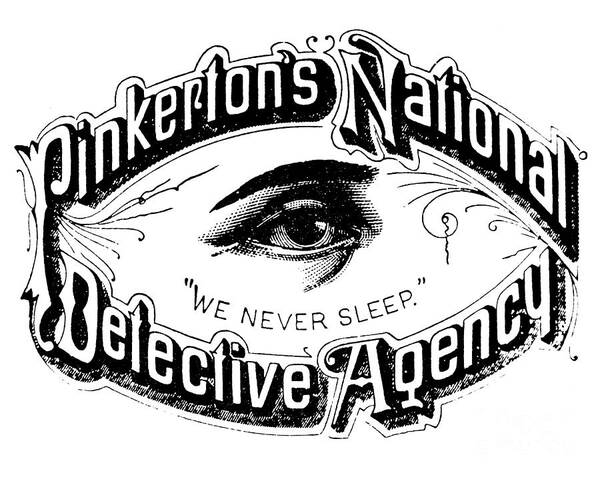
The familiar story of the Pinkerton National Detective Agency usually begins with detectives, railroads, undercover operatives and the open eye beneath the words “We Never Sleep.” The Independent Order of Odd Fellows normally enters an entirely different history, one concerned with lodge halls, ritual, sickness benefits, widows, orphans and cemeteries. Put the administrative machinery of the two organizations beside one another, however, and the separation becomes much less tidy. By the end of the nineteenth century both had developed extensive private systems for identifying people, keeping records about them, moving confidential information between cities and turning those messages into action
The visual resemblance between the organizations is striking but should not carry the argument by itself. Odd Fellows imagery repeatedly used an open eye alongside the three links of Friendship, Love and Truth, while Pinkerton built its public identity around an eye that supposedly never slept. Open-eye imagery was widespread in nineteenth-century religious and fraternal culture, so there is no reason to claim that Pinkerton simply copied the Odd Fellows emblem. What matters is that the institutions behind the two eyes were increasingly engaged in related kinds of work: observation, authentication, investigation, recordkeeping and communication across distance.


Pinkerton Was Built Around Information
Allan Pinkerton’s organization is often remembered through its field work, but the surviving agency archive shows how heavily the operation depended upon paper. The Library of Congress holds approximately 63,000 Pinkerton items, including correspondence, investigative reports, police and prison records, code books, criminal rosters, procedural manuals, photographs, wanted notices, maps and card indexes. The administrative files alone contain code books, directories, employee records, criminal rosters and filing systems designed to make information retrieved in one investigation available somewhere else. (Library of Congress)
The archive was never complete. Branch offices often maintained their own files, many case records went back to clients, and a substantial amount of early material disappeared in the Chicago Fire of 1871. Even with those losses, the surviving records show an organization whose real strength lay in its ability to detach information from a particular investigator and make it portable. A description, photograph, criminal history or report created in one city could become useful to another Pinkerton office later. (Research Guides)
That was enormously powerful in a country being transformed by railroads. A man could move into another jurisdiction before a local police department had any idea who he was, while a telegram containing his description could arrive ahead of his train. Pinkerton’s business grew inside that gap between personal anonymity and increasingly rapid communications, and the agency responded by building a private bureaucracy capable of remembering people across distance.
The Odd Fellows encountered the same problem for a very different reason.
The Odd Fellows Had to Authenticate Strangers
American Odd Fellowship had spread out from Baltimore into thousands of communities by the later nineteenth century. Its responsibilities included caring for sick members, relieving distress, helping widows and orphans and burying the dead, but those duties became administratively complicated once members began traveling and relocating across the country. A man could walk into a lodge hundreds of miles from home and claim that another lodge owed him recognition and assistance.
The receiving lodge needed more than fraternal goodwill. It had to establish whether the visitor really belonged to the Order, whether his membership remained current and whether the lodge he named would accept financial responsibility for him. Visiting cards, lodge seals, signatures, secret recognition and periodically changing passwords all belonged to that system of verification.
The same obligation produced an extensive documentary record. Membership rolls could record initiation, transfer, suspension and death, while benefit records connected identity with actual financial liability. The lodge secretary was therefore doing more than taking ceremonial minutes. He maintained the information that determined whether a person was recognized by a larger interstate organization.
This becomes especially clear when the Odd Fellows’ internal judicial structure is examined. The Illinois code of 1906 provided for investigating and prosecuting committees, required committees to gather material evidence and insisted that a disciplinary record be complete enough that someone unfamiliar with the events could later understand what had happened. Members knowledgeable in law and rules of evidence could even be brought in to help committees conduct proceedings properly. (Wikimedia Commons)
That is an administrative culture built around the preservation of usable intelligence. Its purpose was internal discipline rather than criminal policing, but the lodge was already accustomed to asking questions, examining testimony, determining credibility and writing down findings for later review.
Then the telegraph entered the system.
The Telegraphic Cipher
The Odd Fellows eventually developed a standardized Telegraphic Cipher and Key, and the surviving 1915 Illinois proceedings reproduce the version amended by the Sovereign Grand Lodge in 1909. The code is one of the clearest surviving pieces of evidence for what the national lodge network actually did when a member appeared far away from home. (Library Digital Systems)
The code word RIVER asked whether the receiving lodge had a member in good standing by a particular name. DOUBT meant that the claimant’s identity was uncertain and requested that a description be wired back. WHITE reported that the supposed member was unknown to the lodge, while BLACK said he was a fraud and that any papers he possessed from the lodge were forged. SECRETARY specifically identified a fraudulent visiting card, and CAUTION warned another lodge to watch for a named impostor. (Library Digital Systems)
The same code handled money and medical care. CASH reported that someone was asking for financial assistance while claiming membership elsewhere, FUNDS asked whether the local lodge should advance money, and HELP asked whether the home lodge would cover nursing expenses. When illness became death, the system continued rather than stopping. FINAL announced that a member had died away from home, GREEN requested immediate instructions for the disposition of his remains, LODGE ordered the body forwarded home, and PURPLE indicated that local burial appeared preferable. (Library Digital Systems)
This was a functioning private communications protocol for identity, fraud, benefits, medical care, death and burial. The telegraph operator did not need to receive the full story of a sick member or a suspected impostor because standardized terms allowed lodge officers to communicate the necessary information quickly and with some degree of privacy.
The implications go well beyond colorful lodge secrecy. Odd Fellows had created a network through which an unknown person in one town could be checked against records stored somewhere else, have his status confirmed or denied and trigger an institutional response once that verification occurred.
The Secretary’s Ledger and the Detective’s File
This is where the administrative resemblance to Pinkerton becomes useful. A Pinkerton office might receive the description of an unknown man, compare it with agency files and determine whether he matched a wanted person or someone involved in an investigation. An Odd Fellows lodge could receive a traveler, compare his claims with credentials and lodge knowledge, and then telegraph his supposed home lodge if more verification was required.
The populations being tracked were different, but the informational process was similar. Pinkerton generally indexed suspects, criminals, employees, operatives and subjects of investigations, while the Odd Fellows tracked members, benefit recipients, traveling brothers, disciplinary cases, widows and the dead. One organization wanted to know whether the stranger matched the suspect described in its files; the other wanted to know whether he matched the brother described in its membership records.
This similarity does not require the two institutions to have been secretly identical. It shows how two large private organizations responded to the same technological environment. Railroads increased mobility, telegraphy increased the speed of information, and both organizations created systems capable of attaching a persistent institutional identity to a person who was physically somewhere else.
That administrative parallel becomes more interesting because an actual Pinkerton rose to the highest office of the Odd Fellows.
Alfred S. Pinkerton
Alfred S. Pinkerton of Worcester, Massachusetts was a lawyer and major Odd Fellows figure. Contemporary reporting records that at the September 1898 session of the Sovereign Grand Lodge he was unanimously elected Grand Sire, the highest office of the Order. A later historical listing gives his term as 1898–1900, while a published address from September 1900 identifies him explicitly as Grand Sire of the Sovereign Grand Lodge. (Library of Congress Tile Gallery)
Alfred S. Pinkerton was not Allan Pinkerton, and I have not found evidence establishing that he belonged to Allan Pinkerton’s detective family. That distinction matters because later lists of “famous Odd Fellows” can easily blur the men together. Alfred had his own well-documented career in Worcester, where contemporary records identify him as a lawyer, public official and senior fraternal leader. (LDS Genealogy)
What makes the coincidence more interesting is that a 1905 Boston directory lists the men and organizations separately. Alfred S. Pinkerton appears as a lawyer at 52 Boylston Street, while another Allan Pinkerton appears as assistant general manager of Pinkerton’s National Detective Agency at 30 Court Street, with the agency itself separately listed there. The directory therefore confirms that the Odd Fellows leader and the detective-agency Pinkertons occupied the same Boston professional world while remaining distinct individuals. (Tufts Digital Library)
The surname alone cannot establish kinship, but Alfred’s position still matters. Around the moment when Pinkerton’s National Detective Agency had matured into a major private information organization, a man named Alfred S. Pinkerton was presiding over the Sovereign Grand Lodge of an organization possessing its own national membership records, investigation procedures, benefit systems and communication channels.
That is specific enough to justify looking harder at Worcester, Boston and the surrounding legal and fraternal networks.
Pinkerton Learned How Fraternal Systems Worked
The detective side of the relationship becomes clearer through James McParland. During the 1870s, Pinkerton sent McParland into Pennsylvania’s anthracite region under the identity James McKenna, where he infiltrated the Ancient Order of Hibernians in the investigation later associated with the Molly Maguires. The Library of Congress Pinkerton collection preserves reports concerning McParland’s movements and identifies the Molly Maguires investigation as one of the significant operations represented in the archive. (Library of Congress)
A contemporary account describes McParland ingratiating himself with men suspected of belonging to the Ancient Order of Hibernians and successfully joining the society in 1874. He remained inside until 1876, gathering information that was later used in arrests and prosecutions. (Library of Congress Tile Gallery)


The importance of this operation is larger than the Molly Maguires case itself. McParland’s job required him to understand how a closed association established trust. He had to possess a biography that sounded plausible, know how local relationships worked and survive questioning by men who had strong reasons to distrust outsiders.
Pinkerton was therefore studying the mechanics of private association as part of detective work. Membership, sponsorship, secret recognition and fraternal affiliation were not merely cultural curiosities; they could determine whether an operative gained access to an organization or was exposed as an impostor.
That places Pinkerton and the Odd Fellows on opposite sides of the same nineteenth-century authentication problem. The lodge constructed tests meant to distinguish an authentic insider from a fraudulent outsider, while an undercover detective constructed an identity meant to survive precisely those kinds of tests.
The Shirey Murder Brings the Networks Together
The most concrete connection between the Odd Fellows and the Pinkerton Detective Agency comes from Arkansas in 1910. Arthur W. Shirey was a wealthy merchant who was murdered at his store in Minturn on March 8. His death became more than a local murder mystery because Shirey’s estate was substantial and his will directed major assets toward the Arkansas Odd Fellows for charitable purposes. (LocalWiki)
The Odd Fellows consequently had a direct institutional interest in what followed. Contemporary newspaper material collected in the local historical record says that John P. Paul, Grand Secretary of the Arkansas Odd Fellows and a former Indiana police chief, became involved in the investigation and contacted the St. Louis office of the Pinkerton Detective Agency. Pinkerton sent Herbert Mosher, an assistant superintendent, to work the case. (LocalWiki)
The Arkansas State Archives independently preserves the Pinkerton side of the episode. Its discussion of the Lawrence County court records confirms that Sheriff William Surridge deputized Herbert L. Mosher of the St. Louis Pinkerton office during the investigation. Mosher pursued James C. Langston as a suspect, though Langston was acquitted and Shirey’s murder remained unsolved.
That produces a remarkably clear chain of authority. A prominent Odd Fellow is murdered and leaves an estate in which the Grand Lodge has major interests; a senior Odd Fellows officer with previous police experience helps direct the response; that officer calls in the Pinkerton Detective Agency; Pinkerton supplies an investigator; and the county sheriff gives that private operative public authority through deputization.
The lodge, detective agency and government police structure are not the same institution, but in the Shirey affair they occupy the same investigation.
Why the Shirey Case Matters
The Shirey case gives us a better model than simply claiming that Pinkerton secretly ran through the Odd Fellows. The lodge already possessed internal records, officers, disciplinary procedures, lawyers, benefit obligations and communications. When a problem exceeded what those internal mechanisms could reasonably handle, an outside professional detective organization could be brought in.
The arrangement looks surprisingly modern. A large private organization maintains its own administrative records and internal investigations, then hires outside investigators when a matter becomes criminal or unusually complex. Public authorities can subsequently cooperate with or deputize those private investigators.
In Shirey’s case, the boundary between fraternity, estate administration, private detection and official police authority becomes porous without disappearing. That is more historically interesting than trying to collapse the three into a single secret organization.
It also shows why the Odd Fellows’ own information infrastructure would have been valuable. The Grand Lodge knew who Shirey was, understood its financial relationship to his estate and possessed its own channels for moving information through the fraternity. Pinkerton supplied a different form of intelligence: suspects, surveillance, interviews, informants and interstate investigation.
Two Private Networks on the Same Telegraph System
The telegraph tied this whole environment together. Pinkerton’s archive contains telegrams embedded in ordinary investigative administration, while Odd Fellows developed a dedicated cipher for the kinds of problems its lodges repeatedly encountered. Both organizations were therefore using commercial communications infrastructure to create private networks layered on top of the public telegraph system. (Finding Aids)
The distinction resembles the later relationship between physical telecommunications and the information protocols carried across them. Western Union or another telegraph company supplied the wire, but Pinkerton and the IOOF supplied the specialized language and administrative structure that made the wire useful to them.
For Pinkerton, a telegram could contain an assignment, a warning or identifying information about a suspect. For an Odd Fellows secretary, a telegram could ask whether a traveler was genuine, whether a card was forged, whether money should be advanced or whether a dead member should be shipped home.
The wire itself did not determine the organization.
The information system riding on it did.
Insurance Is the Missing Piece
The Odd Fellows’ surveillance-like characteristics become easiest to understand when the organization is viewed through insurance rather than ceremony. A mutual-benefit system cannot simply hand money to everyone who appears at the door claiming membership. It needs rules of eligibility, proof of good standing and some means of investigating whether a claim is legitimate.
Sickness creates the same requirement. If the lodge is paying benefits because a member cannot work, someone has to know whether he is actually sick and whether the condition continues. Local knowledge makes this relatively easy when everyone lives in one neighborhood, but the system becomes more complicated when members travel between states.
That explains why lodge membership generated information. A member’s financial relationship with the Order depended upon his identity, status and conduct. Traveling cards and passwords authenticated him, ledgers preserved his status, committees investigated disputes and telegraph messages allowed another lodge to verify him remotely.
What looks superficially like fraternity therefore had an administrative layer resembling a private social-insurance bureaucracy.
Burial Made the Records Permanent
The obligation to bury the dead pushed that bureaucracy farther. The Odd Fellows’ telegraphic code makes clear that death away from home created questions that had to be answered immediately: Who is the man? Which lodge is responsible for him? Does his family want the body returned? Who pays the undertaker? Should he be buried where he died?
The Order’s cemeteries consequently make more sense as part of the same information structure. A lodge could follow a member from initiation through dues, travel, sickness and death, after which the cemetery supplied the permanent physical record of where his remains ultimately went.
This is particularly important when looking at towns where Odd Fellows burial grounds stood beside undertaking businesses, newspapers, hotels and railroad lines. The lodge did not merely possess symbolic authority over death. It had to turn information about a deceased member into physical action involving coffins, undertakers, rail transportation, family notification and burial.
That makes the secretary’s ledger and the cemetery plot two ends of the same custodial system.
Pinkerton Had Its Own Custodial Memory
Pinkerton’s organization approached mortality from a different direction, but it also preserved the identities of people long after individual investigations ended. The agency’s famous “secret archive” accumulated material on important cases and later became the basis for institutional histories of the company. The Library of Congress notes that the remaining archive contains administrative and criminal files, while card indexes cross-referenced individuals and gangs across different investigations. (Library of Congress Blogs)
That culture of preservation mattered because detective work depended upon institutional memory. An individual operative might retire or die, but the description, photograph or case history he created could remain useful decades later.
The IOOF possessed a parallel form of memory in lodge records and burial data. Pinkerton’s institutional memory centered on investigation; the Odd Fellows’ centered on membership and obligation. Both turned individual lives into records that could outlast the people who created them.
The Eye as an Information Symbol
The open eye gains a different meaning once the administrative structures beneath it are understood. Pinkerton’s eye represented vigilance because the agency sold vigilance. Its business depended upon finding out what people were doing and ensuring that information could reach clients or investigators elsewhere.
The Odd Fellows eye belonged to a broader moral and fraternal symbolism, but the Order also developed a practical culture of watching over members. Members were expected to visit the sick, committees investigated misconduct, secret recognition guarded the lodge, and officers verified traveling brothers whose identities were uncertain.

The symbols do not prove institutional descent. They reveal two organizations operating in a period when “watching” was becoming something that could be organized beyond the range of a person’s own eyesight.
The telegraph made that possible.
Alfred S. Pinkerton Still Deserves More Attention
Alfred S. Pinkerton remains one of the most intriguing loose ends in the story because his position is unusually specific. In 1897 he was already serving as Deputy Grand Sire and representing national Odd Fellowship at a ceremony at Lincoln’s monument in Springfield. In September 1898 he was unanimously elected Grand Sire, and in 1900 he delivered a published address in Richmond in that capacity. (Library Digital Systems)
Two years after his death in 1922, newspapers still remembered him as a former Grand Sire of the Odd Fellows, and the Sovereign Grand Lodge later published a memorial collection of his addresses. (Georgia Historic Newspapers)
At the moment, nothing I found establishes that Alfred belonged genealogically to Allan Pinkerton’s detective family. That question should remain open until birth, probate and family records provide an answer. The interesting fact is that the name appears independently at the summit of Odd Fellowship while Pinkerton’s detective organization was simultaneously becoming one of America’s best-known private information systems.
The 1905 Boston directory makes the overlap almost tangible: Alfred’s legal office and the detective agency appear as separate Pinkerton entries inside the same metropolitan directory. (Tufts Digital Library)
A Private Information State Before the Modern State
The larger historical setting helps explain why these organizations could become so powerful. The nineteenth-century United States did not possess today’s centralized identification systems, national criminal databases, universal social insurance or federal investigative bureaucracy. Local police, sheriffs and courts remained fragmented while railroads and corporations increasingly operated across state lines.
Private institutions filled portions of that gap. Railroads employed their own police. Banks paid for private investigative protection. Fraternal organizations administered sickness and burial benefits. Telegraph companies provided communications capable of linking those otherwise separate institutions in minutes rather than days.
Pinkerton became one of the best-known products of that environment because it openly sold investigation and security. The Odd Fellows developed a quieter but enormous information apparatus because administering mutual benefits across thousands of lodges required identification and communication.
In both cases, bureaucracy followed mobility. Once people began routinely leaving the places where everyone knew them personally, institutions had to invent ways to make identity travel.
The Lodge and the Detective Office
This is why the Pinkerton–IOOF connection is more interesting when approached as an overlapping information system rather than as a claim that one secretly controlled the other. The evidence gives us real points of contact without needing to invent the missing pieces.
Alfred S. Pinkerton actually did become Grand Sire of the Odd Fellows. The Order actually did maintain investigative committees and detailed disciplinary records. Its lodges actually did use a telegraphic cipher to verify strangers, detect forged credentials, authorize money, report sickness and manage the remains of members who died away from home. (Library of Congress Tile Gallery)
Pinkerton actually maintained code books, criminal rosters, card indexes, procedural files and private investigative records. James McParland actually penetrated a fraternal organization under a false identity. When Arthur Shirey was murdered, an Arkansas Odd Fellows official actually contacted Pinkerton’s St. Louis office, and the Pinkerton investigator who arrived was subsequently deputized by the county sheriff. (Library of Congress)
Those facts are enough to reveal a world that is usually hidden when fraternal history, police history, insurance history and telecommunications history are studied separately. The same nineteenth-century city could contain an Odd Fellows hall holding membership records, a telegraph office carrying coded lodge traffic, a railroad moving traveling members and detectives, an undertaker handling lodge burials and a Pinkerton office maintaining its own private dossiers.
The institutions had different purposes, but they were learning the same lesson: information becomes power when it can move farther than the person it describes.
The Eye and the Three Links
The old Odd Fellows eye and the Pinkerton eye therefore belong beside one another, but not because a symbol proves a secret merger. They belong together because both organizations were responses to a country in which identity, money, business and people had begun moving across enormous distances.
Pinkerton made the surveillance side visible. Its investigators followed people, penetrated organizations and built files intended to recognize someone wherever he appeared. Odd Fellowship built the reciprocal structure: a member could travel far from home and still be recognized, verified, insured, cared for and eventually buried through a network of men who had never personally known him.
That is also why the moments when the systems intersect are so revealing. McParland’s undercover work shows Pinkerton learning how private fraternities established trust. Alfred S. Pinkerton places the Pinkerton surname at the highest level of the IOOF, even though the family connection remains unresolved. The Shirey murder shows the lodge network directly reaching outside itself and calling Pinkerton into a case involving one of its own members and a major Odd Fellows estate.
By 1910, American private institutions had already assembled much of the machinery later associated with modern information bureaucracies: identity credentials, coded communications, private investigative files, membership databases, interstate verification, insurance records and networks capable of dispatching assistance after receiving a remote message.
The detective office watched the outside world, while the lodge kept track of the people inside its own system. Between them ran the telegraph, carrying information faster than the person being described could travel.
That is the deeper meaning behind the two eyes. The important innovation was not simply watching someone standing in front of you. It was building a network that could know who he was when he appeared somewhere else.