Eddie Lincoln’s burial, a disputed Montgomery marriage, and the households behind a familiar name.

Edward Baker Lincoln died in Springfield on February 1, 1850, a little more than a month before his fourth birthday. His funeral took place the following morning, and he was buried in Hutchinson Cemetery, the private burying ground on the western side of the city. Abraham Lincoln was still a practicing lawyer, eleven years away from the presidency, and the cemetery proprietor’s place in this story began with an ordinary transaction between a grieving family and a local businessman. Identifying that businessman beyond his connection to the grave has proved considerably less straightforward.

John Hutchinson was a cabinetmaker, furniture dealer, undertaker, and cemetery proprietor. Those occupations belonged together in his advertisements, which offered furniture alongside coffins, burial lots, a hearse, and horses. His commercial life already crossed several categories before anyone attempted to reconstruct it from a census occupation. A man recorded as a cabinetmaker in one document and an undertaker in another might be conducting the same business throughout, with different aspects becoming relevant to different customers. The surviving advertisements make that much clear.
The difficulty begins when his family is added to the account. The Papers of Abraham Lincoln identifies the Springfield cemetery proprietor as a Pennsylvania-born man, born around 1811, who married Mary Jane Montgomery at Island Grove in June 1848. Its separate biography of his wife calls her Mary L. Hutchinson, gives Montgomery as an alternate name, and places her birth around 1813–1815 in New Jersey. Both entries cite the marriage record and the newspaper announcement. The association between the cemetery proprietor and Mary Jane Montgomery is therefore an explicit editorial identification within the Lincoln Papers. It was already there before this investigation began.
Meanwhile, the Montgomery family’s genealogical account identifies Mary Jane’s husband as John Steel Hutchison, also rendered Steele in other references. This John was reportedly born in Pennsylvania in 1813, the son of Robert Hutchison and Nancy Steel, and later lived in the Pekin, Wapella, and Decatur area. His wife was Kentucky-born Mary Jane Montgomery, and their son Robert Alexander was born in 1849. The family account describes John as a farmer and innkeeper, placing a recognizable household around a man whose life continues beyond the brief cemetery biography.
That is why John Steel Hutchison became a serious candidate. The identifying connection was a wife’s full name and a marriage in the right county and period, matching the marriage that the Lincoln Papers assigns to the cemetery proprietor. The objection to that identification comes from the census records, which appear to describe two different households.
In Springfield’s 1850 census, John Hutchinson is recorded as a thirty-nine-year-old cabinetmaker born in Pennsylvania. Mary L. is thirty-seven, with her birthplace apparently entered by ditto as Pennsylvania. Lydia E. Smith, twenty-one, completes the recorded household.

In Pekin’s 1850 census, John Hutchison is thirty-five, Pennsylvania-born, and explicitly described as a hotel keeper. Mary Jane is twenty-three and Kentucky-born; Robert A. is one. Elizabeth H. Montgomery, nineteen, appears among the hotel’s other occupants.

Ten years later, the 1860 Springfield census lists John as a fifty-year-old undertaker, again Pennsylvania-born. Mary is forty-five, with New Jersey entered as her birthplace. The household also includes Lydia Pleasant, thirty, Mary Pleasant, nine, and a servant.

The 1860 Wapella census describes a different family arrangement. John is forty-six, a farmer, and Pennsylvania-born. Mary J. is thirty-four and Kentucky-born, and Robert Alexander is eleven. Younger children continue onto the following page.

The Pekin and Wapella entries form a particularly convincing household sequence. Mary’s Kentucky birthplace remains consistent, her recorded age advances from twenty-three to thirty-four, and Robert A., aged one in 1850, becomes Robert Alexander, aged eleven in 1860. Elizabeth H. Montgomery’s presence in the Pekin hotel adds another reason to take the Montgomery connection seriously, although the census does not state how she was related to Mary Jane. The 1850 schedule did not include the later relationship-to-household-head column.
The Springfield sequence also has continuity. John’s occupation develops naturally from cabinetmaking to undertaking, and the recorded household remains distinct from the family appearing in Pekin and Wapella. Lydia E. Smith in 1850 and Lydia Pleasant in 1860 offer a possible further connection, given their similar ages, but their identification and relationship to the Hutchinsons still require investigation.
These are the strongest grounds for separating the records. Anyone arguing for one John has to account for two household descriptions in 1850 and another pair in 1860, including substantially different descriptions of Mary. A fourteen-year difference between the women’s recorded ages in 1850 requires considerably more explanation than a disagreement over the husband’s age or occupation. The two-household interpretation has real evidentiary strength.
Where I remain unconvinced is in the speed with which that interpretation can become a finished biography of two separate couples, followed by the removal of John Steel Hutchison from consideration. The census establishes what the enumerators recorded. Connecting those entries to marriages, deeds, children, and deaths remains a separate historical task, especially when the published Lincoln biographies have already joined details that the household reconstruction would separate.
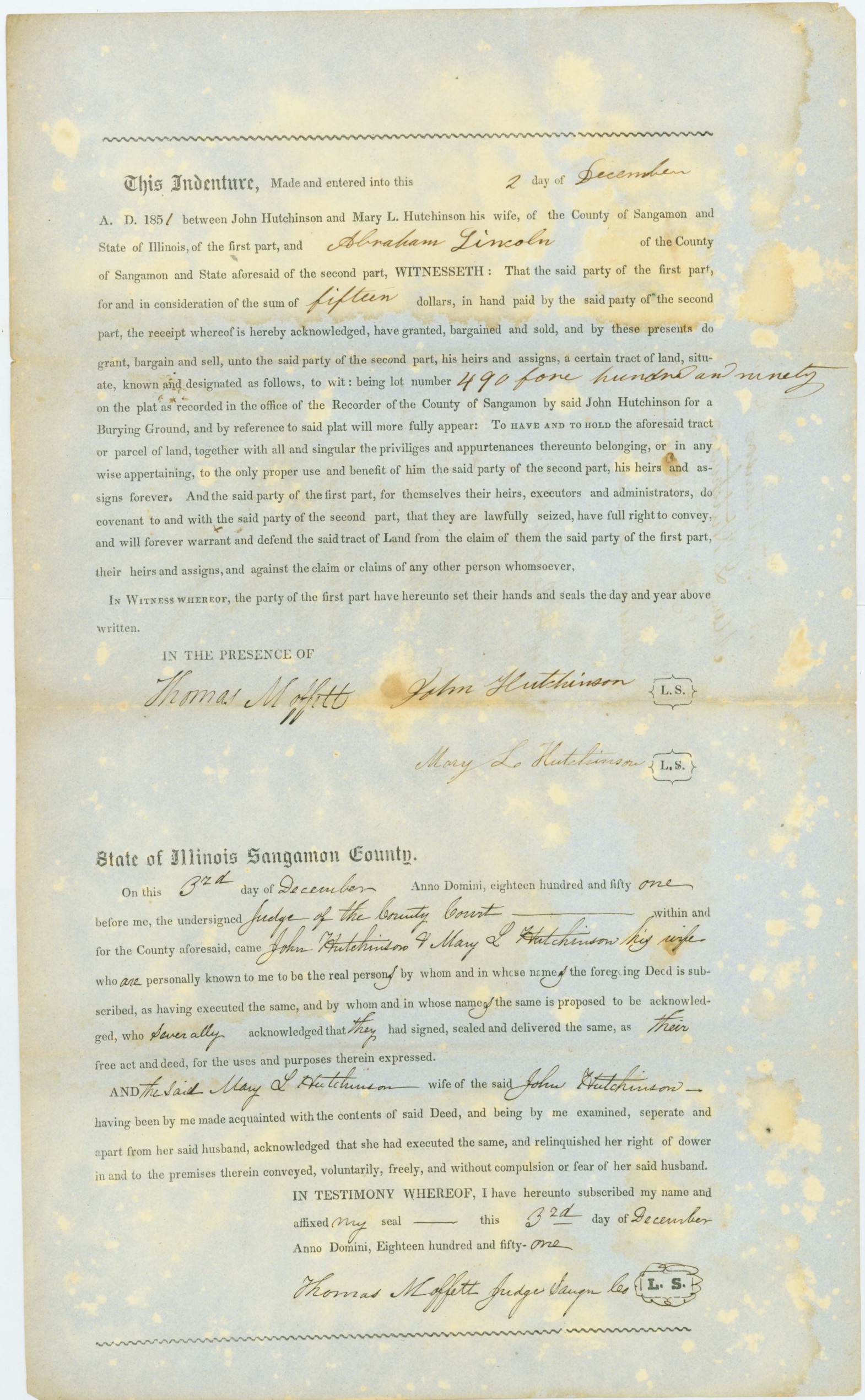
Mary’s initial is central to that disagreement. The December 2, 1851 deed conveying cemetery lot 490 to Abraham Lincoln for fifteen dollars identifies the grantors as John Hutchinson and Mary L. Hutchinson. Her signature and Judge Thomas Moffett’s acknowledgment also use the L. The instrument is a printed form with handwritten entries, so its names cannot be treated as typeset declarations immune to handwriting questions. Nevertheless, the repeated initial deserves weight, particularly because Mary herself signed the document. Its appearances belong to one transaction, with information potentially copied within it.

A proposed J-for-L error therefore remains a possibility to examine in the handwriting, rather than a demonstrated correction. Even establishing that one letter had been misread would leave the differences in ages, birthplaces, and household composition to explain. Equally, identifying an L does not supply Mary’s parents, establish her maiden surname independently, or explain why the Lincoln Papers identifies her husband’s bride as Mary Jane Montgomery.
The New Jersey detail illustrates the problem. In the material examined here, its documentary basis is the Springfield census entry of 1860. The 1850 Springfield entry appears to place Mary’s birth in Pennsylvania through a ditto mark, while the Pekin and Wapella entries consistently identify their Mary as Kentucky-born. There may have been a separate Mary with a New Jersey origin, but a census birthplace is still a reported birthplace. Her birth family, marriage, and eventual burial would give that identification a much firmer foundation.
Likewise, the absence of identifiable Hutchinson children from the Springfield entries cannot become a positive claim that the couple had no children. The records describe the people included in those households. Whether every family member was represented correctly, and what relationships connected the other occupants, are questions the schedules alone cannot settle.
There is another source that complicates an immediate dismissal of the Montgomery association. The Abraham Lincoln Presidential Library’s newspaper index lists Mary Jane Hutchinson, née Montgomery, wife of John, as a defendant in a chancery notice published on January 6, 1852. Its entry for the Sangamon County furniture maker John Hutchinson points to a chancery suit in that same issue. That notice appeared only five weeks after the cemetery deed naming Mary L.

The index contains editorial identifications, and I have not directly inspected the original January 1852 notice. It would be premature to claim that the newspaper itself printed every element of the expanded name. Nevertheless, this gives us something specific to investigate. The Montgomery connection appears within an indexed legal context as well as the marriage attribution. Determining what the notice actually says, which property the litigation concerned, and how the indexer identified the defendants could materially change the interpretation.
The distinction between a document and its later explanation matters elsewhere in the Lincoln Papers. The annotation accompanying the cemetery deed says Lincoln formally purchased Eddie’s burial lot “nearly a year” after his son’s death. Eddie died in February 1850; the deed is dated December 1851. The interval was twenty-two months, nearly two years. That is a demonstrable editorial error, while the deed’s date remains perfectly legible.
This small mistake establishes no particular answer about the Hutchinson family, but it demonstrates why an authoritative edition must still be read at the level of its individual claims. The same standard belongs on the genealogical side. The Montgomery family database gives different marriage dates in its structured entry and narrative notes, and different months for John’s death. A family account can preserve valuable identifications while carrying mistakes of its own. Its usefulness depends on recovering the documents beneath those entries.
My working concern is that clerical discrepancies can become biographical barriers when they are handled too rigidly. A misspelled surname, an uncertain initial, or an inaccurately reported age can exclude a person from a reconstruction before the stronger connections have been examined. Once the exclusion has been made, the researcher may begin building a second life around the remaining fragments and treating the resulting separation as another piece of evidence.
That is the danger I have in mind when questioning an imperial approach to an imperfect historical dataset: the confidence that administrative categories have already mastered the people they describe. Nineteenth-century individuals conducted business through partnerships, employed managers, owned property away from their homes, and appeared under different occupational descriptions according to the purpose of the record. Their lives could extend well beyond the locality and occupation assigned to them on a particular page.
The census itself was an administrative undertaking with specific rules. The 1850 instructions asked for a person’s usual abode on June 1, including people temporarily absent. Consequently, the later dates on the Springfield and Pekin sheets cannot simply be treated as proof that John moved between two enumerators’ visits. A duplicate entry would require explanation within the census’s residence rules and their implementation. The possibility of error belongs inside the investigation, alongside a proper understanding of what the record was supposed to capture.
The occupations deserve particular care because the hotel evidence describes a substantial commercial household. John’s Pekin entry explicitly calls him a hotel keeper. His household includes a lawyer, a saddlemaker, a grocer, a grain buyer, and other occupants, alongside Mary Jane, Robert, and Elizabeth Montgomery. It supplies a much fuller picture of an innkeeper’s working environment than the occupation alone conveys, although it gives neither the hotel’s name nor proof that he owned its building.
Pekin stood about sixty miles north of Springfield, on the Illinois River below Peoria. A period gazetteer describes a busy shipping town where agricultural produce moved by steamboat and several steam mills operated. Twelve Mile House lay considerably closer to Springfield, twelve miles north along the Peoria road. These places occupied the same broader regional geography, although their business relationships remain to be established.
At Twelve Mile, the postal record supplies another John Hutchison. The 1849 federal register lists him as postmaster following J. R. Young, whose service ended that May. The locality’s post office had opened in 1848, became Nestor in March 1850, and closed in July 1851. A postal appointment is therefore documented before Eddie’s death, followed by the Pekin hotel entry later in 1850. Whether the postmaster and hotel keeper were the same man remains an identification to prove. The appointment also does not establish that Hutchison owned or managed the inn.
A reproduced 1851 sale advertisement describes Twelve Mile House as a 280-acre farm with a house, barn, orchard, and an operating tavern and stage stand. Its furnishings and grain were available with the property. The advertisement directs inquiries to E. J. Warren on the premises or J. C. Crowder, located two miles west of Springfield. Here the document itself separates the location of the business, its on-site contact, and the advertiser’s residence. It gives a concrete reason to resist assuming that a property’s location must also identify the home of everyone financially involved with it.

This is where the station model becomes useful to the inquiry. A mill, inn, post office, stable, and repair trade could form a connected commercial environment in which goods, travelers, credit, and information passed through the same locality. New Salem provides a nearby documented example: its development around a mill was accompanied by a stage line, stores, an inn, a tavern, a blacksmith, a wheelwright, and a ferry. Lincoln himself later served as its postmaster while undertaking other work, including work at the mill. The overlapping functions are part of the region’s recorded economic history.
That comparison gives substance to the questions raised through the Kerr and Comstock research. It also helps explain why furniture manufacture, undertaking, hospitality, and postal work should be investigated together where the records suggest an overlap. A Masonic or Odd Fellows relationship would require an additional connection through membership, property, correspondence, or shared officers. A saddlemaker’s residence in Hutchison’s hotel is likewise a transport-related detail; a wagon works or blacksmith shop operated by Hutchison has yet to be established.
The Springfield cemetery offers a documented example of formal responsibility extending beyond the sale of furniture or coffins. On September 3, 1859, Lincoln and other lot owners appointed John Hutchinson their agent to take charge of the cemetery’s general superintendence until February 1, 1861, agreeing to cover the expenses he incurred. The signatories included Thomas Moffett, John Bunn, and Willard & Zimmerman. That agreement places Hutchinson within an identifiable circle of people entrusting him with the management of property in which their families had an interest. His custodial role was expressed in an actual contract.

The subsequent incorporation also needs to be described precisely. The Illinois law creating the Hutchinson Cemetery Association was approved on February 18, 1861, a week after Lincoln departed Springfield. It provided for nine directors elected by the lot owners. Section 14 authorized the association to accept a conveyance from Hutchinson and his wife, preserving their rights in unsold lots, and made his release from responsibility conditional on that conveyance. The legal transition therefore involved more than an instantaneous disappearance of the proprietor on the day a corporation was created. The statute’s provisions give us specific transactions and institutional records to pursue.

There is an additional reason the name attracts attention in Lincoln’s history. During the Baltimore investigation in February 1861, Allan Pinkerton operated under the name John H. Hutchinson. In the account reconstructed by Daniel Stashower, Pinkerton gave twenty-five dollars to James H. Luckett while cultivating access to secessionists, and Luckett subsequently introduced him to Cypriano Ferrandini. The payment belonged to Pinkerton’s reported undercover activity. Its immediate recipient was Luckett, an important distinction when describing what the money actually establishes.
Pinkerton’s later memoir independently describes registering under the Hutchinson name during the operation. The alias is consequently a documented feature of the story. No evidence examined here establishes that he borrowed it from the Springfield cemetery proprietor, that either Illinois household was his cover identity, or that a fraternal organization supplied the name. The Baltimore material explains why the question arose, while leaving the Illinois family identification to be resolved through its own records.
My inclination is to keep John Steel Hutchison in consideration and to investigate how the Montgomery identification entered the Lincoln biographies before discarding it. One possibility is that an older local or family identification survived into the later historical account, carrying knowledge that a census comparison cannot recover on its own. People who knew a businessman might identify him through his wife’s family, his partners, or property he controlled in several places. A later investigator could encounter discrepancies in the administrative records without recognizing the relationships that once made the identification intelligible.
That possibility has to remain explicitly provisional. No named oral informant or traceable oral account has been identified in this inquiry. The published association could equally have arisen from an editor or indexer attaching a marriage between similarly named people to the wrong biography. Recovering the history of the identification would help distinguish inherited local knowledge from an inherited editorial mistake.
The two-household explanation remains a substantial competing interpretation, particularly because the differences recur in 1860. A defensible case for one man would have to explain the women’s conflicting descriptions and the family arrangements across both enumerations. The case for two men should also explain the Montgomery attribution in the Lincoln Papers, clarify the January 1852 litigation, and establish the separate families as fully as the surviving evidence permits.
The most consequential outstanding sources are therefore quite specific. The original June 1848 marriage record and June 29 newspaper notice may identify the groom’s residence, occupation, or fuller name. The January 6, 1852 chancery notice and underlying case may connect the couple to particular land or family interests. Later deeds, probate records, and the cemetery association’s records could carry the Springfield proprietor beyond the brief biography through which he is now usually encountered.
Eddie Lincoln’s burial gives this inquiry its starting point because it places John Hutchinson within a documented relationship to the Lincoln family. The uncertainty concerns how much of his life has been correctly attached to that name. I remain open to the possibility that the cemetery proprietor and John Steel Hutchison were different men, while resisting a certainty that the present reconstruction has yet to earn. The Montgomery connection deserves to remain part of the question until the original marriage, litigation, and property records explain why it is there.