There is a man buried in Monroe, Wisconsin, whose name is Napoleon Bonaparte Latta, and that name is the easiest way into the larger story behind The Latta Connection. He belonged to the nineteenth-century counterfeiting world of the American Midwest, a world of unreliable bank notes, horse thieves, farms, taverns, mills, county roads, state lines, and people who understood that information usually moved more slowly than a man on horseback. On its own, Napoleon Bonaparte “Bone” Latta would already be a memorable piece of outlaw history. The problem is that the Latta name does not stay with Bone Latta, and Napoleon does not stay buried in Wisconsin.
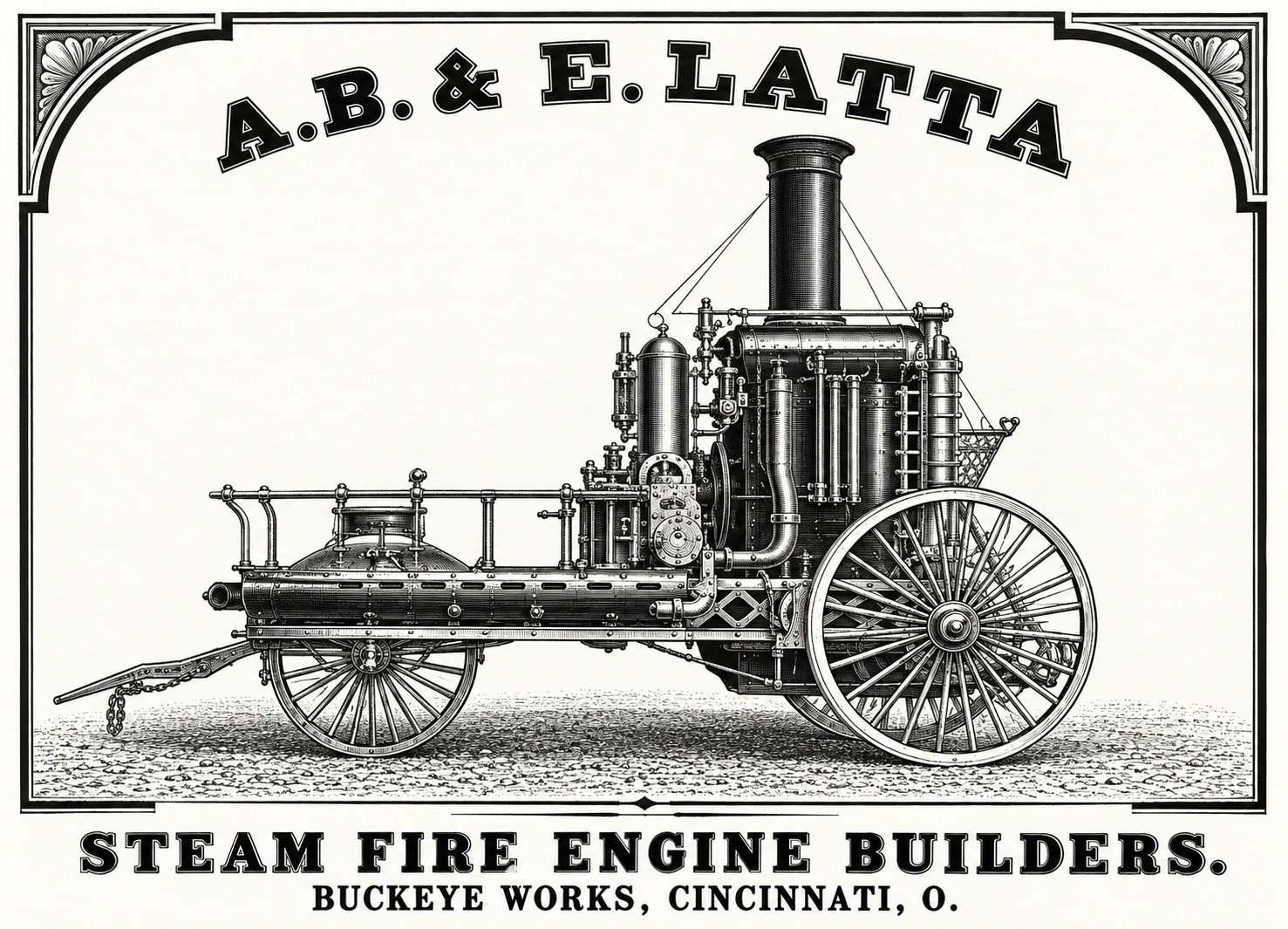
Follow the name east and it turns up in Cincinnati’s early machine culture, attached to Alexander Bonner Latta and the development of the practical steam fire engine. Follow it back through Indiana and another Latta rises from the same northern Indiana country into the early institutional world of Purdue agriculture. Follow it into Philadelphia and William J. Latta, a senior Pennsylvania Railroad executive, turns out to have assembled a major collection devoted to Napoleon and the French Revolution. Between those points are horse-thief detective associations, the Wabash corridor, a national Belgian draft-horse registry headquartered in Wabash, Indiana limestone, railroad systems, roads, patents, and a documented American Bonaparte family that was much closer to nineteenth-century American life than most people realize.
Those are the pieces that became The Latta Connection: Counterfeit, Steam, Stone, and the Hidden Architecture of an American Bonapartist Network. The book is not built around pretending that every strange connection is equally proven. Its basic rule is the opposite: documented facts, reasonable inference, and speculation have to remain separate. What made the project worth finishing was that after making those distinctions, a surprisingly large structure was still standing. The same unusual surname kept appearing near systems that moved money, horses, machinery, stone, information, or authority, and the geography kept pulling the investigation back through the same Midwestern corridors.
The full investigation is available now: The Latta Connection on Amazon.
A Country Full of Bad Paper
The story makes more sense if we begin by forgetting what American money looks like now. Before the Civil War, ordinary people lived with a bewildering mixture of bank notes issued by different institutions under different rules. A merchant in one town could be handed a note supposedly issued by a bank several hundred miles away and have no immediate way to determine whether the bank was sound, whether the note was genuine, or whether somebody had altered the denomination. People used bank-note reporters and counterfeit detectors because accepting paper money involved judgment. A piece of currency had value partly because the next person believed it would still have value when he tried to spend it.

That uncertainty gave the counterfeiter room to work, but it also meant that counterfeiting was not merely a printing problem. Somebody needed engraving skill, suitable paper, presses, signatures, and finishing work, yet none of that mattered if the finished bills could not be injected into circulation. A counterfeit sitting in a drawer was only paper. It became money when somebody accepted it, passed it forward, bought a horse with it, paid a hotel bill with it, or settled an account without realizing that the value had been manufactured somewhere else.
The successful operator therefore had to understand geography. He needed to know where a note would be unfamiliar enough to pass, which markets were short of reliable currency, where strangers could arrive without attracting attention, and how quickly news of a bad issue might move from one town to another. He needed roads, inns, fairs, livestock markets, ferry crossings, county seats, religious migration routes, and later railroad stations. Counterfeiting at scale began to resemble a rough commercial supply chain because distribution mattered as much as production.
Andrea Nolen’s research into Monroe, Wisconsin, provides the foundation for this part of the story. Her work recovered Napoleon Bonaparte “Bone” Latta and the wider counterfeiting environment through local records, graves, families, aliases, criminal memory, and the scattered pieces left behind by people who were not trying to preserve a coherent archive. The Latta Connection begins by acknowledging that foundation and then follows the road in the direction that became increasingly difficult to ignore: back through Michigan and into Indiana.
What appeared there was not a criminal world floating outside respectable society. It was a world housed inside ordinary movement. A farm could explain horses, wagons, barns, storage, hired men, cash, and strangers arriving before sunrise. A mill had freight. A tavern had travelers. A livery stable expected animals to change hands. A boarding house expected people from somewhere else. The best cover did not necessarily look like cover at all. It often looked like an entirely ordinary business because an ordinary business already possessed the exact capabilities a mobile criminal network needed.
That changes the way the landscape has to be read. A nineteenth-century network did not need a secret underground headquarters full of masked men. It needed useful infrastructure. The same road could carry wheat, mail, a preacher, a stolen horse, a sheriff, a family moving west, legitimate bank notes, and counterfeit bank notes. The road itself made no moral distinction between them. The advantage belonged to the people who understood where it went, where travelers stopped, which county line slowed the law, and who could make a stranger seem familiar by supper.
Once the investigation is organized around movement rather than county history, the map begins to change. Monroe is no longer simply a Wisconsin story. St. Joseph County, Michigan, is no longer simply a Michigan story. Noble County is no longer an isolated pocket of outlaw folklore. Each becomes part of a broader interior geography in which men, money, horses, land, and information could move through overlapping routes while later historians filed the surviving pieces in separate archives.
That is especially important in southern Michigan and northern Indiana, where roads, wetlands, farms, state boundaries, growing rail lines, and older migration routes created a seam between jurisdictions. The Latta material in that region includes landholding and criminal refuge, and land introduces another kind of transformation. Counterfeit paper could expose a man immediately if it was discovered in his possession. Property could absorb suspicious value and slowly become respectable. Once land had moved through deeds, bonds, seizure, inheritance, or resale, the paperwork surrounding the property could become much cleaner than the money that first bought it.
The route then bends south into the Wabash system, and that is where the story becomes much larger than a counterfeiting history.

The upper Wabash had been a transportation corridor long before nineteenth-century settlers imposed their own towns and property lines on it. Fort Wayne sat near the old carrying place connecting the Maumee and Wabash systems, making the region a natural hinge between the Great Lakes and the Ohio-Mississippi interior. The Wabash & Erie Canal later laid another transportation system across that older geography and linked inland Indiana more directly to Toledo, lake commerce, and eastern markets. Lafayette became one of the places where river, canal, road, warehousing, livestock, commerce, and eventually rail traffic converged.
The canal looks harmless now because we see it through the softened lens of heritage. In its own time it could determine which towns prospered, which land became valuable, where warehouses filled, and where merchants could reach distant markets cheaply enough to matter. It turned geography into an economic decision. Once that is understood, the small institutions along the corridor look different as well. A ferry mattered because somebody controlled the crossing. A post office mattered because correspondence, appointments, contracts, legal notices, and private news all passed through it. A stable mattered because transportation depended on animals. A hotel mattered because travelers needed somewhere to stop, listen, meet, and move on.
None of that makes every ferryman, postmaster, stable owner, or hotel keeper part of a criminal organization. The point is simpler and more useful: power often sat in ordinary places because ordinary places controlled movement. The corridor running from Lafayette through Delphi, Logansport, Peru, Wabash, Huntington, and Fort Wayne was not just a row of small towns. It was a circulation system through which grain, livestock, letters, soldiers, machinery, political information, fugitives, and money could all travel.
The Horse, the Registry, and the Machine
The horse is where the outlaw world and the respectable world begin to resemble one another in an unexpected way. In nineteenth-century Indiana a horse was not a nostalgic rural accessory. It was transportation, agricultural power, military supply, personal wealth, credit, breeding value, and access to market contained inside one animal. A stolen horse could damage a household economically in the same way losing a truck, tractor, and savings account at once might damage one today.
That is why horse theft produced elaborate responses. Indiana developed horse-thief detective associations because ordinary county enforcement faced a structural problem: the stolen object could outrun the jurisdiction. A thief could take a horse at night, cross into another county, alter its appearance, trade it, sell it, or hide it before the owner had properly organized pursuit. The law was divided into boundaries that meant something to sheriffs and courts. The horse was not. The associations attempted to build communication and recognition networks capable of moving more quickly than isolated local officers.
A generation later, Wabash became the center of an entirely legitimate institution solving the opposite version of the same problem. In 1887, Harmon Wolf, Abraham Straus, Nathan Meyer, and attorney James D. Conner Jr. organized the American Association of Importers and Breeders of Belgian Draft Horses there. The organization later became the Belgian Draft Horse Corporation of America. A town on the old river-canal-rail corridor had become a national documentary authority for the identity and pedigree of an imported European draft breed.

The registry matters because it shows what paperwork can do to physical value. A buyer several states away might know nothing about the breeder who raised a particular horse. The certificate allowed a recognized institution to stand between them and say that the animal was what the seller claimed it was. Pedigree became portable. Ownership became easier to transfer. The horse remained flesh and blood, but its commercial identity increasingly lived on paper.
That is why the horse-thief story and the registry story belong in the same book without being confused as the same organization. The thief and the registrar stand on opposite sides of the law, yet both understand that a horse’s value depends partly on the story traveling with the horse. The thief wants the true story to disappear or be replaced. The registrar wants the true story standardized and made authoritative. The object stays the same while the information system surrounding it becomes more powerful.
William Carroll Latta appears in this respectable agricultural world from another direction. Born in northern Indiana in 1850, he eventually became one of the formative figures in Purdue agriculture, expanding practical instruction, agricultural courses, experimental work, and extension. The point is not that William Carroll Latta was secretly operating a criminal inheritance beneath a university title. That would turn a structural observation into a cartoon. What matters is that the Latta name appears again where informal rural knowledge is becoming organized, measurable, teachable, and institutional.
The old horseman’s eye becomes animal science. The breeder’s reputation becomes a registry. Local practice becomes curriculum. Practical knowledge that once moved through families and neighborhoods becomes something a university can test, certify, publish, and distribute across the state. The region does not stop knowing how horses, soils, markets, and roads work. It changes the authority under which that knowledge is presented.
At roughly the same historical moment, another Latta story shows the horse-powered world beginning to give way to a different source of power altogether. Alexander Bonner Latta belonged to Cincinnati’s early machine culture, an environment of locomotives, boilers, pumps, valves, foundries, ironworks, patents, and mechanics’ institutes. Along with Abel Shawk and Miles Greenwood, Latta became part of the development history of the machine remembered as the “Old Joe Ross” or “Uncle Joe Ross,” the pioneering practical steam fire engine presented to Cincinnati in 1853.
The engine is one of the best visual symbols in the whole investigation. In northern Indiana the horse remains mobile capital that can be stolen, hidden, bred, registered, and sold. In Cincinnati, engineers are learning how to concentrate working force inside iron. Steam itself was not new, but making it useful in a mobile municipal machine required boiler design, pumps, valves, timing, manufacturing, and practical shop knowledge. A machine like this also changed the institution that owned it. It needed capital, maintenance, skilled operators, parts, fuel, procurement, and technical authority.
Technology does not simply perform an old task faster. It changes what an organization has to become in order to use it. That is part of the “hidden architecture” in the book’s subtitle. Machinery brings administration with it. The same is true of patents. The counterfeiter tries to make paper imitate authority, while a patent allows the state to place authority on paper by recognizing a legal claim over technical knowledge. The moral worlds are opposite, but both demonstrate the growing power of documents.
The nineteenth-century suppression of counterfeit money therefore did not mark the end of paper authority. It coincided with an enormous expansion of paper authority into industrial life. Patents, deeds, certificates, corporate charters, securities, freight schedules, contracts, registries, and credentials became increasingly important because the country was becoming too large for personal recognition to do all the work. America did not move from paper to machinery. It built machinery surrounded by more paper than ever.
That observation is what eventually carried the investigation into southern Indiana limestone, which initially seemed so far from Bone Latta’s counterfeiting world that it almost belonged in another book. The connection becomes obvious once the question is not “What is this object?” but “What system has to exist before this object can move?” Limestone is almost defiantly immobile. Turning a block of southern Indiana stone into part of a building in Chicago or another distant city requires quarry machinery, cutting, rail access, freight agreements, working capital, architects, contractors, and buyers who trust that the quarry will deliver what has been promised.

The quarry is not simply a hole where stone is removed. It is one end of a logistics system. Earlier operators needed to know roads, horses, county lines, and weak markets. Later industrial operators needed to understand railroad access, freight prices, banking, contracts, machinery, architectural demand, and urban construction cycles. The technology changes, but the strategic advantage still belongs to people who understand how value moves.
This is also where fraternal and civic networks become interesting again, and where the argument has to remain precise. The book does not claim that a Masonic commandery secretly operated the limestone industry. The surviving evidence does not justify a claim that crude. What does matter is that clubs, lodges, professional associations, banks, boards, churches, and repeated civic relationships created environments in which commercial reputations could travel. In a capital-heavy business, trust was not social decoration. It was part of the machinery.
That principle helps explain what I mean in the book by the “Wabash Combine.” It is not supposed to be one hidden corporation with a board operating unchanged for a century. It is closer to a regional habit of power. The useful position is the place where movement has to pass. In one era that might be a ferry or canal landing. Later it may be a railroad branch, a paved road, a truck terminal, or a manufacturing plant. The technology can change completely while the strategic geography survives.
Then Napoleon Comes Back
If the book ended there, it would already be a strange Midwestern investigation into the way outlaw knowledge, transportation geography, machinery, and respectable institutions can occupy the same landscape in different generations. The problem is that the Napoleonic thread returns at the respectable end of the story. William J. Latta, a senior Pennsylvania Railroad executive in Philadelphia, assembled a collection of Napoleon and French Revolution material significant enough to be sold by Anderson Galleries in 1913 as an “unequalled collection.”
A collection does not prove ancestry. It does not prove that William J. Latta and Bone Latta belonged to the same branch, and it certainly does not prove that either man was secretly a Bonaparte. What it does is return Napoleon to the Latta surname at the opposite end of the social spectrum. The investigation begins with a Midwestern counterfeiter named Napoleon Bonaparte Latta and later reaches a railroad executive collecting Napoleon at serious scale. Between those points lie machinery, agriculture, railroads, registries, roads, patents, quarries, and a recurring relationship with systems of movement and administrative control.
That recurrence forced a closer look at the Bonapartes who actually lived in America, and this is where the history becomes strange without any speculative help. Elizabeth Patterson was the daughter of wealthy Baltimore merchant William Patterson. In 1803 she married Jérôme Bonaparte, Napoleon’s youngest brother. Napoleon opposed the marriage because the Bonaparte family had become part of an imperial political structure in which the marriages of his siblings were matters of state rather than private romance.

Jérôme eventually abandoned the American marriage under pressure from his brother, but the American Bonaparte line did not disappear. Elizabeth preserved the name, the claim, and the social connection. Their descendants continued carrying the Bonaparte identity in the United States. The important point is that “American Bonaparte” is not a secret-history invention. It is documented family history.
The American Bonaparte world was also larger than Baltimore. Napoleon’s elder brother Joseph, who had actually served as King of Naples and King of Spain, eventually lived for years at Point Breeze near Bordentown, New Jersey. One of the most extraordinary facts in the whole story is also one of the simplest: a former European king, Napoleon’s own brother, maintained a substantial American estate and social world on the Delaware.

Other branches touched the United States as well. Charles Lucien Bonaparte, the naturalist son of Napoleon’s brother Lucien, married Joseph’s daughter Zénaïde and spent time in America. Their son Joseph Lucien Charles Napoléon Bonaparte was born in Philadelphia in 1824. The Bonaparte presence therefore crossed dynastic, Catholic, scientific, military, commercial, and social worlds rather than consisting of one colorful Baltimore marriage that ended badly.
The Baltimore line eventually produced Charles Joseph Bonaparte, grandson of Elizabeth Patterson Bonaparte and Jérôme. He entered Theodore Roosevelt’s reform circle, served as Secretary of the Navy and then Attorney General, and in 1908 created the regular Justice Department force of special agents from which the FBI traces its institutional beginning. That is ordinary documented American political history, not a speculative part of the Latta theory.

The arc is remarkable even before the Latta material enters the room. Napoleon rejects his brother’s Baltimore marriage because it does not fit the dynastic architecture he is building. Generations later, a descendant of that rejected American branch reaches the top of the Justice Department and helps create a permanent federal investigative force. The American Bonaparte story begins with dynastic exclusion and ends, at least institutionally, with bureaucratic power.
That is where the book splits the Bonaparte question into two very different possibilities. The sensational version is a hidden bloodline. Perhaps some Latta branch was biologically Bonaparte or Bonaparte-adjacent and an anglicized surname obscured the genealogy. The naming pattern and later Napoleon collecting make the possibility interesting enough to examine, but biological descent ultimately requires genealogical evidence. A strange name, however suggestive, cannot substitute for a missing parentage record.
The other possibility is institutional inheritance, and I think it is the more interesting one. Napoleon’s historical importance was not limited to battlefield victories. The Napoleonic world reorganized law, bureaucracy, education, military command, engineering, taxation, policing, record keeping, and centralized administration. The empire collapsed, but many of the administrative methods associated with the era proved far more durable than the dynasty itself.
America publicly rejected monarchy while enthusiastically building systems. Railroads crossed state lines. Corporations concentrated capital. Patent law standardized claims over invention. Universities professionalized knowledge. Registries standardized identity and pedigree. Police organizations became more formal. Federal departments expanded. None of that makes the United States secretly Bonapartist, but it does make Bonapartism useful as a language for thinking about administrative power that can survive without a throne.
What the Book Is Actually Arguing
That distinction is the center of The Latta Connection. A hidden Bonaparte bloodline would require a missing genealogical bridge. Institutional inheritance can be examined through recurring behavior, organizations, and methods. Where does authority become centralized? Where does movement become standardized? Where does a certificate or patent become more powerful than personal memory? Who occupies the conversion points when an informal system becomes a respectable institution?
Once those questions are asked, the apparently disconnected parts of the story begin talking to one another. The counterfeiter understands that value depends on confidence. The horse thief understands that property depends on provenance. The breed registry centralizes provenance. The agricultural college centralizes expertise. The patent system centralizes legal claims over technical knowledge. The railroad centralizes movement. The quarry system coordinates extraction with distant markets. The federal bureau centralizes investigative authority.
These things are not one organization, and the book does not need them to be. They are different expressions of a civilization learning how to make authority travel across distance. That is also why the book does not collapse if one speculative thread eventually turns out to be wrong. The documented layers still exist. The Black Legs and Regulators existed. Latta-name counterfeiting appears in the historical record. Indiana’s horse-thief detective associations existed. Wabash really did become the documentary center of a national Belgian draft-horse organization. Alexander Bonner Latta really did belong to the Cincinnati steam-engine story. William Carroll Latta really did become a major figure in Purdue agriculture. Indiana limestone really did become national architecture. Joseph Bonaparte really did live at Point Breeze. Charles Joseph Bonaparte really did enter the Justice Department. William J. Latta really did assemble a major Napoleon collection.
The reconstruction lies in deciding what those repetitions mean when they are placed together. Some readers will see a regional explanation first. Indiana occupied a remarkably useful part of the American interior, so people and institutions that understood transportation, agriculture, machinery, and logistics repeatedly prospered there. That explanation is powerful and probably accounts for a great deal. Other readers may see family continuity where the genealogy remains incomplete. Still others may care most about the institutional argument and the way informal systems get professionalized rather than simply disappearing.
What changed my own view most was realizing how rarely modernization means one system vanishing and an unrelated one appearing in its place. A horse trader’s practical knowledge can become animal science. Local recognition can become a professional association. A road can become the line later followed by a railroad, which then helps determine the highway corridor. Private pursuit can become organized detection. Mechanical craft can become patented engineering. The older system may be cleaned, standardized, renamed, regulated, absorbed, or stripped of the parts that are no longer acceptable.
Sometimes the people disappear while the method survives.
That is why the title Counterfeit, Steam, Stone is more than three dramatic nouns. Counterfeit money is about making value move. Steam is about concentrating usable power. Stone is about forcing an almost impossibly heavy material into a national transportation market. Horses, canals, railroads, registries, patents, quarries, roads, and institutions sit between those three because each is another answer to the same historical problem: how do you make value, information, power, or authority travel farther than the personal relationships that originally created it?
The question remains modern. Money now moves through databases. Packages move through tracking systems. Professional authority moves through credentials. Property moves through title records. Corporations exist because law recognizes paper entities that can outlive the people who created them. A person in one place is constantly being asked to trust claims made somewhere else by an institution he may never physically see.
The nineteenth century is fascinating because so many of those systems can still be watched in the process of being invented, and the Latta name provides an unexpectedly good route through them. The story starts with a counterfeiter in Wisconsin carrying the remarkable name Napoleon Bonaparte Latta, but it does not remain a counterfeiting story for long. It moves through Michigan and Indiana, down the Wabash corridor, into horses and registries, into Cincinnati machinery, through quarries and railroads, and eventually into the documented American world of the Bonaparte family.
That is the reason I wrote the book. The project did not begin by inventing a giant theory and searching for names to fill it. It began because the names, roads, technologies, and institutions kept appearing in places that made the normal walls between criminal history, local history, industrial history, and family history harder to maintain. Leaving those files open at the same time produces a second map of the Midwest, one organized less by county lines than by movement.
The mill is still a mill after you see that map, but you start asking what moved through it. The road is still a road, but you ask which older route it followed and who profited when it changed. The horse is still a horse, but the certificate attached to it becomes almost as interesting as the animal. The steam engine is still machinery, but the patents, municipal contracts, skilled labor, and administrative structure surrounding it become visible. The quarry is still stone, but the railroad behind the stone becomes impossible to ignore.
The Napoleon collection is still a collection, but after beginning with a Midwestern counterfeiter named Napoleon Bonaparte Latta, you probably look at it twice. That second look is where The Latta Connection lives.
If a trail running from counterfeit bank notes through Indiana horse thieves, Purdue agriculture, steam fire engines, limestone quarries, the Pennsylvania Railroad, Point Breeze, and the American descendants of Napoleon sounds like your kind of historical rabbit hole, The Latta Connection is available now on Amazon.