Before Indiana had railroads, automobiles, federal agents, or a modern police bureaucracy, its economy moved on animal muscle. Along the Wabash and Maumee corridor, horses were transportation, machinery, freight power, military assets, agricultural capital, and easily transferable wealth. That helps explain why the same landscape that produced horse markets and eventually one of America’s most important Belgian draft-horse institutions also produced horse thieves, counterfeiters, Blacklegs, private detective companies, Regulators, and vigilante organizations.

The easiest way to misunderstand the Latta Gang is to begin with the Latta Gang.
The story really begins farther south and west, in the horse country and transportation corridors that made an organization like the Lattas possible. Long before William Latta, William D. Hill, and George T. Ulmer became notorious in northern Indiana, the Wabash Valley already possessed the essential machinery of a black-market transportation system: horses, Indian trails, river crossings, isolated settlements, taverns, wooded hiding places, ferries, county boundaries, and buyers far enough away that a stolen animal could quickly acquire a new identity.
That is why the local tradition surrounding the Witt gang, the George High organization, and then the Latta Blacklegs deserves to be read as one long history of mobility rather than three disconnected crime stories.
There is an important qualification at the beginning. The digitized record is much stronger for George High and William Latta than it is for a formally organized group called the “Witt Gang.” Wabash County’s own published history, however, independently confirms the world in which the Witt tradition is situated. Around Pony Creek near North Manchester, the county history describes hundreds of Miami ponies congregating in the Wind Brake grazing country and says that bands of horse thieves operated in the area, regarding Indian ponies as particularly tempting targets. The animals were hardy, valuable and, critically, mobile.
That is enough to move the question away from folklore about a few colorful criminals and toward something much larger: what did a horse mean in the Wabash country?
Before the Latta Gang: Pony Creek, Miami Horses, and the Witt Country
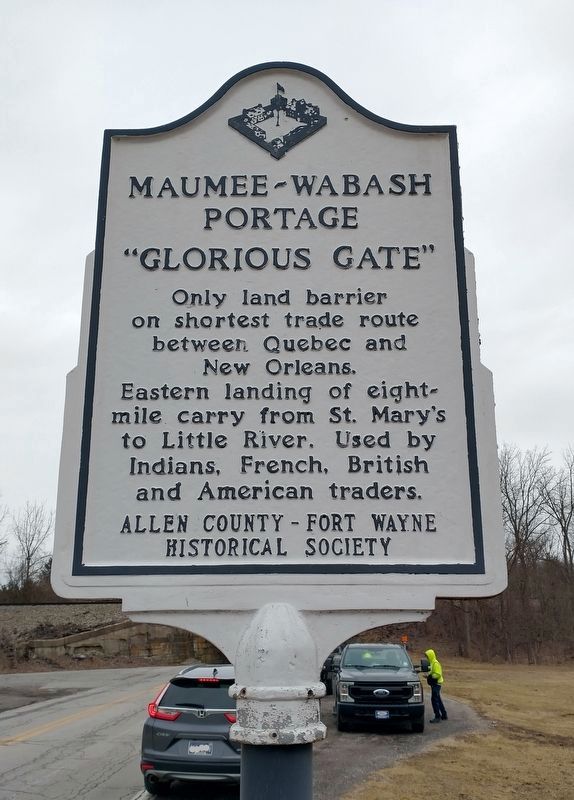
The northern Wabash Valley was not simply agricultural land waiting for white settlement. It had been Miami country, traversed by older paths connecting villages, hunting grounds, rivers, trading points and the great Maumee–Wabash portage. The junction of the Wabash and Little rivers near Huntington formed the western end of that portage. French and British traders had been moving through it during the eighteenth century, and Miami villages stood around the Forks long before the canal turned the same geographical logic into state infrastructure.
In Wabash County, the horse was already embedded in that landscape. The 1914 county history describes the Miami turning large numbers of ponies loose in the Wind Brake south of Pony Creek, where luxuriant grazing drew them “by the hundreds.” It also says horse thieves operated around this country and that stealing Indian ponies was perceived as less dangerous than stealing horses from white settlers.
This is the useful historical setting for what local accounts call the Witt gang. The web-accessible record does not yet give us the kind of named indictment, confession or court file that exists for George High or the Lattas, so I would not manufacture one. What the documentary record does establish is arguably more important: northern Wabash County contained a known horse-theft environment tied to Pony Creek, Miami livestock and relatively sparsely policed country.
Richvalley belongs on the map for the same reason. It sits inside the larger Wabash County landscape from which roads lead toward Wabash, Lagro, Peru and the river corridor. I have not found a source proving a single documented Witt-to-Richvalley horse drive, so that particular route should remain a hypothesis rather than a declared fact. But once the geography is laid out, the logic becomes visible: animals could be accumulated in relatively rural country and pushed toward a transportation artery where they became far harder to trace.
The Wabash–Maumee Machine Ran on Horses
This is where the horse story becomes much bigger than horse stealing.
The Maumee–Wabash portage had always been a place where cargo had to change modes. Boats could carry enormous quantities of goods over water, but the break between watersheds required people, pack animals and eventually roads to get freight across the land bridge. In the nineteenth century Indiana effectively mechanized that old geography by cutting the Wabash & Erie Canal through the corridor.
The canal began at Fort Wayne in 1832, reached Huntington in 1835, Logansport in 1838 and Lafayette in the early 1840s. Eventually it connected the Lake Erie system with the Ohio River. But “canal transportation” can obscure what actually powered it. Canal boats were drawn by one to three horses or mules walking the towpath. On the Toledo–Lafayette packet route, fresh teams could be substituted every fifteen to twenty miles. Freight boats moved loads that could reach eighty tons.
So the canal was not the replacement of horse power. It was the multiplication of horse power.

The entire Wabash–Maumee system created demand for strong animals at several levels simultaneously. Horses and mules pulled canal boats. Teams hauled goods between farms, warehouses, mills, river landings and canal basins. Large wagons moved loads where water transportation ended. Road construction itself used animal power. Canal construction employed horse-drawn slip scoops. As towns such as Huntington, Wabash, Peru, Logansport and Lafayette expanded, every additional warehouse and market increased the value of dependable draft animals.
That changes the meaning of “horse thief.” A stolen horse was not analogous to stealing a recreational animal today. It could mean stealing somebody’s truck, tractor, freight engine and bank account at once.
And because the asset could move itself, horse stealing had a peculiar advantage over almost every other form of property crime.
George High and the Redwood Relay
By the middle of the nineteenth century, the Wabash Valley gives us a much better documented example of what an organized horse-transfer operation could look like.
A historical account preserved by the Library of Congress describes George High and his family in the Redwood country near the Wabash. According to that account, fugitives and criminals arriving from eastern and southern states became associated with the Highs. Horses stolen in Ohio, Kentucky and elsewhere were brought into the neighborhood. George High emerged as leader of what the source calls an organized band of horse thieves and counterfeiters.
The geography described in that account is striking. Horses were brought near Portland, crossed the Wabash around Hanging Rock at the mouth of Redwood, and disappeared into a dense thicket. The importance of the brush is obvious: once an identifiable horse crossed the river and vanished into an area controlled by confederates, the pursuing owner or sheriff ceased to have a straightforward trail.
Other Warren County accounts place the associated Claflin property near what became Pence and describe it as a frequent resort of counterfeiters and horse thieves. George High was eventually captured by horse-thief detectives, escaped during the confrontation, and several members or associates of the family were convicted.
There is even an extraordinary Abraham Lincoln connection. The Papers of Abraham Lincoln document High’s prosecution for horse stealing and state that Lincoln was among the lawyers who represented him. High was convicted on two larceny charges in 1855; two years later Lincoln petitioned for his pardon, which was granted.
This matters because High’s network begins to show the anatomy of the system. The theft is only the first step. The important part is transfer.
A horse must be taken somewhere. Someone must know which crossing is safe. Someone must provide pasture or concealment. Someone else must know where the animal can be sold. If counterfeit money moves through the same social network, the criminal organization acquires another means of converting property into value. The gang becomes less like a band of highwaymen and more like a primitive logistics company.
That is the bridge from High to Latta.
Lafayette’s Caverns and the Hidden Geography of Transit
Lafayette’s place in this world is unusually evocative because local history actually preserves a physical hiding-place tradition.
The Tippecanoe County Historical Association records that an unfinished brewery excavation at Durkee’s Run, south of the city near the Fourth Street road, acquired a reputation in the 1870s as a rendezvous for robbers, “especially horse thieves.” The hill became known as Brewery Hill. The same area accumulated stories about stolen gold and criminal hiding places.
That does not prove a secret subterranean headquarters for George High, William Latta or the Witt group. But it establishes that Lafayette itself retained a local memory of excavated spaces being used by mobile thieves.
And the location makes sense.
Lafayette was not a random Indiana town. It sat on the Wabash at the meeting point between river navigation, canal transportation, roads and eventually railroads. The 1868 bird’s-eye image of Lafayette is almost a diagram of the problem: river, canal, warehouses, roads, bridges and an expanding town compressed into one transportation node.

A criminal network does not require a mysterious underground empire when ordinary commercial infrastructure already supplies nearly everything it needs. A tavern can be a meeting point. A barn can be a warehouse. A ferry can be a border crossing. A horse pasture can function as inventory storage. A legitimate livestock buyer can separate an animal from its history. A county line can create a jurisdictional problem.
The legal and illegal economies used the same roads.
Then Come the Lattas and the Blacklegs
By the late 1840s and early 1850s, northern Indiana had acquired an infamous name for another network: the Blacklegs.
Here the documentation becomes remarkably explicit. M. H. Mott’s History of the Regulators of Northern Indiana, published in Indianapolis in 1859, described Noble County as a major rendezvous for an organized population of counterfeiters and horse thieves. Mott named William Latta, William D. Hill and George T. Ulmer among the chief pioneers and leaders of the northern Indiana banditti. He associated the broader organization with robbery, horse stealing, gambling, arson and the manufacture and circulation of counterfeit money.
The source is not neutral. Mott wrote on behalf of the Regulators who fought these people, and his language is openly moralistic and sensational. That is precisely why it has to be read critically. But the names, organization, arrests, statutes and existence of the Regulators can be cross-checked against other records. His book is extraordinarily valuable because it records how contemporaries understood the Blackleg system only a few years after the events.
Mott also describes the theft of Native ponies in northern Indiana and portrays isolated woods, settlements and hiding places as essential to the criminal economy. He says that stolen Indian ponies were driven into other states for sale.
The Latta story therefore sits comfortably beside what we have already seen at Pony Creek and Redwood. Different people, different counties, overlapping method.
One correction is worth making because it sharpens the geography: the Latta/Blackleg material I found clusters around Rome City and northern Noble County, rather than “New Rome.” Later genealogical summaries based on Mott likewise place the Blacklegs around the Rome City area and the tamarack country.
The Blacklegs were therefore not simply “horse thieves.” The term denoted a larger underworld in which stolen animals, counterfeit money, gambling, receivers of stolen property and concealment overlapped.
That combination is the heart of this story.
Horses Were Money That Could Walk
Counterfeiting and horse theft make much more sense together than they do separately.
Before a standardized national paper currency, Americans routinely encountered bank notes issued by institutions far from where the notes were being spent. Verification was difficult. A stranger could arrive in a frontier settlement with a horse whose ownership was difficult to establish and paper money whose authenticity was equally difficult to establish.
The two systems complemented each other.
A stolen horse could be traded for cash or goods. Counterfeit notes could finance purchases without sacrificing legitimate capital. A horse could be moved to another county before the theft became widely known. A forged or fraudulent note might circulate several times before anyone discovered that it was worthless.
The Blackleg economy was therefore built around distance, imperfect information and jurisdictional fragmentation.
That is exactly what modern logistics systems try to eliminate. Tracking numbers, serial numbers, databases, identity records and instant communication exist because movable goods without reliable provenance are extraordinarily difficult to police.
Indiana’s nineteenth-century solution was initially much more primitive.
It created its own detectives.
The Other Side of the Network: Comstock’s Private Intelligence Service
One of the most important pieces of evidence in the whole story comes from Wabash County.
A county history records that in 1851 an organization of “horse thieves, burglars and counterfeiters” extended from Ohio across northern Indiana and into Illinois. After John Comstock’s store was robbed of roughly $1,000 in goods, Comstock, William and Isaac Thorne, John J. Shaubert and the Shaubert sons formed what the history explicitly calls a private detective service.
Within less than a year, the account says, this self-organized intelligence group had learned the names of more than two hundred people associated with the criminal network. It credited the group with helping send horse thieves, a counterfeiter and others to prison.
Think about what that means.
Before telephones, fingerprints, automobile patrols or a federal investigative bureau, a private Wabash County organization was compiling names, following associations, sharing information, identifying suspects and coordinating arrests across a criminal network said to span several states.
That is the proto-detective environment that makes Indiana’s later history much easier to understand.
It should not be called the institutional ancestor of the FBI; there is no organizational lineage connecting Comstock’s group to the federal Bureau. But it is unquestionably part of an American culture of private and quasi-public intelligence gathering that preceded professional investigative bureaucracies.
The horse thief helped create the detective.
Indiana Legalizes the Regulator
In 1852 Indiana went a step further.
Mott reproduced the state law authorizing groups of between ten and one hundred citizens to form corporations for “the detection and apprehension of Horse Thieves and other felons.” Once approved by county commissioners, these organizations could maintain officers and bylaws, raise money, summon peace officers and, while arresting offenders, exercise rights and privileges comparable to constables.
That is an extraordinary institutional response.
The state did not simply hire more sheriffs. It legalized a network model.
Local men could form an association, maintain membership records, elect officers, collect intelligence, cooperate with official authorities and pursue mobile criminals. The National Horse Thief Detective Association tradition later carried that model much further. Wabash College’s archival collection dates Indiana’s first horse-thief agency to Montgomery County in 1845 and preserves meeting minutes, bylaws, correspondence and records from scores of later associations.

The 1922 journal of the National Horse Thief Detective Association is almost surreal to modern eyes: three horse heads over the words NATIONAL HORSE THIEF DETECTIVE ASSOCIATION. Yet that cover represents an institution that survived long after the frontier conditions that created it.
That longevity becomes important later.
The Patterson–Stockdale Letter: A Useful Clue, but One We Should Not Overstate
There is also a tantalizing Latta document in the Indiana Historical Society: correspondence from William A. Latta, a private in the 47th Indiana Infantry, to Elizabeth Patterson of Stockdale, Indiana.
The finding aid establishes that Latta enlisted in Wabash County in 1861 and that two surviving 1862 letters were sent to Patterson at Stockdale. The collection even contains transcripts.
This is worth bringing into the larger Latta story because it anchors the names Latta, Patterson, Stockdale and Wabash County in an actual archival collection rather than genealogy alone.
There is one thing I would not print as settled fact yet: the online finding aid does not reproduce the horse passage you have identified in the letter. It summarizes the correspondence as routine descriptions of military duties and daily life.
So the stronger version of the blog should say that the Latta–Patterson–Stockdale correspondence survives and then, once we have the actual transcript/page containing the horse reference, insert it verbatim and analyze it. That is a much better use of the evidence than having somebody later discover that the catalog description itself never mentions the horse.
From Stolen Ponies to Belgian Giants
And now the story makes a jump that initially looks unrelated.
It is not.
By the 1880s, Wabash, Indiana, was becoming important not because somebody was stealing horses but because businessmen were importing some of the most valuable draft horses in the world.
This is where the Belgian horse belongs.


The Wabash Importing Company was organized by Harmon Wolf, Abraham Straus and Nathan Meyer to import Belgian draft stock. National Register documentation says the firm was established in the 1880s with the purpose of importing and breeding animals for agricultural use. Horses were purchased in Belgium, shipped across the Atlantic and then moved by rail to Wabash. The company’s Teague farm became part of its breeding operation.
In 1887, Wolf and attorney James D. Conner Jr. helped organize the American Association of Importers and Breeders of Belgian Draft Horses in Wabash. That organization eventually became today’s Belgian Draft Horse Corporation of America. Its purpose was explicitly about provenance: maintaining records of imported animals, descriptions, genealogies, pedigrees and transfers so purebred Belgian horses could be authenticated.
That is the fascinating reversal.
Half a century earlier, the horse underworld profited from the difficulty of establishing provenance. A horse could be stolen, hidden, transported and resold because identity was unstable.
By the late nineteenth century, Wabash was building a registry system designed to make valuable horses legible.
Pedigree. Description. Ownership. Transfer. Registration.
The criminal horse network and the Belgian registry are not the same organization, and I have found no evidence that the Wabash Importing Company itself was a Klan operation. That connection should not be asserted. What is historically defensible—and much more interesting—is that the same broad Indiana horse economy generated increasingly sophisticated systems for controlling identity, ownership and movement.
The Belgian story is therefore not an incidental epilogue. It is the industrial end of the horse-power story.
And this is why saying that the Latta story is “about Belgian horses” needs one chronological adjustment. The High and Latta networks were operating decades before Belgian draft importation became a Wabash specialty. They were not, on present evidence, stealing Belgian draft horses. But the later Belgian business reveals just how economically important large, powerful, traceable horses became in the same corridor that had earlier struggled to control horse theft.
The Belgian does not explain the Latta gang backward. It shows what the Wabash horse economy eventually became.
From Regulators to White Caps
Once Indiana had legalized private detective companies, another problem appeared: who regulates the regulators?
Some associations remained essentially mutual-protection organizations pursuing stolen property. Others slid toward vigilantism.
In Harrison County, a different organization calling itself the Regulators appeared in the 1870s. County history describes secret signs, grips, passwords, white hoods, investigation committees and nocturnal punishments. These men became known as White Caps. Their targets could be beaten or otherwise punished without ordinary judicial process.
That group should not simply be declared a direct continuation of the Latta-era northern Indiana Regulators. The historical evidence does not establish one uninterrupted organization.
The continuity is institutional rather than genealogical: Indiana repeatedly produced private associations that claimed responsibility for protecting property, policing conduct or enforcing communal norms where members believed ordinary law enforcement was insufficient.
Horse theft provided one of the earliest and most defensible reasons for such organization.
Once the structure existed, its purpose could change.
The Northwest Conspiracy and the Expansion of the Detective Idea
The Civil War enlarged this world from criminal intelligence into political and military intelligence.
Indiana Governor Oliver P. Morton and military authorities relied on detectives and infiltrators to investigate secret organizations opposed to the Union war effort. By 1864 authorities were investigating the Sons of Liberty and claims of a broader Northwestern conspiracy. Evidence gathered by government operatives concerned arms, plans to release Confederate prisoners and proposals for coordinated uprisings.
This episode remains historically contested in important respects. The Indiana Historical Bureau notes both that investigators uncovered weapons and plans and that the announced dates for uprisings passed without the proposed rebellion occurring. Morton also used the revelations politically during the 1864 campaign. The military prosecution of civilians ultimately produced Ex parte Milligan, in which the Supreme Court held that civilians could not properly be tried by military commission where civilian courts remained open.
The reason it belongs here is not because the Latta Gang secretly became the Sons of Liberty. There is no evidence for that.
It belongs because the method had scaled.
Networks were mapped. Informants penetrated secret organizations. Names were collected. Communications were watched. Local cells were related to wider regional structures. Intelligence was shared with state and military authorities.
The same nineteenth century that produced the mobile Blackleg also produced the network detective.
Big Jim Ford and the Darker Meaning of “Transfer”
There is an older, darker parallel farther down the river system.
On the lower Ohio, James “Big Jim” Ford’s ferry and outlaw reputation became associated with river robbery and the interception of movable property. More importantly, the National Park Service documents the nearby Crenshaw House in southern Illinois as a station on a “Reverse Underground Railroad,” through which kidnapped free Black people and captured freedom seekers could be transported into slavery. Period evidence led to repeated indictments of John Hart Crenshaw.
Regional histories have associated Ford with Crenshaw, although the precise degree of Ford’s participation in the kidnapping operation is less securely documented than Crenshaw’s own activities.
Again, this should not be collapsed into a single Latta conspiracy.
Its relevance is structural.
A ferry owner, tavern keeper, livestock dealer, warehouseman or road agent possesses something more valuable to an underground economy than a dramatic criminal reputation: control of transfer points.
Goods can be legitimate or stolen. Currency can be genuine or counterfeit. People can be free or kidnapped. What makes illicit transfer possible is an infrastructure capable of moving something from one jurisdiction and social identity into another.
That is the real common denominator running through these stories.
Prohibition Brings the Horse Detectives Back
By the early twentieth century automobiles were replacing horses. One might expect the Horse Thief Detective Associations to disappear.
Instead, something strange happened.
They came back.
The Smithsonian’s National Museum of American History documents a resurgence of Indiana Horse Thief Detective Associations during the 1920s. The legal structure had survived long after its original purpose weakened. The revived associations sometimes had four or five chapters in a county and could possess officially sanctioned investigative or arrest powers.
The Ku Klux Klan then exploited that structure.
The Smithsonian documents overlapping membership, Klan financial support for some HTDA activity and the use of horse-detective organizations against bootleggers, labor organizers, immigrants and Black communities. In one preserved association’s bylaws, membership was explicitly restricted to a “one hundred percent AMERICAN WHITE MALE.”
This is the part of the history that makes the entire nineteenth-century chain suddenly look modern.
The horse is almost gone.
The legal shell built to chase the horse remains.
And now that shell can be used to pursue alcohol, gambling, political enemies or people defined as socially undesirable.
That is a far more substantial historical connection than trying to make the Wabash Importing Company itself into a Klan company. The documented Klan connection is with the horse-thief detective apparatus, particularly during the 1920s.
From Horse Theft to Prohibition—and From Local Detectives to Federal Investigation
This is also where the Comstock story becomes useful, though there are really two different Comstocks in this larger narrative.
John Comstock’s Wabash County response to horse thieves in 1851 was private intelligence directed at a mobile criminal network. Anthony Comstock’s federal career after the 1873 Comstock Act belonged to a different field: the policing of materials moving through the United States mails. The National Archives describes Anthony Comstock as a moral-reform activist who secured broad authority as a postal special agent to suppress material defined as obscene.
The names are coincidental for our purposes. The institutional rhyme is not.
Again and again, nineteenth-century policing reorganized itself around networks of circulation. The horse detective followed animals and thieves across roads and county lines. Postal inspectors followed prohibited material through the mail. Revenue agents followed illicit liquor. Federal investigators followed interstate crime.
Eventually the federal government created a permanent investigative force.
Attorney General Charles J. Bonaparte established a Department of Justice special-agent force in 1908 after Congress restricted Justice’s practice of borrowing Secret Service investigators. That force became the Bureau of Investigation in 1909 and, after later reorganizations, the Federal Bureau of Investigation in 1935.
So Indiana’s horse detectives were not “the first FBI,” and pretending they were would weaken the argument.
But they absolutely belong to the prehistory of the investigative state: private citizens maintaining suspect lists, sharing intelligence, carrying commissions, crossing jurisdictions, coordinating with sheriffs and using organized information to attack networks that ordinary local policing struggled to control.
By Prohibition, the object being tracked had changed from horseflesh to bottles, automobiles, money and people.
The logic survived.
The Latta Gang Was Really a Transportation Story
Seen this way, the Latta Gang stops looking like an isolated rural legend.
Start with the Miami horse country and Pony Creek. Move into the Witt tradition and the poorly policed northern Wabash landscape. Follow George High’s organization as stolen horses from Ohio and Kentucky cross the Wabash and disappear into the Redwood brush. Continue north into the Latta, Hill and Ulmer Blackleg world, where horse stealing overlaps with counterfeit currency and networks of concealment.
Then turn the picture around.
John Comstock’s Wabash County associates build an intelligence operation to identify hundreds of suspected criminals. Indiana legalizes horse-thief detective companies. Regulators and later White Caps demonstrate the danger of private enforcement becoming social coercion. Civil War authorities use infiltrators and detectives against secret political organizations. The horse associations survive into the automobile age and, during the 1920s, some are captured by the Klan and redirected toward Prohibition enforcement and racial or political intimidation. Meanwhile the federal government develops specialized investigative agencies of its own.
And running straight through the center of all of it is the Wabash.
It is a river, a portage corridor, an Indian country, a canal route, a market system, a livestock region, a railroad corridor and an information corridor.
The horse is the perfect object for revealing how that system worked because the horse was simultaneously power, transportation and property.
And Then Wabash Puts a Pedigree on the Horse
That may be the most satisfying place to end the first part of the Latta series.
In the early period, the recurring problem is anonymity. Whose horse is this? Where did it come from? Who sold it? Was the money real? Which tavern did the rider stop at? Which road did he take? Which county has jurisdiction? Who is working with whom?
By the late nineteenth century, Wabash’s Belgian horse industry answers those questions with paperwork.
Import records.
Pedigrees.
Descriptions.
Ownership.
Transfers.
Registration.
The Belgian Draft Horse Corporation says plainly that the association organized in Wabash in 1887 existed to preserve a register of imported animals and their descendants.
That is almost the inverse of the Blackleg system.
The Blackleg prospered by breaking the relationship between an object and its history.
The registry derived value by making that history permanent.
So the deepest connection between the Latta Gang and the Belgian horse is not that William Latta was stealing Belgian stallions. The chronology does not support that.
It is that the Wabash Valley spent the nineteenth century learning how to control the movement, ownership and identity of one of the most valuable mobile assets in America.
First came the horse trails and river crossings.
Then the thieves.
Then the counterfeiters.
Then the detectives.
Then the Regulators.
Then the registries.
And, when the horse finally ceased to be the machine that moved America, the surveillance structure built around movement and illicit transfer found entirely new things to follow.
That gives us a much bigger story than a gang of horse thieves.
It gives us the Latta economy.