Andrea Nolen’s Lincoln’s Counterfeiters takes Napoleon Bonaparte “Bone” Latta out of the realm of Wisconsin local legend and places him inside a much larger nineteenth-century financial underground. Her book argues that the Monroe, Wisconsin, counterfeiting organization was connected not only to eastern engravers and Midwestern distributors but, ultimately, to the extraordinary transformation of American finance during the Civil War. Some of Nolen’s conclusions about Lincoln, Salmon P. Chase, political protection, and wartime finance go substantially beyond the conventional historical account and should be understood as her interpretation. The underlying criminal geography, however, is real, and when the story is followed backward from Wisconsin it leads directly into Indiana, southern Michigan, the St. Joseph Valley, the northern Indiana Blacklegs, and an older Ohio counterfeiting world.

4
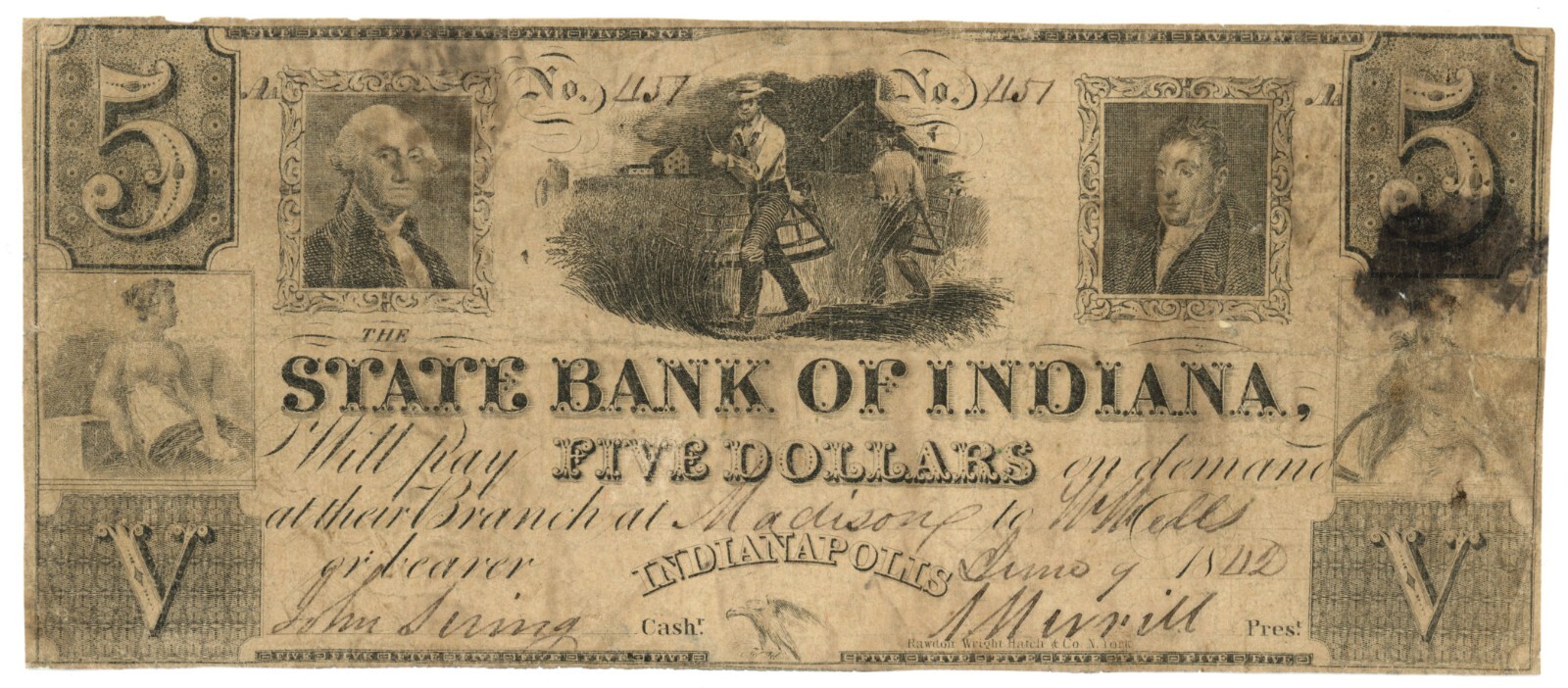
The images above show four different pieces of the story: Nolen’s book, M. H. Mott’s 1859 History of the Regulators of Northern Indiana, a period State Bank of Indiana note, and the Ohio & Erie Canal system that helped turn northeastern Ohio into a transportation market. Put beside one another, they immediately suggest something larger than a local Wisconsin gang. The Latta history crosses the transition from the canal frontier and state-bank currency into railroads and national money.
The Latta Story Begins Before Wisconsin
One of the most important corrections to the usual Bonelatta narrative is chronological. Bone Latta did not arrive in Monroe and suddenly learn the counterfeiting business. Nolen herself traces the Latta family backward to the Michigan–Indiana border, while older Ohio and Indiana material pushes the name farther back still.
Stephen Mihm’s work on antebellum counterfeiting identifies a William Latta associated with the famous James Brown counterfeiting organization in Bath Township, Ohio. Contemporary Summit County historian Samuel Lane also remembered Latta as one of Brown’s important associates. The National Park Service’s documentation of the Jim Brown property describes the wider counterfeiting environment that emerged around the Ohio & Erie Canal, where transportation improvements simultaneously enlarged legitimate markets and gave counterfeiters a far greater territory through which fraudulent currency could circulate.
This Ohio background is particularly important because Brown’s organization did not function merely as a few men personally passing bad bills in stores. Historical descriptions portray something much closer to a wholesale operation, with people specializing in production, distribution, and passing. Latta’s tavern in Bath was ideal infrastructure for such a system. A tavern brought strangers, horses, wagons, money, overnight lodging, and explanations for constant traffic under one roof. The same characteristics that made a tavern useful to legitimate commerce made it useful to an underground economy.
Mihm’s reconstruction says that William Latta later resurfaced in correspondence concerning an Indiana counterfeiting enterprise, where he was described as heading a principal “bank” of the company. The terminology sounds strange today, but counterfeit organizations frequently used commercial language because their operations genuinely resembled businesses: capital went in, manufactured paper came out, wholesalers bought quantities at a discount, and distributors carried the product into new markets.
Indiana Had Its Own Blackleg Counterfeit World
By the 1840s and 1850s, northern Indiana had developed a notorious Blackleg culture. M. H. Mott’s History of the Regulators of Northern Indiana, published in 1859, names William Latta, William D. Hill, and George T. Ulmer among what he called the principal leaders of northern Indiana’s “banditti.” Mott accused the broader network of horse stealing, gambling, robbery, arson, and the manufacture, sale, and circulation of counterfeit money.
Mott was not a neutral observer. He wrote from the Regulator side of a violent local conflict and filled his account with moralistic language. Nevertheless, the book is invaluable because it was published close to the events, gives names and locations, and can be compared with independent newspaper and county-history evidence. The important point is not to accept every accusation in Mott uncritically; it is that counterfeiting and horse theft appear together repeatedly in the same northern Indiana social environment.
That combination makes economic sense. A stolen horse and a counterfeit bank note presented essentially the same problem to law enforcement: provenance disappeared with distance. A horse could be driven into another county or state before the owner’s description reached local authorities. A counterfeit note could be carried far enough from the issuing bank that the merchant receiving it had never seen an authentic example.
Both commodities rewarded mobility.
The Blackleg was therefore not simply a horse thief or a counterfeiter. He existed inside an economy of transfer.
The St. Joseph Valley Gives Us the Manufacturing Floor
The strongest primary-source description of that economy may be an article printed in the Berrien County Record on November 20, 1873. The newspaper reprinted an account by E. C. Davis for the South Bend Tribune under the title “The Counterfeiters of St. Joseph Valley.” Davis was remembering events from roughly thirty-five years earlier, so his account should be treated as retrospective testimony rather than an arrest report. Even so, its details are remarkable.
Davis wrote that northern Indiana and southern Michigan had been “flooded” with counterfeit currency. He described several substantial farms between South Bend and Niles, and west of Niles, belonging to apparently respectable men who were secretly associated in counterfeit manufacture and distribution. Davis put the organization at nine men. He specifically identified the State Bank of Indiana as a target and Mexican dollars as the coinage they counterfeited.
The article becomes much more specific when Davis describes a visit to a blacksmith named Melton near Gitchell’s Lake, west of Niles. Davis claimed that he saw Melton engraving a plate for State Bank of Indiana notes directly into steel. According to the account, Melton said he had manufactured large numbers of counterfeiting-tool sets for sale.
Then comes the sentence that pulls Indiana directly into the production operation. Davis wrote that the paper money was manufactured near Elkhart, Indiana, and described counterfeit currency being sold wholesale at a fraction of face value. He also recounted one member deliberately aging a false bill by dipping it in coffee, drying it, and rubbing it before passing it onward.
That entire original newspaper page survives digitally, and it is one of the strongest visuals for this article because readers can see the counterfeiting account in the 1873 paper itself rather than merely reading a modern summary. View the original November 20, 1873 Berrien County Record page
The geography matters as much as the testimony. The images above move from nineteenth-century Niles and South Bend into Monroe, Wisconsin. These were not isolated dots. They belonged to a transportation world in which rivers, plank roads, taverns, farms, railway stations, and state boundaries could all become components of a distribution network.
The State Line Was Part of the Machine
The Indiana–Michigan boundary appears repeatedly in the Latta material because jurisdiction itself could be exploited. Later St. Joseph County histories describe counterfeiters operating along the southern Michigan border and moving across the Indiana line when enforcement approached. Nolen likewise places the Latta family in this border environment before their relocation toward Wisconsin.
This is one of the places where the counterfeit story most closely resembles the horse-theft economy. A nineteenth-century sheriff had limited territorial authority and no shared national database. Photographs were not moving instantaneously between departments, fingerprints were not an established identification system, and telegraphic coordination remained primitive compared with twentieth-century policing. Someone who knew the roads, had allies on both sides of the line, and could disappear into a farm, hotel, or tavern possessed a meaningful operational advantage.
That helps explain why the same types of locations repeatedly appear in histories of organized horse theft and counterfeit money. Farms offered physical isolation. Barns accommodated animals and freight. Hotels and taverns offered plausible traffic. Blacksmiths possessed metalworking skills useful to both transportation and machinery. Roads and ferries connected jurisdictions.
The countryside was not simply where criminals hid.
It was the infrastructure of the business.
The 1856 Arrest Names Bone Latta Before Monroe
The most important chronological anchor is a contemporary Indiana newspaper report from April 1856. The Plymouth Weekly Banner reported arrests stemming from a large counterfeiting investigation and named William B. Latta and his son N. B. Latta. Another suspect, Finch, reportedly escaped carrying dies and plates.
That younger Latta is the figure who matters most for Nolen’s later story: Napoleon Bonaparte “Bone” Latta.
By itself, the report changes the way the Wisconsin years should be understood. Bone Latta was already being named in an organized counterfeiting case before his later Monroe operation became notorious. Wisconsin was therefore not the origin of his counterfeit career.
It was an expansion.
Nolen’s own reconstruction says the family moved toward Green County after the Michigan operation was disrupted in the late 1850s. Once in Monroe, Bone became central to a wider counterfeiting distribution system stretching well beyond Wisconsin.
Rome City Connects Latta Money to the Blacklegs
Nolen’s Bone Latta material becomes considerably more interesting when it is placed beside the northern Indiana Blacklegs because Mott’s account makes counterfeiting central rather than incidental. Mott explicitly names Latta, Hill, and Ulmer in a world where making, selling, and passing counterfeit money accompanied horse theft.
Later Latta genealogical research, while secondary and requiring caution, also preserves the older association between the Latta family and Blackleg activity around the Noble County and Rome City region. That material describes William Latta, Hill, and Ulmer as targets of the Regulator movement after the execution of Gregory McDougall in 1858.
The names are significant because McDougall also appears in the wider Latta counterfeiting material. That does not mean every McDougall reference necessarily identifies the same individual without further genealogical work, but the recurrence reinforces the extent to which the horse-thief, Blackleg, and counterfeiting records overlap.
The Regulator book itself is therefore more than background decoration. It is one of the documentary bridges between Latta’s Indiana world and the counterfeit economy.

The four images above tell the monetary side of the story particularly well. Mott’s Regulator history records the criminal and vigilante environment; the State Bank of Indiana note illustrates the kind of paper the St. Joseph network reportedly targeted; and the two counterfeit-detector publications show the commercial infrastructure Americans created simply to determine whether the money in their hands was real.
That last point deserves emphasis. Antebellum Americans encountered a bewildering number of bank-note designs. A merchant might receive a note issued hundreds of miles away by a bank he had never visited. Counterfeit detectors and bank-note reporters therefore became necessary commercial tools. The Library Company of Philadelphia’s surviving 1849 Van Court’s Counterfeit Detector and Bank Note List is a perfect visual representation of this problem.
Counterfeiters did not have to create mathematically perfect copies.
They needed plausible money in the right place.
Why the Counterfeiters Needed Distance
A fake State Bank of Indiana note was dangerous near a branch where a banker could inspect it. Move it fifty, one hundred, or three hundred miles away and the problem changed. The recipient was more likely to rely upon general appearance, reputation, a printed bank-note detector, or the assurance of the person offering it.
This is why the word distribution matters so much in Nolen’s work.
The engraver was important, but the engraver alone did not turn paper into purchasing power. Somebody had to get the notes out of the production environment, move them into markets where they would be unfamiliar, wholesale them to passers, and convert them into legitimate money or goods.
That is the part of the system Bone Latta appears to have understood extremely well.
Monroe Was a Distribution Hub, Not an Isolated Hideout
Nolen describes Monroe as the later center of the Bonelatta organization. Her research says that after the Michigan operation was disrupted in 1857–1858, the Latta family relocated into Green County, where Monroe became what she calls the ground zero of a much larger distribution system. She identifies eastern sources for counterfeit notes and describes wholesale sales to “Texas men” at rendezvous points such as St. Louis.
The 1871 bird’s-eye view of Monroe is particularly useful because it shows the physical city during the exact period of the Bonelatta crackdown. The Wisconsin Historical Society’s key identifies the railroad depot, courthouse, jail, hotels, breweries, and other major locations. This was not a remote cabin in the wilderness. It was a small commercial city tied into expanding transportation systems.
View the full 1871 Monroe bird’s-eye map at the Wisconsin Historical Society
The Society also preserves an 1857 plat map of Monroe, particularly valuable because it captures the town at almost exactly the moment Nolen places the incoming Latta family in the Green County area. The map shows roads, property ownership, public buildings, and railroads, allowing the city to be examined as physical infrastructure rather than simply a name in court records.
Explore the 1857 Monroe plat map
Illinois Was the Door Out of Monroe
The Illinois connection becomes important because Monroe sat close to the state line. Nolen identifies the road toward Warren, Illinois, in the later investigation and places Ballard-associated material within the wider Monroe network. She also notes that Indiana and Iowa probably formed parts of the overall counterfeiting territory even though they were not the immediate focus of the 1871 federal investigation.
The relationship should not be exaggerated into a single corporate organization stretching neatly from Elkhart to Chicago. Nineteenth-century criminal networks were frequently looser than that. They were family relations, tavern contacts, engravers, passers, hotel owners, fences, railway contacts, and trusted intermediaries that could work together without sharing a central headquarters.
That makes corridor a better word than empire.
The St. Joseph Valley supplied one manufacturing environment. Northern Indiana supplied Blackleg connections and older distribution experience. Monroe became a later western node. Illinois connected that node toward Chicago and the larger transportation economy.
The network worked because no single place had to contain the whole machine.
The Ballards Show How Professional Counterfeiting Became
Nolen’s later Bonelatta story intersects with the Ballard counterfeiting world, which is significant because the quality of national-currency counterfeiting after the Civil War required specialized engraving skills. This was no longer merely a local blacksmith copying an obscure bank note for circulation a few counties away. Federal money and national-bank notes required increasingly sophisticated production.
The contrast can be seen visually.

The first image is an 1862 one-dollar legal-tender note carrying Treasury Secretary Salmon P. Chase’s portrait. The second is an actual counterfeit 1862 twenty-dollar legal-tender note held by the Smithsonian. The third is an 1865 national-bank note, and the fourth illustrates the kind of formal bank paper circulating in postwar Monroe.
This visual progression is critical to understanding what changed during the Civil War.
Antebellum counterfeiters exploited monetary fragmentation.
Postwar counterfeiters could exploit monetary standardization.
Civil War Finance Changes the Product
The federal government’s response to the Civil War produced one of the largest financial transformations in American history. Congress authorized United States notes—the greenbacks—and the National Banking Acts created federally chartered banks issuing more standardized national currency while simultaneously helping create demand for federal bonds.
Nolen’s larger argument begins here. She contends that Bone Latta’s organization intersected with engravers, political protection, and financial figures close enough to wartime currency production that the conventional distinction between criminal counterfeiting and Union finance becomes more complicated. Her publisher goes so far as to describe the book as showing Lincoln turning to counterfeiters for wartime money. That is Nolen’s thesis, not an uncontested conclusion of Civil War financial history.
The Indiana evidence matters because it demonstrates that the criminal system did not originate with Lincoln’s wartime currency policy. Counterfeiters were already operating through Ohio, Indiana, and the St. Joseph border country. Bone Latta was already implicated in a counterfeiting case in the 1850s.
The Civil War therefore did something more interesting than create the network.
It changed the currency underneath an existing network.
The Pinkerton Question Becomes Much More Interesting
Nolen’s updated research has also raised the possibility that Bone Latta operated under some kind of protection connected to Allan Pinkerton. She explicitly says in her 2025 update that she now thinks earlier assumptions about Latta simply being a Chicago police detective may have been wrong and that the Pinkerton connection deserves greater attention. This remains Nolen’s interpretation and needs additional primary documentation before it should be stated as fact.
The visual context is nevertheless striking because Pinkerton stood extremely close to Abraham Lincoln’s wartime security and intelligence environment.
The Library of Congress photograph above shows Allan Pinkerton with Abraham Lincoln and General George McClellan at Antietam. It is a useful reminder that Pinkerton was not simply a private detective chasing local thieves. His Civil War role placed private investigative infrastructure directly alongside federal military and political authority.
That makes the Bone Latta question worth pursuing carefully. Nineteenth-century law enforcement frequently depended upon informants and criminals who understood underground networks. A person could be a counterfeiter, informer, protected source, undercover operative, or some unstable combination of those roles over the course of a career.
The documentation must determine which description actually applies to Bone.
The Secret Service Was Built for This Problem
Whatever one concludes about Nolen’s Lincoln argument, the federal government clearly regarded counterfeiting as a serious enough problem to create specialized investigative machinery. The Secret Service was established in 1865 primarily to suppress counterfeit currency, long before presidential protection became the mission most Americans associate with the agency. Smithsonian material describing the period notes that authorities believed an extraordinary proportion of paper currency in circulation could be fraudulent.
That is the national version of the same policing problem visible earlier in Indiana.
Local thieves crossed township boundaries, so neighbors organized.
Blacklegs crossed county lines, so Regulators coordinated.
Counterfeiters crossed state lines, so investigators followed them.
National currency created a national counterfeiting market, so Washington developed a national investigative apparatus.
The geography of policing was slowly expanding until it resembled the geography criminals had already been using for decades.
The Smithsonian’s Sidedoor episode “Jim the Penman” is worth embedding with this section because it explains both the bewildering nineteenth-century currency environment and the original anti-counterfeiting mission of the Secret Service.
Listen to the Smithsonian’s “Jim the Penman” counterfeiting history
What Nolen Adds to the Indiana Evidence
Nolen’s most important contribution may ultimately be less about proving one spectacular Lincoln conspiracy than about restoring distribution to the center of the story. Counterfeiting scholarship naturally gravitates toward engraved plates, secret presses, spectacular notes, and dramatic arrests. Bone Latta becomes more interesting when viewed as the person who could connect production to circulation.
The Indiana and Michigan sources show what such a person could have learned before reaching Monroe. State boundaries could be exploited. Hotels could provide cover. Farms could conceal operations. Blacksmiths could provide specialized labor. Horses could move men and property. Counterfeit notes could be wholesaled rather than passed directly by the manufacturer. Respectable citizens could participate without appearing outwardly criminal.
Those are not theories imposed on Bone’s later career.
They are behaviors already described in the earlier St. Joseph Valley records.
The 1873 Newspaper May Be the Key Document
For anyone trying to build the Indiana side of Nolen’s story, the Berrien County Record article deserves considerably more attention than it has received. It does something unusual: it describes the alleged production process in physical detail.
The engraving happened near Niles.
Counterfeit paper was said to be manufactured near Elkhart.
The State Bank of Indiana was targeted.
Mexican dollars were also forged.
The participants were described as outwardly respectable farmers.
The notes were deliberately aged to improve their appearance.
The product was sold wholesale.
Even allowing for the fact that Davis was writing from memory decades afterward, that is almost a blueprint for a regional manufacturing-and-distribution network.
It also gives us a particularly productive research lead. Instead of only searching for “Latta” in newspapers, we should be cross-referencing Melton, Elson, Gitchell’s Lake, Elkhart counterfeit arrests, State Bank of Indiana counterfeit plates, McDougall, Finch, Latta, Hill, Ulmer, and the Michigan–Indiana border prosecutions. Those names and locations may eventually reveal whether the nine-man St. Joseph group was directly connected to the Latta organization or whether the two were cooperating networks occupying the same territory.
That distinction is still open.
The Horse-Thief Network and the Counterfeit Network Were Built on the Same Principle
The most important connection back to the broader Latta history is not that every horse thief was a counterfeiter.
It is that both businesses depended upon breaking the connection between an object and its origin.
A stolen horse became easier to sell once nobody nearby recognized it. Counterfeit paper became easier to pass once nobody nearby knew the issuing institution well enough to recognize the fraud. The horse moved physically under its own power; the note moved socially from hand to hand. Taverns, roads, farms, county lines, markets, and trusted intermediaries served both systems.
That is why the Blackleg overlap matters so much.
The real criminal expertise was mobility.
“Latta Money” Was a Logistics Business
Seen from that angle, the geographic progression becomes remarkably coherent. William Latta appears in the Ohio canal counterfeiting environment. The Latta name then appears in northern Indiana’s Blackleg world. A contemporary 1856 newspaper places William B. and N. B. Latta inside a western counterfeiting prosecution. The St. Joseph Valley account independently describes counterfeit production around Niles and Elkhart. Bone Latta then relocates toward Monroe, where Nolen reconstructs a much larger distribution operation reaching Illinois and the Mississippi corridor.
This does not require inventing a single secret organization commanding every counterfeiter from Ohio to Wisconsin. The evidence points toward something more believable and probably more effective: interlocking criminal markets that could exchange people, equipment, knowledge, currency, and routes without needing one centralized command structure.
That is what makes the Illinois–St. Joseph connection worth pursuing.
Where the Lincoln Question Actually Belongs
Nolen’s most controversial material becomes easier to evaluate once this longer history is established. The important question is not whether Abraham Lincoln somehow created the counterfeit network. The network was already functioning before his presidency.
The question is what happened when an established criminal-financial infrastructure encountered the federal government’s extraordinary wartime need for money, the rapid creation of new forms of national currency, private engraving companies, politically connected bankers, wartime intelligence organizations, and an expanding federal investigative apparatus.
That is a legitimate historical problem even if one ultimately rejects Nolen’s strongest conclusions.
Her thesis is worth examining because the people beneath it were real.
The counterfeit economy was real.
The Indiana component was real.
The St. Joseph Valley operation was real enough to be remembered by name and described in technical detail.
The Latta arrests preceded the Civil War.
And Bone Latta unquestionably belongs to the later Wisconsin story.
The Picture That Emerges
Once the photographs, maps, notes, and original newspaper material are placed back into the story, “Latta Money” looks much less like an eccentric footnote about some Wisconsin counterfeiters. It looks like part of the transformation of the nineteenth-century Midwest itself.
The first generation operated beside canals, horses, taverns, farms, state banks, and unreliable local enforcement. The next generation moved through rail towns, hotels, national currency markets, increasingly professional engraving networks, private detectives, and federal investigators. By 1865 the federal government had created the Secret Service to pursue the same basic problem northern Indiana’s Regulators had already confronted on a smaller scale: valuable things could move farther and faster than local authority could follow.
The Latta name happens to run across that transition.
Andrea Nolen’s research gives us the Wisconsin and national end of the trail. The older Indiana, Michigan, and Ohio evidence gives us the other half: the world that produced Bone Latta before Monroe ever became famous for him. When those records are combined, the most compelling story is not simply that a counterfeiter found his way into Civil War finance. It is that a mature Midwestern underground of counterfeit production, horse-powered transportation, border evasion, wholesale distribution, and private intelligence already existed when the United States began turning its fragmented monetary system into a national one.
That is the historical ground beneath Lincoln’s Counterfeiters.
For additional media, Nolen has a recorded public lecture specifically devoted to the book, and she has also done a long-form interview discussing her interpretation of the counterfeiting network and its political-financial connections.
Watch Andrea Nolen’s recorded Lincoln’s Counterfeiters library talk
Watch Nolen’s longer Unregulated interview on the Bonelatta network