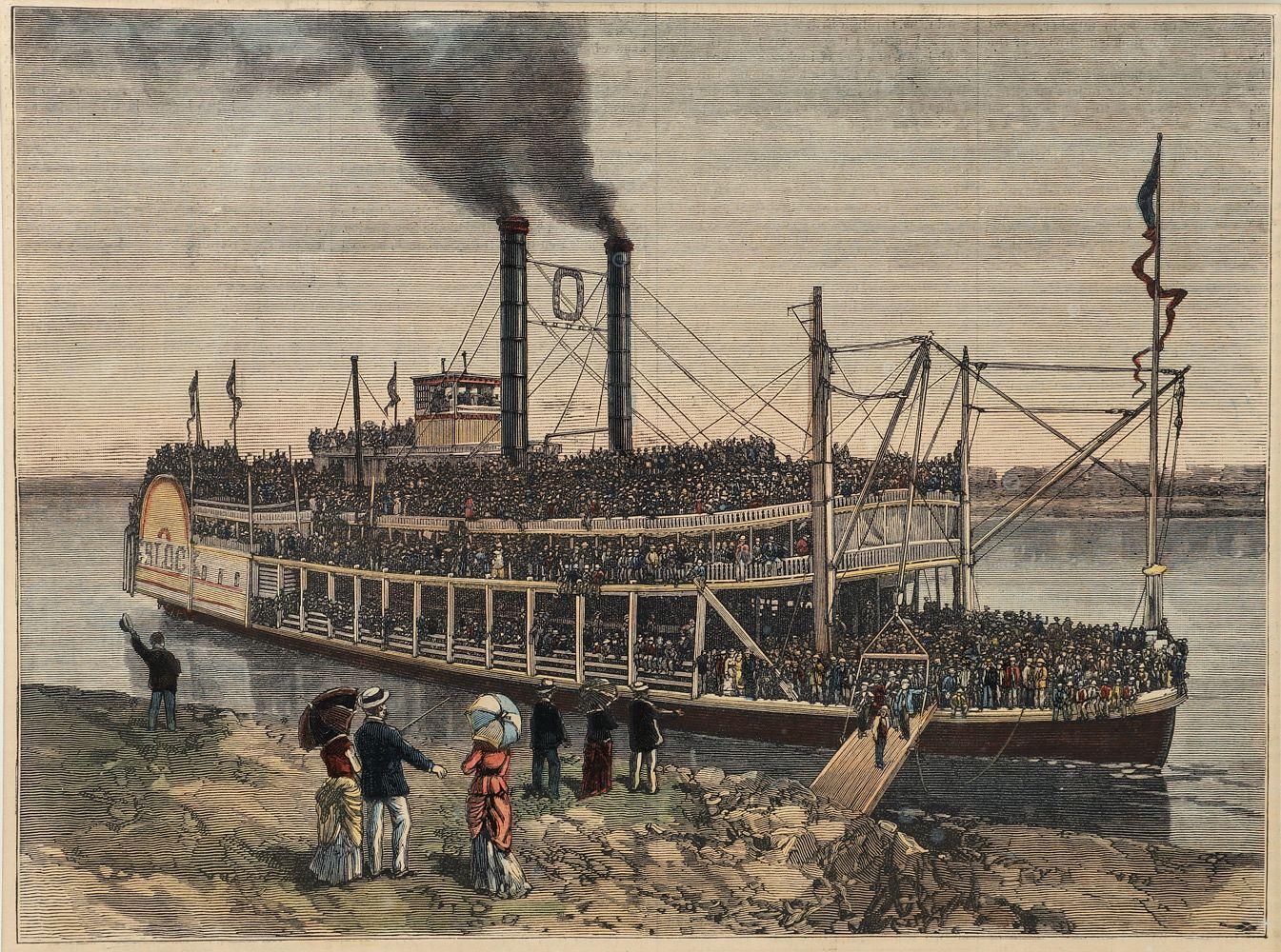
A ford is a place where movement narrows. A river may run for hundreds of miles, but only certain shallow points allow people, livestock, wagons and goods to cross safely. Whoever controls that point does not need to own the river itself, because the economic value lies in controlling the place where movement becomes concentrated.
That literal meaning is the strongest way into FORD: The Name, the Network, the Dynasty. The manuscript does not argue that every Ford in the story descends from one proven family. It instead follows the name as a historical lens and notices that Ford figures repeatedly appear around a particular cluster of functions: crossings, transportation corridors, controlled spaces, industrial bottlenecks, water infrastructure, manufacturing systems and places where movement becomes measurable or permission-based.
The book’s own preliminary pattern table calls the first of those functions “control of passage,” connecting the ferry, road, canal, theater, assembly line and water meter. The value of that idea is not that every appearance proves coordination; the value is that it gives us a concrete question to carry across two centuries of otherwise disconnected American history.


The first image shows Cave-in-Rock and the Ohio River in the early nineteenth-century world in which the story begins, while the second shows Wabash County in 1861 with Lagro, Wabash, the river, canal and railroad geography visible together. Put beside each other, they show the basic transformation this article follows: the natural corridor becomes an engineered corridor, but the economic value remains concentrated at the points where traffic can be controlled.
The First Ford Stood at a Literal Crossing
James Ford of Ford’s Ferry belongs to the lower Ohio River world of the early republic. The manuscript places him at the beginning because his historical position combines legitimate authority with the economics of a choke point: Ford operated a ferry near the Kentucky-Illinois-Indiana border region while also holding land, militia rank and justice-of-the-peace status, even as nineteenth-century accounts associated him with organized robbery and other criminal activity. The manuscript therefore treats him less as a colorful lone pirate than as an operator who occupied the boundary between legitimate transportation and the illicit economy surrounding it.
The broader Cave-in-Rock region really did acquire a reputation for river piracy and attacks on travelers, although later folklore exaggerated some of the most theatrical stories about the cave itself. The important historical point is that the Ohio River concentrated strangers, money, animals and merchandise through terrain where formal policing remained weak, creating exactly the kind of environment in which ownership of a ferry, tavern or landing could provide both legitimate income and extraordinary informational advantage.
A ferry operator knew who was traveling, what they carried, where they had come from and when they crossed. The ferry therefore controlled more than physical movement, because every crossing also generated information about the people and property passing through the corridor.
That is the first version of the Ford at the crossing. The river remains open, but practical movement narrows through the landing, and the operator occupies the narrow place where passage can be observed, charged for and potentially exploited.
Indiana Replaces the Natural Ford With a Machine
The next major stage is the Wabash interior, where engineers increasingly manufactured the crossing instead of merely finding it. The Wabash and Erie Canal created an artificial transportation corridor linking towns, warehouses, locks and river valleys across Indiana, while places such as Lagro became transfer points where goods, labor and information accumulated around canal infrastructure. The manuscript treats Lagro as one of the major northern pivots of the Ford network because the town sits precisely where the older Appalachian and Ohio River world intersects the canal-and-rail economy of the nineteenth-century Midwest.


The modern replica boat on the surviving Wabash and Erie Canal gives a clean view of the narrow engineered waterway, while the historic canal photograph shows the older reality of animal power, towpaths and controlled navigation. A canal did not eliminate the old economics of the ford; it industrialized them by turning passage into a sequence of locks, toll points, warehouses and scheduled movements.
A lock is itself a controlled crossing. Boats cannot simply continue forward as they please, because gates, water levels and operators determine when movement resumes. The same logic applies to the warehouse beside the canal, where cargo temporarily stops moving and enters somebody else’s custody before it continues onward.
The manuscript’s Lagro material is strongest when understood in these terms. It describes a corridor running from the lower Ohio through Indiana toward the Great Lakes, with canal towns, post offices, land transactions, fraternal relationships and commercial nodes giving structure to movement that had previously been much less formal.
The river crossing has therefore evolved into a system of crossings. Instead of one man controlling one ferry, an infrastructure network now contains dozens of points at which movement can be admitted, delayed, recorded, transferred or redirected.
Then the Canal Gives Way to the Railroad
Railroads accelerated this transformation because rail traffic required even tighter control than canals. A train could not casually pass another train on a single-track line, and freight could not simply appear at a destination without waybills, station agents, schedules and telegraphic information connecting the local depot to the larger system.
The railroad station therefore became a new kind of crossing point. Passengers passed through ticket windows and platforms, freight passed through warehouses and sidings, and information passed through telegraph offices. A depot could simultaneously function as a gate for people, a custody point for property and a communications node for the larger railroad.
This is one reason the Wabash corridor matters so much to the larger Ford argument. The manuscript repeatedly places its Indiana material at exactly the moment when canal geography becomes railroad geography and local custody becomes networked custody.
The older ferry owner could watch the river directly, while the railroad manager increasingly had to understand movement through records and signals. Control of passage was no longer simply standing where traffic crossed; it was learning to see the corridor as an entire system.
Captain J. B. Ford Turns River Logistics Into Industrial Power
Captain John Baptiste Ford provides one of the strongest documented transformations in the entire manuscript because his career actually crosses from transportation into large-scale industrial manufacture. Ford had experience in the Ohio River and steamboat world before becoming a major glass entrepreneur, eventually joining John Pitcairn in the enterprise that became Pittsburgh Plate Glass. Historic Pittsburgh identifies Captain John B. Ford and Pitcairn as the founders of the company at Creighton, Pennsylvania, in the early 1880s, while Indiana’s historical marker program similarly traces Ford’s move from river-based enterprises into plate-glass manufacturing.

The Pittsburgh historical marker commemorating Ford and Pitcairn can be read beside the Ohio River image because Ford’s career links those two worlds directly. One represents an economy organized around physical movement on water, while the other marks the development of an industry built around an entirely different kind of controlled interface: the manufactured glass surface.
The manuscript calls J. B. Ford the major industrial pivot because river logistics becomes glass manufacturing. Its formulation is intentionally visual: the network moves from controlling what crosses the river toward producing the material through which modern commercial society increasingly looks.
That is more than a literary analogy. Plate glass radically expanded the commercial storefront, allowing large quantities of merchandise to remain physically separated from the street while remaining visually accessible to anyone walking past.
The modern store window therefore becomes another kind of boundary. The customer can see through it but cannot cross it without passing through the controlled entrance, just as the river traveler could see the opposite shore while still depending upon a crossing to reach it.
Plate Glass Makes the Boundary Transparent
An 1889 account of American glassmaking described the Creighton works as among the most advanced plate-glass facilities in the country. The process created large flat sheets through casting, grinding and polishing rather than the older blown-window methods, producing the smoother surfaces demanded by modern storefronts and other architectural uses.
This changes the meaning of control in a subtle way. The frontier crossing controlled physical passage because terrain prevented movement elsewhere, while the commercial storefront controls movement architecturally by allowing vision to pass through a boundary while the body remains outside.
The boundary becomes transparent without ceasing to be a boundary. In that sense, J. B. Ford’s industrial world belongs comfortably inside the manuscript’s larger pattern even without requiring any genealogical relationship to James Ford of the ferry.
The Ford name has moved from the edge of the river onto one of the defining materials of modern enclosed space. What crosses the boundary is no longer necessarily a traveler; sometimes it is simply the gaze.
John T. Ford Controls a Different Kind of Entrance
John T. Ford belongs to another Ford line altogether, yet his theatrical business places the surname over another highly organized crossing. Ford leased the former Baptist church on 10th Street in Washington in 1861, opened Ford’s Athenaeum in 1862, rebuilt after a fire, and opened the larger Ford’s New Theatre in 1863. Abraham Lincoln attended performances there repeatedly before John Wilkes Booth shot him during Our American Cousin on April 14, 1865.


The portrait of John T. Ford belongs beside the historic theatre exterior because this is one of the clearest examples of a proprietor’s name becoming inseparable from a place. Ford did not cause Lincoln’s presence in the building that night, but his ownership permanently attached his surname to one of the most consequential scenes in American history.
A theater is itself a tightly controlled architecture of passage. Tickets determine whether a person enters, ticket price affects where a person sits, backstage doors separate performers from the audience, and private boxes create still another controlled level of access. The National Park Service notes that Ford’s Theatre used differentiated ticket prices for orchestra, balcony and box seating, making the building literally an architecture in which money determined permitted position.
After the assassination, the federal government took control of the building, prevented Ford from reopening it, leased it and later converted it to government office and storage use. The contested question was therefore immediately one of custody: who controlled access to the place now that the private theater had become the scene of a national political murder?
The Ford name remained attached even after Ford lost practical control of the interior. The crossing had become historical memory itself, because generations of Americans would continue entering the Lincoln assassination through a place still called Ford’s Theatre.
Edwin Ford Shrinks the Crossing Down to a Water Pipe
The most literal return to the original metaphor occurs with Edwin H. Ford, born in Wabash in 1861 and later involved in the Indiana glass industry before moving into municipal water infrastructure. The manuscript follows his transition from glassmaking to waterworks superintendent and then to the meter-box invention that became the Ford Meter Box Company.
Ford Meter Box’s own company history describes Edwin Ford serving as superintendent of the Hartford City waterworks during a period when excessive unmetered consumption created shortages. Existing water meters presented another problem in Indiana because an outdoor installation could freeze, so Ford experimented with buried pits and insulating lids until he developed a practical exterior meter housing.


These old Ford Meter Box lids make the manuscript’s crossing metaphor almost absurdly concrete. The words FORD METER BOX, WATER METER, and WABASH, INDIANA sit directly above a device whose purpose is to measure how much water passes from municipal infrastructure toward an individual user.
Ford’s company began in Hartford City in 1898 and relocated to Wabash in 1911. Company records say the operation first occupied space in the basement of Diehl Machine Works beside the Wabash River before later expanding through several Wabash facilities.
The economic transformation is enormous even though the physical crossing is tiny. James Ford’s ferry potentially measured passage one traveler or wagon at a time, whereas the municipal meter turns thousands of invisible everyday crossings into continuously measurable consumption.
The gate has moved underground. Instead of a ferryman asking who crosses, a mechanical meter records how much crossed, while the Ford box protects the point at which public flow becomes private use.
The Ford at the Crossing Becomes Automatic
The water meter reveals how industrial society changes the old toll-gate principle. A traditional crossing requires somebody physically present to collect money, inspect traffic or decide who passes, but the meter automates much of that function by recording flow without requiring continuous human observation.
That development matters because modern infrastructure is full of invisible crossings. Electricity crosses a meter, water crosses a meter, telecommunications cross switches, automobiles pass toll readers and financial transactions cross networks that record movement without any gatekeeper physically standing in the road.
The manuscript’s idea of “control of passage” therefore becomes more powerful as the infrastructure becomes less visible. The nineteenth-century crossing can be photographed as a ferry or lock, while the twentieth-century crossing increasingly disappears into pipes, wires, meters and control systems.
Edwin Ford is important because his product makes that transition visible in one object. A cast-iron lid on the sidewalk is the physical residue of a much larger system deciding how a basic resource is measured and accounted for.
Henry Ford Turns the Crossing Into a Factory
Henry Ford represents yet another unrelated Ford genealogy, which is precisely why the manuscript treats him structurally rather than as proof of a single family conspiracy. The River Rouge complex in Dearborn nevertheless takes the crossing principle to a scale that James Ford of the ferry could scarcely have imagined.
The Henry Ford describes the Rouge as an attempt to create a continuous industrial system stretching from raw materials to finished vehicles. Ford acquired or controlled mines, forests, transportation resources and other inputs, while ore boats and railways moved coal, iron ore and limestone into a gigantic complex containing blast furnaces, foundries, rolling mills, power generation, glass production and vehicle assembly.


The aerial photograph of the Rouge and the assembly-line image belong together because they show two scales of the same system. From above, the Rouge appears as a landscape of docks, tracks, factories and internal corridors, while inside the plant the automobile moves through a carefully ordered sequence of stations where each worker performs a controlled operation.
The factory changes the old geography of the ford by turning the entire production process into a series of engineered crossings. Raw ore crosses into steel, steel crosses into components, components cross into assemblies, workers cross through gates and finished automobiles eventually cross out of the plant as saleable objects.
Henry Ford’s celebrated moving assembly line intensifies that logic further. The worker does not follow the object freely through the shop; instead, the system controls the object’s route and speed, bringing the product through predetermined stations in a predetermined sequence.
The crossing has effectively been turned sideways. Instead of travelers moving through a fixed gate, the product moves through a succession of controlled gates while labor remains positioned around the route.
River Rouge Is the Ferry Expanded to Industrial Scale
The comparison works because the economic principle remains recognizable beneath radically different technologies. James Ford occupied a narrow point where river traffic could be observed and monetized, while River Rouge attempted to eliminate uncontrolled gaps throughout an entire supply chain.
Henry Ford’s ambition was vertical integration: bring the raw materials, transportation, power generation, processing and final assembly under coordinated corporate control. The Henry Ford’s own account describes this as the pursuit of an almost nonstop movement from raw materials toward a finished vehicle.
This is control of passage on an industrial scale. The important resource is no longer one ferry crossing, because the corporation tries to control every consequential crossing between the mine and the finished automobile.
The industrial organization becomes valuable precisely because it minimizes points where somebody outside the organization can interrupt, delay or charge for passage. In that sense, the enormous factory complex is the inverse of the old ferry monopoly: rather than owning one choke point, it attempts to own the chain of choke points.
The Pattern Is Stronger When It Is Not Forced Into Genealogy
The easiest way to weaken this material would be to insist that every Ford discussed here must secretly belong to one biological line. The manuscript explicitly rejects that approach and instead separates genealogy from network function, treating some Fords as relatives, others as unrelated historical figures and still others as people who adopted the name.
That restraint actually makes the recurrence more interesting. James Ford can be studied as a documented ferry operator associated with a frontier criminal ecology, J. B. Ford as a river entrepreneur who became a plate-glass industrialist, John T. Ford as a theater proprietor, Edwin Ford as the inventor behind a water-meter enclosure and Henry Ford as the builder of an enormous vertically integrated manufacturing system.
Their biographies do not have to collapse into one family tree for the recurring function to remain visible. The common question is what happens when the Ford name appears next to an interface through which people, goods, water, vision or industrial material must pass.
That is the level on which the book’s central metaphor works.
Eventually the Name Itself Becomes a Crossing
The later manuscript takes the argument one step farther by examining people who actually adopted Ford as a public name. Francis O’Fearna became Francis Ford, while his younger brother John Martin Feeney became the filmmaker John Ford, whose Westerns helped construct some of the most durable visual mythology of the American frontier.
Here the crossing is cultural rather than mechanical. An Irish-American family entering the developing motion-picture industry uses a short, unmistakably American surname, and that chosen name then becomes associated with some of the twentieth century’s defining images of cavalry, settlement, frontier movement and national mythology.
The name has moved a long way from the Ohio River, but the manuscript’s symbolic reading is consistent. A Ford once occupied the physical crossing; eventually “Ford” itself becomes something that can help a public identity cross into mainstream American culture.
This is not genealogical evidence, and the book does not treat it as such. It belongs to the manuscript’s explicitly symbolic evidence tier, where recurrence and cultural meaning are analyzed without being presented as proof of biological descent.
The Best Place to End Is Under the Sidewalk
The grandest ending would be River Rouge, with ships unloading ore, trains moving through the plant and assembly lines carrying automobiles through a nearly continuous industrial process. The smaller ending is better because it reduces the entire argument back to the simplest possible object.
An old Ford Meter Box lid in a sidewalk does not look like a monument. Most people step across it without reading the name, yet directly beneath it sits a controlled crossing where municipal water moves toward private property and the amount passing through can be measured.
That image carries the project all the way back to the river. James Ford’s world monetized physical passage across the Ohio, while Edwin Ford’s invention helped utilities measure the passage of water through an underground line; between them sit canals, railroads, glass, theater doors and the enormous controlled corridors of industrial production.
The manuscript describes this recurrence in deliberately functional terms: the Ford at the crossing persists even when the crossing changes form.
That does not prove one hidden dynasty controlling two centuries of American infrastructure. It gives us something more useful for a historical investigation: a repeatable question that can be tested figure by figure, document by document and crossing by crossing.
Whenever the Ford name appears, the question becomes worth asking: what, exactly, is passing through here, who controls the passage, and what becomes possible because they stand at that point?