In 1904, Wabash’s street commissioner lived at 117 West Sinclair Street. Charles Dexter Brooks had been born at Rich Valley in 1861, into a family established in the neighborhood when moving a load of grain was still an undertaking for ox teams. His office placed him in the daily business of maintaining streets at a time when contractors were competing to sell communities a different kind of road. Gravel, brick, concrete, and asphalt carried different promises, and choosing among them committed public money, private assessments, labor, and material.
Charles’s parents, Norman Brooks and Mary Jane Keller, had married at Rich Valley in 1852. Their sons included James Willard, born in 1859, and Charles two years later. Family compilations identify Norman and Dexter Brooks as sons of John Brooks and Eunice Blackmer. John, remembered in the local burial register as a War of 1812 veteran, was among those buried in the Brooks ground east of Rich Valley. That cemetery has been plowed over. Its reconstructed register survives through family papers and newspaper accounts, preserving a few relationships that can no longer be read from the stones.

The county history’s account of Dexter gives the earlier road problem a practical scale. To obtain seed for a wheat crop in 1836, he took three yoke of oxen to White County and helped thresh the grain before bringing it home. There was labor in obtaining the seed, labor in carrying it, and another season’s work waiting at the destination. The distance a farmer could profitably haul something helped determine what he could afford to grow. At Liberty Mills, merchant and mill owner John Comstock tried to enlarge that distance by promoting plank roads toward North Manchester, Lagro, and Huntington. Better access meant more grain for his mills, more customers for his store, and a wider market for the settlement’s businesses.
By Charles’s generation, Wabash had officials and firms specializing in the work. Mayor Joseph W. Murphy headed the administration; John Hilty was city engineer and Frank O. Switzer city attorney. Thomas Bridges’ Son kept a contracting office on East Canal Street and operated a quarry at the east end of Chestnut Street. Philip Hipskind & Sons offered paving and sewer construction. Brooks’s particular contracts still need to be identified, but his office and the businesses around it are firmly placed in the 1904 directory. The street office had been close to the contracting trade from the beginning: the county history identifies Archibald Stitt as its first appointee under Wabash’s city government and describes his earlier road and bridge contracting. He died while holding the office in 1867. A generation later, city engineering could draw on suppliers well beyond Wabash. Hilty’s 1905 Ferry Street bridge brought together local construction and Detroit’s Trussed Concrete Steel Company’s reinforced-concrete system.

The demand for better surfaces also came from people who had no paving company to sell. An 1896 inventory names the Dragon Cycle Club of Wabash, the Huntington Cycle Club, and the Fort Wayne Cycling Club; Peru appears in the state’s record of bicycle businesses. A wheel caught in a rut or buried in loose stone made a persuasive argument for an improved road. Bicycle organizations turned that experience into conventions, petitions, and an enduring public campaign.
Horatio Earle, the Michigan road advocate, had worked as an iron moulder, inventor, commercial traveler, and bicycle businessman. One cycle venture lost enough money for his 1900 biographer to describe it as a “gift enterprise.” He became chief consul of Michigan’s League of American Wheelmen and later a highway commissioner. His Good Roads gathering at Port Huron in 1900 offered something more convincing than a speech alone: delegates watched a demonstration road take shape under crushers, grading equipment, traction power, and rollers.

Earle’s affiliations also put the Masonic and Odd Fellow worlds directly within the road movement’s social setting. His contemporary biography names Detroit’s Ashlar Lodge, Peninsular Chapter, Damascus Commandery of Knights Templar, and Michigan Lodge No. 1 of the Odd Fellows, alongside his cycling leadership. Wabash lawyer David F. Brooks was a Royal Arch Mason and an Elk, while Stitt had been an Odd Fellow. These men’s professional and civic lives ran through several organizations at once. Earle’s public road campaign can be followed through the cycling league, conventions, and demonstrations; the lodge memberships supply another part of his personal associations.
For the paving companies, that growing interest had to become a material choice and a paying job. In February 1900, bids for Wabash’s Hill Street included Barber Asphalt Paving, listed from Chicago, Western Paving & Supply of Indianapolis, and P. Hipskind & Sons of Wabash. The published proposals covered 21,780 square yards, with paving alternatives, a concrete foundation, drainage, and guarantees. The notice identifies the competition, although it does not identify the winner.
Barber’s Chicago address was a branch address in a much larger concern. The company already appeared in Fort Wayne directories during the 1890s. In 1905, it maintained offices in the Schmitz Block and a yard at Broadway and the Wabash Railroad. Its bid in Wabash came from an organization with a nearby operating base and a way of bringing material into the region. A surviving photograph of its Fort Wayne crew in 1906 shows the work at street level: men with hand tools spreading pavement beside tracks, a loaded wagon, and the buildings their work served.

The company’s reach began much farther away. At La Brea in Trinidad, then a British colony near Venezuela, Pitch Lake supplied natural asphalt for export. Amzi L. Barber participated in consolidating access to that deposit. The concession preserved by Trinidad’s National Archives is dated July 12, 1888, and granted exclusive rights to remove asphalt under specified fees and conditions. It names Joseph Weedon Previte, Henry Alfred Greig, and the New York and Trinidad Asphalt Company. A business offering an American city a new street surface was connected to an extraction agreement under British colonial government.

Barber’s 1927 promotional booklet pictured the labor behind the product. Men dug asphalt from the lake and carried it to cars on a narrow gauge railway. At the refinery, heat drove out water; refined material could be packed into barrels. An aerial conveyor carried loads toward the pier, where buckets discharged into ships. The company offered readers a view of an entire export operation.

Its photographs are a useful companion to the promises made in a paving bid. A smooth American street depended on extraction, processing, loading, and transport, with much of the first work performed by laborers in Trinidad. The finished surface reached the customer after a sequence of jobs, each with its own equipment and costs.

Control of a source became particularly valuable when customers specified that source by name. In the 1904 case Field v. Barber Asphalt Paving Co., a Westport, Missouri, property owner challenged paving assessments partly because the contracts required Trinidad Lake asphalt and excluded competing materials. The Supreme Court rejected the federal constitutional and antitrust challenges. It also acknowledged that a Barber agent had actively obtained signatures for the petition specifying that asphalt, while finding the allegations of fraud and corruption unproved.
The sales work began with a material choice. A city selecting a particular source of asphalt was also shaping the field of businesses that could supply it.
John Foster Brooks learned that business as an employee. Born at Dunkirk in 1882 and raised in Logansport, he grew up around his father’s trade collecting farm produce for processing and shipment to New York by rail. After attending Purdue, he worked for William Moellering & Sons in Fort Wayne; the 1905 directory lists him as a time clerk, boarding at 121 East Pontiac Street. The company history then places him selling liquid asphalt for Barber. His relationship to Charles Dexter’s Rich Valley family has not been established. His employment gives a direct connection to the concern already seeking paving work in the region.

In 1909, Brooks and engineer Lester E. Ginn obtained $7,000 from Fort Wayne businessman Ralph Magee to start their own concern. Magee wanted his money back promptly and required detailed cost accounts that he could inspect. The first job in the family account was Forest Park Boulevard, where Brooks went house to house persuading property owners to select asphalt over brick. Those owners could vote on the material for their street. The boulevard had hosted bicycle races in the preceding decade; by 1909, it was a place where an improved surface had to win approval from the people beside it. Brooks was offering a finished condition of the street and asking them to commit to its cost. The sales experience acquired at Barber remained useful after he became an independent contractor, while Magee’s accounting requirements kept the partners responsible for what their jobs cost. Within three years, they had repaid him.
Building the surface required a steady delivery of heavy material, and Wabash was producing equipment for that kind of work. Service Motor Truck Company’s officers in 1914 included Fred B. Walter as president, Jean Marks as vice president, Edward Bridges as treasurer and manager, and Moi Cook as secretary. Bridges also appeared in Wabash’s quarry and contracting business. Walter’s interests extended into manufacturing and the Citizens Savings & Trust Company. Stone, vehicles, and finance were represented in the careers of particular local businessmen.

Preferred shareholders were promised a cumulative seven-percent annual dividend from profits, while the company’s vehicles were assembled through a supply system reaching beyond Wabash. A 1914 advertisement called the product “The Standardized Truck” and named Timken, Buda, Warner, Stromberg, and Eisemann among the component suppliers. Customers could choose chassis and bodies for different jobs; the illustrated vehicle was lettered for a Dayton bottling business.

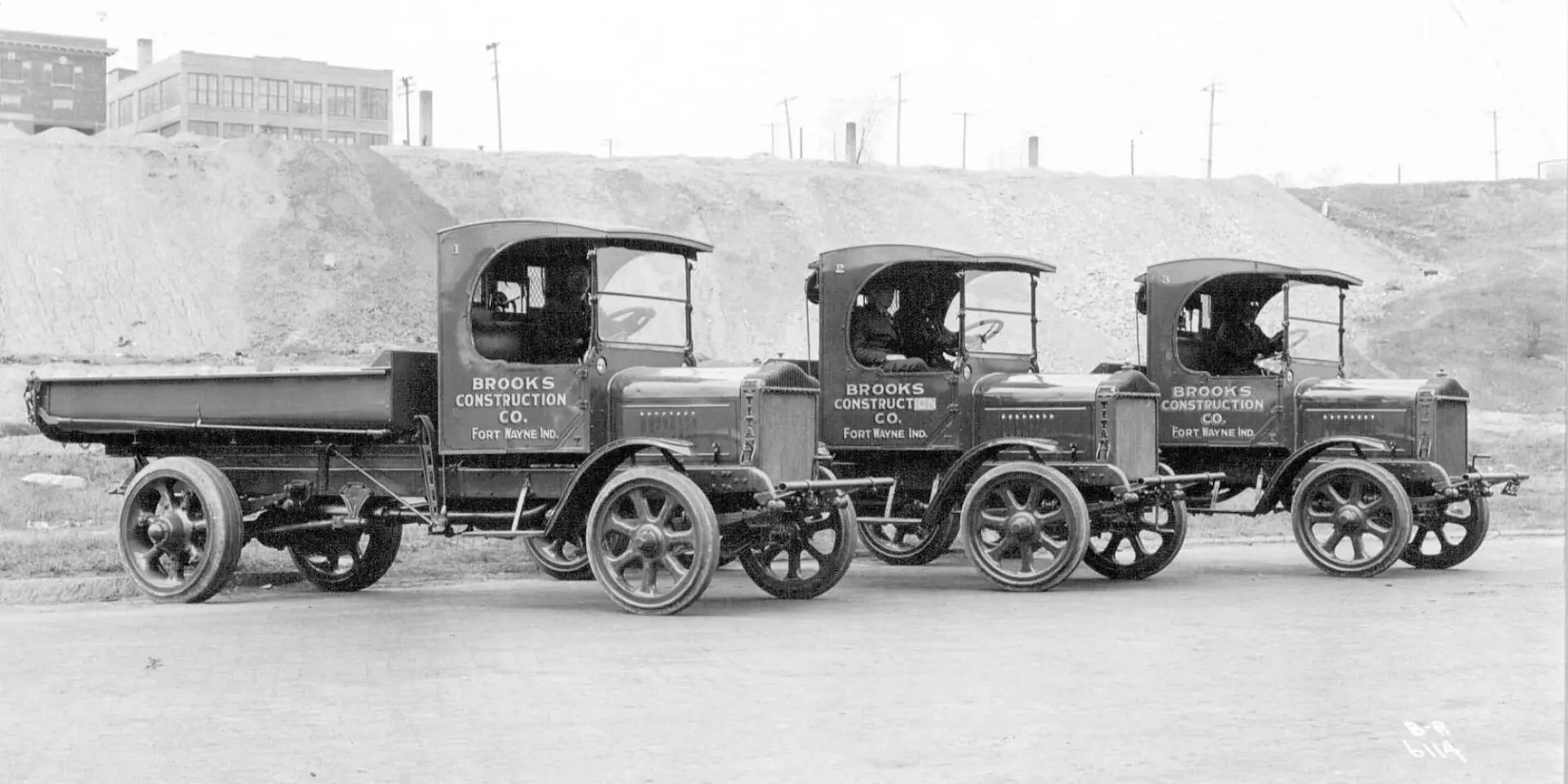
That commercial use of standardization preceded the wartime Class B Liberty truck, built to a common military design by multiple manufacturers. Brooks’s own fleet photograph identifies the equipment it was using more directly. The three dump trucks in the picture dated 1921 carry TITAN vertically on their radiator sides, with Brooks Construction’s name painted on the cabs. Titan was a Milwaukee manufacturer, separate from Wabash’s Service company.

Milwaukee also supplied the company’s Koehring mixer, and the two manufacturers had an executive in common. In 1922, Philip A. Koehring was secretary and treasurer of Koehring Company and a vice president of Titan Truck Company. His contemporary biography credited him with a paving-mixer patent that used a boom and bucket to distribute material. The trucks and mixing equipment came from businesses already serving related parts of the construction trade.
Early Brooks jobs included substantial concrete work, with sand, stone, cement, and water brought together at the site. The self-propelled Koehring mixer helped organize production there. Another improvement described in the family history was a turntable in front of the paver. A driver could pull onto it and be turned into position for unloading, saving the crew from waiting while a truck was repeatedly backed into place. These machines improved the handling of loads, an old problem in the Wabash region now being worked out with engines, gears, and specialized equipment.
The company acquired its first asphalt plant in 1917. In 1923, it established the yard at 1123 Barthold Street in Fort Wayne on railroad land obtained for a nominal dollar. The bargain required aggregate to move from Huntington to Fort Wayne by rail, and two spurs served the yard for cement and aggregate. A cheap site brought the railroad continuing freight business; Brooks obtained a place to receive and prepare material before sending it to the job.
At this scale, the comparison with a vertically integrated company becomes useful. A quarry contractor could also manage a truck maker; a manufacturer could hold a position in a trust company; a paving contractor could secure its yard through a freight agreement. Work that a large corporation might coordinate among its own departments could also be arranged among separate businesses, lenders, and public offices in a county and its neighboring towns. Wabash, Huntington, Peru, and Fort Wayne formed a regional setting for those arrangements, while companies such as Barber, Titan, and Koehring connected it to suppliers farther away.

Long before the Fort Wayne contractor needed a rail yard, James Brooks of New Albany had helped build a route north from the Ohio River. He led the New Albany & Salem Railroad from 1847 to 1859, developing its connection toward Lafayette and Michigan City. John W. Brooks became president of the Michigan Central. In 1860, Michigan Central’s annual report described coordinating its trains with the New Albany & Salem, including the expense of special engines between Michigan City and Chicago when the southern line could not meet its regular services. John W. Brooks worked alongside H. H. Hunnewell, the Michigan Central’s vice president, and a board representing Forbes, Thayer, Corning, Williamson, and Minturn interests. The report stressed control of the telegraph line and accurate accounts of the loads carried by individual engines. Tonnage had risen by about a quarter, while freight-train mileage had barely changed. Information arriving from distant points could be compared and acted upon, helping management get more work out of the railroad’s existing equipment.
The later Delano connection runs through the New Albany railroad’s institutional successors. James Roosevelt led the company in 1884–85, and Frederic A. Delano in 1913–14. Those dates describe successive administrations over a long period. Hunnewell’s connection with John W. Brooks was a contemporary officer relationship, while Delano’s was the later stewardship of a railroad James Brooks had helped develop.
Compiled family records identify James Croxall Brooks as the son of New Albany’s James Brooks and Phebe Ann Paxson. He served as a captain and commissary of subsistence during the Civil War, beginning in January 1863, and received a brevet majority in 1865. By 1902, he was president of Southwark Foundry & Machine Company in Philadelphia and a trustee of the Williamson School. Military provisioning, machinery manufacture, and technical education were all part of his career. He also belonged to the Pennsylvania Commandery of the Military Order of the Loyal Legion, a society of veteran officers.

The railroad business also required protection of its property and investigations of people accused of attacking it. In the Michigan Central conflict that produced the 1851 railroad conspiracy trial, John W. Brooks and James F. Joy employed agents to gather evidence against the accused. The ensuing prosecution drew the company into a political controversy extending beyond the original damage to railroad property, turning a dispute along the line into a wider contest over the company’s power.
Comstock’s businesses faced their own threats in the same period. The county history credits him with organizing a private detective committee in 1851 after thefts and threats against local merchants. Its members included William and Isaac Thorne and several members of the Shaubert family. The account describes them pursuing suspects beyond the immediate neighborhood. Comstock’s interest in roads and his interest in investigation arose within the same commercial life: goods, livestock, and cash had to travel, and the people moving them could be robbed.

James J. Brooks directed investigations under federal authority as chief of the Treasury’s Secret Service from 1876 to 1888. In the attempt to steal Abraham Lincoln’s body, Chicago operative Patrick D. Tyrrell reported to Brooks’s Washington headquarters about a counterfeiting circle’s plan to exchange the remains for the release of an imprisoned engraver. Informants, reports, and instructions passed between a regional operative and the chief directing the service. John Carroll Power, custodian of the Lincoln monument, preserved correspondence from the operation. The Brooks name in that Washington office belonged to a federal chief supervising work across several states.
Union City brings the name back to a local business whose range was broader than its modern description suggests. Russell Brooks’s undertaking concern dated from 1919, according to the history preserved by its successor funeral home. A 1920 buyers’ guide listed R. R. Brooks Music Store as a music store and an undertaker. During the radio boom, Brooks & Brooks offered another service to the same community.

Imperial Radio Laboratories operated at 201 South Columbia Street in Union City. Its sets were among the products advertised by Brooks & Brooks in the Evening Times on December 5, 1925, alongside Zenith, Hartman, and Magnavox. The firm invited readers to call for help with radio trouble and assured them they would get what they paid for. A familiar local business was offering equipment that brought voices and music into the house from beyond the town, with service as part of the sales pitch.

The notice put its radio offer in large type, with the manufacturers’ names and assurances of service underneath. Near the bottom came the business name and telephone number, 543. The same advertised number served a firm offering help with a troublesome radio and attending to a family funeral. Beneath the names of the radio makers, the small print still read: Funeral Directors.
The Rich Valley line, John Foster’s Logansport background, and the New Albany family have separate documentary histories. Common ancestry has not been established across them, the Michigan Central president, the federal chief, and the Union City undertakers. The clearest connections running through these records are specific business relationships: John Foster’s employment by Barber, Koehring and Titan’s shared officer, and the two railroads’ connecting services.
Roadbuilding around Wabash drew on businesses already accustomed to handling heavy loads. Bridges’s quarry and Service’s truck works were part of that setting. Huntington aggregate and Fort Wayne rail facilities supplied Brooks’s operation; Barber’s sales organization had given John Foster experience persuading customers to choose asphalt. The Trinidad concession reaches farther back along the paving trade’s supply chain. A street’s surface could be the last stage of an operation that began with colonial extraction and passed through shipping, rail transport, local finance, and a public decision about the material to buy. Charles Dexter’s street office stood at the city’s end of that business.
When Ginn retired in 1937 and John Foster’s sons James and Robert entered the firm, they joined a company with an asphalt plant, a rail-served yard, and years of experience buying, moving, mixing, and laying material. The scale of the business would have been unfamiliar to Dexter setting out with his oxen in 1836. Its dependence on the cost of hauling a load would have been easy enough to recognize. A city purchasing a road was now paying for the work of that whole supply chain. Brooks Construction had learned to organize it and sell the result as a finished street.