Imagine walking into an old supermarket or warehouse on the edge of an American city and finding something very different from another row of self-storage units or a furniture outlet. Along one wall are bins of switches, connectors, tiny displays, motors, batteries, antennas and circuit boards. Across the aisle somebody is rebuilding a PSP under a magnifying lamp. A radio dealer has coils of coax hanging behind the counter, next to LoRa modules, SDR receivers and handheld antennas. There are Raspberry Pis, ESP32 boards, mechanical keyboard parts, e-ink screens, old industrial controls and dozens of objects whose purpose is impossible to determine until somebody explains them.
In the back, people are working at benches. One customer is putting together an offline computer in a rugged case while another is programming a Meshtastic node. A teenager is learning how to replace a Game Boy screen. Somebody has dragged in an old shortwave receiver that has not worked since the 1990s. A local builder has rented a glass display case and is selling a dozen handmade terminals assembled from 3D-printed shells and off-the-shelf components.
There is no particularly good name for this place because America largely stopped building places like it. We once had fragments of it in RadioShack. Ham-radio stores provided another piece. Electronics-surplus shops provided another. Computer stores, hobby shops, swap meets and later makerspaces filled in pieces of the picture. What never really developed in the United States was the dense public hardware culture visible in places such as Shenzhen, where components, repair, experimentation, fabrication and commerce can occupy the same physical neighborhood.
That absence is becoming more noticeable because American technology culture is quietly moving back toward hardware.
The machine is becoming interesting again
For most of the last twenty years, personal electronics moved in the opposite direction. Computers became thinner, cleaner and increasingly difficult to open. Phones absorbed the functions of cameras, GPS units, MP3 players and handheld game systems. Software moved into subscriptions and cloud services. Storage disappeared inside sealed devices. Buttons disappeared. Ports disappeared. Batteries disappeared behind glue.
The result was extraordinary convenience, but it also produced a world of remarkably similar machines. A thousand-dollar phone and a two-hundred-dollar phone are both black rectangles. Laptops vary enormously inside, yet most share the same basic physical vocabulary: screen, keyboard, trackpad, thin shell. Against that background, the renewed enthusiasm for cyberdecks makes much more sense.
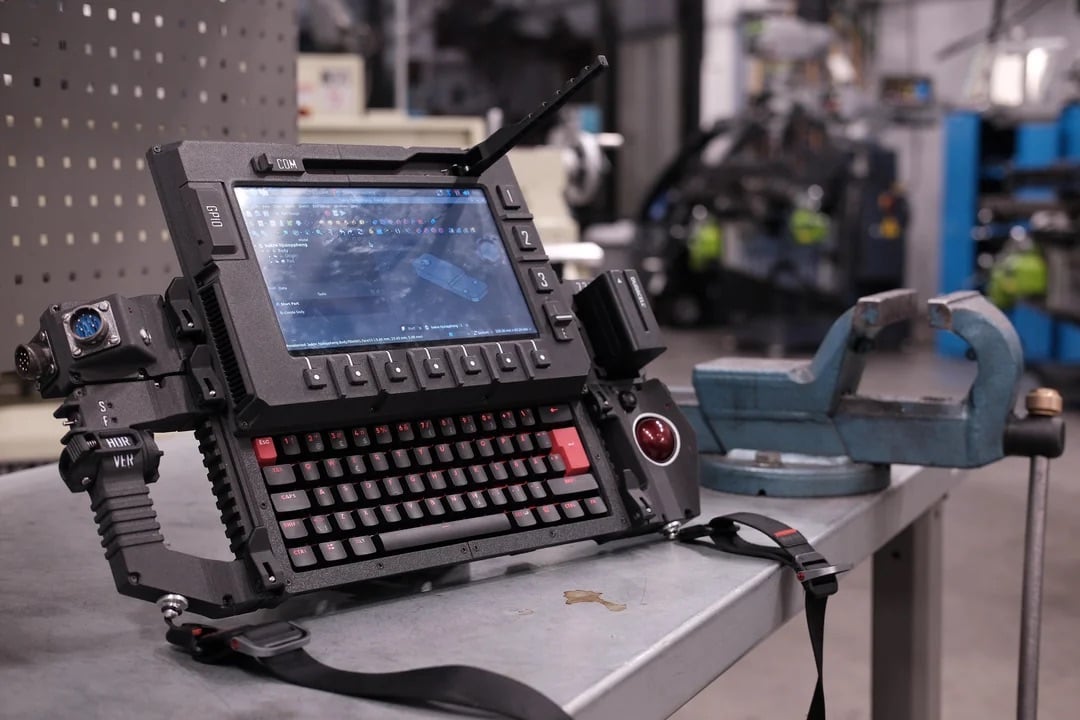
The cyberdeck existed for years as a niche maker obsession, usually involving some combination of Raspberry Pi hardware, unusual keyboards, portable displays and science-fiction aesthetics. During 2026 it became much more visible. TechCrunch covered a new wave of personal cyberdeck building in June, and Raspberry Pi followed in August with a complete guide after observing how heavily the machines had returned to maker culture. The attraction is broader than retro styling. A cyberdeck asks a question ordinary consumer computers rarely ask anymore: what do you actually want this machine to be?
A homemade machine can be built around writing, radio, maps, local storage, music, field work or software development. It can have one screen or three, a trackball or joystick, a removable battery, physical switches, external antennas and storage that can be pulled out and replaced. It turns the computer back into an object-making hobby rather than a finished appliance.
A Raspberry Pi 5 handheld cyberdeck combining a custom keyboard, PSP-style joystick and software-defined radio.
The old handheld suddenly makes sense again


Retro handhelds belong to the same cultural moment. PSPs, Game Boys, Nintendo DS systems and older portable devices are being restored instead of automatically discarded. Replacement shells, modern screens, batteries, buttons and repair parts have created a second life for machines that were once simply old consumer electronics. Some of the demand is collecting and some is nostalgia, but the machines also possess a quality that has become more conspicuous with time: they are self-contained.
A Game Boy does not care whether Nintendo’s servers are online. A cartridge does not need to check whether a subscription is active. A PSP loaded with local games, music or video remains useful on an airplane, in a basement or somewhere with no internet connection. The machine simply does what the machine was built to do.
That used to be so ordinary that nobody needed a word for it. Now offline is becoming a feature. The same impulse appears in people rebuilding old iPods, carrying dedicated e-readers, storing movies on home servers, collecting physical media and constructing small computers that hold local copies of books, manuals, maps and software. This does not require dreaming about the collapse of the internet. Sometimes people simply want a device they own all the way down.
Radio people have been living in this world for a century

Amateur radio makes the hardware revival more interesting because the United States already has a large community built around this kind of technological independence. ARRL’s FCC-data counts continue to show hundreds of thousands of active amateur-radio licenses in the United States. Around those license holders sits a much larger body of practical knowledge about antennas, propagation, batteries, portable power, field communications, RF electronics and building systems out of interchangeable pieces.
Spend enough time around radio operators and the modern cyberdeck movement begins to feel less new than it first appears. A traditional ham station is already a modular personal technology system. The operator chooses the transceiver, power supply, tuner, key, microphones, antennas, computers, interfaces and accessories. Portable operators compress the same philosophy into rugged cases, batteries, folding antennas and equipment that can be carried to a park or campsite. The exact form of the system belongs to the person using it.
The ham shack was a cyberdeck before anybody had a fashionable word for one.
What has changed is that radio experimentation is mixing with communities that arrived from software rather than traditional amateur radio. Meshtastic is one of the clearest examples. Cheap LoRa boards let people experiment with decentralized text communication using devices that can relay messages without depending on ordinary cellular service or Wi-Fi. Someone who would never begin by studying for an amateur-radio license can start with a tiny board, pair it with a phone and immediately begin asking radio questions.
Why did the signal travel farther yesterday? Would a better antenna help? What happens if the node goes on the roof? Can it run from solar power? Could it act as a repeater? Could several neighborhoods build a linked network? Can a keyboard be attached? Can the entire thing be built into a portable terminal? That progression turns an inexpensive gadget into an education in antennas, propagation, power management, electronics, packet routing, embedded software and enclosure design.
Off-Grid Communication: Meshtastic and the LoRa Mesh Network
A practical introduction to Meshtastic, LoRa radios and decentralized messaging without ordinary cellular service.
Reticulum and related projects carry the same instinct farther into networking by treating communications infrastructure as something that can be assembled from independently operated pieces and unusual low-bandwidth links. The hardware hacker, open-source developer, amateur-radio operator and off-grid communications enthusiast are beginning to occupy overlapping territory. One person calls it mesh networking, another calls it packet radio, and another simply calls it a project built because two computers ought to be able to communicate without asking a cellular company for permission.
Then there is Shenzhen

Huaqiangbei is difficult to understand through ordinary American retail assumptions. The attraction is not simply that electronic parts are cheap. It is the density of material and knowledge. Displays, batteries, switches, cameras, connectors, LEDs, motors, development boards, chips, tools and finished devices sit inside an ecosystem connected to design firms, prototype shops, assembly houses and factories.
If somebody has an idea for a machine, the distance between the idea and its physical ingredients can be remarkably short. A screen discovered in one stall changes the enclosure. A connector found somewhere else solves the power problem. A nearby shop can make a board, another can make a case, and someone nearby has probably seen the same failure before. Hardware knowledge becomes geographically dense.
Inside the World’s Largest Electronics Market — Huaqiangbei Hardware Tour
A 2026 walk through Shenzhen’s component markets, with stalls selling chips, boards, motors, sensors and prototype hardware.
The United States cannot duplicate Shenzhen simply by opening a clever retail store. The manufacturing environment that produced Huaqiangbei grew out of industrial conditions that do not exist in most American cities. The public-facing part of the idea is much more portable, however. America could build a place where hardware, repair, fabrication, radio, surplus electronics and people who understand those things are concentrated together.
That physical space is strangely absent.
What replaced RadioShack never replaced RadioShack
America already has nearly every piece required to build such a place. DigiKey and Mouser can supply components. Adafruit and SparkFun built enormous educational ecosystems around microcontrollers and sensors. Micro Center still provides physical access to computer parts, Raspberry Pi equipment, 3D printers and maker hardware. Amateur-radio stores serve hams. Retro-game shops restore consoles. Makerspaces operate in libraries, universities and industrial buildings. Electronics-surplus stores survive in scattered pockets. Repair cafés and community fix-it events have expanded in many cities.
All of those things exist. They rarely exist in the same room.
The obvious temptation is to say that America needs RadioShack back, but that is probably the wrong model. RadioShack is remembered because its better stores accidentally performed a function larger than retail. A person could walk inside carrying a broken cable, a strange plug or a half-formed idea and begin touching the parts that might solve the problem. There were drawers of components, switches, connectors, batteries, antennas and enclosures, and sometimes somebody behind the counter could tell you why the thing you were building kept burning out the same transistor.
Online distribution solved the inventory problem better than RadioShack ever could. If you already know the exact connector, voltage regulator, microcontroller or sensor you need, the modern supply chain is extraordinary. The weakness appears one step earlier, when a person has an idea but does not yet know the vocabulary needed to convert it into a parts list.
Search works beautifully once you know what the thing is called. Physical places teach the names by accident.
Someone arrives looking for a battery connector and sees an e-ink display on the next rack. Another customer is buying an SDR. There is a LoRa board on the counter. Somebody at a repair bench is rebuilding a twenty-year-old handheld. A strange homemade computer is running from a battery pack in the corner. A flyer announces a soldering class that evening. The customer leaves with the connector they came for and three ideas they did not have when they entered.
A website can sell parts. A physical hardware market can create hardware people.
Build a market, not another chain store
The American version does not need to be enormous. It could begin in a vacant supermarket, an old Kmart, a strip-mall anchor or a light-industrial warehouse. Instead of one company trying to stock every category, the stronger structure might resemble an indoor public market made up of independent specialists.
One shop specializes in microcontrollers and sensors. Another carries displays, mechanical switches, small keyboards and cyberdeck parts. A radio vendor sells coax, antennas, SDR hardware, LoRa equipment and portable power systems. A retro-game repair shop handles PSPs, Game Boys and older computers. Another business deals in batteries, charging equipment, solar gear and DC power. A surplus seller occupies the corner with motors, industrial switches, old displays, military connectors, transformers, test equipment, cases and mysterious pieces of obsolete machinery that are irresistible precisely because nobody knows what they were meant to do.
The rear of the building contains shared soldering stations, microscopes, oscilloscopes, 3D printers and laser cutters. A small PCB service helps customers move from breadboard to finished board. Another counter prints enclosures and custom panels. Local hardware builders rent display cases and sell devices in runs of twenty rather than twenty thousand. Small manufacturers bring in overstock, obsolete development boards and leftover components rather than sending everything to a recycler.
Then the social side takes over. Tuesday is a soldering class. Thursday belongs to Meshtastic. A radio club meets on another night. A retro-console workshop teaches people to replace screens and capacitors. On Saturday the parking lot becomes a swap meet. Once a month there is a cyberdeck show where builders arrive with machines that are elegant, ridiculous, beautifully engineered or held together by zip ties.
The vendor structure also solves an economic problem that killed many specialist stores. A radio dealer may not generate enough foot traffic for a large standalone retail building, and neither will a console repair shop or a surplus seller. Put them together and the building itself becomes the destination. The ham operator walks past the retro counter. The Raspberry Pi customer discovers SDR. The person waiting on a PSP repair spends half an hour digging through surplus switches. Every customer becomes foot traffic for everybody else.
Repair belongs in the same room

Repair culture offers another clue. Community repair events work because someone brings in an object they regard as broken and opaque, then watches another person remove the screws. A cover comes off and the mysterious sealed appliance becomes a board, wire, switch, motor, belt, capacitor or damaged solder joint. The repair itself matters, but the change in understanding can matter just as much.
Once somebody has watched a supposedly inscrutable machine come apart on a table, the psychological barrier to opening the next one gets smaller. This is the same cultural mechanism that operates in amateur radio and maker culture. Technology becomes easier to understand when people are allowed to touch its insides.
A permanent hardware market could make that experience ordinary rather than occasional. Repair benches would sit beside retail instead of disappearing behind a service counter. People could bring a broken console in, buy the part in the same building, borrow the right tool and learn how to install it. A dead radio might become the reason somebody learns to solder. A failed cyberdeck build might become somebody else’s lesson in power management.
AI may make hardware more physical
There is an irony inside the current AI boom. Software that can answer technical questions may make physical experimentation much easier. Electronics has always punished beginners because several unrelated problems can produce the same symptom. A display that stays black could have the wrong voltage, reversed wiring, bad firmware, an outdated library, the wrong communication protocol or a defective part. Somebody with experience works through those possibilities methodically. A beginner sees a dead screen and concludes that electronics is incomprehensible.
Modern AI tools can help a novice read a datasheet, explain a circuit, calculate ordinary component values, interpret compiler errors, compare parts and construct a troubleshooting sequence. Combine that with inexpensive development boards, open-source software, downloadable CAD files, cheap PCB fabrication and desktop 3D printing, and a person can attempt increasingly serious projects without first spending years collecting every prerequisite skill.
That does not eliminate the value of experienced human builders. It may make them more useful. Software can help somebody reach the point where there is a half-working object on the table. A person standing beside them can notice that a battery is getting hot, recognize a terrible solder joint or simply hand them the connector they should have bought in the first place.
Offline is becoming a feature
There is a broader reason these communities are meeting now. For years, physical possession quietly became access. Music became subscriptions. Movies became streaming libraries. Software became services. Games became accounts. Photos moved into cloud systems. Appliances acquired apps. Functions that once existed entirely inside a machine became dependent on servers operated by companies that may change their terms, discontinue products or disappear.
Most people interested in offline hardware are not preparing for civilization to end. They are noticing that a machine capable of performing its basic job completely on its own has a particular kind of value. A Game Boy does. An MP3 player full of files does. A local media server does. A cyberdeck carrying maps, books and manuals does. A radio does. A LoRa mesh does. A computer that can be opened, repaired and understood does.
The appeal is partly resilience, but it is also psychological. There is satisfaction in possessing a machine whose continued usefulness is not entirely contingent on permission from somewhere else.
America already has the people
We do not need to invent an American maker culture. It is already here, scattered across communities that use different names for themselves: hams, hardware hackers, retro gamers, repair people, home-lab builders, Arduino users, Raspberry Pi builders, SDR experimenters, Meshtastic groups, robotics clubs, keyboard builders, vintage-computer collectors and electronics-surplus fanatics who know perfectly well they do not need another oscilloscope and buy it anyway.
Their interests overlap constantly. Their physical infrastructure does not.
Shenzhen demonstrates what can happen when hardware knowledge, components and fabrication become geographically dense. America probably will not construct another Huaqiangbei from the top down, and it does not need to. A smaller version could grow from the bottom up. Start with a warehouse. Fill it with independent vendors and parts. Give people benches. Put the radio guys beside the Raspberry Pi kids. Put the retro-repair shop beside the 3D printers. Let somebody sell weird industrial surplus in the corner. Teach people to solder. Hold swap meets. Give small builders somewhere to display machines nobody would ever approve for sale at Best Buy.
The things that come out of such a place might be useful, ridiculous, beautiful or all three at once. That is how technical cultures become durable. People stop being merely consumers of machines and begin developing the confidence to alter them, repair them, combine them and eventually design new ones.
For decades the consumer-electronics industry worked very hard to make the computer disappear inside the appliance. The maker revival suggests that a surprising number of people would like to see the computer again, take out the screws, attach an antenna to it and decide for themselves what the machine is supposed to do.
A country with that many people taking things apart could use a decent place to buy parts.