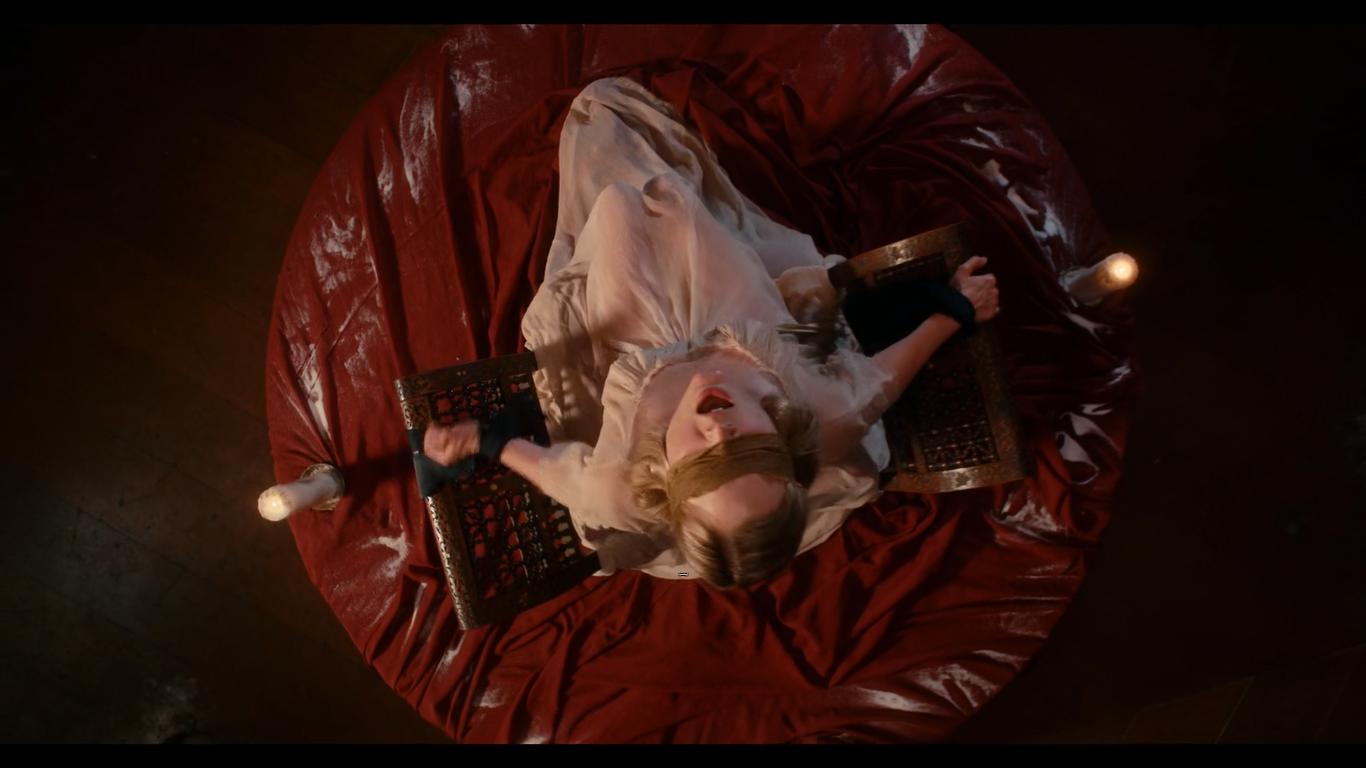
In the television series Strange Angel, a California rocket engineer named Jack Parsons becomes involved with a religious community that treats sexual experience as a source of spiritual power. Parsons was a real person, one of the pioneers of American rocketry, and the community was Agape Lodge, a local body of the Ordo Templi Orientis, or O.T.O. Its members practiced forms of ritual magic associated with Aleister Crowley and Thelema, the religion he developed around the discovery of an individual’s deepest purpose, called True Will. Their sexual “workings” were experiments in which desire, bodily intensity, and concentrated intention were supposed to produce effects beyond the immediate encounter. The series gives this world a particularly revealing dramatic expression. An initiate is photographed and questioned about intimate ritual experiences, and the fictional teacher Alfred Miller places the photographic evidence against the participant’s own account. Hearing that the workings have produced frustration, he replies that “the camera tells a different story.” The person who underwent the experience has described it; the man examining the photograph claims access to something more authoritative. A sexual encounter has become a spiritual exercise, the exercise has produced a record, and another person has acquired the power to interpret that record. These scenes are dramatic inventions, but the combination feels recognizable because each element has a substantial history. Understanding how they came together requires following the religious and sexual culture Parsons inherited, along with the growing collection of methods for making private experience available to examination.

Parsons’s lodge belonged to a California world that had been receiving religious experimenters, communal reformers, healers, and occult teachers for decades. Much of that experimentation grew from nineteenth-century arguments about the organization of ordinary life. Abolitionists challenged the ownership of human beings, women’s rights advocates disputed husbands’ authority, and utopian communities attempted to rearrange labor, property, child-rearing, and marriage. Sexuality ran through these arguments because a marriage joined affection to legal power, economic dependence, reproduction, and religious obligation. Reformers asking how people might become free repeatedly encountered the same practical difficulty: a person’s most intimate relationship could also be the institution exercising the greatest authority over them. Free love developed within that larger struggle. Its advocates proposed that mutual affection and continuing consent should determine the legitimacy of an intimate relationship. Some envisaged lasting partnerships, others accepted successive relationships as affections changed, and communal experiments attempted broader arrangements. Communities inspired by the French social theorist Charles Fourier explored the organization of society around human passions; at Oneida, founded in New York in 1848, “complex marriage” placed sexual relationships within a communal religious family. Across these differences, the authority of the marriage ceremony became a subject of dispute. A union could remain legally valid after the affection sustaining it had disappeared. Some reformers consequently described loveless marriage itself as adulterous. For women, these arguments concerned the ability to leave an unwanted relationship, refuse intercourse, and determine the conditions under which they would bear children. They also raised a difficult question within the reform movements: whose judgment established that a particular attachment was spiritually or morally true?
Universalism provided one of the religious environments in which such questions could develop. Its central Christian teaching held that a loving God would ultimately save every soul. Believers disagreed about the process of salvation and the suffering or correction it might involve, but universal redemption gave some ministers a reason to reconsider institutions organized around punishment, exclusion, and inherited subordination. Prison reform, abolition, women’s religious participation, and communal experiments attracted people from these congregations. The denomination contained substantial disagreements over such commitments, and some of its more adventurous ministers carried their preaching, reform work, and belief in human spiritual development into new associations. Universalism thus supplied people and habits of thought to a wider religious culture in which further revelation remained possible.

Mesmerism offered a bodily explanation for extraordinary experience. Named after the physician Franz Anton Mesmer, it proposed an invisible force, animal magnetism, operating through living bodies and susceptible to manipulation for healing. A person placed in a magnetic trance might appear to acquire unusual perception under another person’s guidance. Spiritualism brought these possibilities into a popular religious movement, spreading rapidly in America after 1848. Séances and trance lectures presented communication with the dead as an event that could happen in a domestic room, before witnesses, through a living medium. Women acquired public platforms as speakers whose authority came from spirits. The resulting messages could address the institutions governing life on earth, including marriage. A deceased teacher might recommend reform; a medium might disclose a spiritual affinity; a community might reorganize itself around instructions received in trance. Revelation acquired immediate social consequences.
John Murray Spear moved through these overlapping settings. He had served as a Universalist minister and worked as an abolitionist before beginning to deliver spirit messages in the early 1850s. He published communications attributed to the Universalist preacher John Murray and claimed direction from a congress of distinguished dead people whose plans encompassed social regeneration, healing, and technological invention.

Spear established spiritual associations and secret societies through which this instruction could be organized. By 1857, his program included sexual relationships governed by mutual love, access to birth control, and a woman’s right to refuse intercourse within marriage. The claims passed from a medium’s private experience into transcribed messages and organized instruction. Thomas Lake Harris followed another route from Universalist ministry through mesmerism and Spiritualism into communal religion, eventually establishing Fountaingrove in California. His teachings about “internal respiration,” divine masculine and feminine powers, and heavenly counterparts placed intimate relationships within a comprehensive spiritual system. Both men connected the prospect of a transformed society to guidance about the body, and both created settings in which an individual’s experience could be explained through a teacher’s account of a larger spiritual order.
For their followers, the possibility of revelation also created a demand for recognizable evidence. A voice, a bodily response, a successful healing, or a message containing private information could serve as confirmation. Spiritualism developed a practical culture of demonstrations and tests, conducted through networks of lecture halls, churches, private sittings, and camps. Indiana became an important setting for that activity. The association founded in 1886 that developed Camp Chesterfield helped give Spiritualism a durable regional home. Mesmerism, trance speaking, magnetic healing, and phrenology, which claimed to read character through the shape of the skull, circulated through the wider lecture culture. These practices trained audiences to expect that a specialist could detect something about a person that ordinary acquaintance had missed. Spirit photography made such a claim portable. In the early 1860s, William Mumler began producing portraits containing faint additional figures beside the living sitter. A grieving customer might recognize one as a dead relative. The sitting joined a person’s memories and longings to an operator’s equipment and procedures, producing an object that seemed to hold evidence of an invisible relationship. The print could be carried home, shown to friends, or examined by someone who had never attended the sitting. Its interpretation remained dependent on the identities assigned to the figures and on confidence in the operator. Mumler’s work provoked disputes when a supposed spirit was recognized as a living Boston resident, and he later faced charges of fraud. The photograph had nevertheless established a powerful form of encounter: private experience entered a room, passed through a specialist’s apparatus, and emerged as a visible object with a claim upon belief.

Paschal Beverly Randolph approached this world as a medium, healer, lecturer, and increasingly ambitious teacher of occult practice. Born in New York in 1825 to a Black mother and a white father, he worked within the same culture of religious experiment and social reform while also participating in Black emancipation and education. He cultivated a Rosicrucian identity, placing himself within a Western tradition of secret learned brotherhoods, and developed a system in which the practitioner’s own will and bodily capacities became instruments of spiritual action. Sexuality occupied its center because, in his account, the force capable of generating a human life also possessed wider powers of transformation.
Randolph taught that loving sexual union, deliberately prepared and guided by concentrated intention, could bring two people into an exceptionally potent state. At the moment of mutual orgasm, he believed, a sustained purpose could act with unusual force. His claimed applications included restored vitality, strengthened affection, spiritual development, clairvoyance, the achievement of worldly aims, and influence over conception and the qualities of offspring. The participants needed to attend to their physical condition, emotional relationship, and purpose. Much of his practical writing addressed couples and the difficulties of their shared life. A woman’s pleasure and active participation mattered to the operation itself. The sexual encounter became something that could be prepared, cultivated, and evaluated according to a body of specialized knowledge. The vocabulary makes more sense within the nineteenth century’s overlapping worlds of medicine and occult investigation. Animal magnetism, electricity, nervous force, vital energy, and mental influence offered explanations of how bodily and spiritual states might affect one another. Randolph’s Affectional Alchemy, developed in his 1874 book Eulis!, placed love, health, generation, and reciprocal magnetism within one account. A troubled marriage might be interpreted through incompatible conditions or a failure of mutuality; a successful union could replenish the partners and improve their capacity for other forms of action. Sexual magic assumed the character of experimental medicine, with preparation, controlled circumstances, an operation, and an anticipated result. The teacher possessed the explanation that allowed the partners to read what their bodies were doing.
Randolph gave this system an international ancestry. In accounts of his travels, he described an encounter with an Arab woman as a revelation of the spiritual significance of love and claimed further instruction among dervishes and other Eastern adepts. He attached the name Ansaireh, used for the Nusayri religious community of Syria, to his Ansairetic Mystery. The details of those claimed initiations remain uncertain; his writings combine personal narratives with the era’s literature about Eastern mysteries. They also bring together sexual instruction, hashish, clairvoyance, and magic mirrors. His presentation invited an American reader to see a disputed teaching about the intimate body as an inheritance from a much older religious world.

Older traditions supplied recognizable forms for that claim. In Indian Tantric traditions, initiation, sacred speech, visualization, and bodily disciplines could make the practitioner’s own body a means of encountering divine reality. Within traditions devoted to the deities Shiva and Shakti, consciousness and creative power were expressed through a divine sexual polarity. The linga and yoni, associated with the male generative organ and the female womb or vulva, represented that relationship in devotional form. Particular practices of maithuna, ritual sexual union, gave bodily intimacy a transformative purpose within a larger discipline. A teacher and an inherited account of the body established how the experience should be approached and understood. Sacred-marriage traditions also joined erotic union to the ordering of the world. Sumerian hymns about Inanna and Dumuzi connected their embrace to fertility, agricultural abundance, and kingship. Early Christian material offered another language of restorative union. The Gospel of Philip, associated with Gnostic traditions of salvation through spiritual knowledge, described a bridal chamber and connected the division of male and female with death. Reunion expressed a return to wholeness. The ritual meaning of its bridal chamber remains debated, but the text gave later readers a Christian vocabulary in which marriage, spiritual generation, and salvation belonged together. Occult writers could find religious precedents for treating bodily union as an encounter with a larger reality.

Persian and Ottoman cultures contained further traditions in which erotic experience and spiritual interpretation overlapped. Sufi love language allowed the human beloved, intoxication, longing, and surrender to carry divine meanings. Ibn Arabi, the medieval Islamic mystic born in Muslim Spain, developed an explicitly sexual account in his Bezels of Wisdom: contemplation of God in a woman could encompass the divine as both active and receptive, while sexual union expressed an exceptionally complete bodily joining. Women could also exercise authority as spiritual teachers; Ibn Arabi described studying with Fatima of Cordoba. These traditions made room for the woman as beloved, manifestation of divine beauty, and guide to the experience’s meaning.
Intoxication belonged to some religious practices in this wider world. Accounts of Qalandars and related wandering dervish groups record cannabis use, while sixteenth-century descriptions of the Abdals of Anatolia include hashish carried in pouches and consumed in settings involving food and music. Persian sources describe dugh-e vahdat, a hashish drink called the “beverage of unity,” used by certain mystics during their rites. Such accounts supplied examples of bodily alteration interpreted through religious instruction. Drugs, music, discipline, and the expectations supplied by a community could shape an experience subsequently described as access to another order of reality.

European readers also inherited the much more theatrical stories about the people they called the Assassins, widely known through the name Hashshashin. The historical communities were Nizari Ismailis, a branch of Shi‘i Islam with medieval strongholds in Persia and Syria, whose struggle against stronger adversaries included targeted killings by devoted agents. Hostile reporting and travel literature developed an explanation of their obedience around drugs, women, and a concealed paradise. In Marco Polo’s account, young men were carried unconscious into a garden furnished with luxurious buildings, drink, music, and beautiful women. After enjoying its pleasures, they were removed while drugged and told that service to their master would secure their return. The master controlled the experience and the account of what had happened to them. Sensation became revelation through an explanation supplied by the person who had arranged it. The garden story belongs to the history of the Assassin legends, traced by the historian Farhad Daftary through medieval polemic and European reporting. It gave subsequent readers an enduring model of secret initiation: a closed environment, an extraordinary bodily experience, women assigned roles within it, and a superior who converted the initiate’s desire into a commitment. Randolph’s claimed Syrian teachers belonged to the Nusayri setting, while the Assassin legends concerned the Nizari Ismailis. Both appeared within the much broader literature through which Western readers imagined hidden Eastern religious knowledge. Eulis! itself reproduces accounts of Eastern mirror-gazing and refers to travel writing and a history of the Assassins. Books and their circulation provide a tangible route by which such material entered the American occult world.

Randolph turned the promise of privileged knowledge into a distinctive publishing practice. The Ansairetic Mystery described itself as a private letter, printed but unpublished, sacred and confidential. His public works pointed readers toward further instruction available through restricted texts and correspondence. The intimate operation and its explanation belonged together: a couple could acquire a document telling them how to prepare, direct their attention, and understand an experience otherwise unavailable to public discussion. Secrecy gave the text a special status, while the text made a bodily practice reproducible beyond the teacher’s immediate presence.
Conception gave this instruction another consequence. Randolph believed the condition of the parents could affect the person coming into existence, placing generation within a larger project of human improvement. Older dynastic societies had already organized reproduction and upbringing around the formation of exceptional people. Ancient Persian royal households joined descent, legitimacy, property, succession, and education; royal women could possess estates and exercise influence, while a prince developed among attendants and teachers charged with preparing him for rule. The comparison extends to an oracle whose words reach a community through interpreters, or a sacred ruler whose public role is carefully supervised. The recurring structural possibility was an individual whose special status emerged within a managed environment. Randolph offered private couples their own account of how intimate conditions might help shape a future person.
His teachings acquired a further life through organizations that made restricted instruction their ordinary method. The Hermetic Brotherhood of Luxor, whose outer circle became active in the 1880s, incorporated selections from Randolph’s writings into a correspondence curriculum of practical occultism. Private letters, prescribed exercises, and recognition by a teaching authority gave sexual and spiritual development an institutional form. European occultists also worked within Masonic and Rosicrucian traditions of graduated admission. The eighteenth-century Rite of Strict Observance had constructed an identity modeled on the medieval Knights Templar, a Christian military order, through ranks, obligations, and claims about unknown superiors. Such systems supplied a way to make a person into an initiate through controlled stages of knowledge. Sexual teachings could be located within those stages, becoming something a member was deemed ready to receive. Around the turn of the twentieth century, Theodor Reuss and Karl Kellner developed the project that became O.T.O. within this European world of Masonic systems, Hermetic teachings, and interpretations of Asian religious practice. Its founding narratives invoked Eastern adepts as sources of higher knowledge. Crowley took charge of the British section in 1912 and increasingly aligned the organization with Thelema. Sexual magic now operated within his account of True Will and the practitioner’s progress toward discovering and fulfilling it. The result carried a long nineteenth-century history into a new religious framework. Agape Lodge brought that work into a local California organization during the 1930s, first in Los Angeles and subsequently in Pasadena. Parsons entered a community with rituals, teachers, obligations, correspondence, and a place within an international order.

His 1946 Babalon Working sought contact with Babalon, a divine feminine figure in Thelemic cosmology. Marjorie Cameron, a Navy veteran and artist who entered his life during that period, became central to his interpretation of the working. Parsons identified her with the Scarlet Woman, a human partner through whom he believed that divine power could manifest. Cameron developed her own artistic and spiritual life, carrying elements of that world into painting, poetry, and film after his death in 1952. The religious identity assigned to her, her understanding of it, and the work she subsequently made belonged to a lived relationship with consequences extending beyond the ritual that helped define it. The California setting introduced in Strange Angel had accumulated teachings about bodily power, methods of initiation, and practices for interpreting a person’s intimate experience.
Written records were part of those practices. For students of his teaching order, generally known as A.A., Crowley prescribed detailed accounts of exercises and experiments, including physical and mental conditions, circumstances, results, and failures. His instructional text Liber E treated the record as essential to evaluating the work. A practitioner had to become an observer of his own spiritual development and produce an account that another person could read. Dates and circumstances gave extraordinary experiences an ordinary documentary form. The record could preserve a revelation, expose a repeated error, or become the basis on which someone else judged progress. Long before a camera appeared in a television dramatization of Agape Lodge, the examined self had become a written object within Crowley’s teaching. That relationship also had familiar religious and medical forms. A Christian confessor heard private conduct and desire within a system that gave the listener authority to identify their moral significance and prescribe a response. Personal testimony could establish a conversion or sustain a religious claim. In medicine, an intimate account entered a case history through the physician’s questions and classifications. The movement from experience to record depended on an encounter in which one person disclosed something and another possessed a recognized way to read it. Photography added the possibility that the body could appear to speak independently of the account its owner gave.

At the Salpêtrière hospital in nineteenth-century Paris, Jean-Martin Charcot’s study of hysteria, then a broad diagnosis for disturbances of movement, sensation, and mental state, brought clinical observation, public demonstration, and photography together. A patient could be represented through a sequence of poses and symptoms, reproduced in a publication, and recognized by physicians elsewhere as an example of a condition. The institution supplied the circumstances of the image and the language accompanying it. A future reader could encounter the patient principally through that combination. An expression or bodily posture might become evidence of a diagnosis, much as another photograph could become evidence of a spirit presence or a supposed state of spiritual development. Each required the observer to trust a particular way of translating a visible sign into hidden knowledge.
Sexual material was simultaneously acquiring another class of specialized readers. Victorian collectors assembled libraries of erotic books, private printings, suppressed works, and images circulating outside ordinary public commerce. Henry Spencer Ashbee, a businessman who published bibliographies as Pisanus Fraxi, made knowledge of this literature into a learned undertaking. The work required identifying pseudonyms, distinguishing editions, recognizing the same text beneath different titles, and knowing where a scarce copy might be obtained. Such expertise gave the collector or dealer a position within a network that ordinary readers could barely see. Possession mattered, and so did knowing who possessed what. The British Museum’s Private Case and the French Bibliothèque nationale’s Enfer, French for hell, gave restricted literature an institutional address. Purchases, donations, and seizures helped fill collections whose contents were preserved under conditions limiting access. An official might seize a book; a librarian might catalogue it; a qualified scholar might receive permission to consult it. The same object moved through different systems of judgment, carrying consequences that depended on its custodian and intended audience. Censorship could therefore help create the archive of the censored. A society publicly condemning certain images and descriptions also developed positions in which a person could become an expert on them. The forbidden collection required someone who knew its contents, kept its catalogue, and controlled the door.

Alfred Kinsey brought intimate disclosure and the restricted collection into a single research institution. A zoologist at Indiana University, he began gathering sexual histories in 1938; the Institute for Sex Research was established there in 1947. Interviewers used a large memorized schedule and coded the information they collected, encouraging people to describe experiences they might conceal from relatives, clergy, employers, or the law. The studies of men published in 1948 and women in 1953 brought the resulting material into public arguments about sexual norms. A private history became part of a body of evidence intended to reveal patterns across many lives. The interviewer’s questions, the recruitment of subjects, and the coding system helped determine what the record could subsequently show. Kinsey’s encounter with the subject had a recognizable confessional shape. A person sat before someone with specialized authority and disclosed intimate conduct. The authority promised a setting in which the disclosure could be understood, and the account acquired a form suited to that purpose. Kinsey’s categories organized behavior for comparison and analysis. Confidentiality made this possible while concentrating custody of the histories within the research project. Information a person might never have placed in public could now contribute to a published account of humanity. The passage from individual memory to anonymous data changed the uses to which the disclosure could be put.
The institute also assembled books, photographs, artworks, and films as evidence of sexual life and imagination. Stag films, short erotic movies commonly shown at private gatherings, belonged to an existing world of restricted circulation. Scarce books and private images required access to collectors and dealers whose expertise had developed outside the university. Gershon Legman, a writer and bibliographer with extensive knowledge of erotic literature and sexual folklore, helped Kinsey locate material and develop the library. The work involved knowing editions, private printings, overseas suppliers, and the people through whom difficult material could be found. The forbidden library had become a laboratory, staffed partly through knowledge accumulated by people familiar with the forbidden library’s previous life. That change of setting could acquire legal importance. A shipment of thirty-one photographs sent by the Copenhagen bookseller Philobiblon in 1951 became the subject of United States v. 31 Photographs. In 1957, the court allowed their admission for the institute’s restricted scientific use, giving weight to the circumstances of access and the audience consulting them. Their destination and purpose helped establish how the images would be treated. Material implicated in an obscenity proceeding became legitimate research evidence through the institution’s claim to possess and study it. Kinsey’s project gave an academic organization the standing to collect a class of objects around which police, customs officers, dealers, and private collectors had already built their own systems of custody.
His conception of research could accommodate the occult world as well. The 1948 male volume listed “materials on sex cults” among possible sources for sexual investigation. A magical community’s pictures, teachings, and records could enter the same expanding collection as medical literature, erotic fiction, and privately circulated films. The person who supplied a route into that world was Kenneth Anger, an experimental filmmaker whose work joined sexual imagination to an increasingly explicit interest in Crowley. Anger’s Fireworks, released in 1947, organized a young man’s encounter with sailors, desire, and violence through dream imagery. Kinsey acquired the film and interviewed its maker; Anger also contributed material and knowledge to the research project. For a sex researcher, a fantasy film could preserve evidence of sexual imagination and its forms of expression. For Anger, cinema provided a means of arranging desire and giving it a force that ordinary description could scarcely reproduce. The same filmmaker could supply an object for the archive and use moving images to seek an experience in the viewer.

He also knew Cameron and cast her in Inauguration of the Pleasure Dome, completed in 1954. She embodied figures including the Scarlet Woman and the Hindu goddess Kali within a film of costumes, saturated colors, ceremonial gestures, and superimposed images. A woman who had occupied a central place in Parsons’s magical life became a performer in Anger’s cinematic treatment of occult identities. The relationships were direct: Parsons and Cameron, Cameron and Anger, Anger and Kinsey. Ritual practice, artistic expression, and the research collection now shared people and material. Cameron’s art made the passage between those settings especially tangible. A drawing associated with her first peyote experience was reproduced in Semina, the journal of the Los Angeles artist Wallace Berman. In 1957, police cited the drawing as lewd when shutting down Berman’s exhibition at Ferus Gallery. The image had begun in a private altered experience, acquired a place in an artistic network, and become an object in an obscenity dispute. Its meanings and consequences changed as it passed from the artist to the publisher, the gallery, and the police.

In 1955, Kinsey joined Anger at Crowley’s former Abbey of Thelema in Cefalù, Sicily. Crowley had established the Abbey in 1920 as a communal setting for his religious and magical life. Anger worked to uncover surviving wall paintings beneath later whitewash, including erotic images in Crowley’s former rooms. The visit placed the sex researcher and the occult filmmaker before physical remains of a community in which sexual experimentation, spiritual instruction, and personal records had already coexisted. For Kinsey, the paintings could enter an investigation of sexual behavior and representation. For Anger, recovering them also brought the imagery of a religious tradition he valued back into view. A concealed image could become evidence and a source of renewed artistic power through the same act of preservation.

Anger’s films developed that second possibility through the practical resources of cinema. Editing could make two images act upon one another; repetition could establish a rhythm; music could attach desire or menace to an otherwise ordinary gesture. Scorpio Rising, completed in 1963, assembled motorcycle culture and male self-presentation alongside popular songs, Christian imagery, and Nazi symbols. Clothing, machines, poses, and emblems became materials through which identity was constructed and desire directed. The viewer experienced the relationships created by the sequence, often before having time to settle them into a verbal explanation. Anger’s interest in magic had a working instrument in cinema’s ability to organize perception and association. His book Hollywood Babylon, first published in 1959, used another feature of the forbidden image: its apparent promise of access to a concealed life. Photographs accompanied celebrity scandals whose reliability varied widely, giving the assembled legends a documentary surface. A reader could feel admitted to knowledge kept behind the polished image of the film industry. The author occupied the position of someone who knew where the pictures were and what stories belonged to them. Celebrity gossip, crime, erotic curiosity, and the collector’s prestige became parts of the same publication. The existence of the image helped make the surrounding narrative feel like disclosure.
Underground cinema and the expanding pornography markets of the 1960s and 1970s supplied further settings in which access itself became an attraction. Private screenings, seized materials, collectors’ libraries, and specialized research archives gave real examples of images that circulated through particular people and institutions. Those conditions help explain the imaginative appeal of a collection located beyond all the collections already encountered. An audience accustomed to the promise of suppression could be offered a still more exclusive object, one whose importance seemed guaranteed by the difficulty of seeing it. The snuff-film legend gave that expectation its most extreme form: a person murdered for the production of a film intended for viewers. The imagined object crossed the boundary between a represented act and an act committed to make the representation. Its owner would possess evidence of a killing and admission to the experience of watching it. The 1976 release Snuff exploited this expectation by repackaging an earlier horror film with a fabricated ending presented as a killing during the making of the movie. Marketing and controversy invited audiences to treat the apparent collapse of performance into recorded murder as the essential attraction. The image’s disputed status became part of what was being sold. The forbidden archive had acquired a mythical final item, a film whose authenticity would establish the ultimate corruption of its production and possession.

David Cronenberg’s Videodrome, released in 1983, gives the pursuit of that object a bodily consequence. Max Renn, a television programmer searching for extreme material, encounters a transmission of sexualized violence whose source and status remain uncertain. He approaches it as an acquisition, something he might obtain and show. Viewing it changes his perceptions and, within the film’s world, transforms his body. Access to the hidden program places the viewer inside a process he understands only gradually. A recording sought as an object of possession becomes an instrument acting upon the person who watches. The film also gives authority a recorded existence. Professor Brian O’Blivion survives his death through a collection of videotaped statements maintained by his daughter. His image continues speaking, teaching, and directing action, allowing the record to perform the work of a living presence. Videodrome joins the preserved teacher to the transformed viewer: one exists through an archive, while the other is being altered through images. The earlier promise that a camera might disclose an invisible reality has become a fictional world in which recorded images help produce reality itself.
At the photographic examination in Strange Angel, Miller can appeal to all those expectations at once. The initiate has entered a setting in which an intimate act is supposed to carry spiritual knowledge, a teacher is equipped to recognize it, and a record can expose something that the participant’s own account has missed. The camera provides an apparently independent witness, while the teacher retains the authority to say what its testimony means. A fragment of an encounter becomes material for a judgment about the person.
A record gives an encounter a future. It can preserve a voice that would otherwise disappear, carry an experience beyond the person who lived it, and expose conduct that someone wished to conceal. It also gives its custodians something they can classify, interpret, circulate, or withhold. The person represented may continue to understand the event in one way while the teacher, clinician, archivist, or viewer understands it in another. The recurring mystery lies in that transfer of authority: how an intimate life becomes a record, and how the record comes to speak with a force of its own.