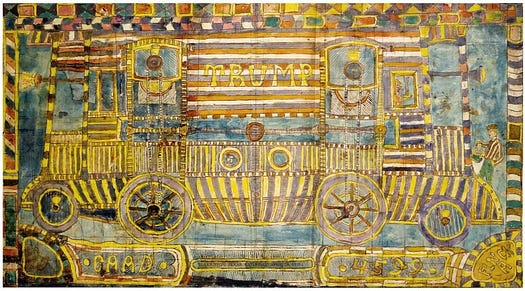
In April 1920, Charles August Albert Dellschau was nearly ninety years old and still filling enormous handmade books with flying machines. His pages were crowded with oval airships, mechanical devices, handwritten notes, decorative borders, newspaper clippings, names, symbols, and fragments of an elaborate private history that reached back toward Gold Rush California. Dellschau called the machines “Aeros,” and by the end of his life he had created one of the strangest bodies of aeronautical imagery to survive from the period.
Then a name appears that is almost impossible for a modern reader to encounter without stopping.

The later catalog record associates a small group of Dellschau pages dated April 9 and 10, 1920 with the words TRUMP and HOMER. Christie’s later cataloged one double-sided work as Aero Trump Below, April 9, 1920 / Homer Trump, April 10, 1920. A major 2013 Dellschau monograph reproduces Aero Trump Below as plate 4589, while a description of an earlier catalog identifies three related Aero Trump plates and reports that plate 4590 carries TRUMP in capitals and HOMER at the lower left. Those descriptions are close enough to establish a genuine Trump/Homer problem in the published record, but different enough that the original sequence still deserves high-resolution examination before every transcription and plate assignment is treated as settled.
That uncertainty is not a reason to ignore the story. It is the reason the story is worth investigating.
A century later, the word Trump arrives carrying meanings Dellschau could not have known. Modern readers bring politics, celebrity, internet numerology, time-travel theories, family genealogies, and an entire culture of retrospective coincidence to a page made in Houston in 1920. The first task is therefore to strip all of that away and ask a much more basic question: what did the word mean inside Dellschau’s world?
The answer begins with the man himself.
Dellschau was born in Brandenburg, Prussia, in 1830 and can be placed in Texas by 1860. His documented life was far more ordinary than the world inside his notebooks. He worked around saddlery and the practical material culture of transportation: harness, leather, straps, wagons, fittings, repair, and the everyday mechanics of keeping people and goods moving. By the time he began the surviving phase of his great notebook project around the turn of the twentieth century, he had lived through one of the most radical technological transformations in human history. Railroads had crossed the continent, telegraph lines had compressed distance, electricity had entered cities, balloons had become public spectacle, and engineers were beginning to treat powered flight as an increasingly serious technical problem.

Dellschau’s books looked backward as much as they looked forward. Inside them he described a circle of aeronauts associated with California during the 1850s, a group later interpreters came to call the Sonora Aero Club. The notebooks contain named men, named machines, arguments, accidents, technical language, secrecy, money problems, and repeated references to an internal world that feels unusually specific for pure fantasy. Yet no independent corporate or club record has established the organization as Dellschau presented it. Researchers have looked outside the notebooks for the Sonora group and have not found the ordinary documentary trail that would turn the internal story into confirmed public history.
That leaves Dellschau in an uncomfortable historical position. He may have been preserving distorted memories. He may have been creating an elaborate mythology. He may have mixed genuine names, technical reading, newspaper stories, grief, private jokes, and fiction into something that felt to him like recollection. The important point is that the books are detailed enough to be tested, and every test forces the reader to distinguish what is physically on the page from what later interpreters have built around it.
That problem became even more complicated after Dellschau died. His books did not enter a clean institutional archive with their original order perfectly preserved. Pages were separated, volumes passed through different owners, individual leaves entered the art market, and later researchers had to reconstruct parts of the internal sequence. Pete Navarro spent decades indexing the surviving corpus and became one of the central figures in its second life, but that very work also gave later readers another interpretive layer between themselves and Dellschau. A physical page became a photograph, the photograph became a plate in a book, the plate became a catalog title, and the title eventually became a sentence repeated online.
That chain of custody matters enormously when the sentence being repeated contains the words Homer Trump.
Dellschau habitually gave names to his Aeros. Mary, Jourdan, Goeit, Gander, Axel, Trump, and others appear inside a much larger naming system. A name might indicate a craft, a person, a joke, a direction of view, an episode, or some private association whose key has disappeared. The important fact is that Aero Trump does not arrive as an isolated modern prophecy pasted into an otherwise unrelated book. It appears inside a long-established Dellschau habit of naming machines and arranging words around them.
That cools the modern interpretation, but it does not make the name uninteresting. In fact, it opens a much better historical question.
Dellschau physically cut printed material out of newspapers and incorporated it into his books. These fragments, often called “Press Blooms,” prove that public print crossed directly into his private machine-world. A name could enter the notebooks because Dellschau saw it in a newspaper, advertisement, trade catalog, patent notice, exhibition report, or machinery article. He did not necessarily need to know anyone named Trump. He only needed to encounter the word.
Once the problem is framed that way, the nineteenth-century record produces a remarkable candidate.
Long before the Trump surname acquired its present cultural charge, Trump was already an American machinery name.

The Trump Brothers Machine Company of Wilmington, Delaware, grew from a business associated with Charles Newbold Trump and Samuel N. Trump. The Smithsonian preserves part of a Fleetwood scroll saw made by the company around 1876, and the firm’s products belonged to a broad nineteenth-century culture of home workshops, fretwork, pattern cutting, model making, and small mechanical production. Its machines and name circulated through catalogs and advertising rather than remaining confined to Delaware.
The company also appeared in international exposition records. An official American catalog for the Paris Universal Exposition of 1878 listed Trump Brothers with foot-powered scroll saws and examples of their work. By 1889 the Trump Brothers Machine Company was represented with scroll saws, grinders, and chucks, and the industrial name continued circulating into the twentieth century. Whatever the word Trump meant to Dellschau in 1920, it had already spent decades moving through exactly the kind of printed industrial channels that could carry a manufacturer’s name far beyond the factory that produced the machines.
The patent record makes the coincidence even stranger. On December 12, 1876, a United States patent for a scroll-sawing machine was issued to Charles N. Trump, Samuel N. Trump, and a third inventor named Christian Frederick, all of Wilmington. Three years later, Samuel Trump and Christian Frederick patented an improved padlock and assigned it to the Trump Brothers Machine Company. That lock was described for use on freight-car doors, mail bags, crates, trunks, and other goods moving through transportation systems.

None of this proves Dellschau copied the word Trump from Trump Brothers. No surviving Press Bloom has yet been identified that contains one of the company’s advertisements, no correspondence links Dellschau to Charles or Samuel Trump, and no inventory places a Trump Brothers machine in his household. What the machinery evidence does establish is much more useful: Trump was not an impossible or anachronistic word in Dellschau’s technical environment. It was already attached to machines, patents, exhibitions, transportation hardware, advertisements, and trade literature during his lifetime.
Then there is the other word: Homer.
One Indiana lead points toward a man identified in the working research as Cortez Homer Trump of Whitley County, born in 1895 and therefore alive when Dellschau created the April 1920 pages. The match is striking because it puts Homer and Trump together in the right generation and in a state that becomes increasingly important to the larger airship story. The accessible cemetery record independently confirms a Cortez H. Trump, born in 1895 and dead in 1964, but the current evidence does not yet provide the obituary, occupation, travel history, machinery connection, Houston connection, or printed transmission route needed to identify him as Dellschau’s Homer Trump.
That distinction is essential. A matching name creates a lead, not an identity. Indiana also provides another Trump-related print environment. A Van Trump newspaper family was active in Rochester, Indiana, and by 1918 Harold Van Trump was listed as editor and publisher of the Fulton County Sun. The family’s work placed the name Van Trump directly into newspapers, commercial printing, mastheads, political writing, and regional circulation during the same broad period in which Dellschau was producing his late books. Again, there is no demonstrated route from those Indiana newspapers to Dellschau’s Houston household. The importance of the evidence is that it establishes a wider American field in which Trump and Van Trump were already printed names long before modern readers attached twenty-first-century meaning to them.
At that point, the investigation becomes more interesting than the prophecy theory.
The useful question is no longer, “How could Dellschau have known the future?” It becomes, “What might Dellschau have seen before April 1920?”
The dates themselves make that question unusually practical. April 9 and 10, 1920 are not mystical coordinates. They are a search window. Houston newspapers, national wire reports, machinery journals, advertisements, patent notices, mail-order catalogs, and whatever printed fragments survive around those dates can be searched for Trump, Homer, Aero, dirigible, machinery, and related language. A dated private artifact turns a vague coincidence into a finite transmission problem.
The larger airship context makes the problem even stranger. Dellschau was not creating flying machines in a world that had never seriously contemplated them. By the final decades of the nineteenth century, powered and steerable airships were already an engineering field. Companies formed around aerial navigation. Investors put money into experimental craft. Patent agents handled aviation ideas. Newspapers reported secret inventors, spectacular claims, crashes, sightings, and supposed breakthroughs. The period between the first practical dirigible experiments and the Wright brothers was full of machines that failed, vanished, remained unfinished, or survived only as drawings and paperwork.
Indiana preserves one especially important example.
In April 1892, more than a decade before Kitty Hawk, the surviving record begins to preserve the Brightwood Aerial Navigation Company in Indianapolis. The original articles of incorporation still need to be pulled before every corporate detail can be hardened, and the company’s surviving paper trail does not prove successful flight. What it does establish is that aerial navigation had crossed into the corporate and industrial imagination of Indianapolis before the airplane became an ordinary historical fact.
Then, in June 1893, the record changes. Patent solicitors Thurman & Winn sued the Aerial Navigation Company for labor and material furnished in the construction of an airship. The notice used a phrase that has become one of the central clues in the Brightwood story: the machine was described as being made “after the Brightwood pattern.” The claim suggests that some quantity of physical construction, model work, prototype work, or material preparation had taken place, even though the exact meaning of “pattern” remains unresolved and successful flight is unproven.

That is where the Dellschau problem stops looking like an isolated piece of visionary art and begins to sit inside a much larger nineteenth-century world.
Real men were organizing real aerial-navigation companies. Real machine firms were circulating technical products and names through catalogs and expositions. Real patent solicitors were dealing with airship-related labor and materials. Newspapers were carrying reports of mysterious aircraft years before the Wright brothers. At the same time, Dellschau eventually assembled a private archive in which named Aeros, technical claims, newspaper fragments, and remembered or imagined aeronauts lived together on the page.
There is no evidence that Brightwood and Dellschau were directly connected. There is no evidence that Trump Brothers supplied Dellschau with the name Aero Trump. There is no proof that Cortez Homer Trump was the Homer represented in the 1920 sequence. There is no demonstrated genealogy that turns the artifact into a prediction about a later famous family.
The real historical mystery is the network of ordinary transmission that existed before any of those modern interpretations were possible.
Names traveled through print. Machines traveled through catalogs. patents stabilized identities. Newspapers transformed experiments into legends. Failed companies left lawsuits. Private notebooks preserved names after the objects they described had disappeared. Decades later, museums, dealers, catalogers, and researchers rearranged those surviving fragments into the forms in which we encounter them now.
That is the problem at the center of The Lost History of Brightwood.
The book began with the question of whether anything in Dellschau’s impossible airship world could be found outside Dellschau. The answer was not a secret society waiting intact in some forgotten archive. What emerged instead was a real nineteenth-century environment in which the boundary between invention, speculation, promotion, machinery, fiction, rumor, and corporate failure was much thinner than it appears from the far side of Kitty Hawk.
Homer Trump remains unresolved.
That is exactly why the name matters.
A coincidence becomes historically valuable when it can be tested without being forced into a conclusion. The Dellschau pages give us a date, a name, a machine-world, and a surviving documentary chain. The nineteenth-century record gives us Trump machinery, patents, print circulation, Indiana name matches, real aerial-navigation companies, and a culture obsessed with the possibility that somebody, somewhere, had already learned how to steer a machine through the sky.
The sensational version of the story asks whether Charles Dellschau somehow knew something about the future.
The harder and ultimately stranger question is whether we have forgotten how much of that future already existed around him.
In November 1896, readers of the San Francisco Call began encountering reports of something extraordinary moving through the California sky. Witnesses described mysterious lights, strange shapes, and what some believed to be a mechanical flying machine. Within months, similar stories were appearing across a broad swath of the United States. Some observers reported little more than lights in the darkness, while others described cigar-shaped craft, propellers, engines, searchlights, crews, secret inventors, emergency landings, and machines that seemed to possess capabilities just beyond the acknowledged technology of the day.

From the far side of the twentieth century, the stories resemble early UFO reports. That resemblance is one reason the airship wave is often pushed into paranormal history, where it sits as a strange prelude to Roswell, flying saucers, and the modern mythology of unexplained aircraft. Yet the reports become far more interesting when they are returned to the technological world that produced them. Americans in 1896 were not inventing the concept of an airship from nothing. Engineers had been working on the problem for decades, inventors were seeking patents, promoters were organizing companies, newspapers were reporting aeronautical experiments, and the public already understood that somebody was eventually going to learn how to navigate the sky.
The mystery was therefore more specific than it first appears. Americans did not suddenly decide that impossible machines existed. They began wondering whether someone had solved a problem that everyone knew people were already trying to solve.
Airships Were Real Before the Wright Brothers
The history of flight is so strongly organized around the Wright brothers and December 1903 that everything before Kitty Hawk can seem like a collection of balloons, failed experiments, and eccentric dreamers waiting for the airplane to arrive. People living in the nineteenth century could not see the story that way because they did not know which technology would eventually win. Lighter-than-air craft, gliders, powered balloons, experimental engines, propellers, wings, electric motors, and dozens of combinations of those systems were competing approaches to the same basic problem.
One of the most important breakthroughs had already occurred in France. In 1884, Charles Renard and Arthur Krebs flew the military dirigible La France at Chalais-Meudon. The electrically powered craft demonstrated something crucial: a powered lighter-than-air machine could be controlled sufficiently to travel and return to its point of departure. The surviving period record identifies the August 1884 flights as the first fully controlled free flights of the electric dirigible.

That did not make airship travel practical. The engineering problems remained severe. Batteries were heavy, engines struggled to provide enough power for their weight, lifting gas could leak, structural materials added mass, and even a successful machine could become helpless against unfavorable wind. The importance of La France was that the problem had changed. The question was no longer whether a navigable flying machine belonged exclusively to fantasy. The question was whether engineers could make all of its systems light, powerful, reliable, and controllable enough to operate together.
That distinction helps explain the strange atmosphere of the 1890s. Flight was simultaneously real and unfinished. Newspapers could report genuine experiments on one page and wildly speculative machines on another without the division between them being obvious to a reader at breakfast.
By 1893, Flight Had Become an Organized Technical Field
The World’s Columbian Exposition in Chicago offers one of the clearest markers of how seriously aerial navigation was being taken before the mystery-airship wave. In August 1893, Chicago hosted the International Conference on Aerial Navigation. The published proceedings ran hundreds of pages and dealt with engineering, meteorology, propulsion, apparatus, experimentation, and the physical problems that had to be solved before reliable flight became possible.
Octave Chanute stood near the center of that effort. He was not a novelist constructing imaginary machines or a carnival promoter selling tickets to see a miracle. He was an experienced civil engineer who had spent much of his career around railroads and bridges. By the 1890s he had become one of the major organizers of aeronautical knowledge in the United States, collecting experiments, corresponding with inventors, comparing designs, and trying to turn a scattered field into something engineers could evaluate systematically.
That conference occurred in 1893, three years before the California airship reports began in earnest and ten years before the Wright brothers flew at Kitty Hawk. The public was already hearing that aerial navigation was a legitimate technical problem. Engineers themselves knew commercial success was still difficult, but they also knew that measurable progress was occurring.
This is the environment in which the mystery airship appeared.
Then the Sky Filled With Machines
The California reports of late 1896 gave the phenomenon its first major newspaper life. Once an unexplained light had been described as an airship, later reports inherited a vocabulary. Lights could become searchlights. A dark outline could become a hull. A distant noise could become an engine. Once newspapers introduced the possibility of a secret inventor, another witness hundreds of miles away could interpret what he saw through the same framework.
This does not require every witness to have lied, nor does it require every witness to have seen a genuine aircraft. Newspaper culture and human perception are more complicated than either explanation. A person can sincerely see something ambiguous and interpret it through the technological expectations already available to him. A journalist can then sharpen the description, another newspaper can repeat it, and a third witness can encounter the next strange light already knowing what an “airship” is supposed to look like.
The speed at which the mystery spread is therefore part of the story. The nineteenth-century newspaper system functioned as an enormous information network. Reports crossed cities through exchanges and wire services, were rewritten by local editors, and returned to the public in slightly altered forms. The mysterious craft was moving through print at the same time it was supposedly moving through the sky.
By the spring of 1897, the phenomenon had spread into the Midwest and Texas. Accounts became increasingly elaborate. Some described pilots making repairs after landing in isolated places. Others introduced secret workshops, wealthy financiers, electrical engineers, railroad mechanics, or inventors who promised that the machine would soon be revealed to the world. The imagined operators were usually recognizable nineteenth-century technical men rather than supernatural beings. That detail is easy to overlook, but it is one of the most important clues to why the stories worked.
The secret airship inventor was believable because America was full of inventors.
Aurora, Texas, and the Story That Would Not Die
The most famous story from the entire 1897 wave appeared in the Dallas Morning News on April 19. Correspondent S. E. Haydon described an alleged event in Aurora, Texas, two days earlier. According to the article, an airship had approached the town at low speed, apparently suffering from mechanical trouble, before colliding with Judge Proctor’s windmill and exploding. Haydon then pushed the story beyond the ordinary airship report by claiming that the dead pilot appeared to be from another world.

The story reads uncannily like a prototype of twentieth-century UFO mythology: an unknown aircraft, a crash, wreckage, an unusual metal, a dead pilot, mysterious writing, and a burial. Yet the article belongs firmly to 1897. Its machine is repeatedly called an airship, and its supposed mechanical trouble is presented as if readers already understand that such machines are traveling around the country.
Aurora should not be treated as proof that a technologically advanced craft actually crashed in Texas. The surviving case rests overwhelmingly on Haydon’s newspaper story, and later assessments have often treated it as local fiction or publicity. The historical value of Aurora lies somewhere else. A spectacular false story can still reveal what its audience is prepared to believe. Haydon could write about an airship striking a windmill because the airship had already become culturally legible.
A joke about a machine works only when the audience knows what machine is being joked about.
The Secret Inventor Was Already a Familiar Character
Other Texas stories are useful because they remained closer to the industrial world. One report discussed an alleged aeronaut named Hiram Wilson and connected him with Willard H. Wilson, described as an assistant master mechanic associated with the New York Central Railroad, along with an electrical engineer named C. J. Walsh. The story also claimed that an unnamed uncle had supplied the airship design. Later attempts to connect these newspaper Wilsons directly to Charles Dellschau’s private airship archive do not survive close scrutiny, but the period report itself reveals exactly how an 1897 newspaper imagined hidden technological development: railroad mechanics, electrical engineers, family knowledge, private construction, and an inventor operating beyond public view.
That image was powerful because it sat only one step beyond ordinary reality. Telegraphy, electricity, railroads, telephones, industrial machinery, photography, and increasingly sophisticated engines had transformed daily life within living memory. People had repeatedly watched technologies arrive that would have sounded unbelievable to their grandparents. The possibility that an obscure mechanic had quietly made another breakthrough was therefore sensational without being completely absurd.
The mystery-airship wave flourished in that narrow space between established technology and expected technology. Newspapers could exploit that space, inventors could promote themselves within it, and witnesses could interpret unfamiliar sights through it.
Brightwood Changes the Question
Five years before the great 1897 wave, an aerial-navigation company appeared in the Indianapolis story that would eventually become The Lost History of Brightwood. The surviving record places the Brightwood Aerial Navigation Company in 1892, at a time when the idea of commercial powered flight still appeared extraordinarily ambitious. The original corporate material requires further archival work before every detail can be treated as final, and nothing presently establishes that the Brightwood machine achieved successful flight. What matters is that aerial navigation had crossed from speculation into corporate organization.
Then, on June 24, 1893, the paper trail becomes much more concrete. Patent solicitors Thurman & Winn sued the Aerial Navigation Company for $127 for labor and material furnished in the construction of an airship. The notice described the company as attempting to manufacture airships “after the Brightwood pattern.” The claim does not tell us precisely what the pattern was or how much of the machine had been completed, but it suggests enough physical work to produce a labor-and-material dispute.
The phrase “Brightwood pattern” should not be inflated into evidence for a secret production blueprint. In ordinary industrial usage it could describe a model, plan, frame, template, casting form, recognizable type, or some other reproducible basis for construction.
Its importance is chronological.
Brightwood was leaving an airship paper trail before the great newspaper wave of 1896–97. La France had already demonstrated controllable dirigible flight. Engineers were already meeting in Chicago to discuss aerial navigation. Experimental gliders were being tested. Inventors were seeking money and patents. None of this proves that the mystery craft reported over American towns were real, but it radically changes the cultural setting in which those reports were received.
Americans had good reason to believe that somebody was trying to build the future.
They simply had no reliable way to know who was closest.
While Newspapers Chased Airships, Chanute Was Actually Flying
The contrast becomes especially sharp in 1896. While California newspapers were beginning to fill with mystery-airship reports, Octave Chanute and his collaborators were conducting heavier-than-air glider experiments on the Lake Michigan dunes. Chanute’s work formed part of the experimental foundation that would later matter to the Wright brothers, and the surviving photographs look surprisingly modern compared with the illustrated fantasy machines appearing elsewhere in the same period.

This photograph captures the central contradiction of the airship mystery better than almost anything else. Americans in 1896 were neither secretly operating fleets of twentieth-century aircraft nor waiting helplessly for the Wright brothers to invent flight from nothing. They were experimenting. Some approaches were working a little. Others were failing badly. Some existed mostly on paper. Some attracted investors. Some generated lawsuits. Some became newspaper entertainment. The outcome remained unsettled.
Later history makes technological development appear cleaner than it felt at the time because we remember the machines that worked and forget the thousands that did not. We remember the Wright Flyer because it crossed a threshold that can be clearly defined and documented. We rarely remember the company that failed before its machine survived, the inventor who ran out of capital, the airship whose engine was too heavy, or the design that existed only as a model and a creditor’s bill.
That forgotten population of failed and unfinished machines is where the mystery-airship stories lived.
The Mystery Was a Product of a Real Technological Threshold
The easiest explanation for 1897 is to choose an extreme. Either secret inventors really were crossing America in advanced aircraft, or gullible people and dishonest journalists fabricated the entire phenomenon. The historical record suggests a more complicated environment. Real engineering and fake reporting were occurring at the same time. Serious experiments and spectacular exaggerations shared newspaper pages. Witnesses lived in a culture primed to expect technological breakthroughs, and journalists lived in a market that rewarded dramatic stories about them.
That combination is enough to create a mystery without requiring a single explanation for every report.
Some observers almost certainly misidentified ordinary lights or astronomical objects. Some stories were embellished. Some were probably deliberate inventions. It remains possible that isolated witnesses saw balloons or experimental craft that were never identified. The surviving record is too uneven to collapse hundreds of reports into one answer.
What survives much more clearly is the atmosphere.
By 1897, flight was close enough to reality that an unknown object in the sky could plausibly be interpreted as somebody’s machine. The public understood that engineers were working on the problem, yet no institution could tell them exactly how far every private inventor had progressed. Rumor rushed into that uncertainty.
That may be the real secret of the Great American Airship Mystery.
It happened during the brief historical interval when the future was technically plausible but had not yet acquired an official shape.
Six years later, the Wright brothers would fly at Kitty Hawk. Their success would eventually help organize the story of aviation around wings, engines, controlled powered flight, and a recognizable lineage of development. The strange newspaper sky of 1897 would be pushed toward the margins, where it gradually became part of UFO history, folklore, and unexplained Americana.
Yet the airship stories belong just as much to the history of technology. They preserve the public experience of standing beside an invention before anyone knew which version of it would become real. Brightwood, La France, Chanute, the airship companies, the newspaper hoaxes, and the witnesses looking upward all occupied that same unstable moment.
The mystery airships may never yield a single answer, but they tell us something more valuable about the age that reported them. Americans were ready to believe someone had conquered the sky because, by 1897, they already knew that somebody was trying.
There is a tendency to tell the history of aviation as though almost nothing happened before December 1903. Human beings dreamed about flight, a handful of eccentric inventors experimented with balloons and gliders, and then the Wright brothers finally transformed fantasy into technology. It is a useful story for textbooks because it gives aviation a clean beginning, but the actual history is considerably messier. By the time the Wright brothers reached Kitty Hawk, inventors had already spent generations experimenting with powered balloons, dirigibles, gliders, propellers, engines, lightweight frames and commercial schemes intended to turn the sky into a new transportation system.
One of the strangest survivors of that forgotten period appeared in Indianapolis. In 1892, eleven years before the Wright brothers flew, an actual corporation called the Brightwood Aerial Navigation Company was organized there. The surviving papers of Boyd Mercer Kerr Ralston, now held by Indiana University’s Lilly Library, identify the company directly and preserve material relating to the enterprise. That makes Brightwood something substantially more interesting than a forgotten newspaper rumor. Someone in Indianapolis created a corporate organization around the idea of navigating the air, recruited officers, attempted to finance the project and left enough of a documentary trail that pieces of the enterprise survived.
To understand why that is not as technologically bizarre as it initially sounds, look at what existed only eight years earlier.
La France, the French military dirigible designed by Charles Renard and Arthur Krebs. In 1884 it demonstrated controlled powered flight and a return to its point of departure, eight years before the Brightwood company appeared. The surviving designs and imagery are now public domain.
The location matters almost as much as the date. Brightwood was an industrial railroad community on the northeastern side of Indianapolis, embedded in the transportation and manufacturing world of the late nineteenth-century Midwest. This was not some isolated farm where a lone dreamer was hammering together a machine in a barn. Indianapolis was tied by rail to Cincinnati, Chicago, Louisville and the larger industrial economy of the Ohio Valley and Great Lakes. Machine shops, foundries, railroad facilities, pattern makers, machinists, metalworkers and skilled mechanics were already part of the city’s working landscape. If someone wanted to construct a strange experimental flying machine in the 1890s, Brightwood was exactly the kind of place where the necessary labor and material culture could exist.
The surviving Brightwood story centers on a young inventor generally identified in later accounts as Walter or W. A. Mercer. Retrospective Indiana sources remembered Mercer as the inventor associated with the company and described an aircraft project that ended unsuccessfully, followed by the disappearance or destruction of its plans. Those later recollections have to be treated carefully because a story remembered decades afterward is not the same thing as a contemporary engineering record. The company itself, however, is independently documented, which leaves us with a fascinating gap between what can be established and what remains unresolved. We know the enterprise existed, we know who some of its officers were, and we know that material relating to it survived. What remains much less certain is precisely what Mercer intended to build and how far the project progressed.
That missing machine sits inside one of the most important transitional periods in aviation history. By 1892, the basic idea of controlled powered flight was no longer purely speculative. Henri Giffard had flown a steam-powered dirigible in France in 1852. American inventor Solomon Andrews had experimented successfully with his unusual Aereon during the Civil War era. Then, in 1884, Charles Renard and Arthur Krebs flew La France, an electrically powered dirigible capable of completing a controlled circuit and returning to its starting point. Brightwood therefore appeared after the world already possessed examples of controlled aerial navigation, but before anyone had established the practical airplane as the dominant solution.
The technological lineage can even be seen in the surviving drawings of La France. The machine possessed a long streamlined envelope, a gondola suspended beneath it, propulsion equipment and deliberate steering architecture. Krebs’s original gondola plans also survive, reminding us that these were engineered machines rather than illustrations from speculative fiction.
The late nineteenth century was full of experimental machines, speculative companies and attempts to solve different pieces of the flight problem. Investors were already learning that aerial navigation could be promoted through corporations. Engineers were studying propellers, steering systems, engines, gas envelopes and lightweight structures. Patent offices were receiving flying-machine designs. Military planners had already discovered the value of balloons for observation. Newspapers regularly reported proposals for new aircraft, while inventors moved between workshops, public demonstrations, patent offices and groups of subscribers willing to gamble on technologies that might never work.
One of the clearest American precedents came from Solomon Andrews, who did more than build an experimental airship. After demonstrating his Aereon, Andrews established an Aerial Navigation Company intended to commercialize flight. His surviving prospectus shows that the phrase itself had a practical nineteenth-century meaning. The business model was recognizable: develop a machine, demonstrate that it could move through the air, organize a company, attract capital and attempt to convert experimental technology into transportation. Brightwood appeared several decades later in a world where this model was already known.
That context makes Boyd Mercer Kerr Ralston especially interesting. Ralston was not primarily known as an aeronautical engineer. He was an Indianapolis businessman associated with real estate and civic affairs, which may help explain why he would appear as president of an experimental aviation company. Flying machines required far more than invention. They required money, legal organization, land, workshop space, suppliers, transportation, publicity and people capable of persuading others that the machine might eventually become valuable. Mercer could supply the technical idea, while men such as Ralston could help supply the institutional machinery needed to turn an invention into a company.
This is one of the places where the standard heroic-inventor story of aviation becomes misleading. Aircraft did not emerge from engineering alone. They emerged from networks of machinists, investors, lawyers, patent agents, printers, railroad men, real-estate promoters and local businessmen who created the infrastructure around experimental technology. The Wright brothers eventually solved a particular combination of problems involving control, lift, propulsion and structural efficiency, and their achievement deserves its place in history. What their success should not erase is the crowded technological world that preceded them.
Brightwood also matters because of what happened only a few years later. During 1896 and 1897, newspapers across the United States reported one of the strangest aerial episodes of the nineteenth century: the so-called mystery-airship wave. Some reports were obvious hoaxes, some were probably astronomical misidentifications, and others were embellished by newspapers competing for attention. Yet the assumption that nobody in the American interior could possibly have been experimenting with airships becomes harder to sustain once forgotten enterprises such as Brightwood are restored to the chronology. Brightwood does not prove that the mystery airships were real machines, but it proves that serious enough interest in aerial navigation existed in the Midwest for people to incorporate a company around it before that wave even began.
The archival survival of the Brightwood story gives it another layer. Somewhere within the surviving paper trail may be a clearer explanation of Mercer’s machine, the capital structure of the company, the people who subscribed to it, the materials purchased for the project, the workshops used to construct it and the reasons the enterprise disappeared. Those are archival questions rather than speculative ones. Brightwood is compelling because the company itself existed, while the unresolved problem is what it actually built, how far the work progressed and why something apparently significant enough to organize as a corporation vanished so completely from the standard history of flight.
In the standard history of American flight, 1903 exerts so much gravity that the years before Kitty Hawk can begin to look almost empty. There were balloons, gliders, strange patents, failed machines, and a long parade of inventors who never quite solved the problem. Then the Wright brothers arrived and the airplane became real.
Brightwood belongs to the part of that history that has largely disappeared.
In 1892, eleven years before the Wright brothers flew in North Carolina, an aerial-navigation company appeared in Indianapolis. It was not based in a university laboratory or one of the famous centers of American engineering. It was associated with Brightwood, a railroad town on the northeastern edge of Indianapolis whose daily life revolved around locomotives, machine shops, freight, foundries, workers, and the industrial infrastructure of the late nineteenth century.
The surviving papers of Indianapolis businessman Boyd Mercer Kerr Ralston provide one of the strongest institutional anchors for the story. Indiana University’s Lilly Library identifies the Brightwood Aerial Navigation Company as an 1892 corporation and records Ralston as its president and Thomas Marion McKee as vice-president. The same archival collection preserves Brightwood material among Ralston’s papers and scrapbooks.
That does not establish that Brightwood successfully flew an aircraft. It does establish that the company itself belongs to history rather than legend.
The question is what the people behind it were trying to build.

Before the Airship, There Was the Railroad
Brightwood had been platted in 1872 and incorporated as a town in 1876. Railroad workers associated with the Bee Line were among its earliest residents, and in 1877 the railroad opened a major yard and machine shop there. The shops quickly became the economic center of the community. Brightwood remained an independent town until Indianapolis annexed it in 1897.
This is more important to the airship story than it may appear.
A nineteenth-century flying machine could begin in an inventor’s imagination, but it could not remain there if anybody actually intended to build it. The moment a design crossed into construction it required the ordinary machinery of industry: timber, metal, fabric, boilers or engines, fittings, shafts, gears, patterns, skilled labor, drafting, transportation, suppliers, money, and legal organization.
Brightwood already possessed much of the culture needed to understand that process. The Bee Line shops had brought machinists and railroad workers into the town, and contemporary descriptions praised the facilities as substantial railroad yards and machine shops. By 1880 the railroad property represented roughly half of Brightwood’s assessed valuation, while wagon making, foundry work, and other manufacturing also existed around it.
This does not mean railroad employees secretly built an airship. It means that the appearance of an aerial-navigation venture in Brightwood was less absurd than it sounds when the company is separated from the place that gave it its name.
The sky was speculative. The labor underneath it was not.
Indianapolis Already Knew How to Build Large Machines
The industrial environment extended well beyond Brightwood. Indianapolis in the 1880s and 1890s was a rapidly growing railroad and manufacturing city. The rail network shaped where factories were located and connected those factories to national markets. Large machinery companies operated within the city, including Atlas Engine Works, which produced steam engines and boilers.
There is no evidence presently tying Atlas directly to the Brightwood airship, so it should not be inserted into the company’s supply chain. Its importance is visual and contextual. It shows the kind of heavy mechanical culture already operating in Indianapolis when the Brightwood company appeared.

This distinction matters because early aviation is often described as though its inventors were trying to leap directly from imagination into the sky. In reality, they were recombining technologies already being developed for other purposes. Steam engines came from an older industrial world. Electric motors emerged from a rapidly growing electrical industry. Propellers drew from marine engineering. Lightweight structures borrowed from bicycles, carriages, boats, bridges, and other mechanical traditions. Gasbags belonged to a century of ballooning. Aerial navigation was new, but many of the skills required to attempt it were not.
Brightwood existed at exactly that intersection.
The Company Enters the Record
Indiana University’s archival description gives the company a firm historical foothold. It states that the Brightwood Aerial Navigation Company was incorporated in 1892 with Ralston as president and McKee as vice-president. Ralston himself was an Indianapolis realtor and businessman rather than an eccentric aeronaut living outside respectable society. He later accumulated extensive business, political, and civic papers, which is one reason the airship venture survived inside an archive at all.
The original articles of incorporation remain one of the most important documents to examine directly because they should clarify the incorporators, capital structure, signatures, stated purpose, office address, and exact legal language of the company. The surviving book research therefore treats the corporation as established in the archival trail while keeping several finer details open until those original papers are examined.
Later Indianapolis memory associates the invention with Walter Mercer, and a 1939 retrospective reportedly remembered Brightwood in exceptionally grand terms and showed or described a draft of a steam airship. That later article may preserve genuine information, but the distance of nearly half a century means it cannot simply be substituted for the 1892 record. The book treats Mercer as an important memory-chain figure while leaving his exact original role open to further documentation.
This may sound overly cautious until the next piece of evidence appears.
Because in 1893 Brightwood left something far harder than a memory.
It left a bill.
The $127 That Changed the Story
On June 24, 1893, the Indianapolis Journal reported that Thurman & Winn had sued the Aerial Navigation Company before Justice Daniels for $127. Their claim concerned labor and materials furnished in the construction of an airship. The notice also used a phrase that has become the single most intriguing piece of language in the Brightwood story: the company was associated with airships made “after the Brightwood pattern.”
A company prospectus can promise almost anything. A newspaper promotion can describe a revolutionary machine that exists only as a model. Investors can put money into an idea that never progresses beyond drawings. The language surrounding a new invention is naturally optimistic because optimism is often how the invention gets financed.
A creditor’s claim operates differently.
Someone was alleging that labor had been performed and material supplied. The amount was specific. The dispute had moved into the legal system. Even if the company failed, and even if the machine never achieved flight, the claim suggests that the Brightwood project had crossed at least some distance from promotion into physical work. The surviving evidence does not determine whether this was full-scale construction, prototype work, model making, component fabrication, or some mixture of those activities, but it is sufficient to say that construction-related work was being claimed.
That is what makes $127 such an extraordinary little number.
It is not impressive as capital.
It is impressive as residue.
The grand dream vanished, but the unpaid obligation survived.
What Was the Brightwood Pattern?
The phrase “Brightwood pattern” sounds almost too good to be real because a modern reader naturally hears pattern as though it refers to a secret blueprint or standardized aircraft design.
The nineteenth-century word was broader.
In industrial practice a pattern might refer to a model, template, casting form, plan, frame, recognizable type, or other repeatable basis for manufacturing. The phrase by itself therefore does not establish that Brightwood possessed a complete production system or a set of blueprints from which multiple airships could be built. The book deliberately leaves several ordinary industrial meanings open until stronger documentation settles the question.
Yet the wording is still important. A machine being described as made “after” a particular pattern suggests that Brightwood identified more than a vague desire to fly. Some recognizable design concept seems to have existed strongly enough for the term to enter the surviving account.
That raises a series of questions that have never been completely answered. Was the pattern a physical shop model? Was it a frame arrangement? Was it a drawing set? Did Brightwood intend to build more than one machine? Was the term simply a convenient newspaper description for the company’s design?
Those questions remain open because the machine itself is gone.
The phrase survived instead.
The City Beneath the Experiment
The physical environment of Indianapolis helps explain why this kind of venture could reach the construction stage at all.
The new Indianapolis Union Station had been completed in 1888, only four years before the Brightwood company appeared. The station symbolized a city whose commercial life depended heavily on the movement of people, raw materials, finished goods, information, and capital through interconnected railroad systems.
An airship did not escape this terrestrial system simply because it was intended for the sky. Its inventor needed correspondence delivered. Parts needed to move. Investors needed to travel. Materials had to arrive. Patent papers had to pass through offices. Newspapers had to carry promotional stories. If a creditor wanted payment, the dispute entered a court whose records could survive long after the workshop disappeared.
This is one of the deeper reasons Brightwood matters.
The airship was an aerial machine supported by a terrestrial network.
Then the Economy Collapsed
Brightwood’s construction dispute appeared during a disastrous year for speculative enterprise.
The Panic of 1893 began unfolding that spring and developed into a severe national economic depression. Banks failed, railroads went into receivership, investment contracted, businesses collapsed, and unemployment surged. An experimental aviation company would have faced considerable financial risk under the best conditions. The arrival of a national credit crisis made that environment even harsher.
The dates alone do not prove that the Panic killed Brightwood. The surviving corporate and court records still need to reveal exactly how the company ended. What can be said is that the legal claim appeared at almost the worst possible moment for a small company trying to finance an unconventional machine.
This was also a recurring feature of nineteenth-century aerial ventures. Experimental companies could form around a design, raise money, promote demonstrations, commission work, and then discover that the technical problem consumed capital much faster than investors expected. When the company failed, the machine could disappear while the paper generated by the failure remained.
Brightwood belongs naturally within that broader world. The company was unusual, but the mechanism of its disappearance was painfully ordinary.
The Machine Shop Was the Real Laboratory
The machinery culture surrounding Brightwood becomes easier to visualize in surviving images of Indianapolis industry. Atlas Engine Works, for example, employed skilled mechanics operating enormous steam machinery and produced equipment for customers well beyond Indiana.
Again, there is no known direct connection between Atlas and Brightwood. The photograph matters because it shows the human environment behind nineteenth-century mechanical innovation.

Brightwood’s own railroad shops belonged to the same broader culture of mechanical competence. Indiana Historical Society collection guides preserve references to Big Four blacksmiths and mill crews at the Brightwood car shops, confirming the kind of skilled railroad workforce associated with the area.
The airship venture therefore did not appear in an environment where machinery was exotic. Machinery was the town’s ordinary language.
The unusual step was applying that language to the sky.
Brightwood Appeared at Exactly the Wrong and Right Moment
The date of the company makes it especially interesting.
In 1884, the French dirigible La France had already demonstrated controlled lighter-than-air flight. In 1893, the same year Brightwood’s creditor action appeared, Chicago hosted the International Conference on Aerial Navigation. Octave Chanute and other engineers were trying to turn flight into a disciplined technical field. Three years later, Chanute would conduct important glider experiments on the Indiana Dunes. Meanwhile the American newspapers would erupt during 1896 and 1897 with reports of mysterious airships and secret inventors.

Brightwood stands almost exactly in the middle of that transformation.
It was late enough for navigable airships to be technically imaginable and early enough that nobody knew which form of powered flight would dominate the twentieth century.
The company did not need to possess technology from the future. It belonged to a historical moment when balloons, engines, gas systems, railroad mechanics, patent culture, capital promotion, and experimental engineering could still be assembled under the broad phrase aerial navigation. After the 1890s, those fields increasingly separated. Lighter-than-air technology followed the dirigible and military balloon path, while heavier-than-air research increasingly focused on lift, control, stability, and powered airplanes.
Brightwood catches the story before that sorting was complete.
What Happened to the Airship?
That remains the most obvious question, and the evidence does not currently provide a satisfying final answer.
No verified Brightwood aircraft survives in a museum. No securely authenticated contemporary photograph shows it flying. No surviving record presently proves successful powered flight. Later Indianapolis stories enlarged the company’s memory and reportedly described Walter Mercer and a steam-airship drawing, but those later accounts must remain separate from what can be demonstrated from the early 1890s.
The absence of a surviving machine is not unusual.
Failed inventions disappear easily.
Wood is reused. Metal is scrapped. Fabric rots. Workshops close. Investors die. Families throw away papers whose significance they no longer understand. Corporate records are lost during mergers or moves. A technical object that seems revolutionary to one generation can become junk to the next.
Brightwood’s strange achievement was to disappear badly enough that the machine vanished while enough paper remained to prove that people had been trying.
That reversal is central to the larger story.
Why a Failed Airship Company Matters
Brightwood does not have to be declared the first airplane company, the secret ancestor of modern aviation, or proof that someone beat the Wright brothers. Those claims would make the story larger while making the history weaker.
Its real position is more interesting.
In 1892, men in an Indianapolis railroad suburb were willing to organize an aerial-navigation company. The company had identifiable officers. It existed inside a community dominated by railroad shops and industrial labor. In 1893, a creditor claimed $127 for labor and materials connected with constructing an airship. The surviving report described that craft as being made “after the Brightwood pattern.”
Those facts place Brightwood inside the genuine prehistory of American aviation.
They also show why failed technology can be historically valuable. Success tends to preserve the finished machine and erase the abandoned alternatives. Failure sometimes does the opposite. It destroys the machine but generates lawsuits, debts, correspondence, disputes, and explanations. The failure becomes the event that exposes what people had actually been attempting behind the promotional language.
Brightwood’s $127 bill is therefore more than an embarrassing remnant of a company that could not pay its creditors.
It is the place where the missing machine briefly touches the documentary world.
The airship disappeared. The obligation to build it did not.
That is why, more than 130 years later, Brightwood can still be found.
Charles August Albert Dellschau did not leave behind a handful of whimsical balloon drawings. His surviving project runs into thousands of pages and roughly twenty-five hundred drawings by some estimates, spread across large illustrated books and three handwritten Recolections manuscripts. Machines have names, parts are labeled, designs change, accidents have causes, and the same people return across different pages and years. Some drawings open the machines into sectional views Dellschau called “Broad Cutts,” while other pages incorporate newspaper material into the compositions known as “Press Blooms.” The effect is closer to a private technical archive than a conventional sketchbook, even though that does not establish that the machines themselves were historical.
That distinction matters because Dellschau’s own description of the material was unusually ambiguous. His first Recolections manuscript referred to the “real and speculative” work of friends from a time long gone. Dellschau therefore never gave us the comfortable modern choice between memoir and fiction. His books may contain genuine memory, invented history, technical reading, old grievances and private mythology at the same time.
The internal story centers on a group generally called the Sonora Aero Club, supposedly active in California during the middle nineteenth century. Dellschau populated that world with roughly sixty named people and around a hundred Aeros, depending on how the surviving material is counted. Peter Mennis, George Newell, Jacob Mischer, Louis Caro, Tosh Wilson and others appear not merely as labels but as participants in a remembered or imagined community. Men quarrel about secrecy and money, machines crash, designs are modified, and Mennis becomes associated with the mysterious substance Dellschau claimed allowed the Aeros to operate. Dellschau himself usually appears as the draftsman and recorder rather than the great inventor or pilot.
The problem is that researchers have repeatedly tried to locate this Sonora organization outside Dellschau’s pages and have not succeeded. Searches of California records, newspapers, cemeteries and other documentary sources have not produced an independent institutional record matching the club as Dellschau described it. That does not prove an informal circle never existed in Gold Rush California, where enormous amounts of paper disappeared, but it does mean the Sonora Aero Club cannot presently be treated like an ordinary documented corporation or association.
Where NYMZA enters the story
The most mysterious layer came later through Pete Navarro, the collector and researcher who spent decades organizing and interpreting Dellschau’s scattered books. Navarro did serious archival labor. By the time he worked with them, pages had already been separated from bindings and the original sequence was partly damaged. He built an enormous working index of plates, machine names, people and terminology in an attempt to reconstruct Dellschau’s system. The difficulty is that this also meant later readers frequently encountered Dellschau through Navarro’s transcription and organization rather than directly from the original page.
Among Dellschau’s pages is a recurring formula-like cluster of marks. Modern writers often render it as something resembling DM=X or DM=XØ, although even that transcription simplifies unusual characters that do not always fit comfortably into ordinary lettering. Navarro claimed Dellschau was using a substitution cipher of roughly forty symbols and said that he and several helpers had broken the system. From that proposed decoding came the name NYMZA, which Navarro described as an organization standing behind or above the Sonora group.
This is where the famous NYMZA story becomes much less settled than it usually appears online. The visible marks are real, but Navarro’s complete key was never made independently reproducible. The important distinction is therefore between the object and the interpretation. Dellschau made the marks. Someone later transcribed them into familiar characters. Navarro proposed that those characters belonged to a code and then interpreted that code as NYMZA. Later retellings went farther and described NYMZA as a functioning secret organization with hierarchy, financing and international connections. Those may eventually prove useful ideas, but they are not all the same level of evidence.
This is one of the central arguments in The Lost History of Brightwood: historical claims can change simply through custody and repetition. A physical object becomes a photograph, a photograph becomes a catalog entry, an interpretation receives a citation, and the next writer repeats the interpretation as though it had been written plainly on the original page. Dellschau’s archive gives us an unusually visible example of that process.
The missing 1897 problem
Dellschau’s use of newspapers makes NYMZA even harder to interpret. His Press Blooms prove that outside information physically entered his books. He clipped newspapers and rebuilt pieces of public print inside his own private visual system. That means a machine name, technical phrase or aviation idea in a later Dellschau page does not automatically have to originate in the 1850s world he claimed to remember. He was actively reading about technology while making the books.
That becomes especially important because Dellschau’s surviving illustrated project begins around 1899, immediately after the great American mystery-airship wave of 1896 and 1897. Newspapers across the country had reported lights, cigar-shaped craft, propellers, mysterious pilots, landings, crashes and secret inventors. Some reports were obvious jokes or exaggerations, and newspaper stories copied and embellished one another. By the time the phenomenon reached Texas, the public already possessed a ready-made vocabulary for imagining a hidden inventor operating an unknown flying machine.
The obvious explanation would be that Dellschau simply absorbed those stories and projected them backward into his Sonora narrative. Yet the surviving archive contains an odd complication. Navarro reportedly observed that the famous 1896–97 airship reports themselves do not appear among the known Press Blooms. That absence still needs to be confirmed through a complete inventory, but if it holds, it is peculiar. Dellschau was cutting up newspapers, loved aviation material and had easy access to the richest American newspaper mythology of secret airships — yet the very material that would have been most useful for constructing a fake airship past appears to be missing from what he preserved.
That does not prove NYMZA or Sonora were real. It simply makes Dellschau more difficult than either a straightforward hoaxer or a straightforward witness.
Then Brightwood changes the evidence
This is where the Dellschau story connects directly to The Lost History of Brightwood. After dealing with private notebooks, disputed names and an unreproduced cipher, the investigation reaches Indiana and encounters something completely different: an aerial-navigation company that entered the ordinary public record.
On April 12, 1892, the Indianapolis Journal reported that the Brightwood Aerial Navigation Company had filed articles of incorporation the previous day. Indiana’s Documentary Journal independently preserves the incorporation. The company was organized around the invention of Walter Mercer, a young machinist reportedly not yet nineteen, with $2,500 in capital stock. Mercer had recently worked as a machinist in Brightwood, and a model of his airship was reported to be under lock and key in Cincinnati.
Brightwood itself was a railroad machine town. The Bee Line had established a major yard and machine-shop complex there in the 1870s, creating a community where engines, metal, fittings, bearings, boilers, patterns and skilled mechanical labor were part of ordinary life. Mercer’s proposed aircraft may have been extraordinary, but the industrial culture surrounding him was entirely real.
Then, in 1893, a small court notice pushed the Brightwood story even farther into the material world. A claim was filed for labor and materials connected with constructing an airship described as being made “after the Brightwood pattern.” Whatever eventually happened to the machine, someone expected to be paid for work performed on it. The dream had become a corporation, and the corporation had become a debt.
That produces the fascinating inversion at the center of the book. Dellschau gives us an enormous collection of machines but no independently verified organization matching his Sonora society. Brightwood gives us the verified organization while the machine itself has disappeared. One archive is visually overwhelming and institutionally uncertain; the other is institutionally solid and materially incomplete. They do not prove one another, but their opposite forms of survival make them unusually useful to compare.
NYMZA therefore matters to the Brightwood story without needing to become the all-powerful secret society later writers sometimes make it. It shows how fragile the border is between an object and the story attached to it. Dellschau’s marks survived. Navarro’s interpretation survived. Parts of the original notebook order did not. In Indianapolis, meanwhile, a real aerial-navigation corporation survived mainly as paperwork while its physical machine faded from view.
That may be the stranger story. The supposed secret organization became famous because mystery kept expanding around it, while the documented airship company in Brightwood almost disappeared because its surviving evidence was ordinary. The Lost History of Brightwood begins in the space between those two outcomes, where the spectacular archive and the boring paperwork finally have to be examined by the same rules.
A century after Charles Dellschau made his strange airship pages, one word has acquired enough cultural weight to overwhelm almost everything else around it. The word is Trump. On a Dellschau work dated April 1920, it appears in connection with an aircraft, and the surviving catalog record supplies an even stranger combination: Aero Trump Below, April 9, 1920 / Homer Trump, April 10, 1920. Christie’s cataloged the double-sided work under that title and connected it to plate 4589 in the major 2013 Dellschau monograph.

It is exactly the sort of artifact that the internet handles badly. A modern reader sees TRUMP, jumps immediately to the famous American family, and begins working backward from everything the surname came to mean long after Dellschau died. That approach nearly guarantees that the object will disappear beneath its own afterlife. In The Lost History of Brightwood, the more useful approach is to strip those later associations away and ask a colder question: what did the word mean in Dellschau’s world in April 1920, and by what ordinary route could it have entered his notebooks?
That question becomes more complicated almost immediately, because even the artifact itself reaches us through an unstable documentary chain. Christie’s calls the work Aero Trump Below / Homer Trump. The 2013 monograph identifies Aero Trump Below as plate 4589. An earlier description of the 1997 Ricco/Maresca catalog, however, places three Trump images together as plates 4588, 4589 and 4590 and attributes the especially explicit TRUMP and HOMER wording to 4590. Those records may ultimately fit together perfectly through recto and verso, neighboring sheets or catalog conventions, but until the original sequence is reconstructed they should not be compressed into a certainty they do not yet possess.
That is more than catalog trivia. It is a miniature version of the whole Dellschau problem. An original sheet becomes a photograph. The photograph becomes a book plate. The plate becomes an auction title. The auction title becomes an online description. With each transfer the object survives, but its context gets thinner. By the time “Homer Trump” reaches a search engine, the words can look much simpler and more definite than the paper trail that carried them there.
Dellschau’s own habits offer the first restraint. He named aircraft constantly. Mary, Jourdan, Goeit, Gander, Axel and many other names appear throughout what he called his Aeros. A name can identify a machine, a person associated with it, a joke, an episode or a private association whose meaning died with Dellschau. Trump therefore has to be treated first as another name inside that established naming system rather than as a singular prophecy that somehow broke into it. More interestingly, Trump appears to recur. Alongside the April 9 Aero Trump Below, a published selected-works list identifies plate 4599 as Trump Flanck, dated April 24, 1920. The word was therefore apparently useful to Dellschau more than once during the same month.
The recurrence tells us that Trump belonged to Dellschau’s vocabulary. It still does not tell us why.
Before Trump was a famous family, Trump was a machine company
This is where the Brightwood research changes the problem substantially. Dellschau did not live in an information vacuum. Newspaper clippings physically entered his notebooks as the elaborate collages now known as Press Blooms. His working life had also kept him around saddlery, harness, fittings, wagons and the practical material culture of transportation. The simplest explanation for an unfamiliar name entering one of his pages therefore does not require a secret acquaintance. Dellschau merely had to encounter the word in the immense printed and mechanical environment surrounding him. The manuscript puts the point neatly: the name problem is first a problem of transmission, not genealogy.
Once the search is framed that way, a remarkable nineteenth-century candidate appears.
The Trump Brothers Machine Company of Wilmington, Delaware was founded in the 1870s by Charles Newbold Trump and Samuel N. Trump. The company manufactured the Fleetwood foot-powered scroll saw, a machine sold into the large American culture of home workshops, fretwork, pattern cutting and mechanical hobbies. The Smithsonian preserves Fleetwood material and dates the company’s foundation to 1873. Its records also note that Fleetwood patterns and equipment circulated through catalogs and mail order, exactly the kind of distribution system capable of moving a manufacturer’s name hundreds or thousands of miles beyond its owners.
This is where the older machinery becomes unexpectedly relevant to Dellschau. Trump Brothers was not an obscure surname buried in one local census. Its name was deliberately manufactured for circulation. The company advertised. It appeared in trade literature. Its equipment traveled. The official American catalog for the Paris exposition of 1878 listed Trump Brothers with foot-powered scroll saws and examples of their work; later exposition material placed the company among American machine-tool manufacturers with grinders and chucks. The surname had become an industrial brand circulating through exactly the world of tools, machines, catalogs and printed technical material from which Dellschau drew.
The patent history makes the overlap more interesting. In 1876, Charles N. Trump, Samuel N. Trump and Christian Frederick received a patent connected with a scroll-sawing machine. Three years later, Frederick and Samuel Trump patented an improved padlock assigned to the Trump Brothers Machine Company. That lock was described for use on freight-car doors, mail bags, crates, trunks and other packages in transportation. In other words, the Trump name occupied both the world of small-machine fabrication and the infrastructure of goods moving by rail.
None of this proves that Dellschau owned a Fleetwood saw, handled one of the company’s locks or clipped a Trump Brothers advertisement. No surviving Press Bloom yet provides that bridge, and the manuscript deliberately leaves it open. What the machinery record establishes is more modest and more useful: Trump was already an ordinary American machine name during most of Dellschau’s adult life. Patents stabilized it. Advertisements repeated it. Catalogs moved it. Exhibitions sent it abroad. A product name was designed to travel farther than the family that created it.
That makes April 9 and 10, 1920 valuable dates rather than mysterious numbers. They create a finite research window. Houston newspapers, national wire copy, machinery journals, advertisements, catalogs, patent notices and surviving Dellschau clippings from the surrounding weeks can eventually be searched against those dates. If the source of Trump was public print, the answer may be sitting in a completely ordinary advertisement that nobody has yet compared with the drawing.
Then “Homer” pulls the trail toward Indiana
Trump can plausibly travel through machinery and print. Homer is harder because it looks like a personal name, and this is where the manuscript uncovers a genuinely intriguing Indiana lead.
A man usually identified in this research as Cortez Homer Trump was born in 1895 in Whitley County, Indiana, and was alive when Dellschau made the Trump pages in 1920. The public record currently establishes a Cortez H. Trump, born in 1895 and buried at South Park Cemetery after his death in 1964. What the accessible record does not yet establish is just as important: the expanded middle name, his occupation, lodge affiliations, travel, machinery work, a Houston connection or some piece of print capable of placing his name in Dellschau’s environment before April 1920.
So Cortez should not be declared Dellschau’s Homer Trump. He is a lead with clearly defined requirements. An obituary establishing Homer and connecting him to an employer, trade, military unit, newspaper item or organization with a plausible route into Dellschau’s world would strengthen the match. Without that bridge, Cortez H. Trump proves that the name existed in Indiana in the right period, not that Dellschau meant him.
A second Indiana branch is less spectacular but may be more important because it provides something genealogy alone does not: a mechanism for moving the name. Rochester, Indiana, had the Van Trump newspaper family. By 1918, Harold Van Trump was listed as editor and publisher of the Fulton County Sun. Harold and his brother had previously operated the Rochester Sentinel, then established a commercial printing operation and the Sun. Their name was consequently printed on mastheads, advertisements, exchange copies, trade directories and correspondence before Dellschau made the Trump plates.
There is no evidence yet that a copy of the Fulton County Sun reached Dellschau’s Houston household. The significance is broader. The Trump and Van Trump names were already moving through multiple American systems at once. One branch appeared on machinery, patents and industrial exhibits. Another appeared on Indiana newspapers and commercial printing. Another appears as a period Indiana personal name. That is a very different historical environment from the modern assumption that the surname automatically points toward one specific family.
This is also where The Lost History of Brightwood begins to separate itself from most Dellschau writing. Instead of asking which spectacular identity the name can be made to fit, the book asks how names move. Machinery firms move names through catalogs and products. Newspapers move them through printing and exchange networks. Railroads move machines and people. Lodges, associations, commercial correspondence and patent records create other forms of transmission. A surname match is not a connection. A demonstrable route is.
In Indianapolis, the fog becomes a corporation
Eventually the investigation has to leave Dellschau’s unstable private archive. A drawing, however fascinating, cannot be required to prove an entire forgotten history of American flight. The next step in The Lost History of Brightwood is therefore intentionally abrupt: leave the disputed name and look for an aerial-navigation enterprise that entered the public record independently.
That object exists.
On April 12, 1892, the Indianapolis Journal reported that the Brightwood Aerial Navigation Company had filed articles of incorporation the previous day. Indiana’s own Documentary Journal independently preserves the incorporation. The company was organized around the invention of Walter Mercer, a young machinist not yet nineteen. Its reported capital stock was $2,500, and a model of Mercer’s airship was said to be secured under lock and key in Cincinnati.
The IU Lilly Library’s Boyd Mercer Kerr Ralston papers independently describe Ralston as president of the Brightwood Aerial Navigation Company and Thomas Marion McKee as vice-president. The important change is evidentiary. Sonora has to be reconstructed from Dellschau’s pages and later interpretations. Brightwood does not. It has a company, named officers, capital, a legal jurisdiction and contemporary newspaper reporting.
Mercer was also reported to have worked only months earlier as a machinist in Brightwood. That detail gives the company name real industrial weight. Brightwood in 1892 was still a separate town northeast of Indianapolis, built around the Bee Line railroad. Its large railroad yard and machine-shop complex had been operating since the 1870s. It was a place where locomotives, bearings, fittings, boilers, wheels, iron, timber and skilled mechanical labor already circulated every day. An aerial machine might still have been wildly ambitious, but it was not being proposed in a community unfamiliar with machinery.
This is the inversion at the heart of the Brightwood story. Dellschau gives us an extraordinary quantity of flying machines without a verified corporation behind the Sonora society he describes. Brightwood gives us the opposite: a verified corporation whose machine has largely disappeared. One archive is visually abundant but institutionally uncertain. The other is institutionally solid while its physical aircraft has vanished. They are useful beside one another precisely because they fail in opposite directions.
The historical record gets harder still. In June 1893, the Indianapolis Journal reported litigation involving an aerial-navigation company over unpaid labor and materials connected with construction of an airship. The notice described the ship as being made “after the Brightwood pattern.” At that point the story has moved well beyond the language of a young inventor simply dreaming about flight. Somebody was claiming payment for work and material. Something had moved far enough into construction to leave a bill.
That does not prove a successful Brightwood flight. It does something historically more defensible. It demonstrates that, eleven years before Kitty Hawk, people in Indianapolis had incorporated a company, raised or attempted to raise capital, promoted a machinist-inventor, protected a model and incurred expenses in pursuit of aerial navigation. Brightwood was already treating the sky as an industrial proposition.
This is ultimately why the Homer Trump page belongs inside The Lost History of Brightwood. It is not evidence that Dellschau predicted a political future, and it does not prove that one particular Trump family belonged to a secret Aero Club. The page is valuable because it demonstrates how difficult a name becomes once later history floods backward into it. In Dellschau’s 1920 environment, Trump could have been a machinery brand, a newspaper name, an actual person, a joke, a clipping or some private association whose source has not survived. Machinery and print currently provide the strongest transmission routes because they leave actual trails — patents, products, advertisements, catalogs and newspapers — rather than relying on resemblance alone.
The Brightwood company then supplies what Dellschau cannot: a point where the airship story crosses from a private handmade archive into ordinary corporate life. There is no need to pretend Dellschau’s Aero Trump flew over Indianapolis. The documented history is strange enough. By 1892, a railroad machinist in Brightwood was already at the center of an incorporated aerial-navigation company. By 1920, an elderly Prussian immigrant in Houston was still drawing an enormous private history of flying machines and repeatedly using the word Trump within it.
Between those points runs the actual subject of the book: machinery, printing, railroads, workshops, patents, corporations, migration and the fragile paper trails by which an invention can survive long after the machine itself disappears. The question surrounding Homer Trump is therefore not whether the name foretold the future. It is whether we can still reconstruct the forgotten world that made the name ordinary before history made it famous.
And that trail, unexpectedly, runs straight toward Brightwood.