The forgotten history of Aereons, steam aircraft, military balloons and dirigibles that existed decades before Kitty Hawk
When the Wright brothers flew at Kitty Hawk in 1903, they accomplished something extraordinary, but they did not suddenly create the idea of powered flight. By the time Orville Wright lifted from the sand at Kill Devil Hills, engineers had already spent more than half a century trying to solve the problem of aerial navigation. Some built balloons with engines, some constructed gliders, some imagined enormous passenger aircraft driven by steam, and others organized corporations around flying machines that never became commercially successful. That forgotten experimental world is essential to understanding how an obscure enterprise such as the Brightwood Aerial Navigation Company could appear in Indianapolis in 1892 without being nearly as impossible or isolated as it first sounds.
One of the earliest great attempts came in Britain during the 1840s. William Samuel Henson and John Stringfellow developed the concept of the Ariel, an enormous fixed-wing steam-powered aircraft intended to carry passengers and goods. In 1843 they and their partners incorporated the Aerial Transit Company, whose stated purpose was to finance a flying machine capable of transporting letters, goods and passengers through the air. They even launched a major publicity campaign showing the Ariel crossing landscapes around the world, essentially advertising commercial aviation about sixty years before Kitty Hawk.
Those illustrations are remarkable because they show how mature the idea of aviation already was. The Ariel had a fixed wing, a passenger compartment, propellers, a steam engine and a recognizable transportation-business model. Henson constructed scale versions, and the Smithsonian records tentative steam-powered testing along a guide wire, although attempts to make the models fly freely were unsuccessful. The limitation was largely technological: nineteenth-century steam engines could not yet produce enough power for their weight to make Henson’s immense passenger-aircraft vision practical.
Stringfellow continued experimenting after the larger commercial dream faded, but the importance of the project reaches beyond whether the Ariel itself succeeded. By the 1840s, engineers and businessmen were already thinking of powered flight as an industry. They were discussing routes, passengers, freight, machinery, investors and companies, which means the later appearance of organizations calling themselves “Aerial Navigation Companies” did not come out of nowhere.
The American Civil War pushed aviation in another direction. Balloons became instruments of observation and reconnaissance, giving commanders the ability to look down on roads, troop positions and fortifications from above. Thaddeus S. C. Lowe became the most famous Union aeronaut, and his balloons helped establish an early relationship between aviation, military intelligence and communications. At Fair Oaks in 1862, Lowe ascended in the balloon Intrepid to observe Confederate positions, while information from aerial observation could be transmitted back toward Union commanders.
The photographs make the Civil War aviation story much more tangible. This was happening roughly forty years before the Wright brothers. Men were already launching large aircraft in military operations, developing methods to generate hydrogen in the field, tethering balloons near active battlefields and treating the sky as strategically useful territory. Once governments recognized that elevation had practical value, the next obvious technological problem was steering the machine rather than allowing it to travel wherever the wind carried it.
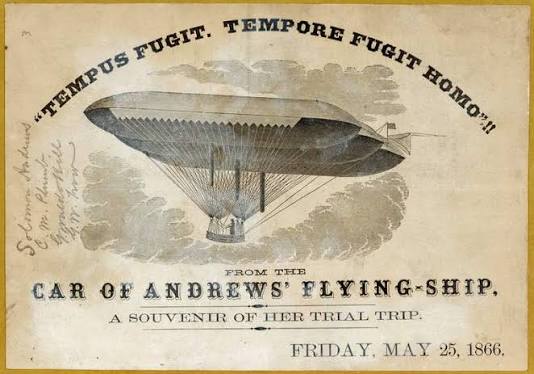
One of the most remarkable American attempts to solve that problem came from a New Jersey physician and inventor named Solomon Andrews. Andrews developed the Aereon, an extraordinary multi-envelope aircraft that looks almost futuristic even in surviving nineteenth-century imagery. Instead of depending upon a conventional engine, Andrews attempted to exploit changes in buoyancy and aerodynamic inclination, allowing the machine to gain forward motion while climbing and descending through the atmosphere. He was effectively trying to create something resembling an aerial sailing vessel.
The Library of Congress preserves a version of this image and identifies it as Solomon Andrews’s Aereon associated with his Civil War-era attempt to develop an airship capable of long-distance travel. The surviving image has no known restrictions on publication, and the original object is preserved in the Library of Congress Prints and Photographs Division.
What makes Andrews especially relevant to Brightwood is that he did not stop at constructing an experimental machine. He also tried to turn aviation into a business. After demonstrating the Aereon and attempting to interest the federal government in its potential, Andrews promoted an Aerial Navigation Company intended to commercialize his technology. That basic pattern — an inventor, an unusual machine, demonstrations, promoters, investors and a corporation — would recur throughout the nineteenth century.
The existence of these companies matters because later aviation history tends to remember successful machines while forgetting unsuccessful business structures. A failed aircraft company can disappear almost completely even if its machine was sophisticated for its time. Investors lose interest, the inventor moves on, drawings scatter through private collections, workshops are reused for something else, newspapers stop reporting the story, and within a generation the entire experiment can become a local anecdote.
European engineers meanwhile continued making dirigibles increasingly controllable. Henri Giffard had flown a steam-powered dirigible in France in 1852, but a decisive advance came in 1884 when French military engineers Charles Renard and Arthur Krebs completed successful flights in La France. Their electrically powered dirigible could be deliberately steered through a circuit and returned to its point of departure. That achievement is critical because it occurred nineteen years before Kitty Hawk and only eight years before the Brightwood Aerial Navigation Company appeared in Indianapolis.
The photographs of La France are particularly useful because they destroy the impression that nineteenth-century dirigibles were little experimental balloons. The machine was enormous. Its elongated envelope towered above the men standing beside it, while its gondola, propeller and steering apparatus formed part of an engineered propulsion system designed specifically for controlled flight. By the middle of the 1880s, anyone seriously following aeronautics could point to a real machine that had navigated through the air under power and returned to where it started.
That puts Brightwood in a completely different historical context. When the Brightwood Aerial Navigation Company was incorporated in Indianapolis in 1892, only eight years had passed since La France. The company therefore appeared during a period when controlled dirigible flight had already been demonstrated, while the practical airplane had not yet emerged as the winning design. Inventors were still free to believe that the future belonged to powered balloons, dirigibles, hybrid machines or configurations that today might look bizarre.
Indianapolis was also an unusually plausible place for such experimentation. The city was tied into the industrial network of Cincinnati, Louisville, Chicago and the wider Midwest, and its manufacturing economy included railroad facilities, machine shops, metalworking, pattern making and skilled mechanical labor. Experimental aircraft required fabric, wood, metal fittings, shafts, bearings, engines, propellers and people capable of fabricating unusual components without purchasing them from an established aviation industry, because such an industry did not yet exist.
That is one reason the bicycle world later became so important to aviation. The Wright brothers themselves were bicycle mechanics, and bicycle manufacture demanded many of the same skills early aircraft construction required: lightweight tubing, chains, sprockets, bearings, wheels, careful balance and precise fabrication. Airship inventors drew from a parallel mechanical world of railroad shops, carriage works, small-machine manufacturers, engine builders and metalworkers. Aviation grew out of the existing industrial culture rather than appearing as an entirely separate technological revolution.
This also explains why flying-machine designs became so strange during the final decades of the nineteenth century. Nobody yet knew what the successful aircraft of the twentieth century was supposed to look like. A serious experimental craft could be a balloon carrying a propeller, an elongated dirigible, a multi-envelope vehicle like Andrews’s Aereon, a giant fixed-wing steam carriage like Henson’s Ariel, a powered glider or some hybrid of wings and gas bags that disappeared once better solutions were found.
That wider technological landscape becomes particularly interesting when the American mystery-airship wave of 1896 and 1897 is placed back into its proper context. Newspapers across the United States reported strange lights, unusual machines and supposed airships moving over towns and farms. Many of those stories were undoubtedly hoaxes, misidentifications, newspaper embellishments or folklore, and there is no reason to convert the whole episode into evidence for a hidden fleet. The difficulty comes when the reports are dismissed on the assumption that controllable aerial machines were technologically impossible during the period.
They were not technologically impossible. By 1896, powered dirigibles had already flown, military balloon operations were decades old, inventors had experimented with steam engines and electric propulsion, aerial-navigation corporations had been created, and American and European engineers had been trying radically different aircraft architectures for half a century. What remained unresolved was which design could become dependable, economical and reproducible.
That is why Brightwood matters. The Brightwood Aerial Navigation Company appeared in Indianapolis in 1892, sitting almost perfectly between La France in 1884 and the American mystery-airship reports beginning only a few years later. Whatever ultimately happened to the Brightwood machine, the company belongs to a recognizable nineteenth-century progression rather than to a technological fantasy.
When the chronology is reconstructed, aviation before the Wright brothers looks completely different. Henson and Stringfellow were promoting a passenger aircraft and an aerial transit corporation in the 1840s; Giffard flew a steam-powered dirigible in 1852; the American Civil War put observation balloons into military service; Solomon Andrews flew and promoted the Aereon during the 1860s; Renard and Krebs demonstrated controlled electric dirigible flight with La France in 1884; Brightwood incorporated in Indianapolis in 1892; the mystery-airship wave swept across America in 1896 and 1897; and the Wright brothers finally achieved their breakthrough in 1903.
Seen together, those events reveal roughly sixty years of experimentation instead of a world waiting for two bicycle mechanics to suddenly invent flight. Most of the earlier machines failed, most of the companies disappeared, and many of their inventors became footnotes because their particular solution did not become the dominant one. Technological history remembers the successful branch of the tree while many of the dead branches vanish into newspapers, archives, patent files and family papers.
The Wright brothers therefore arrived near the culmination of a long nineteenth-century race rather than at its beginning. Brightwood belongs somewhere inside that lost middle period, when nobody yet knew whether the future of flight would belong to wings, balloons, dirigibles or machines so strange that we might no longer have a name for them.