Six years before Kitty Hawk, Americans were already reporting mysterious aircraft in the sky, and the strangest part is that flying machines were no longer entirely imaginary.
In November 1896, readers of the San Francisco Call began encountering reports of something extraordinary moving through the California sky. Witnesses described mysterious lights, strange shapes, and what some believed to be a mechanical flying machine. Within months, similar stories were appearing across a broad swath of the United States. Some observers reported little more than lights in the darkness, while others described cigar-shaped craft, propellers, engines, searchlights, crews, secret inventors, emergency landings, and machines that seemed to possess capabilities just beyond the acknowledged technology of the day.

From the far side of the twentieth century, the stories resemble early UFO reports. That resemblance is one reason the airship wave is often pushed into paranormal history, where it sits as a strange prelude to Roswell, flying saucers, and the modern mythology of unexplained aircraft. Yet the reports become far more interesting when they are returned to the technological world that produced them. Americans in 1896 were not inventing the concept of an airship from nothing. Engineers had been working on the problem for decades, inventors were seeking patents, promoters were organizing companies, newspapers were reporting aeronautical experiments, and the public already understood that somebody was eventually going to learn how to navigate the sky.
The mystery was therefore more specific than it first appears. Americans did not suddenly decide that impossible machines existed. They began wondering whether someone had solved a problem that everyone knew people were already trying to solve.
Airships Were Real Before the Wright Brothers
The history of flight is so strongly organized around the Wright brothers and December 1903 that everything before Kitty Hawk can seem like a collection of balloons, failed experiments, and eccentric dreamers waiting for the airplane to arrive. People living in the nineteenth century could not see the story that way because they did not know which technology would eventually win. Lighter-than-air craft, gliders, powered balloons, experimental engines, propellers, wings, electric motors, and dozens of combinations of those systems were competing approaches to the same basic problem.
One of the most important breakthroughs had already occurred in France. In 1884, Charles Renard and Arthur Krebs flew the military dirigible La France at Chalais-Meudon. The electrically powered craft demonstrated something crucial: a powered lighter-than-air machine could be controlled sufficiently to travel and return to its point of departure. The surviving period record identifies the August 1884 flights as the first fully controlled free flights of the electric dirigible.

That did not make airship travel practical. The engineering problems remained severe. Batteries were heavy, engines struggled to provide enough power for their weight, lifting gas could leak, structural materials added mass, and even a successful machine could become helpless against unfavorable wind. The importance of La France was that the problem had changed. The question was no longer whether a navigable flying machine belonged exclusively to fantasy. The question was whether engineers could make all of its systems light, powerful, reliable, and controllable enough to operate together.

That distinction helps explain the strange atmosphere of the 1890s. Flight was simultaneously real and unfinished. Newspapers could report genuine experiments on one page and wildly speculative machines on another without the division between them being obvious to a reader at breakfast.
By 1893, Flight Had Become an Organized Technical Field
The World’s Columbian Exposition in Chicago offers one of the clearest markers of how seriously aerial navigation was being taken before the mystery-airship wave. In August 1893, Chicago hosted the International Conference on Aerial Navigation. The published proceedings ran hundreds of pages and dealt with engineering, meteorology, propulsion, apparatus, experimentation, and the physical problems that had to be solved before reliable flight became possible.
Octave Chanute stood near the center of that effort. He was not a novelist constructing imaginary machines or a carnival promoter selling tickets to see a miracle. He was an experienced civil engineer who had spent much of his career around railroads and bridges. By the 1890s he had become one of the major organizers of aeronautical knowledge in the United States, collecting experiments, corresponding with inventors, comparing designs, and trying to turn a scattered field into something engineers could evaluate systematically.
That conference occurred in 1893, three years before the California airship reports began in earnest and ten years before the Wright brothers flew at Kitty Hawk. The public was already hearing that aerial navigation was a legitimate technical problem. Engineers themselves knew commercial success was still difficult, but they also knew that measurable progress was occurring.
This is the environment in which the mystery airship appeared.
Then the Sky Filled With Machines
The California reports of late 1896 gave the phenomenon its first major newspaper life. Once an unexplained light had been described as an airship, later reports inherited a vocabulary. Lights could become searchlights. A dark outline could become a hull. A distant noise could become an engine. Once newspapers introduced the possibility of a secret inventor, another witness hundreds of miles away could interpret what he saw through the same framework.
This does not require every witness to have lied, nor does it require every witness to have seen a genuine aircraft. Newspaper culture and human perception are more complicated than either explanation. A person can sincerely see something ambiguous and interpret it through the technological expectations already available to him. A journalist can then sharpen the description, another newspaper can repeat it, and a third witness can encounter the next strange light already knowing what an “airship” is supposed to look like.
The speed at which the mystery spread is therefore part of the story. The nineteenth-century newspaper system functioned as an enormous information network. Reports crossed cities through exchanges and wire services, were rewritten by local editors, and returned to the public in slightly altered forms. The mysterious craft was moving through print at the same time it was supposedly moving through the sky.
By the spring of 1897, the phenomenon had spread into the Midwest and Texas. Accounts became increasingly elaborate. Some described pilots making repairs after landing in isolated places. Others introduced secret workshops, wealthy financiers, electrical engineers, railroad mechanics, or inventors who promised that the machine would soon be revealed to the world. The imagined operators were usually recognizable nineteenth-century technical men rather than supernatural beings. That detail is easy to overlook, but it is one of the most important clues to why the stories worked.
The secret airship inventor was believable because America was full of inventors.
Aurora, Texas, and the Story That Would Not Die
The most famous story from the entire 1897 wave appeared in the Dallas Morning News on April 19. Correspondent S. E. Haydon described an alleged event in Aurora, Texas, two days earlier. According to the article, an airship had approached the town at low speed, apparently suffering from mechanical trouble, before colliding with Judge Proctor’s windmill and exploding. Haydon then pushed the story beyond the ordinary airship report by claiming that the dead pilot appeared to be from another world.

The story reads uncannily like a prototype of twentieth-century UFO mythology: an unknown aircraft, a crash, wreckage, an unusual metal, a dead pilot, mysterious writing, and a burial. Yet the article belongs firmly to 1897. Its machine is repeatedly called an airship, and its supposed mechanical trouble is presented as if readers already understand that such machines are traveling around the country.
Aurora should not be treated as proof that a technologically advanced craft actually crashed in Texas. The surviving case rests overwhelmingly on Haydon’s newspaper story, and later assessments have often treated it as local fiction or publicity. The historical value of Aurora lies somewhere else. A spectacular false story can still reveal what its audience is prepared to believe. Haydon could write about an airship striking a windmill because the airship had already become culturally legible.
A joke about a machine works only when the audience knows what machine is being joked about.
The Secret Inventor Was Already a Familiar Character
Other Texas stories are useful because they remained closer to the industrial world. One report discussed an alleged aeronaut named Hiram Wilson and connected him with Willard H. Wilson, described as an assistant master mechanic associated with the New York Central Railroad, along with an electrical engineer named C. J. Walsh. The story also claimed that an unnamed uncle had supplied the airship design. Later attempts to connect these newspaper Wilsons directly to Charles Dellschau’s private airship archive do not survive close scrutiny, but the period report itself reveals exactly how an 1897 newspaper imagined hidden technological development: railroad mechanics, electrical engineers, family knowledge, private construction, and an inventor operating beyond public view.
That image was powerful because it sat only one step beyond ordinary reality. Telegraphy, electricity, railroads, telephones, industrial machinery, photography, and increasingly sophisticated engines had transformed daily life within living memory. People had repeatedly watched technologies arrive that would have sounded unbelievable to their grandparents. The possibility that an obscure mechanic had quietly made another breakthrough was therefore sensational without being completely absurd.
The mystery-airship wave flourished in that narrow space between established technology and expected technology. Newspapers could exploit that space, inventors could promote themselves within it, and witnesses could interpret unfamiliar sights through it.
Brightwood Changes the Question
Five years before the great 1897 wave, an aerial-navigation company appeared in the Indianapolis story that would eventually become The Lost History of Brightwood. The surviving record places the Brightwood Aerial Navigation Company in 1892, at a time when the idea of commercial powered flight still appeared extraordinarily ambitious. The original corporate material requires further archival work before every detail can be treated as final, and nothing presently establishes that the Brightwood machine achieved successful flight. What matters is that aerial navigation had crossed from speculation into corporate organization.
Then, on June 24, 1893, the paper trail becomes much more concrete. Patent solicitors Thurman & Winn sued the Aerial Navigation Company for $127 for labor and material furnished in the construction of an airship. The notice described the company as attempting to manufacture airships “after the Brightwood pattern.” The claim does not tell us precisely what the pattern was or how much of the machine had been completed, but it suggests enough physical work to produce a labor-and-material dispute.
The phrase “Brightwood pattern” should not be inflated into evidence for a secret production blueprint. In ordinary industrial usage it could describe a model, plan, frame, template, casting form, recognizable type, or some other reproducible basis for construction.
Its importance is chronological.
Brightwood was leaving an airship paper trail before the great newspaper wave of 1896–97. La France had already demonstrated controllable dirigible flight. Engineers were already meeting in Chicago to discuss aerial navigation. Experimental gliders were being tested. Inventors were seeking money and patents. None of this proves that the mystery craft reported over American towns were real, but it radically changes the cultural setting in which those reports were received.
Americans had good reason to believe that somebody was trying to build the future.
They simply had no reliable way to know who was closest.
While Newspapers Chased Airships, Chanute Was Actually Flying
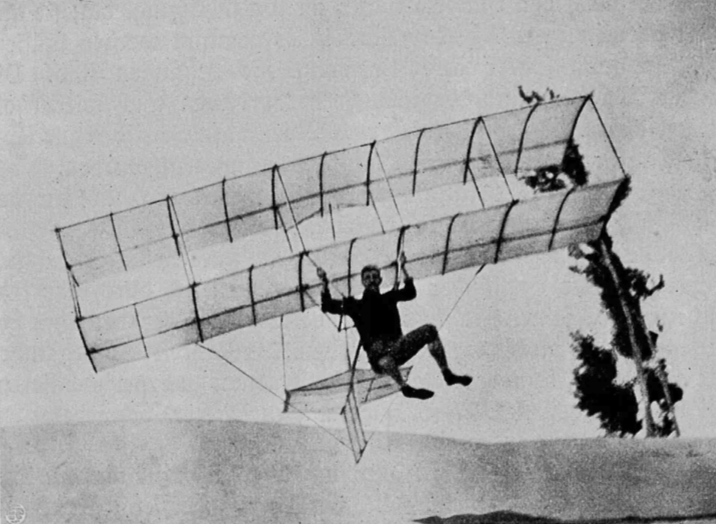
The contrast becomes especially sharp in 1896. While California newspapers were beginning to fill with mystery-airship reports, Octave Chanute and his collaborators were conducting heavier-than-air glider experiments on the Lake Michigan dunes. Chanute’s work formed part of the experimental foundation that would later matter to the Wright brothers, and the surviving photographs look surprisingly modern compared with the illustrated fantasy machines appearing elsewhere in the same period.

This photograph captures the central contradiction of the airship mystery better than almost anything else. Americans in 1896 were neither secretly operating fleets of twentieth-century aircraft nor waiting helplessly for the Wright brothers to invent flight from nothing. They were experimenting. Some approaches were working a little. Others were failing badly. Some existed mostly on paper. Some attracted investors. Some generated lawsuits. Some became newspaper entertainment. The outcome remained unsettled.
Later history makes technological development appear cleaner than it felt at the time because we remember the machines that worked and forget the thousands that did not. We remember the Wright Flyer because it crossed a threshold that can be clearly defined and documented. We rarely remember the company that failed before its machine survived, the inventor who ran out of capital, the airship whose engine was too heavy, or the design that existed only as a model and a creditor’s bill.
That forgotten population of failed and unfinished machines is where the mystery-airship stories lived.
The Mystery Was a Product of a Real Technological Threshold
The easiest explanation for 1897 is to choose an extreme. Either secret inventors really were crossing America in advanced aircraft, or gullible people and dishonest journalists fabricated the entire phenomenon. The historical record suggests a more complicated environment. Real engineering and fake reporting were occurring at the same time. Serious experiments and spectacular exaggerations shared newspaper pages. Witnesses lived in a culture primed to expect technological breakthroughs, and journalists lived in a market that rewarded dramatic stories about them.
That combination is enough to create a mystery without requiring a single explanation for every report.
Some observers almost certainly misidentified ordinary lights or astronomical objects. Some stories were embellished. Some were probably deliberate inventions. It remains possible that isolated witnesses saw balloons or experimental craft that were never identified. The surviving record is too uneven to collapse hundreds of reports into one answer.
What survives much more clearly is the atmosphere.
By 1897, flight was close enough to reality that an unknown object in the sky could plausibly be interpreted as somebody’s machine. The public understood that engineers were working on the problem, yet no institution could tell them exactly how far every private inventor had progressed. Rumor rushed into that uncertainty.
That may be the real secret of the Great American Airship Mystery.
It happened during the brief historical interval when the future was technically plausible but had not yet acquired an official shape.
Six years later, the Wright brothers would fly at Kitty Hawk. Their success would eventually help organize the story of aviation around wings, engines, controlled powered flight, and a recognizable lineage of development. The strange newspaper sky of 1897 would be pushed toward the margins, where it gradually became part of UFO history, folklore, and unexplained Americana.
Yet the airship stories belong just as much to the history of technology. They preserve the public experience of standing beside an invention before anyone knew which version of it would become real. Brightwood, La France, Chanute, the airship companies, the newspaper hoaxes, and the witnesses looking upward all occupied that same unstable moment.
The mystery airships may never yield a single answer, but they tell us something more valuable about the age that reported them. Americans were ready to believe someone had conquered the sky because, by 1897, they already knew that somebody was trying.