The standard Wright brothers story begins almost at the end. A bicycle shop in Dayton becomes a laboratory, two obscure mechanics solve the problem of controlled flight, and on December 17, 1903, a machine rises from the sand at Kitty Hawk. The famous photograph compresses everything that came before it into twelve seconds: Orville lying at the controls, Wilbur running beside the wing, and 120 feet of flight that would become one of the defining technological moments of the twentieth century.
But if the story begins at Kitty Hawk, much of what made the Wright brothers possible has already disappeared from view. Before there was an airplane there were churches, printing presses, lawsuits, warehouses, newspapers, bicycles, patents and a remarkably dense corridor of Midwestern towns where organizations repeatedly learned how to change form without surrendering their function. That is the version of the Wright story that emerges from the research behind The Wabash Combine. In the manuscript, “Wright” becomes especially interesting wherever an institution changes its outer shell while preserving something underneath: a religious organization becomes a publishing organization, a workshop becomes a factory, an invention becomes a patent claim, and competing aviation interests eventually become a corporation.


4
The pictures above tell the familiar story backward. Bishop Milton Wright belonged to the world of church organization and publishing. Orville Wright and Edwin Sines are shown working in the Dayton bicycle shop in 1897. The third photograph is the actual first flight at Kitty Hawk. The final image is U.S. Patent No. 821,393, the document through which a physical method of controlling an airplane became a legal claim over controlled flight.
The Wright Story Was Already in Indiana
The brothers were Dayton men, but their father was an Indiana man. Milton Wright was born in Rush County in 1828 and spent important portions of his religious career in Indiana before becoming one of the leading figures of the Church of the United Brethren in Christ. Wright State University preserves his extensive diaries, which run from 1857 until his death in 1917 and document both his church life and the development of his famous sons.
There is an even earlier Wright story in southern Indiana, although it should not simply be collapsed into a genealogical claim about Milton, Wilbur and Orville. John Wright, his father Amos and his brother Peter helped organize a Free Will Baptist congregation at Blue River around 1810. Within a decade, their religious network had grown into a group of congregations, and in 1819 John Wright successfully pushed to discard the Baptist label in favor of names such as “Church of Christ,” “Christians,” “Friends,” and “Disciples.” Contemporary histories of Indiana’s Restoration movement preserve that sequence quite clearly.
That earlier episode is useful because it establishes something the later Wright history repeatedly demonstrates: institutional identity in nineteenth-century America could be remarkably fluid. Congregations divided, merged, renamed themselves and argued over which body possessed the legitimate continuation of an older tradition. A modern reader accustomed to corporations, denominations and government agencies having stable names can easily mistake the name for the institution. The nineteenth century often worked the other way around. People, property, subscribers, relationships and practical functions could survive even when the sign over the door changed.
That distinction is central to The Wabash Combine. The manuscript deliberately treats “Wright” as a recurring institutional signature rather than insisting that every Wright appearing in Indiana belongs to a single biological dynasty. Its argument is about function: warehouses hold goods, churches hold communities, publishing houses hold narratives, patents hold technological rights, corporations hold combinations, and sensors eventually hold information about the state of a machine. The shell changes more quickly than the thing being organized.
Before Airplanes, the Wrights Were Printers
The most important forgotten occupation of Wilbur and Orville may therefore be printing rather than bicycle repair. The National Park Service notes that the brothers operated a printing business for roughly a decade. They produced the West Side News and the Evening Item, performed commercial printing work, and even designed and constructed their own press.
That was not an irrelevant adolescent hobby. Printing required precisely the combination of mechanical and organizational abilities that would later define their aviation work. Type had to be set accurately. A machine had to repeat the same movement reliably. Paper had to pass through it at the correct interval. Customers had to be found, bills collected, information selected, and a finished product distributed. The Wrights were learning to build machines while simultaneously learning that a machine existed inside a larger system of information, commerce and ownership.
The timing was extraordinary. Orville’s West Side News began in March 1889, the same year that Milton Wright’s denomination exploded into a constitutional crisis. The United Brethren dispute involved the procedure for changing the church constitution, the participation of lay delegates and, especially for Milton’s faction, church rules concerning membership in secret societies. The majority adopted the new constitution in May. Milton Wright and a minority walked out, maintained that they represented the legitimate continuation of the original church, and entered years of litigation over property and institutional identity.
This placed the young printers unusually close to a battle over something much larger than theology. Who owned the church name? Who controlled its press? Which constitution was valid? Which group was entitled to property? Which organization could call itself the continuation of the old institution? Milton Wright actually sued for possession of the denominational printing establishment in 1889 and lost the claim in court.
The minority nevertheless rebuilt. Huntington, Indiana, became an important center of the Old Constitution United Brethren movement. The Christian Conservator, which Milton Wright had helped publish, became its official paper, and the denomination established the institution that became Huntington University in 1897. Huntington University’s own history records Milton Wright participating in the dedication of the new college.
The manuscript interprets this as one of the clearest early examples of its “shell-change” idea. Whatever one thinks of the broader interpretation, the underlying history is firm: a denominational rupture produced litigation over identity and publishing assets, followed by the construction of new institutions in Huntington.
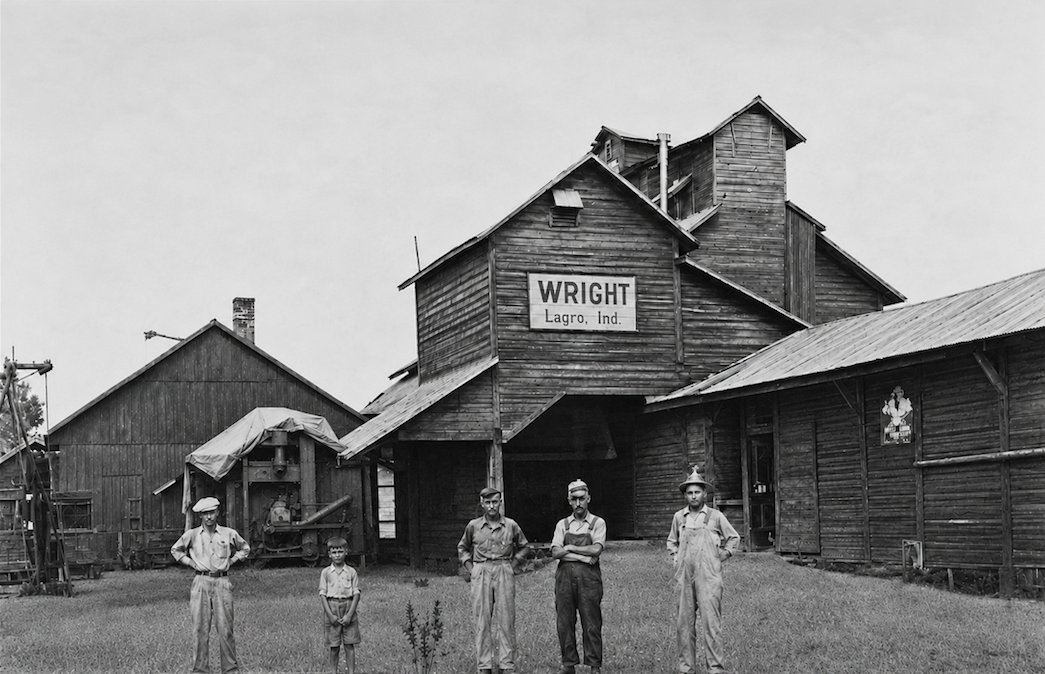
The Strange Wright Warehouse at Lagro
About twenty-five miles west of Huntington lies Lagro, Indiana, an old Wabash and Erie Canal town whose geography matters enormously to this larger story. The canal, river, roads and later railroad made Lagro a transfer point. Grain, livestock and other commodities could be gathered there, stored there and shipped toward eastern markets.

The manuscript identifies a frame warehouse built there by George and Harvey Wright in 1867, on the south side of Washington Street in the old canal freight district. It argues that the significance of the building was less the surname attached to it than the function it performed: commodities arrived, ownership was recorded, goods changed custody, and local production was converted into distant money.
One particularly strange piece of that history can be independently documented in the Indiana Supreme Court record. Todd & Wright operated in Lagro buying and shipping hogs. George W. Wright was the active member of the partnership, John Todd was publicly associated with it, and Harvey Wright was a silent partner. A customer entrusted the firm with more than 17,000 pounds of hogs to be shipped with the partnership’s animals to Buffalo, New York. George Wright traveled with the shipment, sold the hogs, took the proceeds and disappeared.
The Indiana Supreme Court’s reasoning is almost more interesting than the fraud itself. The court concluded that the other partners could not simply escape responsibility by claiming George had acted individually. Their partnership had created the public confidence that allowed the transaction to happen. In other words, the commercial institution gave the individual credibility.
That is an unusually clear nineteenth-century example of what the Wabash research keeps finding: the shell has power. A warehouse is more than boards and beams. A partnership is more than three names. A church is more than doctrine. Each produces trust, and trust makes transactions possible.
There is no evidence that the Lagro Wright merchants secretly created the Wright brothers’ airplane business, and there is no need to invent such a connection. Their importance is structural. Long before aviation, the Indiana interior already contained institutions built to control custody, movement, documentation and claims.
Dayton Turned That Logic Into a Machine
Then comes Dayton.
By the beginning of the twentieth century, Dayton had become one of the most inventive cities in America. Dayton History states that the city led the nation in patents per capita and places National Cash Register, the Wright Company, DELCO, McCall’s and other manufacturers inside the same extraordinary industrial environment.
National Cash Register is especially important to understanding that environment. The cash register did something conceptually similar to the warehouse receipt or courthouse ledger: it converted an action into a durable record. Money passed across a counter and the machine witnessed the transaction. NCR then surrounded the machine with an enormous system of manufacturing, sales training, territorial organization, service and corporate management.

4
That Dayton environment matters because Wilbur and Orville were not inventing in some isolated shed beyond modern industry. They lived amid printers, machinists, manufacturers, patents and business systems. They had already moved from printing into bicycles, and the bicycle operation gave them machine tools and practical experience with balance, lightweight structures, bearings, chains and precision construction. The National Park Service explicitly connects their printing and bicycle experience to the skills later used in aviation.
The manuscript pushes the point further. Its argument is that Dayton represents the moment when an older Midwestern culture of record, custody and organization becomes a culture of patents and technical control. In its language, “Dayton extended that method into patents.” Whether or not one accepts every connection in that larger framework, the juxtaposition is real: the Wright brothers matured in one of America’s densest patent and business-machine environments.
What the Wrights Actually Patented
This is where the heroic photograph from Kitty Hawk can become misleading. The most consequential thing the Wrights possessed was not simply an airplane. It was a legal claim concerning how an airplane could be controlled.
Their famous U.S. Patent No. 821,393 was filed in 1903 and granted in 1906. The patent dealt centrally with the control of a flying machine, including the system associated with wing warping. The Wrights subsequently used their patent against competing manufacturers, most famously Glenn Curtiss. Smithsonian archival descriptions explicitly characterize the pre-World War I period as an era of patent litigation in which the Wrights attempted to prevent Curtiss and others from manufacturing aircraft they believed infringed their claims.
That changes the meaning of the word control. At Kitty Hawk, control meant keeping a machine stable in three dimensions. In court, control meant determining who possessed the legal right to use the mechanism that made that stability possible. Aerodynamic control had become intellectual property.
Wilbur became deeply involved in defending those rights. The National Park Service notes that the brothers stopped flying publicly for a period while their patent application was pending and that Wilbur later devoted considerable energy to infringement litigation. In 1909, the brothers and investors organized the Wright Company to manufacture and sell airplanes; the first purpose-built American airplane factory opened in Dayton the following year.
The progression is remarkable when viewed from the beginning. Printing converted words into reproducible property. The bicycle shop converted mechanical skill into a commercial product. The airplane converted control into a machine. The patent converted the machine into a legally protected claim. The company converted that claim into an industrial organization.
The airplane is spectacular, so it became the memory. The institutional machinery around it may have been just as consequential.
The Patent War Became a National Problem
The Wright-Curtiss struggle eventually became bigger than either side. As the United States entered World War I, the government needed aircraft production at a scale incompatible with an industry trapped in overlapping patent disputes. The result was the Manufacturers Aircraft Association, a patent pool established in 1917 through which participating manufacturers could cross-license crucial aviation patents. Smithsonian’s Curtiss-Wright records describe precisely this wartime transition.
It is an important moment in American industrial history. Private ownership of invention had helped create the market, but national mobilization required the competing rights to be coordinated. The patent had been designed to protect an inventor’s claim; wartime production demanded a system capable of working around the blockage created by those claims.
This is one of the strongest parts of the Wright story for The Wabash Combine, because it resembles what happened elsewhere in transportation. Local companies could innovate. Families could accumulate practical expertise. Individual firms could own factories, routes and patents. But once transportation became a national system, standards and compatibility mattered as much as individual invention.
And Then Wabash Had Airplanes
Here the story unexpectedly turns back toward Wabash.
Separate from Service Motor Truck Company, historical aviation records document a Service Aviation Training & Transportation Company based in Wabash shortly after World War I. The distinction matters because the similar names make it tempting to combine the two companies without proof. The outside records I found establish the aviation company itself, but I would not yet claim a legal corporate identity between it and Service Motor Truck without additional documentation.
What we can prove is already remarkable. The 1921 Aircraft Year Book lists Service Aviation Training & Transportation Co. of Wabash with eleven Canadian J.N. aircraft, its own field, a 120-by-65-foot hangar and shop facilities. A period landing-field guide likewise lists Wabash and the Service Aviation Training & Transportation Company as an aviation facility.
The U.S. Air Service’s own newsletter recorded the Wabash company operating passenger aircraft between Texas and Oklahoma, while another Air Service record lists it among holders of civilian flying licenses.
That is much better than a vague local aviation legend. Wabash genuinely entered the first postwar commercial aviation economy.
4
The images make the overlap easier to see. The first is a Curtiss JN-4D “Jenny,” the general aircraft family at the center of the early barnstorming and training world. The second is a surviving National Archives photograph of a military ambulance manufactured by Service Motor Truck Company in Wabash during World War I. The third is a 1919 Service Motor Truck advertisement. The fourth shows the later Wright aircraft factory in Dayton. Wabash and Dayton were not doing identical work, but both were participating in the transition from the nineteenth-century world of horses, freight and rail connections into a twentieth-century system of standardized vehicles, engines, factories and airfields.
This also tightens one point in the manuscript. Wabash was not merely imagining aviation from a distance. The town hosted a documented commercial aviation concern possessing a substantial fleet of J.N. aircraft at the same time its truck industry was involved in the national motor-transport economy. The precise corporate relationships still need additional work, but the physical overlap of truck, aircraft, field, hangar and transportation business is real.
The Enemies Eventually Became One Company
Then history performed one final trick.
For years, Wright and Curtiss had represented opposing camps in the aviation patent wars. The dispute had helped define early American aviation. Yet in 1929, Wright Aeronautical Corporation and the Curtiss Aeroplane and Motor Company were brought together inside the newly created Curtiss-Wright Corporation. Smithsonian records describe the merger as joining the major Wright and Curtiss organizations, with the Wright side principally associated afterward with engines and propellers while Curtiss concentrated on aircraft.
Curtiss-Wright’s own corporate history describes a combination involving a much larger cluster of affiliated firms and subsidiaries, creating one of the largest aviation concerns of its day.
Think about the sequence. First there were rival inventors. Then there were rival patent positions. Wartime necessity forced cross-licensing. The original inventors gradually separated from the companies bearing their names. Finally the supposedly opposing names were placed on the same corporate shell: Curtiss-Wright.
The manuscript makes this transition one of its central Wright examples. The old patent conflict had become corporate structure. At roughly the same moment, the nineteenth-century Wright warehouse at Lagro was approaching demolition. One wooden shell was disappearing while another institutional shell was expanding into national aviation. The manuscript does not require the timing to be treated as a secret coordinated event; its point is that functions can migrate from one kind of institution to another as the scale of the economy changes.
The Story Before Kitty Hawk Changes the Story After It
None of this diminishes what Wilbur and Orville Wright accomplished. It actually makes their achievement less miraculous and more interesting.
The Wright brothers came from a family in which constitutional wording, publishing, institutional legitimacy and recordkeeping mattered. They became printers and learned how a complicated machine could repeatedly reproduce information. They became bicycle manufacturers and learned precision mechanics, balance and lightweight construction. They lived in Dayton when the city had become an extraordinary center of patents and business machinery. They solved controlled flight, converted that solution into intellectual property, built a manufacturing company around it, and spent years defending the boundary of the claim.
Meanwhile, the Indiana country behind them was full of older versions of the same practical problems. Churches organized people. Newspapers organized information. Warehouses organized commodities. Railroads organized movement. Partnerships organized credit. Courts determined responsibility when trust failed. Patents organized technological ownership. Corporations eventually organized the patents.
That is the Wright story hidden behind the airplane.
The most famous photograph asks us to look upward. The more revealing history may require looking backward: from Kitty Hawk to Dayton, from Dayton to Huntington, from Huntington toward Lagro and the older Indiana interior, and from the airplane itself to the presses, warehouses, churches, courtrooms and patents that taught Americans how to place increasingly complicated forms of movement under organized control.