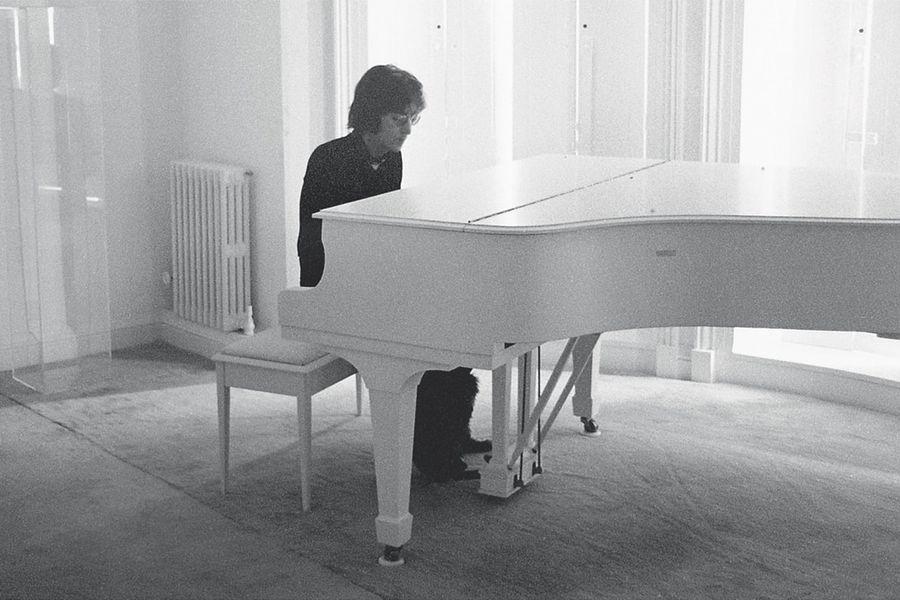
When the Beatles announced “Now and Then” in October 2023, one word almost immediately threatened to distort the entire story: AI. Headlines described an “AI Beatles song,” social media users imagined a computer-generated John Lennon, and some people understandably assumed that software had been trained to manufacture a new Lennon vocal after his death.
That is not what happened.
The voice on “Now and Then” is John Lennon’s real voice, recorded by Lennon himself on a home cassette in New York during the late 1970s. The breakthrough was that modern machine-learning-assisted audio software could finally separate Lennon’s voice from the piano and other sounds that had been fused together on the original recording, allowing Paul McCartney, Ringo Starr, producer Giles Martin, and their collaborators to work with the actual Lennon performance much more cleanly than had been possible when the surviving Beatles first attempted the song in 1995.
That difference is enormous.
A generative system would create a new performance by imitating Lennon.
The technology used on “Now and Then” extracted a performance Lennon had already made.
For Project Abbey Road, that distinction is where the story becomes much bigger than an argument about artificial intelligence. The Beatles spent their entire career pushing against the limits of recording technology, and their final song was completed because the machine had finally learned how to separate sounds that earlier engineers were forced to treat as one object.
It Started With a Man, a Piano, and a Cassette
The last Beatles song did not begin at Abbey Road Studios. It began at Lennon’s home in the Dakota Building in New York, where he recorded himself singing and playing piano during the late 1970s. The official Beatles history describes the original source simply as a home demo containing Lennon’s vocal and piano together on tape.


These are period images of Lennon working at a piano rather than photographs of the exact “Now and Then” recording moment. They are useful because they restore the scale of the original object: this was not a lost multitrack Beatles master sitting neatly in an EMI vault, but the sort of private piano-and-voice recording a songwriter makes when trying to capture an unfinished idea before it disappears.
That distinction drives the “Now and Then” chapter of Project Abbey Road. Beneath the enormous 2023 launch campaign, the remixed Beatles catalog, the videos, the physical editions, and the language of a historic “last song” sat something fragile and ordinary: one person, one piano, tape hiss, and a composition that Lennon never finished for commercial release.
The cassette also preserved all of its limitations. Lennon’s voice and piano occupied the same crude recording, along with noise and artifacts from the tape itself, so later musicians could not simply push a fader marked JOHN LENNON VOCAL and obtain a clean isolated track.
There was no isolated Lennon track.
There was only the cassette.
Yoko Gave the Surviving Beatles Lennon’s Demos
During preparations for The Beatles Anthology in the 1990s, Yoko Ono gave Paul McCartney, George Harrison, and Ringo Starr recordings Lennon had made during his final years. The collection included “Free as a Bird,” “Real Love,” and “Now and Then.”
That created an unprecedented recording situation. The surviving Beatles were not simply remixing old Beatles music, and they were not recording an entirely new song without Lennon; they were trying to construct new Beatles performances around a dead bandmate’s home recordings.
“Free as a Bird” became the first successful experiment.
The process was technologically awkward by modern standards. Lennon’s demo had to remain embedded inside the finished production, so Paul, George, and Ringo essentially built the new recording around the limitations of the old tape rather than being able to extract Lennon and place him freely inside a modern mix. The official Beatles account describes the 1995 recording as a Lennon home demo supplemented by new performances from McCartney, Harrison, and Starr under producer Jeff Lynne.
“Real Love” followed the same general model and became another official Beatles single. The experiment demonstrated that the three surviving Beatles could create meaningful new work from Lennon’s tapes even though the technological relationship between the old recording and the new performances remained imperfect.
Then they tried “Now and Then.”
In 1995, “Now and Then” Couldn’t Be Solved
Paul, George, and Ringo worked on the song during the Anthology period in February 1995. They recorded new material with producer Jeff Lynne, and George Harrison contributed guitar that would eventually survive all the way into the 2023 finished recording.


These images come from the surviving Beatles’ Anthology-era reunion sessions. They matter because “Now and Then” is not a 2023 song pasted entirely onto a 1970s Lennon cassette; an important layer of it comes from the moment in the 1990s when Paul, George, and Ringo were physically making music together again.
The difficulty was the source tape.
Lennon’s voice and piano could not be separated cleanly enough with the technology available to the Beatles at the time. The official 2023 announcement states directly that the technological limitations prevented the group from achieving the clear, unclouded separation necessary to finish the track to the required standard.
The manuscript makes that failure central to the history. Lennon’s voice could be enhanced and surrounded by new instrumentation, but the piano, vocal, noise, and recording defects remained materially entangled inside the cassette; the surviving Beatles could work with the recording, but they could not truly release Lennon from the room in which the tape had captured him.
George Harrison also did not want to keep pushing an unsatisfactory recording merely because completing another Beatles reunion song would be commercially exciting. Olivia Harrison later said that George regarded the technical problems as insurmountable at the time and concluded that the song could not be completed to an acceptable standard.
So it stayed unfinished.
For nearly three decades, that failure became part of the song.
Peter Jackson Was Trying to Solve a Different Problem
The breakthrough did not initially come from people working on “Now and Then.” It came from Peter Jackson’s enormous restoration project for The Beatles: Get Back.
Jackson inherited hours of mono audio from the January 1969 sessions in which conversations, instruments, background noises, and different voices could be embedded together. Traditional audio restoration could improve that material, but Jackson’s team wanted to do something more ambitious: identify different sound sources inside the recording and separate them.
The system developed by Jackson’s WingNut Films team became known as MAL, a name referencing longtime Beatles assistant Mal Evans. The Beatles’ official account describes the technology as machine-learning-assisted de-mixing capable of identifying voices and instruments inside recordings that had previously existed as inseparable mono sound.
This is the technical hinge of the entire story.
Machine learning can be used for generation, where software creates new material based on patterns learned from other material.
It can also be used for classification and separation, where software examines existing information and determines which parts belong to which source.
“Now and Then” used the second kind of process.
The software was essentially being asked to recognize, this part is Lennon’s voice; this part is the piano; this part is other noise, and then produce separated components that engineers could work with independently.
It did not ask a computer to sing like John Lennon.
The Machine Was Learning to Listen, Not Learning to Be Lennon
That is why the phrase “AI Beatles song” is so misleading. It collapses two very different uses of computational technology into the same category.
Imagine an old photograph of Lennon standing behind a dirty window. A generative system would be closer to painting a brand-new picture of Lennon based on examples of what Lennon looked like; source separation is closer to cleaning the window so the original person behind it becomes visible.
The voice remained Lennon’s.
The phrasing remained Lennon’s.
The pitch variations remained Lennon’s.
The timing remained Lennon’s.
The imperfections remained Lennon’s performance.
What changed was the engineers’ ability to isolate that performance from the piano that had occupied the same recording.
The official Beatles credits therefore explicitly list John Lennon as vocalist, while crediting WingNut Films’ MAL system for source separation and Emile de la Rey as head of machine learning.
That wording matters much more than headlines saying “AI brought Lennon back.”
The software did not perform Lennon.
It separated Lennon.
The Official Making-of Film Shows Exactly What Happened
The best video to place inside this article is the Beatles’ own twelve-minute documentary, because it contains the people involved explaining the process rather than someone outside the project speculating about it. It includes Paul, Ringo, archival George Harrison material, Sean Ono Lennon, and Peter Jackson discussing the journey from Lennon’s cassette to the finished record.
At one of the film’s most revealing moments, Lennon’s newly separated vocal can be heard with a clarity that simply was not possible during the Anthology attempt. Ringo described the experience as about as close as they could come to having Lennon back in the room, which captures the emotional effect without implying that the machine created him.
The documentary also makes the chronology visible. A private Lennon recording from the 1970s enters the Beatles archive, three surviving Beatles add to it in 1995, the project waits for technology to catch up, and the two remaining Beatles finally resume work after Peter Jackson’s system makes the source usable.
There is no synthetic Lennon hiding in that sequence.
There is an extraordinarily complicated edit across time.
“Now and Then” Contains Four Beatles From Different Years
The finished song becomes stranger when its components are treated as a timeline. Lennon’s vocal comes from his late-1970s home recording, Harrison’s guitar and other material survive from the 1995 Anthology sessions, and McCartney and Starr added new performances during the twenty-first-century completion of the track.
The official credits list Lennon and McCartney on vocals, Harrison on guitar, McCartney on guitar, bass, piano, electric harpsichord and percussion, and Starr on drums and percussion. The recording also contains a new string arrangement by McCartney, Giles Martin, and Ben Foster.
That means “Now and Then” is genuinely a performance involving all four Beatles, although the four men never occupied the same room or even the same decade while making it.
The manuscript makes this one of the song’s central qualities. Lennon comes from the Dakota demo, Harrison enters from the Anthology period, and Paul and Ringo finish the structure from a later technological era, making the recording less like an ordinary reunion than a piece of music assembled across time itself.
There is also a subtle additional archival layer. Producer Giles Martin incorporated authentic Beatles backing-vocal elements from older recordings, allowing the finished record to contain more of the actual historical group rather than generating approximations of what Beatles harmonies might sound like.
Again, the guiding principle was retrieval.
Use the archive rather than imitate it.
George Harrison Is Still on the Record
George’s presence is particularly important because Harrison died in 2001, long before the MAL system made the final completion possible. The 2023 production retained guitar work he had recorded during the abandoned 1995 attempt, meaning the final song did not simply bypass his involvement after his death.
Olivia Harrison addressed the question directly when the record was announced. She said that George had stopped the earlier attempt because of the technical limitations of the demo, and that she and Dhani believed he would have joined Paul and Ringo in completing the recording had the modern solution existed while he was alive.
That does not erase the fact that George himself never heard the 2023 result. It does, however, distinguish the finished recording from an attempt to manufacture a new Harrison contribution after his death.
His guitar had already been played.
The later technology allowed the project around it to work.
Paul and Ringo Still Had to Make a Record
There is another misconception hidden inside the AI discussion: once Lennon’s vocal had been isolated, the song did not simply emerge automatically from a computer. Source separation solved one crucial technical problem, but somebody still had to arrange, perform, record, edit, orchestrate, mix, and decide what kind of Beatles song “Now and Then” would become.
McCartney recorded new vocal and instrumental material, including bass, piano, guitar, electric harpsichord, and percussion. Starr recorded drums and additional percussion, while the production involved Giles Martin, Spike Stent, a string section recorded at Capitol, and engineers working across several studios.
The machine therefore did something simultaneously enormous and limited.
It opened the door.
Human beings still had to walk through it and decide what belonged on the other side.
That is much closer to the Beatles’ historic use of studio technology than the story of a computer generating a fake band member. From tape loops and artificial double tracking to reversed audio and multitrack editing, Beatles recording history is full of machines extending what musicians could physically accomplish while leaving artistic decisions in human hands.
The Cover Looked Almost Deliberately Unnostalgic
When the finished single arrived, the artwork did not use another photograph of the four Beatles. Artist Ed Ruscha created an unusually minimal cover dominated by the words NOW AND THEN, avoiding the obvious temptation to turn the last single into a memorial collage.
The restraint makes sense for a record already carrying an enormous amount of historical weight. Lennon’s voice, Harrison’s 1995 guitar, McCartney and Starr’s new work, the Anthology history, the Peter Jackson technology, and the entire idea of a “last Beatles song” supplied more nostalgia than any sleeve could reasonably contain.
The record was released on November 2, 2023, paired with a new version of “Love Me Do.” That pairing gave the Beatles catalog an almost absurdly neat set of bookends: the first UK single on one side and the final completed Beatles song on the other.
The technology separating Lennon’s vocal also fed into a wider restoration program. The Beatles’ 2023 Red and Blue collections used WingNut-assisted de-mixing to create new stereo mixes from old recordings, demonstrating that the technique was not simply a one-off resurrection device for “Now and Then.”
It had become part of Beatles archival engineering.
Then Peter Jackson Had to Solve the Visual Problem
The audio created another challenge that was almost philosophical: how do you make a music video for a Beatles song when two Beatles are alive and two are dead?
Peter Jackson initially resisted directing the video because the assignment was so easy to mishandle. He eventually assembled footage from multiple eras, including 1995 Anthology material, modern footage of McCartney and Starr, Lennon and Harrison archival images, home movies supplied by the families, and extremely early Beatles film supplied by Pete Best.
The result deliberately refuses to keep the dead solemnly separated from the living. Younger Beatles appear beside their older bandmates, Lennon mugs for the camera, Harrison appears alive inside old footage, and the group’s different ages occupy the screen together in ways that could never happen physically.
That visual strategy parallels the recording itself.
The song does not pretend all four Beatles were in one room.
The video does not pretend all four Beatles were in one year.
Both simply allow archival time to collapse.
The Beatles Had Been Heading Toward This for Decades
This is where the story connects back to the larger structure of Project Abbey Road. Magic Alex had once promised Apple Corps impossible electronics and a futuristic recording studio, but the actual future arrived through decades of disciplined improvements in tape, digital recording, computing, signal processing, archival restoration, and machine learning.
The manuscript makes the contrast directly. Apple Electronics dreamed about miraculous machines and produced unreliable equipment, while Peter Jackson’s engineers eventually built a system capable of doing something far more meaningful to Beatles history: reaching into an old recording and recovering Lennon’s voice with enough clarity to make the unfinished usable.
That is technological history meeting grief.
It also completes a long arc in the Beatles story.
In the 1960s, studio machines allowed the Beatles to make sounds they could not reproduce live.
In the 1990s, digital technology allowed three Beatles to construct recordings around a dead bandmate’s cassette.
By the 2020s, machine learning could pull individual sound sources apart and let engineers re-enter recordings that earlier generations had considered technically sealed.
The machine did not become Lennon.
The machine became better at hearing Lennon.
Why Calling It “Fake John Lennon” Misses the Most Interesting Part
There are real questions society should ask about generative music, synthetic voices, digital performers, posthumous releases, and whether estates should be able to authorize increasingly lifelike simulations of dead artists. Those questions are only becoming more important as artificial intelligence becomes capable of creating performances that never occurred.
“Now and Then” is useful partly because it shows that new technology does not automatically mean synthetic creation.
Sometimes the most powerful use of machine learning is archaeological.
It can recover.
It can separate.
It can identify.
It can expose something that was already present but technically inaccessible.
The Lennon vocal is valuable precisely because nobody needed to invent it. The hesitation in his phrasing, the sound of the room, the unfinished quality of the demo, and the human performance had survived inside the cassette for decades.
The technology finally gave engineers access to it.
That is a much stranger and more moving achievement than generating an imitation.
The Last Beatles Song Was Really a Time Machine
When “Now and Then” finally appeared, it sounded like a new Beatles record while containing material created across nearly half a century. John Lennon sang from the 1970s, George Harrison played from 1995, Paul McCartney and Ringo Starr contributed from the twenty-first century, and modern machine learning supplied the technical bridge that allowed those moments to coexist cleanly enough to become one finished object.
The song became the Beatles’ 18th UK number-one single, more than half a century after their original chart era, proving that the technological experiment did not merely produce an archival curiosity. It returned the Beatles to the center of contemporary popular culture with a genuinely new release constructed from old and new performances together.
That is why Project Abbey Road treats “Now and Then” as an endpoint rather than simply another Beatles release. The book begins with the machinery capable of making four musicians globally omnipresent and follows that machinery through records, television, Apple Corps, electronics, publishing, Sony, digital distribution, tribute culture, and finally a technology sophisticated enough to extract a dead musician’s real voice from damaged time.
The phrase “AI Beatles” makes the story sound cheaper than it is.
No computer wrote John Lennon’s vocal.
No software impersonated him.
No model was asked to invent what Lennon might have sung.
John had already sung it.
For almost fifty years, the problem was that the machine could not hear him clearly enough.
Eventually, it could.
That is how the final Beatles song happened.
Project Abbey Road: The Beatles, Apple, and the Machine That Made Pop Immortal follows that entire technological path from Abbey Road and Apple Electronics through Sony, Apple Inc., digital music, Peter Jackson’s restoration work, and the final release of “Now and Then.” Project Abbey Road on Amazon