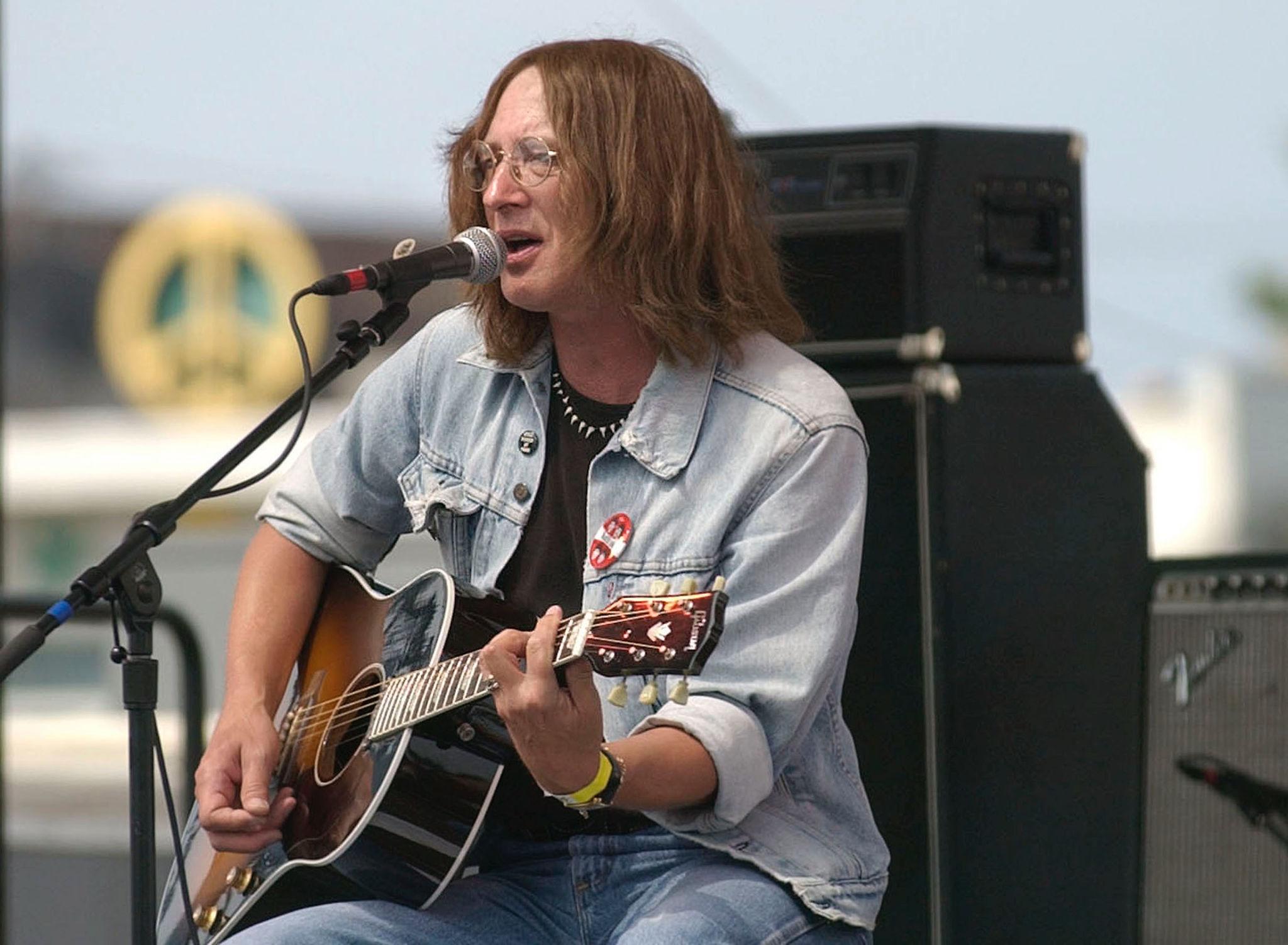
Mark Staycer did not need a secret identity to have an extraordinary story. He was a Michigan radio personality, a lifelong Beatles obsessive, and a John Lennon tribute performer whose resemblance, voice, timing, and knowledge of the Beatles became convincing enough to take him from local stages to major Beatles festivals, Liverpool, and eventually into the lead role of one of the strangest independent films ever made about the afterlife of a rock star.
That distinction matters because the most interesting version of the Staycer story is also the documented one. He was Mark Stephen Staycer, born in East Detroit in 1955, a broadcaster and performer who spent decades learning Lennon closely enough that an audience could experience something more complicated than an impersonation: for the length of a performance, memory suddenly acquired a body again. His obituary described both his long radio career and the Lennon tribute work that became the most unusual part of his public life.


The first photograph shows Staycer doing what he actually did for years: standing onstage with a guitar, performing Lennon for Beatles audiences. The second comes from his later memorial material, while the third is the poster for Let Him Be, the Canadian independent movie that took Staycer’s real-life tribute skill and built an entire fictional mystery around it.
That is the angle Project Abbey Road ultimately lands on as well. The manuscript is explicit that “Mark Staycer died as Mark Staycer” and that the story becomes stronger, rather than weaker, when his real life is allowed to remain real: an East Detroit Beatles fan who learned the songs, built a career partly around resemblance, and eventually entered a movie designed to ask what happens when resemblance becomes emotionally difficult to dismiss.
Before the Movie, Staycer Had Already Built a Lennon Career
Staycer was not discovered because somebody needed a random actor who vaguely resembled John Lennon. By the time Let Him Be appeared, he had already spent years performing Lennon for people who knew the source material extremely well.
The official Abbey Road on the River archive lists Staycer among the performers at the festival in Cleveland in 2003, 2004, and 2005. That matters because Beatles tribute festivals are unforgiving environments for a performer trying to embody one particular Beatle; the audience often knows the records, interviews, instruments, clothes, gestures, stage banter, and chronology in obsessive detail.
In 2004, his tribute act carried him somewhere even more significant: Liverpool. Northern Express reported that Staycer performed during International Beatles Week, including appearances at the Cavern Pub, Liverpool’s Royal Court, and on Matthew Street before large Beatles crowds drawn from around the world.
That is a much better measure of what Staycer could do than simply saying he looked like Lennon. He had learned enough of the musical and behavioral vocabulary to perform the role in the city where Lennon’s image was least likely to be taken casually.
Staycer also possessed something that photographs cannot explain very well: the voice and timing. A 2006 profile described him as a highly convincing vocal and comic mimic who could stay in character through interviews and perform Lennon material strongly enough to survive auditions alongside professional celebrity impersonators.
The skill is closer to acting than simple look-alike work. A successful tribute performer has to reproduce the expectation the audience brings into the room, which means the target is never only a face.
Tribute Performers Are Living Archives
This is where Staycer becomes useful to the larger argument of Project Abbey Road. Beatles culture created an unusually dense archive of photographs, television appearances, studio footage, interviews, instruments, clothing, gestures, vocal mannerisms, jokes, stage positions, and recorded performances.
A dedicated performer can study that archive for decades.
The result is a strange form of cultural preservation. A museum keeps an object still, while a tribute performer tries to make an archive move again.
That is why a good Lennon tribute can create a feeling that goes beyond resemblance. The audience knows perfectly well that the man onstage is not John Lennon, but recognition operates faster than intellectual correction: the glasses, stance, guitar, nasal phrasing, sarcastic timing, familiar chord shapes, and particular way of leaning toward a microphone arrive together.
For a few seconds, memory does the rest.
The manuscript treats Staycer in precisely this way. His importance is not that he provides evidence for a hidden survival story; it is that the Beatles became culturally reproducible enough for another human being to carry a remarkably detailed version of Lennon into rooms decades after Lennon’s death.
Then a Filmmaker Found Him Online
Director Peter McNamee had an unusual problem when developing Let Him Be. His film required a man who could plausibly make fictional documentary students wonder whether an aging John Lennon had somehow disappeared into rural Canada, which meant an ordinary actor wearing round glasses would not be enough.
McNamee later told NOW Magazine that he found Staycer online. Staycer already had the voice, physical resemblance, musical ability, and even the appropriate style of guitar, giving the production a much stronger foundation than makeup alone could create.
The filmmakers then deliberately pushed that resemblance farther. McNamee said makeup artist Sean Samson added to Staycer’s nose, chin, and cheeks and raised the hairline, effectively taking an established Lennon tribute performer and aging or reshaping certain details for the fictional character.
That production detail is much more interesting than treating Staycer himself as a mystery. The film took a man who could already convincingly evoke Lennon and then used ordinary filmmaking techniques to make the resemblance even more unsettling.
The illusion was manufactured in plain sight.
Let Him Be Had a Great Premise
Released in Canada in 2009, Let Him Be follows two young filmmakers who discover footage of an older musician and become convinced that the man might be John Lennon. Their search leads them into rural Ontario, where they encounter a reclusive musician named Noel Snow, played by Staycer.

The film uses the visual language of documentary investigation rather than presenting itself as a conventional Lennon biopic. Cameras become part of the plot, the students follow leads, hidden recording equipment enters the story, and the possibility that the man might be somebody historically impossible becomes the engine that keeps them filming.
That premise gives the movie a second subject beneath the Lennon question. It is really about what people do when they believe a camera might give them ownership of somebody else’s private life.
The film students do not simply want to meet Noel Snow. They want to prove him.
That changes everything.
Noel Snow Never Has to Become John Lennon
One reason the film works is that Staycer’s character does not have to spend the movie announcing that he is Lennon. Contemporary coverage described Noel Snow as an aging Canadian recluse whose resemblance, voice, musicianship, and guarded circumstances allow the characters around him to supply most of the mystery themselves.
That makes the performance much more effective. The less the character insists, the more work the fictional investigators and the audience have to perform.
McNamee also avoided relying on Beatles recordings to create the effect. Northern Express noted that the film did not simply fill the soundtrack with Beatles or Lennon songs, while NOW praised the Lennon-like original material McNamee wrote for the production.
Staycer therefore had to evoke Lennon without being able to lean entirely on the most obvious Lennon material.
That is a real performance challenge.
The Better Question Is Why Anyone Wants Noel Snow to Be Lennon
The film’s premise contains a melancholy fantasy that has existed around dead musicians for generations. People imagine Elvis alive somewhere quiet, Jim Morrison having escaped celebrity, Tupac outside the machinery that consumed him, or Lennon surviving long enough to become an old man nobody recognizes.
Those stories usually say as much about the audience as the celebrity.
A famous person dies at a fixed age, but the people who loved the work continue aging. Eventually the desire appears to see the missing person age too.
Noel Snow satisfies that desire. He gives viewers an image of Lennon with additional decades attached, not frozen in photographs from 1980 but older, quieter, weathered, and living away from the machinery that once made him globally recognizable.
The film then introduces the uncomfortable part.
The moment the characters believe Lennon may have successfully escaped fame, they begin trying to drag him back into it.
If Lennon Escaped Celebrity, Would Fans Leave Him Alone?
This is where Let Him Be becomes much more interesting than its marketing hook. The students use surveillance and hidden-camera logic because discovering Lennon would be the documentary scoop of a lifetime.
Their desire is understandable.
It is also invasive.
The manuscript identifies that contradiction directly: if the fantasy is that Lennon survived and successfully escaped the machine surrounding him, the audience’s immediate response is to find him, photograph him, prove him, and put him straight back into that machine.
That makes the film unexpectedly relevant to modern celebrity culture. Fans routinely say they want authenticity from famous people while simultaneously creating conditions in which the famous person cannot experience ordinary privacy.
The more beloved somebody becomes, the more intensely the public feels entitled to another photograph, another interview, another confession, another recording, another reunion, or another final appearance.
Let Him Be turns that appetite into a plot.
Mark Staycer Was Perfect Because He Had Already Done the Hard Part
The makeup effects helped, but Staycer’s decades of performance experience were more important. The filmmakers could adjust a hairline or reshape a nose, but they could not manufacture years of absorbing Lennon’s voice, guitar mannerisms, humor, phrasing, and physical rhythm.
That is why the film’s central illusion has weight.
Project Abbey Road describes the process as a doubling of the double: Staycer was already performing a cultural version of Lennon, and then the production altered that existing tribute image so he could play Noel Snow, a fictional man whom other fictional characters suspect might be Lennon.
There is a lot of fun to be had with that hall-of-mirrors construction, but it does not require believing Staycer was anything other than an actor and tribute musician. The filmmaking process itself explains why the effect becomes unusually convincing.
That is the point worth preserving.
Staycer’s Real Career Was Bigger Than the Movie
The film is the strangest entry on Staycer’s résumé, but reducing him to Let Him Be misses the larger tribute culture in which he worked. He performed at Beatles gatherings in the United States, played Liverpool, worked as a radio personality, built relationships within the Beatles-festival circuit, and developed an audience that knew him as a working entertainer rather than as an internet mystery.
His appearance at Abbey Road on the River is especially useful because that festival itself demonstrates how extensive Beatles afterlife culture became. Entire events could be constructed around reenacting albums, reproducing costumes, recreating individual Beatles, performing deep catalog material, and giving audiences a temporary version of a band that had stopped performing together decades earlier.

Staycer belongs inside that world rather than outside it. One picture captures him performing Lennon directly, while the other shows the larger tribute-festival environment in which Beatles imagery, instruments, costumes, and characters were reconstructed for audiences that wanted to enter the material rather than merely listen to old records.
This is a form of participatory memory.
The Beatles stopped touring in 1966.
Beatlemania learned how to tour without them.
The Internet Eventually Made the Story Stranger
It was probably inevitable that a film built around an unusually convincing Lennon performer would eventually escape its fictional boundaries online. Screenshots of Staycer circulated, viewers compared photographs, and some conspiracy-oriented writers began treating the actor himself as though his resemblance were evidence rather than the reason he had been cast.
That material is part of the story because it demonstrates what happens when fictional ambiguity enters internet clue culture. It should not become the center of the article because the documented explanation is already sitting in the film’s production history: McNamee deliberately searched for a strong Lennon look-alike and then had a makeup artist alter Staycer further for the role.
The result tells us something more useful about media literacy. Once an image becomes detached from its production context, the special effect can start being circulated as evidence for the proposition the special effect was originally designed to imitate.
That is a genuinely interesting media phenomenon.
It does not require a hidden Lennon.
The Project: Abbey Road Video Archive Shows the Bigger Clue Culture
The Project: Abbey Road YouTube channel has been exploring the Beatles’ surrounding mythology for years, well before the current book pulled those threads into one larger argument. I checked the channel while putting this piece together, and there does not appear to be a separately indexed Mark Staycer or Let Him Be upload in the material surfaced by YouTube search, so it would be misleading to pretend there is one. The channel itself is here: Project: Abbey Road on YouTube
One channel video that does fit the larger context is the Paul-Is-Dead piece, because it shows the kind of replacement and clue-reading culture into which a movie like Let Him Be could later fall. It works best here as background on Beatles mythology, rather than as evidence about Mark Staycer himself.
The channel also contains an older piece on the Tavistock theories surrounding the Beatles. Again, the value here is not treating the theory as established history; it demonstrates the enormous interpretive world that accumulated around the band and helps explain why doubles, handlers, hidden systems, and manufactured-star stories became such persistent components of Beatles internet culture.
There is also surviving Staycer material outside the Project: Abbey Road channel. One long-form upload preserves music associated with Let Him Be and Staycer, which is useful because hearing the voice explains something a still photograph cannot.
That is the better use of the videos for this article: the Project: Abbey Road material establishes the surrounding Beatles mythology, while the Staycer material lets readers hear the performer at the center of the story.
Then Mark Staycer Died
Staycer died at his Traverse City home on December 30, 2023, at age 68. His obituary identified him plainly as a radio personality and John Lennon tribute artist and described a life spent entertaining people through broadcasting and performance.
The timing gave the story one final coincidence. Only weeks earlier, the Beatles had released “Now and Then,” using modern audio-separation technology to recover Lennon’s real voice from an old home recording for an authorized final Beatles single.
One Lennon return was technological and official.
Staycer represented the human version.
The first recovered a recorded vocal from tape.
The second spent decades learning how to make an audience recognize a dead performer in a living body.
They should not be confused with one another, but putting them beside each other reveals how many different forms cultural survival can take.
A Person Dies Once. A Role Can Keep Being Cast.
This is ultimately why Staycer earns such an unusual place in Project Abbey Road. The Beatles became more than four biographies because the cultural forms built around them continued to operate after individual lives and even the band itself ended.
There are recordings.
There are films.
There are photographs.
There are trademarks and publishing catalogs.
There are restored tapes and machine-separated voices.
There are pilgrimage sites such as the Abbey Road crossing.
There are also human performers who learn the material so thoroughly that an audience can temporarily experience the old role in a new body.
The manuscript makes that distinction clearly after Staycer’s death. The individual life ends, while the Lennon role remains available for another singer, actor, tribute artist, film, restoration project, or future technology to inhabit.
That is much stranger than claiming the tribute artist secretly was the original person.
Mark Staycer did not need to be John Lennon.
His story matters because he was Mark Staycer, and that was enough.
For decades, a radio man from Michigan could walk into a Beatles festival, put on the glasses, lift a guitar, open his mouth, and cause thousands of memories stored in other people to activate at once.
Then a filmmaker recognized what that ability meant and built an entire movie around it.
The fictional question in Let Him Be was whether John Lennon might somehow still be alive.
The more interesting real question is why popular culture keeps finding ways to bring him back.
Project Abbey Road: The Beatles, Apple, and the Machine That Made Pop Immortal follows that afterlife from Beatlemania and Apple Corps through Paul-Is-Dead, Let Him Be, Mark Staycer, catalog ownership, iTunes, machine-assisted restoration, and the final return of Lennon’s voice on “Now and Then.” Project Abbey Road on Amazon.