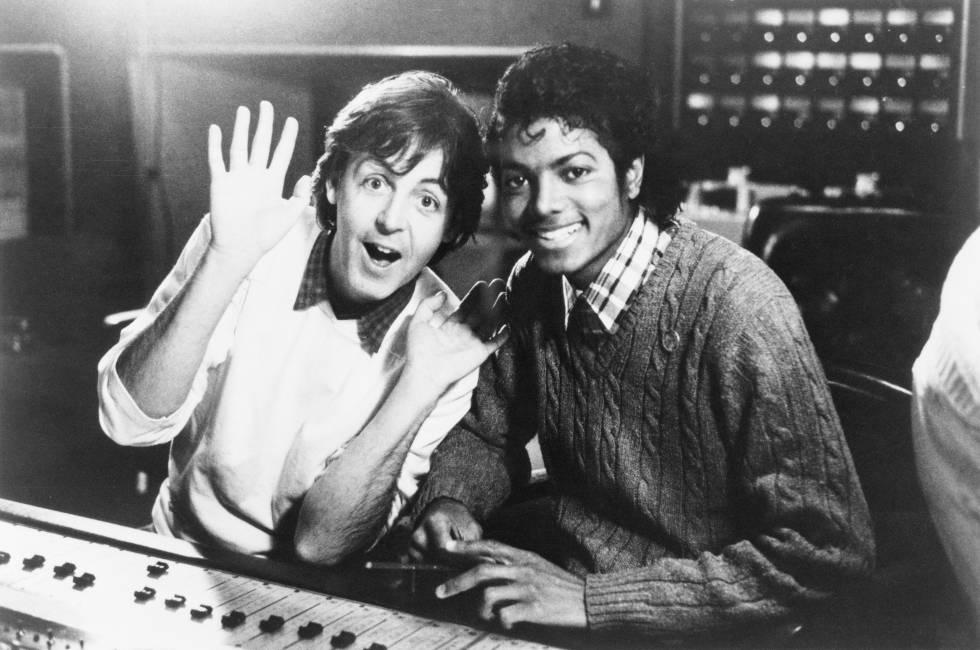
Before Michael Jackson owned the publishing rights to hundreds of Beatles songs, he was sitting in recording studios with Paul McCartney making pop records. The two were friends, collaborators, and two of the most recognizable musicians alive, and McCartney was already trying to teach the younger superstar something the Beatles themselves had learned painfully: writing a hit song and owning the business underneath that song were not the same thing.
The irony is almost too perfect. McCartney showed Jackson how valuable music publishing could be, Jackson listened carefully, and in 1985 he spent $47.5 million on ATV Music, acquiring a catalog whose crown jewels included publishing rights to roughly 251 Lennon-McCartney compositions.
That does not mean Michael Jackson bought the Beatles themselves, nor did he buy ownership of all the Beatles’ master recordings. What he bought was something less visible and, in some respects, more durable: a major share of the underlying songwriting copyrights that generated money whenever many of those compositions were recorded, performed, licensed, broadcast, or otherwise commercially exploited.
That distinction is the heart of the story.


4
The pictures make what happened later feel even stranger. McCartney and Jackson are not corporate adversaries here; they are smiling together at a mixing desk, making records, posing for publicity photographs, and filming the playful “Say Say Say” video in which they portray traveling performers and confidence men.
Their musical partnership was real. “The Girl Is Mine” appeared on Jackson’s Thriller in 1982, while “Say Say Say” was released as a McCartney-Jackson single in October 1983 after the two had already spent time writing and recording together.
Nobody in those photographs looks as though one man is about to acquire a large portion of the other man’s musical past.
That is exactly why the story works.
First, You Have to Understand What “Owning a Song” Means
Music ownership becomes confusing because a familiar record can contain several different kinds of property. The sound recording, often called the master, is the particular recorded performance you hear, while the musical composition consists of the underlying melody and lyrics written by the songwriters.
Those rights can belong to different people or companies. A record label might control a master recording while a music publisher controls the composition, meaning licensing the original Beatles recording of a Lennon-McCartney song can require different permissions from licensing the song itself for someone else to perform.
That is why saying Michael Jackson “owned the Beatles songs” is both broadly understandable and technically incomplete. Jackson’s ATV acquisition gave him the publishing interests held through Northern Songs and ATV in a huge group of Lennon-McCartney compositions, but it did not suddenly make him the owner of every Beatles recording sitting in EMI’s vaults. Contemporary reporting on the purchase described 251 Lennon-McCartney songs as the heart of the transaction.
The difference becomes easier to understand if music publishing is treated like real estate. The public may know the house, visit the house, love the house, and feel that the house belongs emotionally to everyone, while somewhere in an office there is still a deed saying who possesses the legal interest.
That metaphor appears throughout Project Abbey Road. The manuscript describes the music business as repeatedly revealing a land system beneath the sound: ownership, territory, rights, shares, licenses, inheritance, and title, with the song becoming “the house everyone visits” while the deed remains somewhere else.
The Beatles were about to discover how far away their own deed could travel.
The Problem Started Long Before Michael Jackson
The Lennon-McCartney publishing story goes back to the beginning of Beatlemania. In 1963, John Lennon and Paul McCartney entered the Northern Songs arrangement associated with publisher Dick James, creating the corporate structure through which the rapidly expanding Lennon-McCartney songwriting catalog would be administered.
The young Beatles were becoming extraordinary songwriters at exactly the moment their songs were becoming extraordinary assets. Those are different kinds of knowledge, and being able to write “She Loves You” does not automatically teach a twenty-one-year-old musician how a publishing company should be structured for the next sixty years.


The photographs and sheet music from the period show the split perfectly. To the public, these were songs by John Lennon and Paul McCartney; on the paper underneath the photograph sat the publisher’s name, Northern Songs Limited, quietly representing the corporate machinery attached to the composition.
That machinery changed hands. Dick James sold his controlling interest to ATV in 1969, and attempts by Lennon and McCartney to regain control did not succeed; the Beatles eventually sold their remaining Northern Songs shares as the group itself was disintegrating.
The musicians remained the authors.
The property around the authorship moved elsewhere.
By the early 1980s, Paul McCartney understood that distinction extremely well.
McCartney Became a Publishing Buyer Himself
McCartney did not spend the post-Beatles years ignoring publishing. He built MPL Communications into a significant publishing operation and bought valuable catalogs, including rights connected with Buddy Holly and numerous standards, partly because advisers in the Eastman family had encouraged him to invest in the industry he actually understood.
In a 1984 interview, McCartney explained the bitter irony directly: he owned valuable publishing by other writers while somebody else owned the publishing in songs such as “Yesterday.” He described his publishing investments almost as compensation for the fact that the Beatles had never maintained full control over their own early catalog.
That made McCartney exactly the person a young Michael Jackson might ask for financial advice.
Jackson had become phenomenally successful, and Thriller was turning him into something more than a star. He now possessed the sort of earnings that required serious decisions about what to do with money after it arrived.
McCartney had an answer.
Buy songs.
Paul Showed Michael the Book
The most famous version of the story comes from the period when Jackson and McCartney were spending time together making music. According to a detailed Los Angeles Times reconstruction of the ATV acquisition, McCartney showed Jackson a bound notebook containing songs whose publishing he owned and explained how valuable those copyrights could become.
Jackson reportedly became fascinated and started asking questions about how catalogs were purchased and how ownership generated income. McCartney had effectively shown him that a successful recording could disappear from the charts while the composition underneath it continued producing money for decades.
McCartney later remembered Jackson repeatedly joking that he was going to buy McCartney’s publishing. In a 1988 interview, McCartney recalled treating the remarks as a joke until the telephone call eventually came telling him Jackson had actually purchased the catalog.
The manuscript captures the emotional peculiarity of that transition. During the Thriller and Pipes of Peace period, McCartney and Jackson publicly looked like affectionate cross-generational pop royalty, while behind the scenes McCartney was teaching Jackson that publishing meant power.
Jackson listened.
He also had the money.
“Say Say Say” Looks Different After You Know the Ending
The “Say Say Say” video is almost comically appropriate in retrospect. McCartney and Jackson play Mac and Jack, traveling performers selling a bogus miracle potion, performing tricks, charming crowds, and repeatedly slipping between entertainment and commerce.

The video was simply comic entertainment, and there is no reason to pretend it secretly predicted the publishing transaction. The coincidence is still wonderful because the two men are literally dressed as old-fashioned entertainers whose business consists of converting performance, attention, and charm into money.
That was also happening in real life on a far larger scale. “Say Say Say” became a major hit, and the collaboration further linked two enormous cultural catalogs just before their business relationship took an unexpected turn. McCartney’s own site describes their partnership as beginning with Jackson contacting him and asking if they could make hits together.
They succeeded.
Then Jackson went shopping.
ATV Came Onto the Market
By the early 1980s, ATV’s corporate parent had passed into the hands of Australian businessman Robert Holmes à Court, whose interests were being reorganized and sold. That placed ATV Music, including the valuable Northern Songs material, in play.
McCartney knew exactly what the catalog contained, and accounts differ in emphasis over how seriously he considered acquiring it himself. Contemporary reporting says he had expressed interest at different times, while those involved in the eventual Jackson transaction did not regard him as the strongest active bidder during the final sale process.
There were also practical problems. Buying ATV did not mean purchasing a neat box labeled “Paul McCartney’s Beatles Songs”; it meant acquiring a large publishing business containing thousands of copyrights, including music by many other writers.
Jackson was prepared to buy the whole thing.
His representatives began negotiating.
The process dragged on through due diligence, competing bids, and the ordinary complexity surrounding an extraordinary asset.
Then, in August 1985, the deal was completed.
Michael Jackson Paid $47.5 Million
Jackson ultimately paid about $47.5 million for ATV Music. Later reporting gave the catalog roughly 4,000 compositions overall, while the Beatles component contained approximately 251 Lennon-McCartney songs and represented an enormous portion of the company’s value.


This is the point where the popular version says, “Michael Jackson bought the Beatles.” The more accurate version is more fascinating: one of the most valuable living pop performers used the proceeds of his own extraordinary success to buy the corporate publishing structure containing many of the songs written by the previous generation’s most famous songwriting partnership.
The manuscript calls the transaction a symbolic inversion. The Beatles had risen partly by absorbing American rock and roll, rhythm and blues, soul, and pop influences and sending that material back across the Atlantic in a transformed British form; twenty years later, the era’s dominant Black American pop star acquired the underlying publishing interests in much of the Lennon-McCartney catalog.
There is no need to turn that into revenge or hidden symbolism. It was a business transaction whose historical poetry happened to be unusually good.
McCartney Could Hardly Believe It
The purchase clearly changed McCartney’s relationship with Jackson. McCartney later said Jackson had joked about buying the publishing and that discovering he had actually done it was galling, particularly because McCartney now found himself in the bizarre position of owning less publishing interest in “Yesterday” than the younger singer who had once come to him for advice.
At the same time, the simplified story that Jackson somehow tricked McCartney should be resisted. ATV was an asset being openly sold, multiple parties were interested, Jackson made the successful offer, and contemporary accounts portray him as an aggressive buyer who recognized the catalog’s value rather than someone secretly stealing property from McCartney.
The uncomfortable truth is more ordinary.
Jackson learned the business.
Then he played it better.
The Nike “Revolution” Ad Showed What Ownership Meant
Two years later, the publishing transaction stopped being an abstract story about corporate paperwork. Nike began using the original Beatles recording of “Revolution” in a major advertising campaign, prompting Apple and the surviving Beatles’ interests to sue over the commercial use of the recording.


The episode is useful because it demonstrates the distinction between publishing rights and master rights. Nike said it had obtained permission involving both EMI-Capitol for the Beatles recording and Michael Jackson’s publishing interests, while Apple challenged the use of the original recording and sought $15 million in damages.
Jackson was not named as a defendant in Apple’s original complaint described by the Los Angeles Times. His role was nevertheless impossible to miss because he controlled the publishing rights in “Revolution,” meaning a Beatles composition could now be commercially licensed through a structure owned by another superstar.
For McCartney, the lesson he had taught Jackson was now visible on television.
Publishing was power.
Then the Beatles Catalog Became Part of Sony
Jackson did not keep ATV as a completely independent personal kingdom forever. In 1995, he combined ATV with Sony’s publishing operation to create Sony/ATV Music Publishing, transforming his 1985 purchase into part ownership of an enormous global corporate publisher. Sony’s own corporate history confirms that the joint venture brought Jackson’s ATV catalog, including Northern Songs, together with Sony Music Publishing.

The scale kept growing. After Jackson’s death in 2009, his estate retained his stake in Sony/ATV until 2016, when Sony agreed to purchase the estate’s remaining 50 percent interest for $750 million.
The contrast with 1985 is extraordinary. Jackson had paid $47.5 million for ATV, later merged it into a much larger publishing operation, and the estate eventually sold its half of Sony/ATV for hundreds of millions of dollars.
The songs had not suddenly become better.
The ownership structure had become more valuable.
The manuscript traces that escalation directly: Northern Songs becomes ATV, Jackson pays $47.5 million, the property enters Sony/ATV, and Sony eventually pays $750 million for the Jackson estate’s remaining stake.
A Song Can Outlive Every Company That Owns It
That history explains why catalogs have become such desirable assets. A band can break up, an artist can die, formats can disappear, record companies can merge, and technology can change completely while a composition continues generating income whenever somebody streams it, covers it, performs it, broadcasts it, licenses it, or places it into another commercial work.
That durability is what Jackson understood.
McCartney understood it too.
Their disagreement was never really about whether publishing mattered.
It mattered so much because both men knew exactly what it was worth.
The manuscript calls the catalog the body that survives after the band itself dies. Four human beings can separate, argue, age, and disappear, while the publishing catalog simply keeps working through the next contract, the next format, and the next corporate owner.
McCartney Eventually Found Another Route Back
The story did not end when Sony acquired full ownership of Sony/ATV. American copyright law contains termination provisions that, under specified circumstances and during particular statutory windows, allow authors or their heirs to terminate old copyright grants and regain U.S. rights that had previously been transferred. The Copyright Office describes those provisions as a mechanism designed partly to give authors another opportunity to benefit from works whose eventual value could not have been predicted when the original deal was made.
McCartney filed suit against Sony/ATV in January 2017, seeking a declaration concerning his ability to exercise U.S. termination rights over Beatles compositions without Sony claiming that doing so breached existing agreements. The case was settled confidentially that June, so the exact negotiated terms were not made public.
That is why saying McCartney eventually “got the Beatles catalog back” is also too simple. The legal process concerns particular U.S. rights, specific compositions, statutory timing, and the consequences of old grants; it does not mean the entire worldwide Lennon-McCartney publishing catalog suddenly returned to McCartney in one clean transaction.
The manuscript therefore describes the later period as partial reclamation, with certain U.S. interests beginning to return through copyright termination mechanisms while Sony remained a central publishing administrator and owner elsewhere.
The deed was moving again.
The Most Expensive Lesson McCartney Ever Taught
The story is usually remembered as a friendship betrayed, and the emotional element is real because McCartney himself described the result as painful. Yet reducing Michael Jackson to the villain loses the more unsettling lesson.
McCartney taught Jackson how music publishing worked because McCartney had already learned, through the Beatles’ experience, what happens when a songwriter does not control the business surrounding his own songs.
Jackson understood him perfectly.
He bought copyrights.
He bought enough of them that one acquisition became one of the most famous transactions in music history.
Then those rights became part of Sony.
Decades later, McCartney had to use a statutory copyright mechanism to begin recovering portions of the American interests in songs he had written when he was barely out of his teens.
That chain is almost the perfect Project Abbey Road story because nothing supernatural needs to happen for the history to become strange. Two friends make pop songs together, one shows the other his publishing portfolio, the student buys the teacher’s old catalog, a shoe company licenses “Revolution,” a Japanese electronics-and-media corporation eventually controls the publishing company, and fifty years after Beatlemania the songwriter starts pulling portions of his own songs back through federal copyright law.
The melody never changed.
The deed kept changing hands.
Project Abbey Road: The Beatles, Apple, and the Machine That Made Pop Immortal follows that hidden infrastructure behind the Beatles—from Northern Songs and Apple Corps through Michael Jackson, Sony, iTunes, copyright battles, and the technological systems that allowed the catalog to become more durable than the band that created it. Project Abbey Road on Amazon