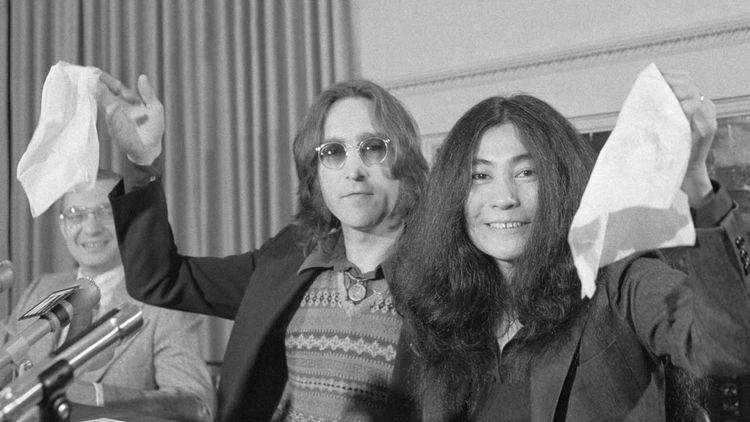
In the spring of 1973, John Lennon had a problem that fame could not solve. The United States government had ordered him deported, his immigration lawyer was fighting through a maze of statutes and administrative decisions, the FBI had accumulated files on his political associations, and Lennon had become convinced that his antiwar activity was part of the reason officials were so interested in removing him.
So Lennon and Yoko Ono responded in the most Lennon-and-Yoko way imaginable: they created another country.
They called it Nutopia. It had no territory, no borders, no passports, and no conventional laws; its flag was completely white, its citizens appointed themselves simply by recognizing that they belonged, and its national anthem was silence. The declaration was dated April 1, 1973, while Lennon and Ono publicly presented Nutopia at a New York press conference the following day, waving white handkerchiefs as the flag of their imaginary nation.


The photographs are essential to understanding the joke because Lennon and Ono did not present Nutopia as some private fantasy scribbled in a notebook. They sat behind microphones in front of reporters, produced the white flag, and performed the creation of a country with the visual grammar of an official diplomatic announcement.
That was the point. The United States was using the machinery of citizenship, admissibility, immigration status, residency, and deportation to decide whether Lennon was permitted to remain inside its borders, so Lennon and Ono answered by inventing a country where those categories had almost completely disappeared.
Project Abbey Road treats Nutopia as the moment when Lennon’s immigration case, Yoko Ono’s conceptual art, celebrity media, and state power all collided in a single performance. The manuscript describes it as a symbolic counter-state in which a man being told that he might not belong in America responded by claiming membership in a country that could not be found on any map.
The Story Really Begins With John Sinclair
Nutopia makes more sense if the story starts two years earlier in Michigan. John Sinclair was a poet, counterculture organizer, former manager of the MC5, and co-founder of the White Panther Party who received a prison sentence of roughly nine-and-a-half to ten years after giving two marijuana cigarettes to undercover officers. His punishment became a national cause among musicians and activists who considered the sentence extraordinarily severe.
Lennon and Ono entered that story on December 10, 1971, when they appeared at the John Sinclair Freedom Rally at the University of Michigan’s Crisler Arena in Ann Arbor. About 15,000 people attended, and Lennon performed a newly written song about Sinclair while sharing the bill with a large collection of activists, musicians, and public figures.
Sinclair was released three days after the rally when the Michigan Supreme Court ordered him freed pending further proceedings; the court later overturned his conviction in the course of broader litigation over Michigan’s marijuana laws. That timing turned the Ann Arbor concert into a powerful demonstration of what Lennon’s celebrity could do when attached to a political cause, although it would be too simple to say that Lennon alone caused the court to act.
The distinction matters because Washington did not need to believe Lennon controlled American politics to regard him as potentially useful to political organizers. A former Beatle could attract cameras, crowds, young voters, journalists, and national coverage simply by appearing in a room, and his fame could amplify causes far beyond the reach of ordinary organizers.
That is the shift the manuscript tracks. Lennon had been manufactured by the entertainment system into one of the most recognizable men on Earth, but once he began attaching that recognition to antiwar activism, criminal-justice controversies, and political organizing, the same scale that made him commercially valuable could make him politically inconvenient.
Lennon Had Become More Than a Former Beatle
Lennon and Ono moved to New York in 1971, and their American life quickly became entangled with radical politics, antiwar activism, downtown counterculture, and the increasingly bitter atmosphere surrounding President Richard Nixon’s 1972 reelection campaign. Lennon was not a conventional political organizer, but he possessed something few organizers could manufacture: an enormous international audience.
The FBI’s own released records confirm that federal investigators collected information about Lennon’s associations with antiwar and radical groups. Bureau files discussed his contacts, his immigration situation, alleged drug use, and political networks while trying to assess his significance.
The files are useful partly because they prevent the story from becoming mythology in either direction. They do not reveal Lennon secretly commanding a revolutionary organization, but they do show federal authorities attempting to understand what a globally famous musician might contribute to antiwar movements and other groups during an election year.
That ambiguity is central to the manuscript’s reading of the FBI material. Lennon appears simultaneously important and unserious in bureaucratic assessments: influential because his presence might mobilize attention, yet also characterized through drugs, celebrities, musicians, and countercultural associations that officials did not always regard as disciplined politics.
The government did not need Lennon to be Che Guevara. It only needed to consider whether a Beatle appearing at rallies could make other people more effective.
Then Immigration Law Became the Battlefield
The formal immigration problem had a much less theatrical origin. Lennon had pleaded guilty in Britain in 1968 to possession of cannabis resin, and when he later sought permanent residence in the United States, immigration authorities relied on that conviction in arguing that American law made him excludable. The legal proceedings also involved the expiration of his temporary status and a complicated dispute over whether the British conviction actually satisfied the requirements of U.S. immigration law.
This is important because the political history should not erase the official legal basis of the case. The government did not write an order saying Lennon was being deported because he opposed Nixon; the formal proceedings rested on immigration statutes and the British drug conviction.
Lennon and his attorney Leon Wildes, however, argued that the way the law was being applied to him was selective. Wildes eventually obtained records showing that the Immigration and Naturalization Service had given nonpriority treatment to many other deportable people, including more than 150 with narcotics convictions, while Lennon’s case was being pursued aggressively.
That argument became sufficiently substantial to enter federal litigation. A 1975 federal district court opinion described Lennon’s claim as essentially an allegation of selective prosecution based on his political associations and the possibility that his participation in demonstrations might embarrass the Nixon administration, although that case did not itself finally decide that political motive had been proven.
The distinction is critical. There is documented evidence of political concern about Lennon, and there was a serious legal allegation that immigration enforcement had been selectively deployed, but the eventual appellate victory that vacated his deportation order rested on statutory interpretation of his British cannabis conviction rather than a judicial finding that Nixon personally ordered Lennon deported for political reasons.
The Immigration Fight Was Happening in Public
Lennon and Ono were repeatedly photographed moving through immigration offices, press conferences, hearings, and public appearances while Wildes worked the legal side of the case. The image of Lennon as a revolutionary mastermind looks rather different when he appears in a suit carrying immigration paperwork with his lawyer beside him.


Wildes later recalled that the case involved a surprisingly aggressive pattern of government action compared with his normal immigration practice. He also discovered the administrative category then called nonpriority status, an exercise of prosecutorial discretion that allowed authorities to defer action against some otherwise deportable immigrants.
Lennon’s case consequently became larger than a celebrity immigration dispute. Wildes pursued government records showing how discretion actually operated, and PBS later noted that the legal history became part of the broader development of the modern concept of deferred immigration action.
For Lennon personally, however, the matter was simpler. On March 23, 1973, an immigration judge denied his application for permanent residence and ordered him deported while granting Ono’s application, leaving Lennon facing the real possibility that the United States could force him to leave.
Within days, Nutopia appeared.
A Country With No Border Is Hard to Deport Someone From
The Declaration of Nutopia was dated April 1, 1973. Lennon and Ono announced that the conceptual country possessed no land, boundaries, or passports, and declared every Nutopian citizen an ambassador while requesting diplomatic recognition and immunity in an intentionally impossible parody of statehood.
Yoko later explained that the white flag represented surrender to peace rather than victory through conflict. They even attached a physical remnant of the joke to their home by putting a NUTOPIAN EMBASSY plaque on the kitchen entrance of their Dakota apartment, allowing the imaginary country to acquire an embassy without ever acquiring territory.
The anthem was perhaps the best part. On Mind Games, the “Nutopian International Anthem” consisted of a few seconds of silence, transforming the conventions of state ceremony into conceptual art.
The manuscript sees exactly why this was effective. Immigration law had reduced Lennon to categories such as alien, resident, conviction, admissibility, discretion, order, and appeal, while Nutopia removed virtually every normal component of sovereignty except the declaration that a country existed.
Yoko’s role is indispensable here because this was as much Fluxus-style conceptual art as Lennon political theater. The empty flag, silent anthem, invented embassy, and self-declared citizenship all work according to the logic that an ordinary object or bureaucratic convention can be made strange simply by changing its context.
The press conference therefore accomplished something a legal brief could not. It made immigration bureaucracy visible by parodying the entire idea of national membership.
Elvis Had Already Walked Into Nixon’s White House From the Opposite Direction
There is an extraordinary counter-image sitting just behind the Lennon story. On December 21, 1970, Elvis Presley walked into Richard Nixon’s White House, expressed support for the president, asked for federal narcotics credentials, and told Nixon that the Beatles had contributed to what Presley regarded as anti-American sentiment. The official White House meeting notes record Presley making that claim and Nixon responding sympathetically to his concerns about drugs and protest.


The contrast does not prove that Elvis caused anything that later happened to Lennon, and there is no need to construct a secret chain between the two events. What makes the photograph useful is the way two enormous products of postwar pop culture had moved into very different relationships with political authority by the early 1970s.
Elvis presented himself to the administration as someone capable of reaching young people on behalf of an anti-drug and patriotic message. Lennon, meanwhile, was entering antiwar circles, supporting John Sinclair, associating with activists, and becoming the subject of federal surveillance and an increasingly contentious immigration battle.
The manuscript calls this the “Elvis mirror.” The earlier symbol of dangerous youth had become welcome in the Oval Office, while a former Beatle who had once seemed harmless enough for American television was becoming a problem federal agencies had to classify.
The FBI Was Powerful, but It Was Not Omniscient
One of the best reasons to look at the actual Lennon files is that they make federal surveillance look more bureaucratic than cinematic. Agencies collected information, exchanged reports, followed associations, and tried to determine what political importance Lennon actually possessed.
That process could also be messy. Project Abbey Road emphasizes the gap between the popular image of an all-seeing surveillance system and the actual paperwork of officials attempting to categorize a celebrity who moved among musicians, activists, drugs, antiwar organizers, journalists, and political theater.
The result is more interesting than the idea of a perfectly coordinated secret operation. Lennon was significant precisely because officials did not have an easy category for someone whose primary power consisted of being able to turn attention into an event.
He had no constituency in the electoral sense and controlled no government office. What he had was an audience trained by Beatlemania to look whenever he appeared.
Nutopia Turned Weakness Into Theater
That is what makes Nutopia such a clever response to deportation. Legally, Lennon remained vulnerable because proclaiming an imaginary country obviously could not cancel an order issued under U.S. immigration law.
Symbolically, however, it changed the frame. The story was no longer simply that immigration authorities had decided whether a British musician could stay in America; now the deportable musician was sitting at a press conference declaring himself an ambassador of a nation with no territory.
The manuscript describes this as Lennon’s ability to make power look strange. His Bed-Ins forced war reporters to conduct political interviews beside a honeymoon bed, his Sinclair performance transformed an obscure marijuana case into national music news, and Nutopia transformed immigration paperwork into a question about what borders and citizenship actually mean.
That did not make Lennon a coherent revolutionary theorist. It made him unusually good at converting abstract institutional power into images that newspapers and television could reproduce.
Yoko was equally important to that method. Conceptual art gave the pair a vocabulary in which a blank flag could become an argument and several seconds of silence could become a national anthem.
The Government Case Eventually Collapsed on a Legal Question
Lennon continued fighting the deportation order after Nutopia was announced. His case moved through the Board of Immigration Appeals and federal courts while Wildes pursued both the statutory problem and the broader allegation that Lennon had been treated differently for political reasons.
The decisive appellate ruling came on October 7, 1975. The U.S. Court of Appeals for the Second Circuit held that Lennon’s 1968 British conviction did not make him excludable under the particular American statutory provision the government had relied upon, vacated the deportation order, and sent the case back for reconsideration.
That victory is sometimes compressed into the idea that Lennon “proved Nixon tried to deport him,” but the actual history is more precise. The court won Lennon relief by interpreting immigration law in his favor; the separate selective-prosecution allegation existed alongside the case and was supported by enough evidence to be seriously litigated, but it was not the basis of the Second Circuit’s final ruling.
Lennon received permanent resident status in 1976. The man who had publicly invented a borderless country while fighting deportation was now legally allowed to remain inside the United States.
Nutopia Was a Joke That Explained the Serious Part
Nutopia never possessed land, armed forces, tax collectors, customs offices, courts, or a seat at the United Nations. It was never supposed to function as a literal sovereign state, and treating it as an actual legal strategy misses what Lennon and Ono were doing.
The joke worked because the real paperwork surrounding it was so serious. Lennon’s right to remain with his wife, home, friends, career, and political community was being determined through government categories that most people encounter only when those categories suddenly acquire the power to rearrange their lives.
Nutopia removed the categories one by one. No border meant nobody could cross it illegally, no passport meant nobody could lack the proper one, voluntary citizenship meant no government office could revoke it, and a blank white flag turned surrender itself into the national symbol.
That is why Project Abbey Road gives the episode more weight than a quirky Lennon anecdote. It is the point where the Beatles machine, having created a celebrity large enough to move products and audiences across borders, suddenly confronted the older machinery that decides whether the physical person behind the celebrity is allowed to cross a border at all.
The contradiction is almost perfect. Beatles records could enter the United States by the millions, Lennon’s face could appear everywhere, American radio could broadcast his voice instantly, and American companies could profit from his work, while the government simultaneously debated whether John Lennon himself was permitted to remain in the country.
Nutopia turned that contradiction into a white flag.
Why It Matters to Project Abbey Road
The larger story of the Beatles is full of machines that make people larger than their physical bodies. Television transformed four musicians into a synchronized national event, records allowed performances to exist everywhere at once, Apple turned a band into a corporation, publishing converted songs into transferable property, and the press turned every gesture into reusable cultural material.
Lennon’s immigration fight revealed what happened when that manufactured scale escaped entertainment. The government was no longer dealing only with a British musician who had an old drug conviction; it was dealing with someone whose appearance at a rally could become national news and whose deportation hearing could become an international political story.
Nutopia was the most elegant joke Lennon and Ono found inside that contradiction. America could classify Lennon as an alien, but it could not prevent him from declaring himself ambassador of somewhere else entirely.
The physical government had courts, files, immigration judges, FBI agents, forms, deadlines, and deportation orders. Nutopia had a white handkerchief, several seconds of silence, an embassy plaque on a kitchen door, and two people willing to announce that a country existed because they said it did.
The real government obviously possessed the legal power.
The imaginary country got the better photograph.
Project Abbey Road: The Beatles, Apple, and the Machine That Made Pop Immortal follows Lennon’s path from manufactured global pop star to political problem, through John Sinclair, the FBI records, Nixon-era immigration pressure, Nutopia, and the larger machinery that kept transforming the Beatles from musicians into symbols, properties, political objects, and eventually ghosts. Project Abbey Road on Amazon.