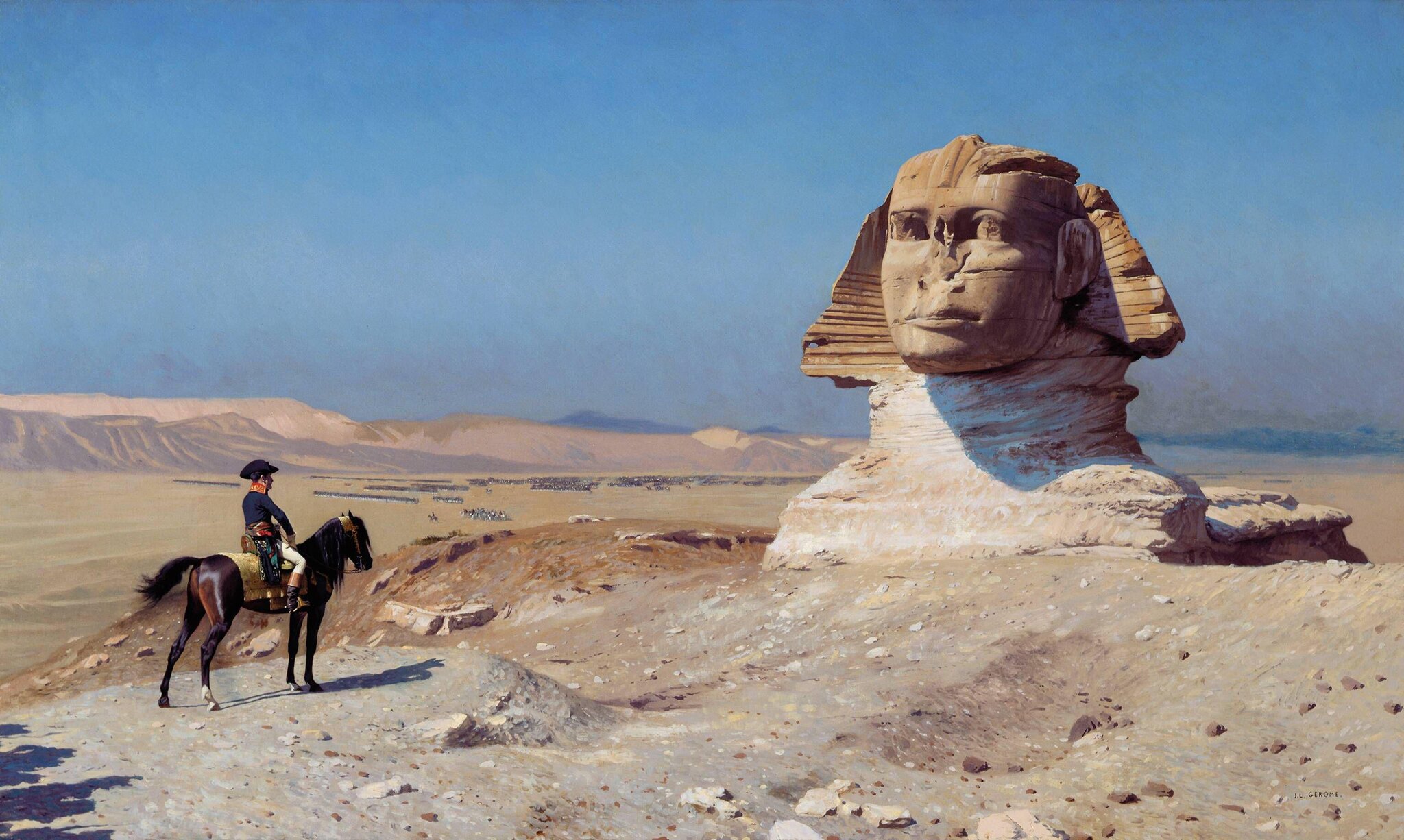
The easiest version of this story is also the weakest one: Alessandro Cagliostro secretly initiated Napoleon Bonaparte, transmitted an ancient Egyptian mystery tradition to him, and Napoleon carried that hidden current into Egypt and the French Empire. Versions of that story have circulated in later Masonic and occult literature, but the documentary record does not support it. Cagliostro died in 1795, three years before Napoleon sailed for Egypt, and the scholarly history of Italian Freemasonry specifically describes Napoleon’s supposed Egyptian-Masonic initiation as a tradition unsupported by written evidence.
What survives underneath that legend, however, is considerably more interesting. Cagliostro had already made Egypt the center of an experimental Masonic system in the 1780s. Napoleon’s Egyptian campaign then transformed European fascination with Egypt on an enormous scale. Within a few years, Napoleon’s brothers, relatives and senior officials occupied leading positions throughout Continental Freemasonry, while an Egyptian Rite of Misraïm appeared inside the Napoleonic Italian world. An academic history of the Grand Orient of Italy explicitly describes that Misraïmic current as an expression of an eastern fascination “dating back to Cagliostro” that returned to fashion after Napoleon’s Egyptian expedition.
There was no necessary secret handshake between Cagliostro and Bonaparte. There was something larger: a change in the political ownership of the world in which Cagliostro’s Egyptian idea had been born.
4
The visual sequence tells much of the story: Cagliostro as an eighteenth-century European celebrity; Napoleon in the imagery of the Egyptian expedition; Joseph Bonaparte as king; and Caroline Bonaparte Murat, who would occupy her own place within the Masonic culture of the imperial family.
Cagliostro Had an Egyptian Rite Before Napoleon Had Egypt
When Napoleon’s army landed in Egypt in 1798, Cagliostro had already been dead for nearly three years. His Egyptian Masonry was older still.
The strongest evidence sits not in later occult genealogies but in an actual surviving manuscript. The French collective manuscript catalogue records MS 6871, Rituel de maçonnerie égyptienne pour la loge de la Sagesse triomphante. It dates the manuscript to 1784–1785, identifies La Sagesse Triomphante at Lyon as the mother lodge of Cagliostro’s High Egyptian Masonry, and describes Cagliostro as the “Grand Cophte.” The manuscript was produced by the lodge’s venerable, Saincostart, during Cagliostro’s stay in Lyon from October 1784 to January 1785.
This is an important anchor because it stops us from confusing two very different propositions. There is no evidence that Cagliostro possessed a lodge charter descending uninterrupted from the priests of ancient Egypt. There is excellent evidence that Cagliostro really organized an eighteenth-century Masonic system that he deliberately called Egyptian.
His system was not merely ordinary Masonry with pyramids painted on the walls. Carlo Francovich’s substantial biographical entry for Treccani describes Cagliostro’s rite as a mystical system promising the regeneration of body and soul through initiations and ritual practices. Men and women could participate, provided they had the necessary Masonic qualifications, and Cagliostro presided under the title Gran Cofto, while his wife Lorenza—Serafina within the Cagliostro persona—had authority over the female work.

The first image preserves wording associated with Cagliostro’s Lyon Egyptian foundation and its claim to restore Masonry to its “true form” and “primitive purity.” The second is a later nineteenth-century representation of female initiation in the so-called Rite of Cagliostro, so it should be treated as retrospective imagery rather than eyewitness documentation. The third is James Gillray’s famous satirical treatment of Cagliostro’s Masonic celebrity. Together they show how quickly the Egyptian system moved from private ritual into public mythology.
Naples Appears Before the Bonapartes
Naples is the geographical hinge that makes the later Bonaparte story especially interesting.
Treccani’s biography places Cagliostro and Lorenza in Naples more than once. It notes their return there in the 1770s and another Neapolitan stop during the period immediately preceding the establishment of the Lyon Egyptian system. The documentation for exactly what Cagliostro did in Naples is not strong enough to claim confidently that a functioning Egyptian mother lodge existed there before Lyon, and later accounts often embellish his Neapolitan activities. What is secure is that Naples belonged to Cagliostro’s Mediterranean circuit before the Egyptian Rite was formally established at Lyon.
That matters because Naples already possessed an unusually rich eighteenth-century environment of Masonry, reform politics, aristocratic culture and esotericism. The scholarly History of the Grand Orient of Italy describes Neapolitan Freemasonry as one of the significant Italian centers of Enlightenment-era intellectual and political networking, particularly around figures such as Gaetano Filangieri and Francesco Mario Pagano.
Cagliostro therefore passed through a city already capable of supporting the mixture that defined his career: aristocrats, reformers, secret societies, foreign travelers, court connections and rival forms of institutional authority.
He could not have known what would happen to Naples twenty years later.
The Bonapartes were coming.
Then Napoleon Went to Egypt
The French expedition of 1798 changed the cultural meaning of Egypt in Europe.
Napoleon’s campaign was military, colonial and scientific at once. The soldiers brought with them a large Commission of Sciences and Arts, while the expedition ultimately produced the monumental Description de l’Égypte. Egypt ceased to exist merely as the largely imagined Hermetic landscape available to eighteenth-century occultists. Europeans now encountered a torrent of measured monuments, antiquities, drawings, architecture and archaeological description.
That did not destroy the older esoteric Egypt.
It supercharged it.
The Napoleonic Egyptian image consequently operated on several levels simultaneously. Egypt was a battlefield and imperial possession, but it was also an antiquarian revelation. The civilization Cagliostro had invoked symbolically in the 1780s became one of the defining cultural obsessions of post-1798 Europe.
This is where the academic history of Italian Freemasonry becomes unusually valuable. Discussing the Napoleonic period, it records the emergence in Milan of a Rite of Misraïm claiming Egyptian origin and characterizes it as part of “a fascination with the east dating back to Cagliostro” which had returned to fashion following Napoleon’s Egyptian campaign. The same source immediately warns that the tradition claiming Napoleon himself was initiated during that campaign lacks written evidence.
That is almost precisely the distinction we need.
The unsupported legend says Napoleon received Cagliostro’s secret.
The evidence supports something broader: Cagliostro had already made Egyptian initiation culturally available, and Napoleon’s Egypt made Egypt culturally explosive.
The Bonapartes Take Over the Masonic Machine
Then something happened that Cagliostro could never have accomplished.
A ruling dynasty moved into Freemasonry’s senior offices.
Joseph Bonaparte had been initiated in 1793, according to the Fondation Napoléon’s history of Imperial Masonry. On 9 November 1804 he was appointed Grand Master of the Grand Orient de France. Louis Bonaparte was Grand Master of the competing Grande Loge Générale Écossaise, and Napoleon pushed the two bodies toward an act of union signed on 5 December 1804. Cambacérès and Lebrun occupied additional senior positions. The Fondation Napoléon goes so far as to describe the resulting Grand Orient as, for practical purposes, an imperial institution whose members pledged obedience to the laws, attachment to the government and recognition of the Emperor.
This does not mean Napoleon personally became the secret Grand Master of a Cagliostrian Egyptian order. It means something more historically concrete. The Bonapartist state recognized Masonic networks as useful structures, and members of the dynasty were installed at their highest levels.
The pattern spread with the Empire. Jérôme Bonaparte became associated with Masonic leadership in Westphalia. Eugène de Beauharnais stood at the head of the new Masonic structure in Napoleonic Italy. The Grand Orient of Italy emerged in 1805, as the new Kingdom of Italy was being constructed under Napoleonic authority. The scholarly history of that body describes the lodges of this period as meeting points for the Franco-Italian military and bureaucratic elite and notes that Napoleonic policy gave Italian Freemasonry a semi-official political role.
Cagliostro had spent the 1780s trying to build an international mystical network around the authority of the Grand Cophte.
The Bonapartes inherited an empire capable of doing something very different: building a Masonic network alongside the state itself.
Joseph Bonaparte Arrives in Naples
The connection tightens dramatically in 1806.
Napoleon placed his elder brother Joseph Bonaparte on the throne of Naples. The same scholarly history that discusses Cagliostro and the revived Egyptian fascination records Joseph as Grand Master of the Grand Orient in Naples during his reign, before he left for Spain in 1808.
This puts Joseph in a remarkable position.
Twenty-odd years after Cagliostro had moved through the Neapolitan world while developing the identity of the Grand Cophte, Napoleon’s brother entered the same kingdom as its monarch while simultaneously standing near the top of Continental Freemasonry.
Nothing in the evidence requires Joseph to have inherited a secret Cagliostrian archive. The institutional continuity is more general and more defensible. Naples remained one of the places where Masonry, government and elite social networks intersected, except the political context had completely changed.
Under Cagliostro, Egyptian Masonry existed on the margins of established authority.
Under Joseph, Masonry was being occupied by established authority.
That is a significant reversal.
Murat Makes Naples Even More Interesting
Joseph left Naples in 1808 when Napoleon transferred him to the Spanish throne. He was succeeded by Napoleon’s brother-in-law, Joachim Murat, husband of Caroline Bonaparte.

Murat himself had actually participated in Napoleon’s Egyptian campaign. Fondation Napoléon records him commanding in Egypt before his spectacular ascent through the imperial military system and eventual installation as King of Naples.
The academic history of Italian Freemasonry says Murat succeeded Joseph in the Neapolitan Masonic structure and placed prefects and commissioners in positions associated with the lodges in order to guard against political opposition.
That is a long way from Cagliostro’s vision of the lodge.
But it occupies some of the same institutional terrain.
The Grand Cophte had offered initiates access to a purportedly primordial authority beyond the conventional state and church. The Napoleonic system increasingly folded Masonic networks into the administrative orbit of the new regime.
The secret society had not disappeared.
It had changed its relationship to power.
Caroline Bonaparte and the Female Parallel
There is another connection here that is easy to overlook and should be treated as a parallel rather than a documented transmission.
Cagliostro’s Egyptian Masonry was striking in part because it provided a formal place for women. Treccani records the Parisian Egyptian lodge Isis admitting both men and women, with Serafina presiding over the women’s assemblies.
Two decades later, the Bonapartist Masonic world likewise contained organized lodges of adoption for women. Fondation Napoléon’s account of Imperial Masonry records Caroline Bonaparte as Grande-Maîtresse des loges d’adoption in the Kingdom of the Two Sicilies.


We should resist the temptation to draw a straight line from Serafina Cagliostro to Caroline Bonaparte. I have not found evidence demonstrating such an institutional succession.
But visually and structurally the comparison is fascinating.
In Cagliostro’s world, the female lodge formed part of a mystical Egyptian system headed by a charismatic couple. In the Bonapartist world, female Masonic organization appeared inside a dynastic court whose members were simultaneously kings, queens and senior figures in an imperial political structure.
The similarity tells us something about the changing social possibilities of Masonry between the 1780s and 1800s without requiring a secret genealogy to explain it.
Misraïm: Where the Two Histories Nearly Touch
The Rite of Misraïm is where Cagliostro and Bonapartism come closest to occupying the same historical sentence.
“Misraïm” is itself a biblical name for Egypt. The nineteenth-century rite eventually developed an enormous hierarchy of degrees and a complicated legendary history. Later Egyptian Masonic traditions frequently attempted to push their lineage far backward—to ancient Egypt, to biblical patriarchs, to Mediterranean initiates, and naturally to Cagliostro.
Those genealogies must be handled cautiously.
But the appearance of Misraïm during the Napoleonic era is historically significant. The scholarly History of the Grand Orient of Italy records a Rite of Misraïm in Milan during the Napoleonic period and explicitly connects the environment surrounding it with a renewed eastern fascination extending back to Cagliostro and revived by the Egyptian expedition.
At the same time, the new Grand Orient of Italy was created in 1805 under Napoleonic political conditions, with Eugène de Beauharnais, Napoleon’s adopted son and viceroy, at its head. The same study describes Italian Freemasonry as becoming partially unified and semi-official within the imperial order.
Now the pattern becomes visible.
Cagliostro provides an influential eighteenth-century model of Egyptianized initiation.
Napoleon provides the expedition that radically magnifies Europe’s Egyptian imagination.
The Bonapartes provide an imperial family deeply placed within the Masonic institutional world.
Napoleonic Italy provides a political environment in which Masonic organizations expand.
Misraïm appears within that same world claiming Egyptian identity.
That is a much more persuasive historical connection than saying Napoleon secretly met Cagliostro.
Why the Legend of Napoleon’s Initiation Appeared
It is also easy to understand why later writers wanted to close the gap.
Napoleon had gone to Egypt. Cagliostro had possessed an Egyptian Rite. Egyptian-style Masonry became prominent afterward. Members of Napoleon’s family really did hold extraordinary Masonic offices. Joseph really was Grand Master of the Grand Orient de France. Murat really did rule Naples. Eugène really did stand over the Masonic structure of Napoleonic Italy.
The pieces practically beg to be assembled into a hidden lineage.
But chronology and association are not transmission.
The academic history we have been using explicitly mentions the tradition that Napoleon was initiated during the Egyptian expedition and immediately notes the absence of written evidence.
That warning actually strengthens the rest of the argument because we do not need the initiation story.
The documented connections are already remarkable.
From the Grand Cophte to the Imperial Lodge
What changed between Cagliostro’s Lyon lodge of 1784 and Joseph Bonaparte’s Grand Orient twenty years later was the relationship between mystery and government.
Cagliostro operated by claiming access to an authority older than the European institutions surrounding him. His title “Grand Cophte,” his Egyptian Rite, his language of primitive purity and his system of regeneration all pointed toward an imagined eastern source beyond ordinary political legitimacy.
Napoleon’s system did something almost opposite.
It absorbed networks.
Rather than standing outside government, leading Masonic organizations could now be headed by members of the ruling family. Joseph occupied the Grand Orient. Louis occupied another senior Masonic office. Jérôme’s Westphalian monarchy had its Masonic structure. Eugène headed Italian Masonry. Caroline occupied a senior position within women’s adoption Masonry. Cambacérès became the great administrative organizer of the imperial Masonic world. Fondation Napoléon’s own history describes Napoleon pushing for a strong and unified Masonic structure.
This does not make Bonapartism “Cagliostrian.”
It shows how rapidly the social technology surrounding Cagliostro changed.
The mysterious lodge of the 1780s and the imperial lodge of the 1800s belonged to different political worlds, yet Egyptian symbolism survived the transition.
Naples Is the Hinge
This is why Naples deserves much more attention in the story than it usually gets.
Cagliostro passed through it before Lyon and before his Egyptian system reached its greatest fame. Naples already possessed one of Italy’s important Masonic and reform networks. Napoleon then conquered the peninsula. Joseph Bonaparte became King of Naples and occupied senior Masonic offices. Murat followed him and brought with him the personal experience of Napoleon’s Egyptian campaign. Caroline Bonaparte became Queen of Naples while occupying a place in women’s adoption Masonry. At approximately the same historical moment, Egyptian Masonry in the form of Misraïm appeared elsewhere within the Napoleonic Italian sphere.
That does not prove a hidden Neapolitan archive passing from Cagliostro to Joseph to Murat.
It gives us something historians can actually work with: the same Mediterranean corridor, the same Masonic social world, a dramatic change of political regime, and the reappearance of Egyptian initiatory language after Napoleon’s expedition.
The connection is cultural and institutional rather than a documented master-to-disciple succession.
And in some ways that makes it more important.
Before Napoleon Went to Egypt, Cagliostro Had Already Invented an Egypt
Cagliostro never saw Napoleon’s pyramids.
He never saw Joseph Bonaparte become Grand Master.
He never saw a Bonaparte on the throne of Naples.
He never saw Murat return from Egypt and eventually become king there.
He never saw Misraïm develop into one of the great Egyptian Masonic systems of the nineteenth century.
Yet when those things happened, Europeans were moving through an imaginative landscape in which Cagliostro had already planted a flag.
His Egypt was not Napoleon’s archaeological Egypt. It was not the Egyptologists’ Egypt that would emerge from the Rosetta Stone. It was an initiatory Egypt: Coptic, Hermetic, regenerative, priestly and supposedly primordial. It was a place from which authority could be claimed precisely because European institutions could not easily verify it.
Napoleon transformed Egypt from esoteric geography into imperial spectacle.
The Bonapartes then presided over a Continental Masonic system expansive enough to carry new rites, new degrees and new political loyalties across borders.
And somewhere inside that Napoleonic world, historians find the Rite of Misraïm—claiming Egypt, looking eastward and emerging from a fascination that a modern academic history explicitly traces back toward Cagliostro.
That is the connection.
Not Cagliostro whispering a password into Napoleon’s ear.
Something bigger.
Cagliostro helped make “Egypt” an initiatory language before Napoleon made Egypt an imperial one. The Bonapartist Masonic world brought those two histories into the same room.