The modern automated building is usually explained backward from computers. We start with software dashboards, electronic thermostats, badge readers, smoke detectors, cameras and HVAC controllers, then describe older equipment as primitive versions of those devices. That makes the history look as though automation suddenly arrived when electronics became sophisticated enough.
The longer history suggests almost the opposite. By the time computers entered the building, engineers had spent roughly a century constructing the conceptual machinery the computer would inherit. Telegraphy established that information could be separated from the physical event that produced it. Burglar alarms attached that principle directly to architecture. Central stations collected signals from many remote buildings. Telephone exchanges proved that the same wires could become interactive networks. Automatic regulators then shortened the loop between sensing and action, until a building no longer needed to tell a person what had changed before machinery could respond.
The forgotten history between the telegraph key and the modern building-management system is therefore the history of one increasingly sophisticated loop: sense what is happening, turn it into a signal, carry the signal somewhere useful, compare reality with the desired condition, and cause something to happen in response.
Before the Thermostat, There Was the Telegraph
Long before buildings could regulate themselves, nineteenth-century Americans had to learn the stranger idea that information could travel independently of the person, object or event it described. Telegraphy established that principle on a continental scale. A physical action at one point produced an electrical state that could be recognized at another point, allowing an operator hundreds of miles away to reconstruct information without seeing the original event.
That sounds obvious after nearly two centuries of electronic communication, but it changed the relationship between geography and administration. Railroads could coordinate trains at distant stations, businesses could receive information before physical documents arrived, and organizations could begin supervising territories larger than any individual manager could see.
The telegraph did something even more important conceptually: it taught engineers that electricity did not have to provide mechanical power to be useful. Electricity could represent information.
That becomes the foundation beneath everything that follows.
Augustus Pope Turns the Door Into a Telegraph Event


These two images show the first great reduction in scale. Instead of transmitting a message between cities, Augustus Russell Pope’s 1853 electromagnetic burglar alarm used an electrical circuit to represent what was happening at a door or window. His U.S. Patent No. 9,802 described contacts that changed state when an opening was disturbed, activating an electromagnet and causing a hammer to ring a bell continuously while the opening remained in the alarm condition.
The little demonstration house in the second image makes the idea easier to understand than the patent drawing. The house itself has become part of the circuit. A door is no longer merely physically open or closed; its condition can now be translated into electrical information.
This is the conceptual birth of the sensorized building.
Pope did not invent electrical communication, and his own patent expressly acknowledged that communicating intelligence through an electric circuit and magnet was already known. His contribution was applying that electrical logic to architectural state: the building could automatically announce that something had changed.
That sounds like a small step until one realizes that almost every modern building-control point follows the same abstraction. A smoke detector translates air conditions into a signal. A thermostat translates temperature into a signal. A pressure transducer translates the condition of a pipe into a signal. An access sensor translates a door’s state into a signal.
Pope begins with the door.
Edwin Holmes Realizes the Bell Does Not Have to Stay in the House
Edwin Holmes acquired Pope’s alarm rights and commercialized the system. The Holmes Electric Protective Company’s own 1924 history recalled Holmes bringing a portable demonstration house to New York in 1858 because electricity was still unfamiliar enough that customers needed to see the alarm operate before they believed it. Opening a little window or door caused the bell to ring, making the invisible electrical relationship between architecture and signal immediately understandable.
The more consequential development came when Holmes stopped treating the alarm as a self-contained appliance. In 1872, the Holmes Burglar Alarm Telegraph Company was organized specifically to furnish protection through central stations. By January 1882, the company recorded two New York central stations serving 471 subscribers.
That changes the architecture completely. The protected building no longer needs the person responsible for interpreting the alarm to be standing inside it, because the electrical signal can leave the premises and arrive at a remote center.
A door has become a remote data point.
That is central monitoring.
The Central Station Is the Missing Link Between Telegraph and Computer
The importance of the central station is easy to miss because the operators and equipment remained thoroughly mechanical. There were no screens full of floor plans, no software alarms and no cloud connection, yet the informational structure already looks familiar.
Many remote endpoints communicate toward one location. The center must distinguish one subscriber from another, determine what a particular signal means and coordinate whatever response follows. Human attention becomes concentrated while sensing becomes geographically distributed.
This is the same economy that later makes computer monitoring powerful. One person cannot continuously stand beside every door, boiler, air handler or fire detector in a large building, but a central system can wait for thousands of mostly normal points to report exceptions.
Holmes had begun constructing that architecture before the modern telephone exchange existed.
Then something remarkable happened: the alarm network helped demonstrate what a telephone network could become.
The Burglar Alarm Becomes a Telephone Exchange


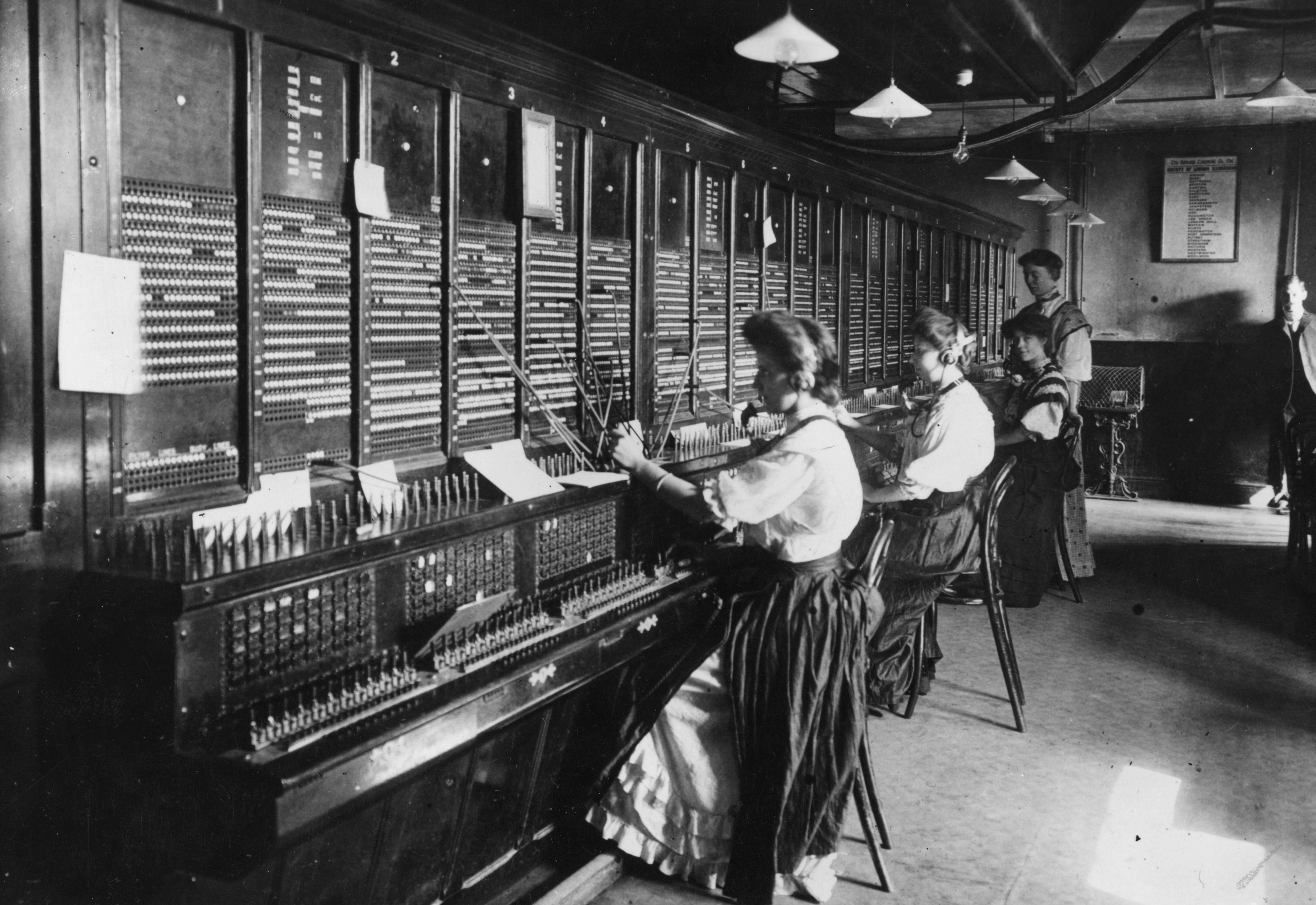
The first image shows the compact switchboard form emerging at the beginning of telephone exchange service, while the second shows the mature human-operated exchange that followed. Rows of individual subscriber connections converge on a central point, and the operator creates temporary relationships between people who are physically separated.
In May 1877, Edwin T. Holmes used Bell telephones as an accessory to the Holmes central-office burglar-alarm system in Boston. A contemporary technical history published in 1906 recorded five alarm wires passing through a small brass pin switchboard so that a telephone could be connected to individual alarm lines. The system expanded rapidly enough that by March 1878 it reportedly had 256 hand telephones in use.
A Boston engineering history likewise described alarm lines radiating from the Holmes central station at 342 Washington Street to banks and stores, with those same lines adapted experimentally for telephone conversations. Telegraph-style alarm signaling and spoken communication were temporarily occupying the same electrical geography.
That is an extraordinary bridge in the history of networks. A system built to answer the question “Has something changed at this remote property?” becomes a system capable of answering “Which remote person would you like to communicate with?”
The wires stay.
The meaning carried by them changes.
The Telephone Makes the Network Interactive
The alarm network mostly moves information in one direction. Something happens at a protected site and the signal moves toward the center, where a person interprets it.
The telephone changes that relationship because communication can now move both ways in rich human form. The central exchange becomes an interactive switching system rather than merely an alarm receiver.
A 1920s Bell System history described the Holmes Boston switchboard as connecting four banks and a manufacturing concern over lines that served telephone purposes during the day and burglar-alarm purposes at night. New Haven then opened a larger commercial exchange in January 1878.
This matters to automation because the telephone exchange taught an entire generation to think of remote buildings as subscribers attached to a center. Each endpoint had an identity. The center knew how to reach it. The network could route information between endpoints without physically moving the people involved.
An alarm system had taught the house to call outward.
The telephone taught the network to talk back.
The Building Still Could Not Correct Itself
At this stage, however, a crucial element remained missing. Telegraphy could transport information, the alarm circuit could detect a change, and the central station could interpret the signal, but a human still usually had to complete the physical response.
A burglar alarm could summon a watchman.
A fire alarm could summon firefighters.
A telephone could summon a mechanic.
The system possessed something resembling nerves but very few automatic reflexes.
The next breakthrough would come from an entirely different problem: keeping a coal-heated room comfortable.
Albert Butz Gives the Building a Reflex
The mechanism above belongs to the Minneapolis Heat Regulator lineage that eventually became one half of Honeywell. Its levers, electrical terminals and mechanical linkages make it look closer to a burglar alarm than to the sleek thermostat most people associate with twentieth-century homes, and technologically that resemblance is meaningful.
Albert M. Butz patented a thermo-electric damper regulator and alarm in 1886. His patent described a system intended to operate furnace dampers or valves as room temperature rose or fell and to sound an alarm if the temperature dropped far enough to suggest that the furnace required attention.
The important word is operate.
Pope’s alarm detects a changed condition and rings a bell.
Holmes’s network sends the changed condition somewhere else.
Butz’s regulator detects an environmental condition and causes machinery to alter the physical system producing that condition.
The loop has started closing.
The Regulator Changes the Direction of the Signal
This is where the thermostat becomes much more than a convenient household device. A simple alarm can be described as environment → sensor → signal → human. Automatic regulation adds another stage: environment → sensor → controller → machinery → changed environment.
The output comes back around and affects the thing being measured.
That is feedback.
Honeywell’s company history traces its Minneapolis lineage directly to Butz’s furnace regulator, which it describes as the predecessor of the modern thermostat. The business passed through the Consolidated Temperature Controlling Company and Electric Heat Regulator Company before W. R. Sweatt ultimately developed it into Minneapolis Heat Regulator Company.
The technological leap is larger than the corporate succession. Once a device can continuously compare actual conditions with desired conditions and automatically manipulate machinery to reduce the difference, the building has acquired a primitive form of self-regulation.
The alarm tells someone the room is cold.
The regulator opens the damper.
Then Wabash Enters the Story
While that automatic-control lineage was developing in Minneapolis, Mark C. Honeywell was building a separate heating business in Wabash, Indiana. Honeywell’s corporate history dates the Honeywell Heating Specialty Company to 1906, centered on hot-water heat generators and related equipment.
That Wabash origin matters because the Honeywell story did not begin as an abstract electronics company. It began with buildings as physical systems: boilers, water, pipes, heat distribution and the practical problem of maintaining useful environmental conditions.
By the 1920s, the Minneapolis regulator business and the Wabash heating business had become complementary. One side had developed automatic regulation; the other had developed heating equipment and control expertise around another kind of building system.
In 1927 they merged as Minneapolis-Honeywell Regulator Company. The Minnesota Historical Society’s corporate history records that Minneapolis Heat Regulator and Honeywell Heating Specialties combined that year, bringing the Wabash and Minneapolis branches of the story together.
The company name now contained both traditions.
The Thermostat Shrinks a Control Room Onto the Wall


These Honeywell Round thermostats look almost trivial compared with a telephone switchboard full of operators. That simplicity is the achievement. By the middle of the twentieth century, an elaborate nineteenth-century control problem had been compressed into a device ordinary people could operate by twisting a dial.
The Round was developed by engineer Carl Kronmiller and industrial designer Henry Dreyfuss, with work beginning before World War II and the commercial product introduced in 1953. The Minnesota Historical Society describes it as easy to manufacture, easy to use and eventually one of Honeywell’s best-known products, while Cooper Hewitt notes that Dreyfuss deliberately pursued a circular form partly because rectangular thermostats had a habit of looking crooked when mounted on walls.
Inside the beautifully simple object is a much older systems history. Temperature changes a sensing element. The thermostat compares that condition with the user’s setting. Electrical contacts change state. Remote heating or cooling machinery responds.
The person does not need to understand the boiler.
The thermostat does not need to know why the person wants seventy degrees.
The system only needs a desired value, a measured value and machinery capable of changing the environment.
That is control.
The User Becomes a Set Point
There is an interesting human transition hidden inside the thermostat. With the old burglar alarm, the person remains the ultimate interpreter of the signal. With automatic temperature regulation, the person increasingly enters the system only by specifying the desired condition.
The human says, in effect, “Make the room this temperature.”
After that, the machinery performs repeated observations and corrections without requiring a new human decision each time the temperature changes.
This is what a set point does. It reduces a human intention to a value the control system can repeatedly compare against reality.
A thermostat therefore does something much more profound than turn the furnace on and off. It translates a human preference into machine-readable control logic.
That same principle eventually spreads throughout the building.
The Clock Teaches the Thermostat About Time
The next step was allowing desired conditions themselves to change automatically. Minneapolis-Honeywell’s Chronotherm line added clock-based scheduling, so the system could maintain different temperatures at different times without requiring the occupant to adjust it manually every morning and evening.
The Smithsonian describes a Minneapolis-Honeywell TM850 Chronotherm from the 1950s as part of a product line dating back to 1935, created specifically to automate changes that conventional thermostats required occupants to make by hand.
Now the building possesses more than feedback.
It possesses a schedule.
The control system can understand that the desired condition at midnight is different from the desired condition at breakfast. Time has become another input.
This is already recognizably programmable behavior.
One Thermostat Becomes Hundreds of Control Points
The domestic thermostat is easy to understand because it usually controls one obvious variable. Commercial buildings quickly became much more complicated.
A large office, hospital, school or factory contains multiple heating zones, fans, dampers, pumps, boilers, chillers, pressure conditions and safety systems. Each subsystem may require sensors and actuators, while the building operator needs some means of knowing what all of those separate machines are doing.
Honeywell’s archival catalog shows the extraordinary breadth of this mid-century expansion: pneumatic control, motorized valves, individual office temperature control, zone control, fire detection, hospitals, schools, industrial applications, railway controls and automatic-control systems all appear in the company’s historical records.
The control problem has therefore returned to something resembling the old Holmes central station.
There are many endpoints again.
The difference is that the endpoints are no longer merely doors.
They are pieces of machinery.
The Central Station Comes Back Inside the Building
This is one of the most interesting circular movements in the whole history. Holmes’s burglar-alarm central station had taken information from many separate buildings and concentrated it in one office.
Twentieth-century building control takes many separate systems inside one large building and concentrates their information in a central control room.
A hospital operator does not want to walk to every air handler to learn whether it is operating.
A boiler engineer does not want to visit every room to determine temperature.
A facility manager does not want independent panels scattered across the property if important conditions can instead be brought together.
The building begins constructing its own internal central station.
The old citywide alarm architecture has been miniaturized into the structure.
The Alarm Contact and Thermostat Meet Again
This convergence also brings security and environmental control back together. The nineteenth-century burglar contact and the nineteenth-century regulator developed as different technologies because they solved different commercial problems, but electrically they were always related.
Both take a physical condition and represent it as a signal.
A door contact asks whether the opening has changed state.
A thermostat asks whether temperature has crossed a threshold.
A smoke detector asks whether combustion products are present.
A pressure control asks whether a mechanical system is inside its safe operating range.
Once all of those devices communicate electrically, the building owner has little reason to insist that each must live in an entirely separate informational universe.
Integration becomes the obvious next step.
Honeywell Begins Integrating the Building
Honeywell’s own retrospective history places an important convergence in the 1970s. The company says its Alpha 1000 and Delta systems brought fire, security and energy-management functions together on unified building-management platforms during that period.
That company account should be understood as Honeywell describing its own technological lineage, but the broader transition is undeniable. By the late twentieth century, digital electronics allowed building-control systems to collect far more information, apply increasingly complex control strategies and display the state of many subsystems to operators from centralized interfaces.
The important historical point is that none of the conceptual pieces were new.
The telegraph had supplied remote signaling.
Pope supplied architectural sensing.
Holmes supplied central monitoring.
The telephone supplied interactive switching.
Butz supplied automatic environmental feedback.
Honeywell and other control manufacturers multiplied those loops through entire buildings.
Computers increased scale and flexibility rather than inventing the basic idea.
The Control Panel Becomes Software
The TDC-era Honeywell material above belongs to the period when control logic was increasingly represented through configurable electronic systems rather than dedicated mechanical relationships. Honeywell dates its TDC 2000 distributed-control system to the mid-1970s and describes it as a shift away from relying upon one large centralized controller toward distributing control functions among multiple modules.
That transition sounds like a break from nineteenth-century centralization, but it is really another refinement of the same problem. The system still requires common information and coordinated supervision; intelligence simply moves closer to the equipment rather than residing entirely in one physical controller.
The architecture becomes hierarchical.
Sensors operate at the edge.
Local controllers make immediate decisions.
Higher-level systems coordinate zones and equipment.
The operator sees an abstraction of the whole building.
This is the direct ancestor of today’s building-management platform.
The Building Finally Gets a Nervous System
By this point the biological metaphor becomes difficult to avoid because each generation has added another function associated with a nervous system.
The telegraph supplied long-distance nerves.
The alarm contact supplied sensory endings.
The central station supplied concentrated observation.
The telephone supplied two-way communication.
The regulator supplied reflex.
The thermostat supplied a desired state.
The clock supplied memory of when the desired state should change.
The electronic controller supplied local decision-making.
The building-management system supplied coordination across the entire organism.
No single inventor created that system.
It accumulated.
The Modern Building Still Contains Pope’s Door
Honeywell’s current building platforms describe an environment in which automation can connect HVAC, security, fire, energy and other systems while software provides centralized management across individual buildings or portfolios.
The hardware and scale would be unimaginable to Pope or Holmes, but the fundamental operation would not.
A modern access-control contact still notices that a door changed state.
A modern fire sensor still produces an alarm signal.
A modern central system still needs to know which point produced the signal.
A modern thermostat still compares actual temperature with desired temperature.
A modern controller still decides whether machinery must change state in response.
The old inventions are not gone.
They are buried inside abstractions.
The Smart Building Was Not Invented All at Once
This is why the century between Pope’s 1853 burglar alarm and the mature Honeywell control systems deserves to be understood as one continuous technological story.
The first stage makes a physical condition electrically visible.
The next stage carries that condition away from the location where it occurred.
The central station allows many conditions to be watched from one place.
The telephone makes the network interactive.
The regulator uses a sensed condition to alter machinery automatically.
The thermostat gives the user a simple means of specifying the desired state.
Scheduling adds time.
Electronic controllers multiply the number of variables that can be managed.
Digital building-management systems finally gather those functions together until the whole structure can be viewed as an interconnected set of points, conditions and responses.
There was no moment when the dumb building suddenly became smart.
The building accumulated senses and reflexes one device at a time.
From Bell to Thermostat

Put these three objects beside one another and the technological progression becomes visible. Pope’s alarm translates the movement of a door into electricity. The Minneapolis regulator mechanism translates temperature into a command affecting the furnace. The Honeywell Round compresses the same feedback principle into an interface so simple that millions of people could use it without knowing anything about electrical control.
The objects become cleaner while the system behind them becomes more complicated.
That reversal is characteristic of mature automation. Complexity migrates away from the user and into infrastructure.
The nineteenth-century customer had to be shown a model house to believe an electrical door alarm could work.
The twentieth-century homeowner simply turned the thermostat.
The twenty-first-century occupant may never know that a building-management system is making thousands of adjustments around them.
The Forgotten Century Is the Important Part
The most dramatic inventions are easy to remember. The telegraph sends a message across distance. Bell speaks through a telephone. The Round becomes an icon of industrial design. Computers eventually fill buildings with digital intelligence.
The connective tissue between those inventions matters more.
A door became a circuit.
The circuit acquired an address.
The address became a subscriber.
Subscribers converged on a central station.
The central station became an exchange.
The exchange established the logic of a network.
The regulator turned the network’s information back toward machinery.
The thermostat converted human intention into a set point.
Honeywell and the larger control industry multiplied those ideas across every mechanical system in a building.
That is the forgotten path from the bell to the thermostat.
The smart building begins long before software because the essential intellectual breakthrough was never the computer. It was the realization that a physical environment could be translated into information, that the information could travel independently of the environment, and that machinery could use that information to change the environment again.
Once that loop existed, the automated building was only a matter of making the loop larger, faster and more intelligent.