Imagine arriving alone in an American city in 1895. You are sick, nearly broke, and hundreds of miles from anybody who knows you. You tell a stranger that you belong to an Odd Fellows lodge back home. That claim does not have to rest on your word alone. You may be carrying a visiting card issued under seal, with information about your standing and benefits. The local lodge has its own passwords and officers. If your identity still cannot be settled, the secretary can put a message on the telegraph wire and ask your home lodge whether it actually knows you.
If the answer comes back in your favor, the consequences can be immediate. A lodge can authorize money, arrange nursing, cover expenses, or help move you home. If you die before the question is settled, the same network can ask what should be done with your body. That last possibility sounds almost too dramatic until one sees the surviving Odd Fellows telegraph code, which contains standardized instructions covering disputed identities, fraudulent cards, sickness, financial relief, death, burial, transportation of remains, widows, and dependent children.
The Independent Order of Odd Fellows was unquestionably a fraternity. It had initiation, regalia, ritual, secret recognition, elaborate halls and a language of Friendship, Love and Truth. But those things sat on top of an unusually practical administrative machine. Beneath the ceremony was a distributed system for keeping records, authenticating strangers, determining benefit eligibility, communicating confidential information across jurisdictions and taking custody of members when illness or death made them unable to speak for themselves.
That is the part of Odd Fellowship that deserves another look. It was not an intelligence service in the modern governmental sense, and there is no need to force it into that category. It was something older: a private information network whose usefulness came from knowing who people were, where they belonged, whether they were entitled to assistance and what another lodge should do when one of those people suddenly appeared hundreds of miles from home.
And the American system began in Baltimore decades before another Baltimore institution, American District Telegraph, began turning standardized distress signals into dispatched assistance.

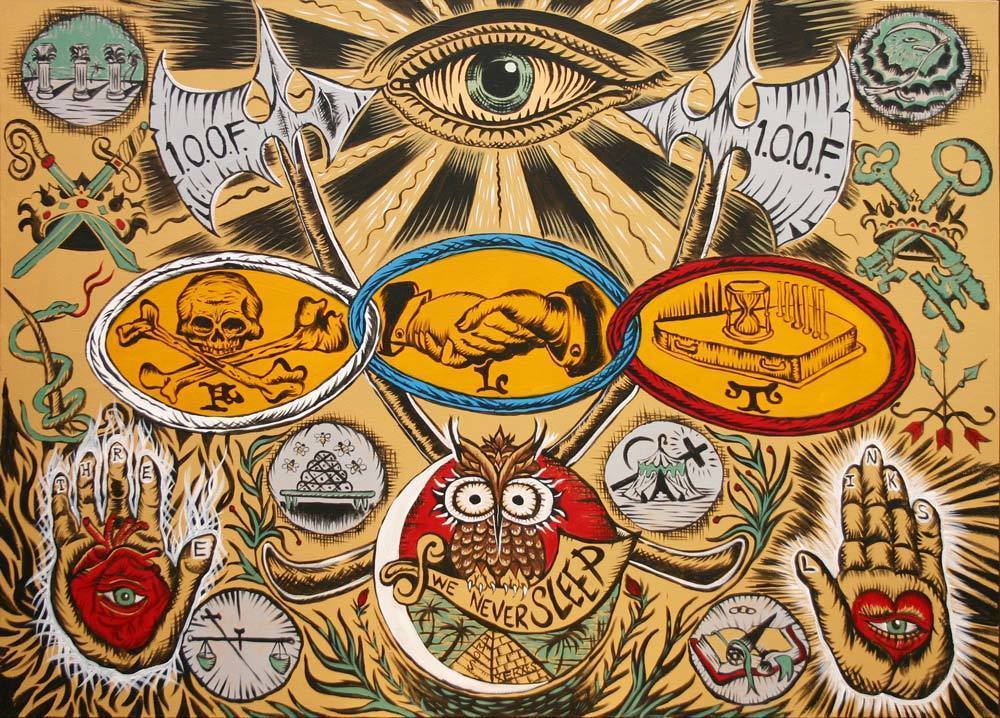
Thomas Wildey and the visual world of Odd Fellowship. The Order’s ceremonial face is the part that survives most visibly, but its books, credentials and relief machinery were every bit as important.
Baltimore Builds a Fraternal Network
The recognized American beginning of the Independent Order of Odd Fellows came in Baltimore on April 26, 1819, when Thomas Wildey and several associates instituted Washington Lodge No. 1. Wildey was an English blacksmith who had belonged to the Odd Fellows before emigrating. Within a few years the Baltimore organization was developing the hierarchy that would eventually connect subordinate lodges to state Grand Lodges and a national governing body. By the time of Wildey’s death in 1861, the Maryland Grand Lodge records describe forty-two jurisdictions and roughly 200,000 members.
The organization’s famous obligations—visit the sick, relieve the distressed, bury the dead and educate the orphan—can be read as moral language, but administratively they are something more. Every one of those duties creates paperwork. A lodge cannot reliably pay sickness benefits unless it knows whether a man is actually a member. It cannot support a widow without establishing whose widow she is. It cannot bury a traveler without identifying him, locating his home lodge, determining his standing and finding out whether the family wants the remains returned.
The larger the fraternity became, the harder those problems became. A man could leave Indiana, take the railroad to Illinois, pass through Missouri and continue toward California while still expecting recognition as an Odd Fellow. The local lodge receiving him might know nothing about his family, employment or history. It nevertheless had to decide whether he was entitled to money or care.
That forced Odd Fellowship to solve a problem that would later become fundamental to banks, insurers, police departments, credit bureaus and electronic networks: how do you verify a person at a distance?
Insurance Changed the Lodge
The answer begins with the Order’s benefit system. By the Civil War era, Odd Fellowship had become much more than occasional charitable relief. Scholarship on its sickness-insurance structure describes stipulated benefits as an institutional obligation. In 1863, the Sovereign Grand Lodge required subordinate lodges to establish sick benefits, and Odd Fellow law increasingly treated qualified relief as something belonging to the member by right rather than depending entirely on spontaneous charity.
That distinction matters. Charity can be informal. Insurance needs records.
A functioning benefit system requires dates of initiation, dues status, transfers, suspensions, reinstatements, reports of illness, expense records and notices of death. Odd Fellows archival guidance still points genealogists toward exactly these kinds of documents because lodge reports tracked the movement of members through the organization: initiation, transfer, withdrawal, death and other changes in standing. The records now prized for genealogy originally existed because the Order needed to know who was entitled to what.
Seen this way, the secretary’s ledger becomes one of the most important objects in the lodge. It is not decoration and it is not ritual. It is the local memory of the institution.
A member enters the books when he joins. His standing changes as he pays or fails to pay dues. Transfers connect one lodge to another. Illness may turn membership into a claim. Death may transform the same record into a funeral expense, a widow’s application or a question about burial. The cemetery is connected to the ledger because the same institution promising relief during life also assumes obligations when life ends.
Burial Was an Information Problem
Odd Fellows cemeteries appeared across the United States as the fraternity spread westward. The cemetery was not merely an ornamental expression of fellowship. It was part of the benefit structure. Death forced the organization to settle identity with unusual precision because the person whose identity mattered could no longer answer questions.
A dead traveler created a chain of decisions. Who was he? Which lodge claimed him? Was he in good standing? Who would pay the undertaker? Was there a wife or child? Did the family want the body returned? Would the home lodge authorize the transportation cost? If he was buried locally, where was the grave and how was the death recorded?
This is why the Odd Fellows’ burial obligation is so revealing. The fraternity had to maintain reliable identity information at the exact moment when ordinary verification became impossible. The member’s body might be lying in one state while the records proving who he was sat in a lodge secretary’s book several hundred miles away.


The cemetery and the fraternal chart look like different sides of Odd Fellowship, but the Order’s ritual obligations and administrative responsibilities were closely connected. “Bury the dead” required identification, money, communication and recordkeeping.
The Traveling Card
Before the telegraph could settle an identity dispute, the traveler carried his own proof.
Odd Fellows issued visiting cards and related certificates to members in good standing. Surviving rules show how seriously these documents were treated. The card could be signed by the lodge secretary, impressed with the lodge seal and tied to the member’s standing. Lodge law also connected valid credentials to recognition procedures and passwords. A traveler therefore did not simply walk through the door and announce that he belonged.
The system combined several different forms of authentication. The traveler possessed a document issued by a recognized lodge. He was expected to know information unavailable to outsiders. The document bore signatures or seals. The receiving lodge could test him through ritual recognition. If there was still doubt, the officers could contact the issuing lodge.
Calling this an early form of multi-factor authentication is not much of an exaggeration. The mechanisms were paper, memory, ritual and personal correspondence rather than databases and login screens, but the underlying problem was the same: possession of one credential did not necessarily settle identity.
A surviving Odd Fellows card makes that system tangible. It is easy to think of fraternal cards as quaint ephemera today. In their original setting they could unlock access to a continent-wide mutual-aid network.

Membership and visiting credentials mattered because recognition had economic consequences. A convincing impostor was not merely trespassing on ritual; he might be trying to obtain money, medical assistance or transportation.
Then the Lodge Put Identity on the Wire
The most revealing evidence for the network is the Odd Fellows’ own Telegraphic Cipher and Key.
The 1915 proceedings of the Grand Lodge of Illinois reproduce the cipher as amended by the Sovereign Grand Lodge in 1909. It assigns ordinary-looking words to standardized operational messages. RIVER asked whether another lodge had a member in good standing by a specified name. DOUBT meant that a claimant’s identity was uncertain and requested a description by wire. CASH reported a person asking financial assistance while claiming membership elsewhere. FUNDS asked whether the receiving lodge would authorize aid.
The code became even more explicit when fraud was suspected. BLACK meant that the claimant was a fraud and any lodge papers he possessed were forgeries. SECRETARY identified a fraudulent card. WHITE meant that the home lodge knew no such person. CAUTION warned another lodge to watch for a named fraud. These were not mystical passwords used only inside a ritual room. They were practical messages for operating a nationwide benefit network.
Illness and death received their own vocabulary. YELLOW reported a seriously ill claimant and asked whether treatment should be provided at the other lodge’s expense. HELP concerned payment for nursing. FINAL reported that a member had died away from home. GREEN requested immediate instructions concerning the disposition of the remains. LODGE ordered the body sent home, while PURPLE recommended burial where the death occurred. WIDOW informed the receiving lodge that a wife or child of a deceased member had appeared seeking assistance.
Once the messages are read together, the architecture becomes difficult to miss. This was a standardized protocol for moving information about identity, fraud, money, health, death and family dependency between local nodes of the same institution.
The telegraph was expensive by the word, so compression had obvious financial value. But compression was only part of it. A telegraph operator seeing a single code word did not necessarily see a detailed description of a member’s sickness, disputed identity, financial distress or death. The code gave the Order a private vocabulary laid across a public communications network.
That is what makes the cipher so important. Odd Fellowship did not build the telegraph, but it built an organizational layer that told lodges what to send across it and what to do when the message arrived.

The telegraph network supplied the wire. Organizations such as the Odd Fellows supplied the meaning. A coded lodge message could move through an ordinary commercial telegraph office while remaining intelligible primarily to the officers receiving it.
The Secretary Was the Node
Fraternal history tends to give its ceremonial officers more attention than its clerks. Yet from the viewpoint of this system, the lodge secretary may have been one of the most consequential people in the building.
The secretary maintained the membership roll, recorded changes of status, handled correspondence, knew whether dues had been paid and preserved the documentary history against which visiting claims could be checked. A distant inquiry arriving by letter or telegram ultimately became useful only because somebody at the receiving end could open the books and answer it.
That gave the lodge a local intelligence function without requiring anything resembling a spy service. A stranger’s claim could be checked against stored information. A man’s status could be confirmed across state lines. A doubtful claimant could be physically described by wire. A fraudulent credential could be reported. A warning about an impostor could move from one node of the fraternity to another.
The word intelligence is useful here in its plain older sense: information gathered, organized and used to make decisions. The question was not simply what the lodge knew. The important feature was that the lodge could act on what it knew.
If the identity was verified, money might move. If the person was sick, a nurse might be hired. If he was fraudulent, assistance could be refused. If he had died, the body could be shipped. If his widow appeared later, her claim could be referred back into the same institutional chain.
The information was valuable because it triggered custody and expenditure.
A Person Became a Chain of Verified Facts
Follow a single traveling member and the system becomes easier to see. Suppose an Odd Fellow leaves Indiana carrying a valid card. He reaches Chicago and becomes badly ill. A Chicago lodge examines the document but finds something questionable, so its secretary contacts the man’s Indiana lodge.
The home secretary checks the rolls and confirms that the member exists and is in good standing. Chicago then asks whether it may provide nursing care at Indiana’s expense. Indiana authorizes a certain amount. The local lodge spends the money, records the cost and later draws against the responsible lodge.
If the traveler recovers, the episode ends as a benefit claim. If he dies, however, the network immediately changes function. Chicago reports the death. Indiana determines whether the remains should be buried locally or returned by rail. An undertaker becomes involved. Transportation is arranged. Expenses are settled. The widow or dependent child may later enter the system through another lodge.
From the institutional point of view, the member has become a linked series of facts: identity, membership, standing, present location, sickness, authorized expenditure, death, disposition of remains and surviving dependents.
That sequence is what makes the network look strikingly modern. None of its components is modern on its own. What is modern-looking is the integration.
The Undertaker Was Part of the Communications System
The telegraph cipher also clarifies something that can disappear when fraternal history is separated from funeral history. The undertaker stood at the operational edge of the lodge network.
A distant lodge might authorize the disposition of a body, but someone in the town where the member died still had to take custody of the remains. Someone had to prepare the body, supply the coffin, obtain transportation, deal with the railway or express company, receive instructions from relatives and preserve the paperwork showing what had been done.
The telegram sits in the middle of that chain rather than at the end of it.
This is why local overlaps among Odd Fellows, undertakers, hotels, railroad men and cemetery officers deserve careful attention. In a community such as Rochester, Indiana, for example, an undertaking establishment serving lodge families stood exactly where an Odd Fellows promise concerning death became a physical operation. The same point applies in Wabash, Lagro, Mount Carmel and scores of other towns where lodge, railroad, newspaper, hotel, telegraph and funeral businesses clustered within a remarkably small downtown area.
The cemetery was the terminal archive of that process. Once the traveler had been identified, his lodge contacted, the expenses authorized and his remains transported or buried, the grave converted the chain of messages into a permanent location.
Insurance Was the Engine Behind the Secrecy
Fraternal secrecy is often treated as ceremonial theater. In the Odd Fellows system, secrecy also had economic value.
Passwords mattered because membership opened access to real benefits. A forged card was not merely an insult to lodge symbolism. It could be used to obtain lodging, money, medical treatment, nursing or transportation. A convincing impostor might persuade a lodge to spend funds belonging to actual members.
That makes the Order’s elaborate concern with recognition easier to understand. Ritual, passwords, seals and visiting cards functioned partly as defenses around a mutual-benefit system.
This becomes especially important in the nineteenth century, before the modern welfare state, widespread employer health insurance and many of the public programs later generations took for granted. Sickness could immediately destroy a wage earner’s income. The Odd Fellows reduced some of that risk through local mutual aid, but doing so cheaply depended upon local knowledge.
A commercial insurer might struggle to determine whether a distant claimant was truly incapacitated. A lodge already had people who knew him. A sick committee could visit his home. Fellow members might know whether he was working, traveling or seriously ill. The secretary already possessed his dues history. Mutual insurance and community observation therefore reinforced one another.
“Surveillance” in this setting need not imply sinister monitoring. It describes the practical fact that the benefit system worked because members and lodge officers knew what was happening inside their local social world.
The questions were ordinary but consequential. Was a brother actually sick? Had he left town? Had he stopped paying dues? Had he died? Was a stranger claiming his name? Had his widow become eligible for assistance? Every question could eventually become a financial obligation, so the Order had reason to demand reliable answers.
The Lodge as a Proto-ADT Station
This is where the comparison with American District Telegraph becomes especially useful.
ADT traces its beginnings to Edward Callahan’s response to a nighttime break-in in 1874. Callahan developed a telegraph-based call box through which a subscriber could signal a central office for help, and the company says approximately fifty homes were connected before American District Telegraph was incorporated in Baltimore on August 14, 1874.
A surviving American District Telegraph call box preserved by the Smithsonian makes the design easy to understand. The user did not need to compose a long telegram explaining every circumstance. The box reduced an emergency to standardized choices that a distant station could interpret and turn into a response.

American District Telegraph converted a local problem into a standardized signal that a distant station could recognize. The similarity to the Odd Fellows system lies less in hardware than in the architecture of the request.
There is no demonstrated institutional genealogy showing that the Odd Fellows created ADT or that Callahan simply copied the lodge system. The evidence does not support making that leap. The resemblance is architectural, and that is interesting enough.
ADT organized a sequence that can be simplified as subscriber, signal, central station, location, dispatch and response. Odd Fellowship organized member, credential, local lodge, home-lodge verification, coded communication, authorization and response.
ADT increasingly placed the intelligence inside electrical infrastructure. Odd Fellowship began with people, paper, ritual and local institutions.
But both systems depended on the same fundamental breakthrough: standardizing the meaning of a remote request.
The wire alone is not the network. The network exists when the signal means the same thing at the other end.
Why the Buildings Matter
That comparison raises another question worth pursuing more carefully: where, physically, did all of this communication occur?
Odd Fellows halls frequently occupied upper stories of commercial buildings. Stores, offices and service businesses operated below while the lodge occupied rooms upstairs. That arrangement placed lodge officers directly inside the commercial centers of nineteenth-century towns, often within steps of banks, railroad depots, hotels, newspapers, express agents and telegraph offices.
The important claim is not that every Odd Fellows hall had a private telegraph wire. I have not found evidence for anything that sweeping, and the argument does not require one. A secretary could carry a coded message down the street to Western Union and receive the answer in the same way.
What matters is that the lodge already knew what information it needed to send.
This makes historical mapping unusually promising. Sanborn fire-insurance maps can place a lodge hall relative to the local telegraph office. City directories can identify which businesses occupied the floor below. Newspapers can reveal whether a lodge secretary also worked for a railroad, insurance company, newspaper, bank, express office or undertaking business. Grand Lodge proceedings can provide officer names, while local directories can place those officers in the commercial geography of the town.
In places such as Rochester, Wabash and Lagro, that approach may be much more revealing than looking at lodge membership in isolation. The question becomes not simply who belonged to the Odd Fellows, but where the secretary sat in relation to the town’s communication and transportation machinery.
Baltimore Appears Twice
Baltimore is what gives the whole comparison an especially compelling shape.
American Odd Fellowship takes permanent organizational form there in 1819. American District Telegraph is incorporated there fifty-five years later. One begins as a human mutual-aid network that lets strangers obtain recognition and help from local nodes connected to distant records. The other turns standardized requests into electrical signals reaching central stations that can dispatch assistance.
The missing piece is direct institutional descent. Without evidence connecting specific Odd Fellows officers, lodge operations or benefit procedures to ADT’s founders, it would be too strong to claim that one corporation simply evolved out of the other.
The deeper connection does not require that claim.
Both belong to a nineteenth-century transformation in which American institutions learned how to make distance administratively manageable. Railroads moved people and bodies. Telegraph companies moved messages. Lodges authenticated identities. Mutual-benefit systems determined liability. Undertakers handled the dead. Cemeteries fixed identities into permanent local records.
ADT made one portion of that world electrical.
Odd Fellowship had already made much of it institutional.
The Private Information Infrastructure Hiding Inside the Lodge
By the early twentieth century, the IOOF possessed most of the elements required for a remarkably sophisticated private information network. Thousands of local lodges acted as nodes. State and national bodies created hierarchy. Visiting cards provided portable credentials. Passwords supplied a second means of recognition. Membership rolls preserved status. Secretaries exchanged information. The telegraph moved questions quickly across long distances. A standardized cipher reduced complicated situations to a controlled vocabulary. Relief funds turned verified information into material action.
Its cemetery system extended the same structure beyond death. Widows and children remained inside the benefits network. Fraud warnings could be distributed. Transfers allowed members to move between communities while preserving organizational continuity. The fraternity could therefore follow a person through far more of the human lifecycle than the image of the lodge as a ceremonial clubhouse suggests.
Look again at an old Odd Fellows hall and the visible symbolism can become misleading. The three links, the eye, the heart and hand, the regalia and ceremonial furniture naturally attract attention. Yet a great deal of the institution’s practical power sat somewhere less dramatic: in the secretary’s desk.
Inside were names, dues, addresses, transfers, illnesses, benefit payments, suspensions, deaths and dependents. In a member’s pocket was another part of the system: a credential that could be presented hundreds of miles away. Beyond the lodge walls ran yet another layer—the commercial telegraph network over which the fraternity could verify the man carrying that credential.
A stranger could enter a city without anyone there knowing him personally and, within hours, become legible to a nationwide institution. His name could be checked. His membership could be confirmed. His financial standing could be established. A nurse could be hired. A fraud could be detected. His death could be reported across several states, and instructions concerning his body could return before the remains left town.
That is considerably more than fellowship.
The Odd Fellows’ cemeteries functioned as permanent identity records. Their cards were portable credentials. Their passwords protected access. Their lodge books tracked status. Their telegraphic cipher functioned as a communications protocol. Their sick benefits created financial obligations. Their relief committees provided local response. Their network of lodges gave the whole structure geographic reach.
The pieces look unrelated when separated: a fraternal card, a cemetery gate, a secretary’s ledger, a telegraph office and a coded word printed in a Grand Lodge proceeding.
Together they describe a system.
That is the deeper reason the comparison with ADT works. The American District Telegraph call box made a person in trouble intelligible to a remote station and converted a standardized signal into an organized response. The Odd Fellows had been solving a closely related problem through documents, passwords, local officers and inter-lodge communication long before electronic monitoring became a business.
ADT electrified the request.
The lodge had already built the network.