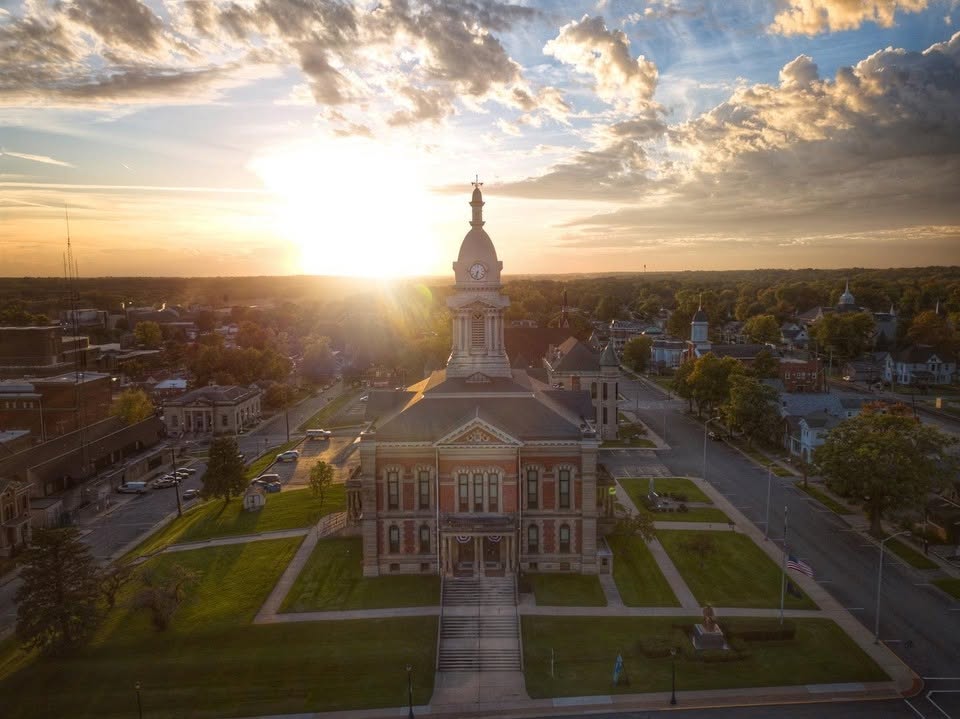
The courthouse in Wabash, Indiana, went up in 1878 and 1879 on the brow of the public square, large enough to dominate the town around it. B. V. Enos & Son designed the building, which required roughly 1.25 million bricks and rose around a central tower that could be seen well beyond the square. The Allen County Public Library’s courthouse survey gives the building an oddly useful architectural classification: “Castle.”
That word opens a surprisingly long history. During the Civil War, organizations of the Knights of the Golden Circle in Indiana called their local bodies castles. Before that, European towns kept charters, agreements, seals, and public money in communal chests known in Anglo-Norman records as the commune huche or huche de la commune. By the twentieth century, Indiana manufacturers were building another kind of ordered enclosure: kitchen cabinets full of bins and compartments, followed by phonograph and radio cabinets containing the machinery of electronic communication.
Wabash happens to stand near the center of all three stories. Its courthouse preserved county memory, its Civil War world knew the language of the secret-society castle, and its later industrial economy produced cabinets for radios. In 1880, the courthouse itself became an electrical center when Brush arc lamps were mounted above the town and a telephone appeared in the clerk’s office. The sequence makes Wabash a particularly good place to ask a larger question: how did a box for keeping things become a building for keeping records, then a node for receiving signals, and eventually a cabinet containing the signal itself?

The old civic hutch
The word hutch once carried more weight than its modern association with kitchen furniture or animal cages suggests. Anglo-Norman huche meant a chest or coffer, and medieval records preserve a specific civic use. The Anglo-Norman Dictionary lists commune huche and huche de la commune as legal terms for a community chest. A fourteenth-century regulation ordered statutes to be entered into a book and deposited in the commune houche. Another agreement specified that one part of an indenture should remain in the community hutch.
The arrangement survives with remarkable clarity at Arras. A three-part legal instrument drawn before the city’s aldermen in 1521–22 distributed one copy to the recipient, another to the donor, and a third to the “huche de cité.” The Pas-de-Calais archives identify that civic hutch as the repository used for the aldermen’s records. The transaction therefore existed simultaneously in private hands and in the city’s own protected memory.

The chest could carry money as well as writing. Anglo-Norman records describe funds being placed in a hutch secured by two keys, and the larger vocabulary of municipal administration included the commune coffre, commune ciste, and other forms of the public chest. The principle was simple enough to survive changes in language: a community needed a place where valuable things could be kept under authority that outlasted any single official.

In some towns, authority over the chest was physically divided. Beaune’s famous municipal chest used seven locks, with keys distributed among civic officers. The chest held records connected with the rights and privileges of the commune. Opening it was therefore an institutional act requiring cooperation among officeholders. Medieval security could be surprisingly literal: the city had several keys because the city itself consisted of several offices sharing custody.
The chest gradually grew into cabinets, record rooms, treasury rooms, guildhalls, archives, and vaults. The geometry survived the change in scale. Information entered a protected center, was classified, preserved, and brought back out when somebody with authority needed it.
Indiana inherited the same practical problem.
Wabash builds a fireproof memory
The first substantial Wabash County courthouse burned in 1871. The surviving county records tell an important part of the story because Indiana law had already required state and county records to be stored in fire-resistant rooms. Wabash responded by building a separate brick record structure on the courthouse square. The building measured eighteen by sixty feet, contained three rooms, and used a plastered overhead bin with sand packed into the ceiling and walls. A sprinkler arrangement provided another layer of protection.
The little building performed the old hutch function at architectural scale. Deeds, judgments, tax books, probate records, maps, and other official writings represented relationships that existed throughout the county. Property might lie miles from town, but the documentary version of that property could be concentrated on the courthouse square. A citizen might live on a farm or in another township, while the legal record connecting that person to land, inheritance, taxes, or litigation lived inside a protected central repository.
The present courthouse absorbed that archival function into a monumental civic building. Its tower and clock made government visible from outside; its rooms made the county retrievable from within. The building divided public information spatially through offices, books, drawers, counters, and clerks. County government depended upon remembering where something had been placed and who possessed authority to certify it.
The cornerstone adds an extraordinary miniature version of the same idea. Wabash County’s own historical summary says its contents included a Holy Bible, a compass, a map of the City of Wabash, “secrets of Hanna Lodge,” and pieces of the old courthouse bell. The source leaves the Hanna Lodge material unidentified, which makes the exact contents of that packet an open archival question. The rest of the inventory is already striking: scripture, an instrument of orientation, a map of the city, lodge material, and fragments of the bell from the former courthouse were deliberately sealed into the new building.

A cornerstone deposit was a familiar nineteenth-century practice, especially in public and Masonic building ceremonies. In Wabash the selection worked almost like a compressed civic cabinet. The city appears as a map, the previous courthouse survives as metal from its bell, and Hanna Lodge contributes something described only through the language of secrecy. The new court physically contains pieces of the institutional world that preceded it.
The larger courthouse then surrounds that smaller sealed collection with offices, books, vaults, clocks, and public authority. A chest has become a building, and the building contains another chest-like deposit inside itself.
Indiana’s castles
The word castle had already acquired another meaning in Indiana before the Wabash courthouse was built.

In 1862 a federal grand jury investigating the Knights of the Golden Circle in Indiana described an oath-bound organization whose local units were called “lodges or castles.” According to the report, these castles operated in different parts of the state while sharing common signs, grips, words, and passwords. A member initiated in one castle could use that common system to gain admission to another. The Indiana Magazine of History later reproduced the report in its account of secret political societies during the war.
The language appears in KGC material outside Indiana as well. Surviving correspondence uses names such as Jefferson Castle, while contemporary exposés describe the castle as the local organizational unit through which the larger order reproduced itself geographically.
The system depended on a form of portable identity. A member could leave the place where he was known personally and present signs or passwords elsewhere. The castle at the destination recognized those signs because it participated in the same organizational grammar. In modern language, credentials traveled farther than personal acquaintance.
That gives the word castle a meaning beyond architectural style. A KGC castle was a local point where a wider body became present. Officers, meetings, recognition systems, records, and ritual were concentrated in one place and connected conceptually to other places organized in the same fashion.

Indiana’s established fraternal culture had already made the lodge familiar as a civic form. Freemasons, Odd Fellows, and other orders built networks of local bodies joined to larger jurisdictions. Secret political organizations of the Civil War era adapted that familiar landscape of degrees, officers, ritual, signs, subordinate units, and controlled meeting space. Indiana Historical Bureau research places the KGC, Order of American Knights, and Sons of Liberty inside this turbulent wartime environment of organized dissent, surveillance, weapons investigations, and secret political association.
The courthouse and the castle therefore present two versions of the nineteenth-century node. The courthouse made the county present in one building through records and offices. The castle made a dispersed organization present in one room through recognized members and shared credentials. Both depended upon classification, authentication, and controlled access. Those features mattered because Indiana was becoming a society in which institutions increasingly had to operate across distance.
Then electricity shortened the distance.
The courthouse becomes electrical
On March 31, 1880, electricians working with Charles F. Brush’s system placed four 3,000-candlepower arc lamps on the Wabash courthouse. Contemporary newspaper evidence confirms the date, and the Indiana Historical Bureau’s later review describes the installation as part of the rapid spread of central-station electric lighting at the beginning of the 1880s. Wabash’s famous claim to being the first electrically lighted city rests on the extent of that experiment and has been debated against earlier Brush demonstrations in Cleveland, but the courthouse’s role in the Wabash installation is firmly documented.
The physical arrangement is more interesting than the race for “first.” Machinery and civic space came together inside the courthouse, while electrical conductors climbed toward lamps mounted high enough to throw light across much of the town. The building that had gathered records inward now projected electrical service outward.
The telephone arrived during the same year. Wabash County’s history records that one of the first local telephones was installed in the clerk’s office inside the courthouse. Residents came so frequently to use and inspect it that the clerk soon had it removed.
That little incident captures the transition better than almost anything else. The clerk’s office had traditionally dealt in paper, signatures, books, indexes, and certified copies. Suddenly a device appeared on the desk that allowed a distant voice to enter the room electrically. The public immediately understood that something important had changed, even if the technology was still enough of a novelty to become a nuisance.

The courthouse had accumulated several layers of information technology by 1880. Records preserved memory. The bell and clock broadcast common signals across the square. Electric light projected power outward from the tower. The telephone brought a remote voice inward to the clerk.
The protected civic center was becoming active in both directions.
The Indiana cabinet
Another transformation was taking place in Indiana’s woodworking economy. The state became closely identified with the Hoosier cabinet, a freestanding kitchen workstation designed around organization and efficiency. The Indiana Historical Society describes its ancestors as baker’s cabinets containing a table, drawers, and upper shelving. Hoosier manufacturers expanded the form with flour bins, mechanical sifters, spice jars, specialized compartments, storage areas, and work surfaces that kept the tools of cooking close at hand.
The cabinet worked because its user learned its internal geography. Flour belonged in one place, spices in another, utensils somewhere else, and the work surface sat in the middle of that ordered field. The cabinet reduced movement by giving materials fixed addresses.
That makes the analogy to a filing system surprisingly strong. The comparison does not require the cabinetmaker to have thought in computational terms. An information system begins with a simpler problem: where is the thing, how is it classified, and how quickly can it be retrieved? A Hoosier cabinet answered those questions with wood, bins, labels, shelves, doors, and drawers.

Indiana sold that logic at enormous scale. The state’s cabinet industry became adept at constructing complex interiors whose usefulness depended on arrangement as much as appearance.
Wabash eventually carried that skill into electronic communication.

The Cardinal Cabinet Company, founded in Wabash in 1914, manufactured period furniture along with phonograph and radio cabinets. In 1927 Cardinal merged with Spencer Table and Chair of Marion to form Spencer-Cardinal, retaining three plant locations. By 1929 the company had discontinued its conventional furniture line and increased production of radio cabinets.
The cabinet had changed jobs.
A kitchen cabinet organized ingredients and tools around a human worker. A radio cabinet organized a chassis, speaker, wiring, controls, and other components around an electrical signal. The exterior remained furniture because the machine had to live comfortably inside a home. The interior became increasingly technical because the box had to accommodate the physical requirements of reception and sound.
A surviving 1941 Spencer-Cardinal sample cabinet from Marion shows that technical turn clearly. Its construction specifications call for sliced walnut veneers, gum lumber, and a five-ply fir speaker baffle. The baffle gives the enclosure an acoustic function as well as a decorative one. The cabinet participates in the operation of the radio instead of merely hiding it.


By then Indiana cabinetry had moved a long way from flour bins while retaining the central idea of an ordered interior. The cabinet still gave components addresses. It still controlled the relationship between outside and inside. The thing passing through the enclosure had simply changed.
Wabash brings the pieces together
The reason Wabash makes such a good center for this story is the concentration of these transitions in one place.
The county first had to protect its written memory strongly enough to survive fire. A brick record building on the public square became a secure container for public documents. The replacement courthouse absorbed that function into a much larger civic structure and sealed its own miniature archive into the cornerstone. The Civil War generation around it already understood the organizational language of lodges and castles, local rooms capable of representing larger networks through officers, ritual, recognition, and controlled access.
Then the courthouse became electrical. Arc lamps mounted above it projected energy over the city, while the telephone briefly entered the clerk’s office below. Records, signals, authority, and machinery met inside the same civic center.
Within a few decades Wabash’s industrial economy was manufacturing another class of enclosure. Cardinal Cabinet began making cabinets for phonographs and radios, and Spencer-Cardinal moved deeper into radio production just as electronic communication became an ordinary part of domestic life.
The movement from court to cabinet therefore becomes more than wordplay. It traces the changing physical scale of information.
The medieval huche concentrated a town’s agreements and rights inside a chest. The nineteenth-century courthouse expanded the repository into architecture, sorting public information into rooms and offices. The fraternal castle showed how an organization could reproduce itself through authenticated local nodes. Electrical systems made the node capable of sending and receiving across distance. Indiana cabinetmakers then built ordered interiors around machines whose entire purpose was to receive information from somewhere else.
The cabinet did not merely contain an object anymore. It housed a connection.
That is the history behind Castles, Courts, and Cabinets. Indiana’s contribution to the information age did not begin with electronics alone. It grew out of older habits of storage, classification, custody, access, and enclosure. The state became unusually good at constructing places where complicated systems could be made manageable, whether the contents were county records, lodge members, kitchen supplies, or radio components.
Wabash lets us watch those forms overlap. The record room kept memory. The courthouse organized authority. The castle organized membership. The cabinet organized contents. Electricity gave the center reach.
By the radio age, Indiana had learned to put the signal inside the furniture.