How Paschal Beverly Randolph, an unknown grandfather, Rosicrucian mythology, Moorish America, and a forgotten 1864 pamphlet created the strange historical soil from which the Ibrahim Kahlooni story could eventually grow.
There is a version of Abraham Lincoln circulating today that bears almost no resemblance to the man found in ordinary presidential biographies. In that story, Abraham Lincoln was really Ibrahim Khaleel Kahlooni, a man of Levantine or Druze descent whose family belonged to an ancient sacred lineage. His son Willie Lincoln supposedly did not die in the White House in 1862 but was removed from America, taken to North Africa, and eventually became Omar al-Mukhtar, the celebrated Libyan resistance leader known as the Lion of the Desert. In some versions, the genealogy expands still farther, linking Lincoln, Druze families, biblical figures, and modern political dynasties into one enormous hidden succession.
There is no archival evidence presently establishing that genealogy. The identifiable online version of the Kahlooni claim appears in a November 2021 article called The Lincoln Kahlooni Druze Minority Bloodline: The Jesus Strand. It explicitly identifies Lincoln as Ibrahim Khaleel Kahlooni and Willie Lincoln as Omar al-Mukhtar. The same article places the family inside a supposedly protected Druze sacred bloodline.
If that were the entire story, the reasonable conclusion would be simple: an elaborate twenty-first-century internet mythology had attached itself to one of America’s most famous presidents.
But it is not the entire story.
When the layers are separated chronologically, an older and much stranger history appears. Long before anyone on the internet called Lincoln “Kahlooni,” nineteenth- and twentieth-century writers had already placed him inside stories involving Egypt, Africa, secret initiation, Rosicrucian authority, uncertain parentage, hidden succession, and eventually Moorish political theology. None of those earlier traditions proves the modern claim. What they do show is that the intellectual machinery required to create such a claim had been developing for more than a century.
The story begins with one of nineteenth-century America’s strangest occultists.
Paschal Beverly Randolph and the President
Paschal Beverly Randolph was born in 1825 and became one of the most unusual figures in American spiritualism and occultism. He wrote about clairvoyance, sexuality, human antiquity, spiritual transformation, Rosicrucianism, Egypt, and what he described as ancient Eastern mysteries. He traveled widely and later became enormously important to American and European occult traditions.
What makes Randolph relevant to Lincoln is not merely something later Rosicrucians claimed.
An advertisement for Randolph’s Pre-Adamite Man described the work as “Dedicated (by Permission) to PRESIDENT LINCOLN.” Randolph’s own circle subsequently claimed that the dedication had been made at Lincoln’s request, and an 1872 biographical pamphlet described Randolph as Lincoln’s personal friend. Those claims of intimacy are harder to independently establish, but the Lincoln dedication itself belongs to Randolph’s nineteenth-century publishing history rather than a recent internet theory.
That particular book matters.
Pre-Adamite Man was an attempt to push human history far beyond a literal biblical chronology. Randolph ranged across Egypt, Africa, Chaldea, ancient monuments, prehistory, race, archaeology, and alternative readings of Genesis. Even the contents of later editions show how heavily the work leaned into Egypt, Assyria and deep antiquity.
At almost exactly the same historical moment, Lincoln himself supplied a phrase that later esoteric readers could easily wrench out of context.
In his December 1, 1862 annual message to Congress, discussing the enormous interior river system of the United States and its need for access to the coasts, Lincoln referred to the Mississippi-centered interior as “this Egypt of the West.” In context there is nothing occult about it. Lincoln was talking about geography, commerce and national unity. But the phrase is real.
So by 1863 an unusual juxtaposition already existed.
Lincoln had publicly called the American interior an “Egypt of the West.” Randolph was publishing a book obsessed with human antiquity and Egypt, and that book was being advertised as dedicated to Lincoln by permission.
Nobody needed to invent those pieces later. They were already there.
Then Lincoln Became “Abraham Africanus”
The next layer appeared in 1864, while Lincoln was still president.
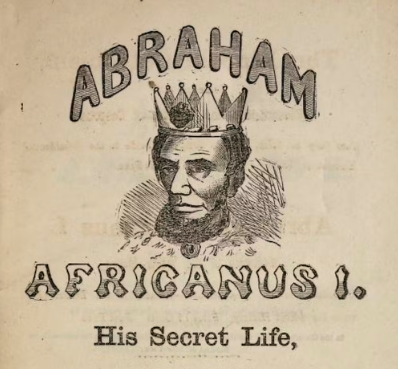
An anti-Lincoln pamphlet appeared under the extraordinary title Abraham Africanus I: His Secret Life, as Revealed Under the Mesmeric Influence. The work belonged to the ugly racial politics of the 1864 election. Lincoln’s enemies portrayed emancipation, wartime executive power and Republican racial policy as evidence that the president had become a kind of despotic African monarch. The related Lincoln Catechism mocked “Abraham Africanus the First” as an enemy of the Constitution.
It is important to keep the original meaning straight. “Africanus” was an insult. The pamphlet was not revealing Lincoln’s secret African ancestry, nor was Lincoln presenting himself as an African king.
Yet historical propaganda has an afterlife.
Once the election of 1864 was forgotten, later readers encountered an actual nineteenth-century publication called Abraham Africanus I, complete with the president portrayed in monarchic imagery. A satirical identity could therefore be detached from its political context and read literally.
That is precisely the sort of transformation that repeatedly occurs in esoteric genealogy. A metaphor becomes a title; the title becomes a clue; the clue eventually becomes ancestry.
And in Lincoln’s case there was another unresolved problem waiting for somebody to fill.
The Empty Place Behind Nancy Hanks
Nancy Hanks Lincoln was born in Virginia in 1784. The National Park Service identifies her mother as Lucy Hanks, an unmarried mother, and notes that Nancy was sent to live with relatives. No portrait of Nancy is known to survive.
That uncertainty produced generations of arguments about exactly where Nancy was born and who her father was.
In 1929 the argument became spectacular.
Andrew Price, president of the West Virginia Historical Society and chairman of a commission studying Nancy Hanks’s birthplace, proposed that George Washington had fathered Nancy Hanks. Lincoln Lore printed Price’s conclusions plainly: “Nancy Hanks’ father was George Washington.” Price also identified Lucy Hanks as Nancy’s mother and placed Nancy’s birth in what is now West Virginia.
The Washington theory was not merely someone shouting a famous name into the genealogical vacuum. Price was attempting to reconstruct a mysterious Virginia planter from old traditions about Nancy Hanks and then connect him with Washington’s western Virginia interests.
But the chronology works badly.
The National Park Service gives Nancy’s birth as February 5, 1784. During the likely conception period in 1783, Washington was still headquartered with the Continental Army at Newburgh, New York; a surviving May 10, 1783 letter is explicitly dated from headquarters there, and his general-orders books document his continued Newburgh presence through the summer.
Another part of the old Washington reconstruction involved inventor James Rumsey and Washington’s presence at Bath, Virginia. That encounter is genuine—but Washington’s diary places his first meeting with Rumsey’s mechanical boat at Bath on September 6, 1784, with Washington issuing a certificate the following day. Nancy, under the standard chronology, had already been born.
The Washington paternity theory therefore remains speculation and faces serious chronological problems.
Yet its historical existence is significant.
By 1929, before the modern Kahlooni story and before the internet, someone had already attempted to turn Abraham Lincoln into the biological descendant of George Washington.
That becomes particularly strange when placed beside what Rosicrucian writers were doing with Washington and Lincoln at approximately the same time.
The Hidden Council
The modern Fraternitas Rosae Crucis preserves an elaborate institutional history in which the ancient mysteries begin in Egypt, pass through various philosophical and esoteric schools, eventually become Rosicrucianism, and continue into America. The organization claims an American “Council of Three” and places numerous famous political figures inside its hidden succession. Its present history claims that during the Civil War the Council consisted of Paschal Beverly Randolph, General Ethan Allen Hitchcock and Abraham Lincoln.
The same tradition separately claims George Washington as a member of its Great or World Council, describing his deeper spiritual identity as known only to initiates.
Taken on its own terms, the system therefore produces an extraordinary succession:
Washington belongs to the hidden order.
Randolph eventually governs its American branch.
Lincoln sits beside Randolph in its wartime Council of Three.
Then place beside it the independent 1929 paternity theory:
Washington fathers Nancy Hanks.
Nancy becomes Lincoln’s mother.
Suddenly two entirely different stories—one genealogical and one initiatic—can be made to overlap.
There is no evidence I have found showing that Andrew Price derived his Washington theory from Rosicrucian doctrine, nor that R. Swinburne Clymer used Price’s paternity theory to construct his hidden succession. Those connections should not be manufactured.
But once both ideas existed in print, a later writer had everything necessary to transform spiritual succession into hereditary succession.
There is an additional problem with the Rosicrucian claim itself. Lincoln Lore investigated the story in 1972 and found no documentary evidence that Lincoln had actually been a Rosicrucian. The article specifically noted the absence of membership certificates, Lincoln statements, correspondence, or contemporary references establishing such a role. It also observed that Paschal Beverly Randolph did not appear in the documented Lincoln administration in the way Clymer’s later history suggested.
That is an important boundary.
The Rosicrucian Lincoln is a tradition about Lincoln, not an established fact about Lincoln.
But traditions have histories too.
And this one was already creating a hidden American government of initiates long before Ibrahim Kahlooni appeared online.
Randolph’s “Ansaireh” and the Eastern Mystery
The Near Eastern part of the story becomes even more revealing.
Later Fraternitas accounts describe Randolph traveling through Egypt, Arabia, Syria, Palestine and Turkey and claim that in Syria he completed his study of the secret teachings of the Ansaireh and was initiated into their priesthood.
“Ansaireh” was a nineteenth-century Western term associated with the Nusayris, the community now generally called Alawites. They are not the Nizari Ismailis historically associated with the medieval “Assassins,” nor are they Druze. Nineteenth-century Western occult literature, however, frequently blurred the boundaries among Near Eastern esoteric communities.
Randolph himself makes the later mythology even more interesting because he openly admitted how some of it had been manufactured.
In Eulis! he wrote that he had studied Rosicrucianism and used the name as a vehicle for ideas that were largely his own. He then said the same thing happened with material presented as “Ansairetic”: he had read a book, found a new name, and watched audiences become fascinated with the supposed exotic authority behind it.
That admission is almost a miniature model of the entire Lincoln problem.
A real thinker acquires an exotic name.
A name becomes an initiation.
An initiation becomes an ancient succession.
The ancient succession acquires famous members.
The famous members eventually acquire sacred genealogies.
Randolph himself is effectively telling us how mythic pedigrees can form.
Egypt Was Already the Language of Hidden Authority
The Egyptian element was not decorative.
The Fraternitas history explicitly describes Egypt as the birthplace of the Ancient Mysteries and Secret Doctrines from which it believes Rosicrucianism ultimately developed. Its institutional genealogy moves Egyptian mysteries outward through Persia, Greece, Gnosticism, Essenes, Hermetists and later European initiates.
This is not literal dynastic descent from a Pharaoh. It is something subtler: a supposed succession of sacred knowledge and office.
That difference matters.
If power is transmitted through initiation rather than exclusively through blood, the same person can simultaneously belong to an ordinary public genealogy and an extraordinary secret genealogy. An initiate can be a carpenter’s son publicly and heir to Egypt symbolically. Nothing about the system requires every member to demonstrate uninterrupted biological descent from Akhenaten.
This is exactly why Lincoln could become so attractive to later esoteric writers.
The president was already a national martyr. His ancestry contained areas of uncertainty. His administration had presided over emancipation. Randolph’s work could be connected to him. “Egypt of the West” came from Lincoln’s own pen. “Africanus” came from his enemies. Later occultists claimed him as an initiate.
The pieces were sitting beside one another before anybody attempted to make them literal.
Then Moorish America Rediscovered Lincoln

A second stream developed independently inside Black American religious history.
The Moorish Science Temple of America became a national movement under Noble Drew Ali in 1920s Chicago. Its Holy Koran, or Circle Seven Koran, appeared in 1927. Scholarship on early Black Islam emphasizes that Moorish Science combined Islamic and Moorish imagery with esoteric and metaphysical material already circulating in American religious culture.
This did not make Moorish Science a branch of Randolph’s Rosicrucian order. There is no evidence for such a direct institutional descent.
The important point is that both occupied a common American symbolic world involving Egypt, the Orient, hidden antiquity, nationality, fraternal ritual, sacred history and alternative readings of identity.
Scholars of African American Islam have also emphasized how Moorish imagery circulated through Black lodges and secret societies. Noble Drew Ali’s movement used the fez, Moorish nationality, Islamic terminology and an account of African American identity that rejected the categories imposed by white America.
Eventually Lincoln entered this world too.
A particularly useful piece of evidence comes from the 1982 Tax Court case Habersham-Bey v. Commissioner. The court recorded the petitioner’s claim that, as a Moorish American, she remained exempt from federal taxation until Lincoln’s supposed “executive will” and another claimed constitutional arrangement were enforced. The court rejected the legal theory, but the case proves that an explicitly Moorish constitutional interpretation of Lincoln existed by that date.
That is a remarkable development.
Lincoln is no longer simply the president who issued the Emancipation Proclamation. He becomes the author of an unfinished act whose completion supposedly determines the political status of Moorish Americans.
The language begins to resemble covenant.
Something was promised.
The founder died.
The work remained unfinished.
Later custodians claim to know the original intention.
That is not an Islamic Imamate in the technical sense, but structurally it begins to look like a succession problem.
Who possesses the authority to interpret the founder?
What survived his death?
Who carries the unfinished mandate?
Once those questions enter the story, bloodline language becomes much easier to introduce.
The Forgotten Meaning of “Africanus”
This is also where the 1864 pamphlet becomes useful again.
To Lincoln’s Democratic enemies, “Abraham Africanus” was racist ridicule.
To a twentieth-century Moorish interpreter encountering the title without its original political context, it could look almost prophetic.
Here was a nineteenth-century artifact apparently calling Lincoln “Africanus.” Here was Lincoln himself talking about an “Egypt of the West.” Here was an uncertain maternal genealogy. Here was a Rosicrucian tradition claiming Lincoln as an initiate of an Egyptian-rooted hidden order. And here was Moorish constitutional theology making Lincoln’s unfinished work important to African American nationality.
Those pieces do not prove one another.
But they reinforce one another symbolically.
That is how a mythology becomes dense enough to survive.
Each fragment gives the next fragment somewhere to attach.
The Kahlooni Mutation
Only after all of that history is visible does the modern Ibrahim Khaleel Kahlooni claim make sense as a cultural object.
The 2021 article does something much more radical than Clymer or early Moorish Science. It converts symbolic association into biological identity. Lincoln is no longer merely connected with Egypt, Africa, Moorish constitutional meaning or a secret initiatic order. He is said literally to have been Ibrahim Khaleel Kahlooni, born into a Druze family and operating in America under another identity.
The article then applies the same process to Lincoln’s son Willie.
Willie becomes Omar al-Mukhtar.


This identification faces severe documentary problems.
Willie Lincoln is documented as Abraham and Mary Lincoln’s son, born in Springfield in 1850. The conventional historical record has him dying in Washington in February 1862. The modern Kahlooni account instead says that he was transferred to Libya and raised by the Sanussi royal family, later becoming Omar al-Mukhtar.
The ordinary chronology of Omar al-Mukhtar gives him a separate nineteenth-century North African life and identity. The modern theory therefore needs much more than a resemblance between photographs: it requires a substituted death, transatlantic transfer, replacement family history, new language and religious education, and decades of concealed identity.
No archival chain demonstrating that transfer has surfaced.
That is why the Kahlooni story should be presented as a modern lineage theory, not established history.
But saying that does not make its antecedents disappear.
The Modern Story Did Not Invent Its Ingredients
This is the distinction that matters most.
The specific claim “Abraham Lincoln was Ibrahim Kahlooni” appears to be modern.
The conceptual world that made such a claim possible is not.
By the time it appeared, more than a century of material was available to anyone inclined to construct a sacred Lincoln genealogy.
There was a real nineteenth-century Paschal Beverly Randolph, whose Pre-Adamite Man was advertised as dedicated to Lincoln by permission. There was Lincoln’s genuine phrase “Egypt of the West.” There was the authentic 1864 caricature Abraham Africanus I. There was genuine uncertainty around Nancy Hanks’s paternal ancestry. There was a published 1929 attempt to make George Washington Lincoln’s maternal grandfather. There was a twentieth-century Rosicrucian tradition claiming both Washington and Lincoln as participants in hidden spiritual government. There was a later Moorish tradition treating Lincoln’s “executive will” as unfinished constitutional business.
The Kahlooni story did not have to invent those things.
It only had to reinterpret them.
And that process appears repeatedly throughout the history.
“Egypt” shifts from geography to sacred antiquity.
“Africanus” shifts from political insult to identity clue.
A missing grandfather becomes a dynastic opening.
A supposed Rosicrucian initiation becomes secret succession.
Moorish constitutional interpretation becomes inherited authority.
Finally, inherited authority becomes blood.
What the Evidence Actually Supports
There is presently no documentary basis for saying Abraham Lincoln was secretly born Ibrahim Khaleel Kahlooni. There is no demonstrated Lincoln genealogy into the Druze community, the Nizari Ismaili Imamate, the descendants of Muhammad, or a pharaonic royal house. The Willie Lincoln–Omar al-Mukhtar identification likewise lacks the documentary bridge that would be necessary to overturn two established biographies.
There is also no reliable evidence that Lincoln actually served in Randolph’s Rosicrucian “Council of Three.” The claim belongs to later Fraternitas history, and Lincoln historians who examined it found no contemporary membership evidence.
Yet dismissing everything around the story as a twenty-first-century invention misses a genuinely interesting historical phenomenon.
Lincoln was already being transformed into an esoteric figure long before the internet.
He stood at the intersection of emancipation, martyrdom, uncertain ancestry and national mythology. Randolph’s occult legacy gave later writers an Egyptian and Eastern initiatic framework. Clymer supplied a secret governing succession. The Hanks genealogical controversy created an unresolved hereditary space. Moorish movements supplied a new language of nationality, Africa, Islam and unfinished emancipation.
The modern Kahlooni story appears to be what happens when all of those old symbolic systems are made literal at once.
From Initiation to Bloodline
The most useful way to understand the development is therefore not to ask whether somebody preserved an unbroken secret file proving that Lincoln was a Muslim prince.
The better question is how American sacred history became genealogical.
Rosicrucianism could transmit authority through initiation. Egyptian mystery lore could transmit primordial wisdom. Christianity could transmit covenant. Freemasonry could transmit degrees. Moorish Science could transmit nationality and sacred history. Islamic traditions supplied powerful models of lineage, hereditary authority and succession. American political culture supplied Washington and Lincoln as almost scriptural founders.
Blend those languages together long enough and political ancestry begins to look like sacred ancestry.
Then biological descent becomes the final step.
Washington becomes not simply the predecessor of Lincoln but potentially his ancestor.
Lincoln becomes not simply Randolph’s ally but a hidden initiate.
The hidden initiate becomes an Egyptian or Moorish custodian.
The custodian becomes an heir.
The heir becomes Kahlooni.
That transformation is historically more interesting than the modern claim by itself because it shows how a national mythology is built. It does not emerge fully formed. It accumulates fragments.
Some fragments are genuine documents.
Some are political satire.
Some are uncertain genealogy.
Some are institutional legends.
Some are religious interpretations.
And eventually somebody draws lines between all of them.
What emerges is the idea of a hidden American succession—not necessarily a monarchy descending biologically from Pharaoh, but an office transmitted through family, initiation, guardianship and political destiny. In that model, names can change while the office remains. Public biography becomes one shell inside another. Blood and initiation provide parallel forms of legitimacy.
That is almost certainly a much later interpretation of Lincoln.
But the materials from which it was constructed were already accumulating around him while he was still alive.
And that is the genuinely strange part of the story.