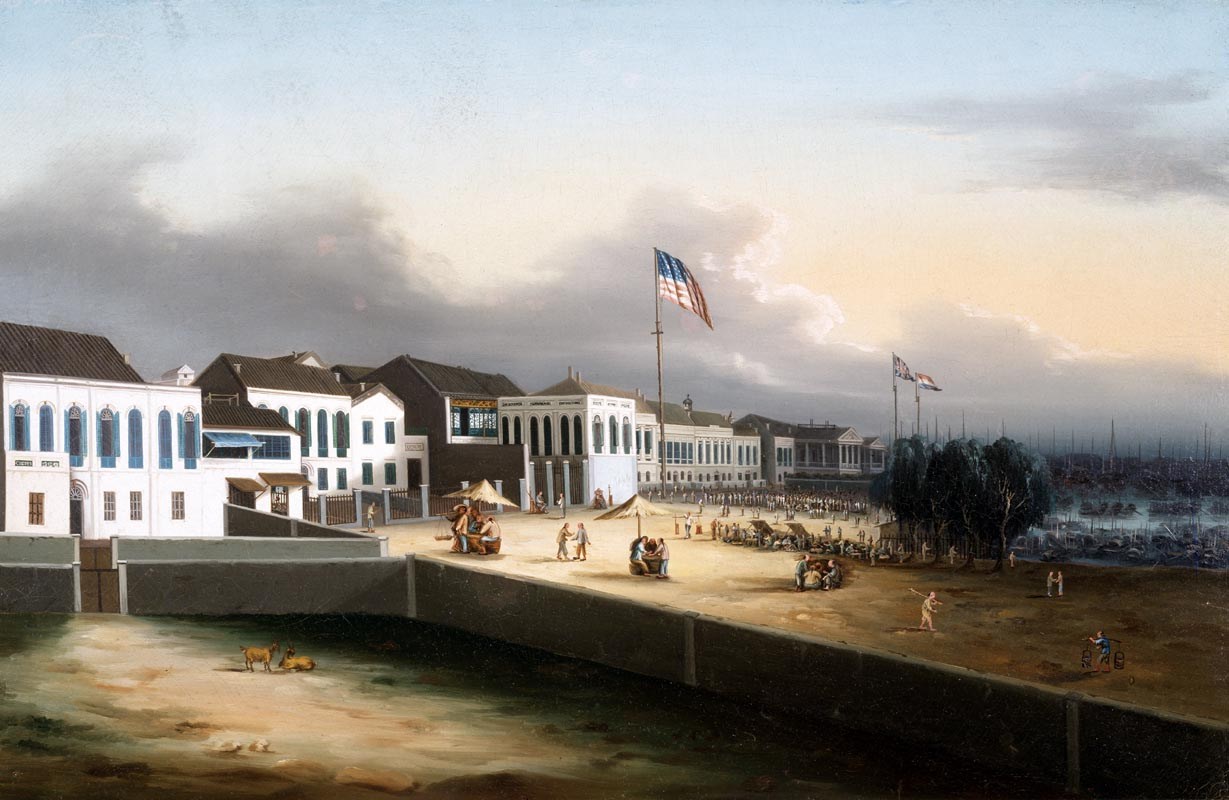
On Abraham Lincoln’s fifty-fourth birthday, February 12, 1863, Massachusetts governor John Andrew wrote to him about warships under construction in England. Andrew understood that Lincoln approved of trying to buy the ships before the Confederacy could take possession. The governor recommended a shipbroker, a builder, and a steamship captain for the job. Lincoln filed the letter under five words he wrote on the envelope. “About buying ships in England.”

The two men who went to London were John Murray Forbes and William Henry Aspinwall. Forbes had started out in the Canton trade. Aspinwall had built a steamship business and promoted a railroad across Panama. By April they had borrowed half a million pounds from Baring Brothers on United States bonds. If they could secure the ships before they sailed, the Union might spare itself the expense of fighting them at sea.
The war that sent Forbes to London also disrupted the supply of American cotton to England. In Bombay the house of David Sassoon was in a position to sell cotton to the same mills that could no longer count on the South. These were separate businesses in 1863. Eleven years later a Forbes and a Sassoon would succeed one another as chairman of the same bank in Hong Kong.

The American merchant and his Chinese principal
John Murray Forbes entered the China trade through his mother’s family, the Perkinses. He went to Canton as a young man, worked in the office of Russell & Co., and took care of English correspondence and shipping business for Wu Bingjian, one of Canton’s leading merchants. Western merchants called him Houqua, the same trade name they had used for his father, Wu Guorong.
Wu Bingjian later entrusted Forbes with money to invest in American securities. The Forbes firm recorded it as American Stock Investment. At a time when Americans were making fortunes by carrying goods out of Canton, Wu sent capital in the opposite direction, with Forbes as his agent.
A folder in Warren Delano’s papers lists Houqua accounts and memoranda from 1865 to 1867. Wu Bingjian died in 1843, and his heirs continued to do business under the name. The catalog leaves the account holder unidentified. The entries themselves could help establish where the family’s American investments stood at the end of Lincoln’s war.


The opium route through Smyrna
The Canton trade that made the Forbes fortune dealt in tea, silk, furs, and opium. British-controlled India supplied much of the opium that entered China. American merchants had another route through Smyrna, the Ottoman port on the Aegean. A cargo purchased there could change ships and hands before reaching the Chinese coast, where foreign traders evaded restrictions on the drug.
In February 1837 Robert Bennet Forbes explained the trade to his wife by appealing to the example of England, the East India Company, and merchants whose honor he respected. The firms that made the business profitable also supplied his reasons for regarding it as respectable. The money went into ventures that remained after the ships and cargoes were gone, including American railroads.
Americans living in Smyrna gathered on May 18, 1865, to mourn Lincoln. The missionary Daniel Ladd opened the meeting, Joseph Langdon chaired it, and F. C. Blackler served as secretary. The next day’s report carried their resolutions from one of the ports that supplied opium for the Canton trade.
Maryland iron and the emperor’s grain
Forbes invested in the Michigan Central and in the railroad enterprises that developed into the Chicago, Burlington & Quincy. His correspondence with the Delanos reached another part of the industry. At Mount Savage, in western Maryland, the rolling mill was credited with making America’s first heavy iron rails in 1844.
The papers of Warren Delano II contain letters from Forbes, Enoch Pratt, and J. F. Winslow about the Mount Savage ironworks. They also hold records of Consolidation Coal’s takeover in 1864. Warren’s brother Franklin kept a separate set of company papers from 1858 to 1863, including wartime correspondence. The ironworks gives the Forbes and Delano businesses a point of contact in the same industry where Forbes was investing in railroads.
George W. Hughes knew that coal country from his work as an engineer. In 1836 he examined the Maryland Mining Company’s coal and iron deposits in Allegany County and surveyed a route from its mines to the Chesapeake and Ohio Canal at Cumberland. Mount Savage lay in the same coal country.
Forbes’s railroads could buy as well as carry. Near the end of the Crimean War, Baring Brothers passed along orders for American grain on behalf of Napoleon III’s government. Forbes’s agents bought quietly so that knowledge of the emperor’s demand would not push up the price. In September 1863 Forbes wrote to Thomas Baring urging cooperation against Napoleon’s intervention in Mexico.
A Treasury loan in a London counting house
The ironclads that worried Lincoln were being built at Laird’s yard in Birkenhead, across the Mersey from Liverpool, for Confederate naval agent James Dunwoody Bulloch. With armored hulls and projecting rams, they threatened the wooden ships enforcing the blockade. Forbes and Aspinwall could buy a vessel outright, acquire a controlling interest, or secure a lien that would give them a say in its disposal.
Bulloch operated out of the Liverpool offices of Fraser, Trenholm & Co., the Confederacy’s financial agent. Its senior partner, George Trenholm, became the Confederate secretary of the treasury in July 1864. On April 18, 1863, Forbes and Aspinwall told Union Treasury Secretary Salmon P. Chase that Baring Brothers had advanced £500,000 for six months against $4 million in United States five-twenty bonds. If Washington authorized privateers to cruise against British shipping, the bank could demand prompt repayment. Forbes and Aspinwall also asked Chase for reliable figures on the government’s debt and revenue.
The Union never bought the rams. Bravay & Co. of Paris claimed to have acted for the late pasha of Egypt. The ships were known as El Toussoun and El Monassir. On September 8 Earl Russell told the American minister, Charles Francis Adams, that orders had gone out to prevent them from sailing. The ships remained in the Mersey and eventually entered the Royal Navy as Scorpion and Wivern.
That same year another British-built fleet put Lincoln’s minister to China, Anson Burlingame, in the middle of a dispute over warships. The Qing government had commissioned a steam fleet through its customs chief, Horatio Nelson Lay. The arrangement collapsed over who could give orders to its commander, Captain Sherard Osborn. Burlingame reported from Peking that Chinese officials had asked his advice on dismissing Lay. He also sought British assurances that the ships would be kept out of Confederate hands.
Osborn took four vessels to Bombay, the Sassoons’ home port. Three warships and a storeship went back to England. British authorities restricted their sale to keep armed vessels out of the hands of belligerents, then withdrew the restrictions in June 1865. Britain’s later account to the Geneva arbitrators records that Egypt bought the three warships in England, the China, Pekin, and Tientsin, for £30,100. The Keangsoo, which had gone to Bombay, eventually fought in Japan under the name Kasuga.
The Confederate rams had carried Egyptian names while they waited in the Mersey. The three vessels ordered by China actually passed into Egyptian hands after the war.

Aspinwall’s sister Mary Rebecca was the mother of James Roosevelt, Franklin Roosevelt’s father. Bulloch was the half-brother of Mittie Roosevelt, Theodore Roosevelt’s mother and Eleanor’s grandmother. When Franklin married Eleanor in 1905, his great-uncle had been the Union agent trying to stop the ships ordered by her great-uncle. The other side of Franklin’s family had been farther east. In 1863 his maternal grandfather, Warren Delano II, was rebuilding his fortune in the opium trade in Hong Kong. Warren’s son Frederic was born there that September.
Aspinwall’s railroad and the China mail
On December 28, 1848, Aspinwall, John Lloyd Stephens, and Henry Chauncey signed a concession with New Granada’s envoy, Pedro Alcántara Herrán, for a railroad across Panama. In early 1849 they sent George W. Hughes, a United States topographical engineer, to survey the route at their expense. They cited his survey in their December 1849 memorial to Congress. The Army’s history of the Panama crossing describes Hughes’s report as overly optimistic about the difficulties of construction.
The contractors George Totten and John Trautwine planned to bring materials up the Chagres to Gorgona. The river ran too low in the dry season and too fast in the rains for the steamers they meant to use. Costs rose as California-bound traffic crowded the isthmus. The company released both men from the construction contract and kept them on as engineers, taking the work on itself.

Hughes later served as a Maryland Democrat in Congress. His term ended on March 3, 1861, the day before Lincoln took office. His son Maxcy Galloway Hughes served with the Confederacy and died of illness in Texas. On March 1, 1863, Mrs. Mercer of Cedar Park found the colonel shaken by a letter that had come through the lines under a flag of truce. Her account survives in the Mercer Collection at Maryland’s Hall of Records and was printed in Maryland Historical Magazine. The same article records that Maxcy’s mother kept a copy of Jefferson Davis’s condolence letter in a scrapbook her son had started at seven.
On February 17, 1865, Lincoln approved an act authorizing a monthly mail line from San Francisco to China, with stops in Honolulu and Japan. The law limited bids to $500,000 a year. Pacific Mail, the company Aspinwall had founded to run steamships on the American side of the Pacific, won the contract. In 1867 its ships began running between San Francisco and Hong Kong.
The Sassoons during Lincoln’s war
David Sassoon left Baghdad after persecution threatened his family. By 1832 he was in Bombay. His sons and agents built a business in cotton and opium that reached into the same Chinese ports where Russell & Co. operated.
The Union blockade disrupted supplies of Southern cotton to Lancashire. On January 19, 1863, three weeks before Andrew wrote to him about the ships, Lincoln acknowledged the hardship in a letter to the workingmen of Manchester. He called their declaration of support for the Union’s stand against slavery an act of “sublime Christian heroism.”
The shortage increased the demand for Indian cotton. Sassoon’s house could buy and ship it, and Sassoon himself subscribed to the relief fund for Lancashire. He died at Poona on November 7, 1864, the day before Lincoln was reelected. The end of the war brought a collapse in Bombay’s cotton boom.

The family’s private business letters often used Baghdadi Jewish Arabic written in Hebrew characters. The seal on David Sassoon’s desk made a more public statement. Its lion held a rod that the Jewish Museum identifies as the scepter of Judah, a reference to the family’s tradition of Davidic descent. It was also the stamp he used to authenticate documents.
The Delanos carried an ancestral name into the next generation. In 1857 Warren named a son Philippe de la Noye Delano, after the ancestor who reached Plymouth in 1621. The family papers preserve genealogical charts and a set of French documents on the de Lannoy family dated from 1568 to 1778. A family genealogy published in 1899 went further, tracing the Delanos through the Flemish de Lannoy nobility to Charlemagne. The genealogy made the claim in print. David Sassoon had put his family’s claim on the seal he used at work.

Forbes and Sassoon at the same bank
In March 1874 The Economist printed a report of the Hongkong and Shanghai Banking Corporation. William H. Forbes of Russell & Co. had succeeded S. D. Sassoon of David Sassoon, Sons & Co. as chairman. Both remained in the governing circle. The report gave shareholders figures for the bank’s deposits and reserves, discussed its agency at Amoy, and attributed weak earnings to the dullness of trade.
The chairman was William Howell Forbes, the son of John Murray Forbes’s cousin Paul Siemen Forbes, a Russell & Co. partner and former American consul in Canton. William Howell had married Warren Delano’s daughter Dora in 1867. John Murray’s own son was William Hathaway Forbes, a Union cavalry officer captured in 1864 who married Edith Emerson and later became president of the Bell Telephone Company.
The outgoing chairman was Solomon David Sassoon. He spent nearly two decades in China and Hong Kong before returning to India. In 1876 he married Flora Gubbay. When Solomon died in 1894, Flora took charge of the business he had run, dealing with the branches through correspondence and making decisions about the firm’s credit and investments. The name beside Forbes in the bank report belonged to the man whose place she took.

The Kadoories enter through employment
When Lincoln took office, David Sassoon’s firm already had a branch in Hong Kong. Elly Kadoorie came to Hong Kong from Bombay in 1880. The Dictionary of Hong Kong Biography identifies his employer as E. D. Sassoon & Co. That house dated to 1867, when Elias David Sassoon split from his brother and started a firm that competed with the family company represented on the bank’s board. The Kadoorie family history also places Elly in Sassoon employment, though it identifies the employer by the family name alone.
Elly’s brother Ellis arrived in 1883. The brothers went into brokerage and eventually invested in businesses that stayed put long after the cargoes changed hands. In 1901 Elly was one of the seven original shareholders of China Light & Power, which was incorporated to supply electricity to Kowloon. Ellis acquired an interest of his own by 1918.
A Delano returns to the opium question
Frederic Delano, the boy born in Hong Kong the year the rams were stopped, went to work for the Chicago, Burlington & Quincy in 1885. He began as an apprentice machinist on the railroad John Murray Forbes had helped build. He later ran the Wabash and the Monon and joined the first Federal Reserve Board in 1914.
In 1890 David Sassoon & Co. had invited subscriptions to a company formed to exploit Persian mining rights granted under a concession from the shah. Frederick D. Sassoon sat on its board. When Delano went to Persia in 1926, the business before him was a crop. As chairman of a League of Nations commission, he investigated how Persia might replace opium production without destroying the livelihoods that depended on it.
The commission considered expanding cotton cultivation even though it could not obtain exact figures for the cotton yield. Sixty years earlier, a shortage of cotton in England had opened a market for the Sassoons, while Warren Delano was making his living in the Hong Kong opium trade. In Persia his son had to work out whether one crop could take the place of the other in a farmer’s accounts.