At Piqua, Ohio, people waiting up for Abraham Lincoln’s funeral train asked if Willie was aboard. He was. A correspondent for the Indianapolis Daily Journal who boarded at Richmond, Indiana, described the boy’s coffin at the front of the funeral car and his father’s at the rear. People along the route had left fresh flowers on both. Willie was eleven when he died at the White House in 1862. His coffin had spent three years in a borrowed vault in Georgetown. Now he was going home to Springfield with his father.

The Khallooni story gives Willie another destination. In accounts that surfaced online in 2020, he survives his illness, crosses the Atlantic and reaches Benghazi in 1863. A religious order called the Senussi raises him under a new name. He becomes Omar al-Mukhtar, the Quran teacher and resistance commander who fought the Italian occupation of Libya. The man the Italians hanged in 1931, the story says, was Abraham Lincoln’s son.

From Benghazi the family runs back to America. A daughter of the man the account calls Willie, named Mary Lincoln or Maryam, supposedly married Said H. Issa Kahlooni, a prince linked to Mount Lebanon and the Golan Heights. He is said to have reached the Libyan coast from Beirut in 1911. Their two sons kept the birthdays of Joseph P. Kennedy Jr. and John F. Kennedy, July 25, 1915, and May 29, 1917, but acquired a different set of parents. The German version leaves their passage into the Kennedy household largely to the imagination. The Greek version calls the younger boy’s removal a kidnapping. A later English retelling says both brothers were adopted.
The same genealogy sends one of President Kennedy’s own children to Libya. The Greek compilation puts Patrick Bouvier Kennedy in Benghazi on November 8, 1963, two weeks before his father’s assassination. It says a grandson of Willie raised him and identifies the person writing as Patrick Kahlooni as the surviving child. Patrick was born prematurely that August, and doctors spent about thirty-nine hours trying to keep him alive. To get him to Benghazi, the story has to do with his death what it had already done with Willie’s.
A readable version of the story surfaced in German on August 15, 2020. The site LiebeIsstLeben asked in its headline whether Q was a conspiracy and what connection it had to Kennedy. It credited Patrick Kahlooni with sending material to Melissa Maria and labeled the result an automatic translation from English. The page defended Q, declared Patrick and JFK Jr. alive, and brought Trump into the discussion before readers reached the account of Willie’s journey to Libya.
There is an earlier English trace. Thread Reader indexes a Twitter thread whose identifier dates to August 12, 2020, in UTC. The indexed fragments include the peculiar spelling “US Peridous” for Benghazi and a recurring numerical label for Patrick. The full thread was inaccessible when I checked. The German editor’s translation notice points back to English as well. The Greek compilation would later point to Facebook and to a video dated August 9. Those fragments and references put several versions close together in August, while leaving their order of composition open.
On October 10 the Greek compilation appeared under a title that translates as “Bloodline of Christ, the Lincolns, Kennedy & Trump.” In its opening, Willie is JFK’s grandfather and Mary and Said are the parents. A heading a little farther down calls Willie JFK’s father. The marriage account goes back to the grandfather version. The Greek page also adds the purported 1914 court appearance, the date of Mary’s alleged death and the date Patrick was supposed to have reached Libya. Several of the dates reappear elsewhere on the same page as numerical parallels.
The shared wording tells us more about the route the story traveled than a second language alone could. Both 2020 pages give Willie’s birthday in three calendars, reduce the digits of sixteen to seven, give the same account of an arrest in 1931 while he was defending three sacred places, and use an unusual rendering of an ancient name for Benghazi. Both name three daughters, put the alleged husband’s arrival in Libya in March 1911, and give the same birthdays for the Kennedy brothers. That sequence is detailed enough to recognize across translation. The two versions could share an English ancestor, or one could borrow through intervening copies. Their overlap gives us one cluster of claims in circulation, with different editors selecting and adding material.
Inside the Greek page, a passage attributed to Daniel Dowell places a meeting in 2016, a conversation in April 2019, and the start of a Facebook effort later that year. A later version of The Jesus Strand links to a Twitter post whose identifier dates to October 27, 2019. It says replies posted in November and December contain a claim by the account’s operator to be Patrick Bouvier Kennedy. The thread and replies were inaccessible when I checked. The link dates a possible precursor to the survival claim. The earliest readable accounts that connect Patrick’s story to Willie Lincoln and Omar al-Mukhtar still date to 2020.
The same material kept turning up in new places. An August 2021 post reproduces the Benghazi spelling and the claim that Issa’s family tree was widely known in the region. A July 2022 Restored Republic circular repeats Mukhtar’s execution with the same place-name and age. A 2024 English compilation links to social-media accounts and online family trees. The Jesus Strand dossier, in circulation by 2021 with an accompanying family map, extends the pedigree to more political figures and cites statements attributed to Patrick.
The later Greek translation of The Jesus Strand belongs to that offshoot. The October 2020 Greek text already had the Christ theme, and the two publications can easily be confused in a search. I found no text from the Onassis era that joins the Kennedy name to Kahlooni, Mukhtar or the Druze claim. The earlier private conversations enter the record through accounts written afterward.
The trees can look like independent witnesses because each appears under a different contributor’s name. One entry gives Abraham Lincoln a different surname. Another attaches the name to Willie and supplies a portrait of Omar al-Mukhtar. A third accepts both profiles and adds a new generation. The surname turns up in Lebanon before it appears in any of these trees.
In April 2014, the Beirut-based magazine The Monthly listed Kahlouni among Lebanese surnames derived from places. It pointed to Kahlounieh in the Shouf and Kahlounieh w Haret Hamza in the Baabda district, described both as Druze localities, and recorded Kahlounis in Ain w Zain and Ain Zhalta. Those are more specific places to look than the genealogy’s phrase “The Orchards.”
The Arabic village spelling الكحلونية gives a way to compare the names. A corresponding surname would be written كحلوني, with kāf followed by ḥāʾ. The root also supplies kuḥl, the name for kohl. The shared consonants make the resemblance visible, though the family-name article traces the surname to place-names and does not settle how the villages got theirs. “Kahlouni,” “Kahlooni,” and “Khallooni” can all circulate as Roman-letter spellings. The first two can differ simply in how the long vowel is written. Initial kh can represent the separate letter khāʾ, خ, in formal transliteration. In an unstandardized English post, it can also reflect a writer’s attempt to represent a sound or copy a name. The spellings cannot establish a deliberate substitution without the Arabic used by the people or institutions concerned.
Abraham Lincoln’s alternative name comes from a different set of sounds. Ibrāhīm is Abraham. Al-Khalīl is the Friend, an epithet taken from the description of God taking Abraham as a friend in Quran 4:125. Hebron is called al-Khalīl in Arabic through its association with the patriarch. The German page already places Lincoln in the Kahlooni family. The fuller claim, giving him the name Ibrahim Khaleel Kahlouni and a birth in Tripoli on February 17, 1809, appears in a readable 2024 compilation. The compilation points to a Twitter post with an identifier dated September 10, 2020. That post was inaccessible when I checked.
The 2024 compilation specifies Tripoli in Libya. That was the seat of Yusuf Karamanli, whose state the United States fought from 1801 to 1805. An unqualified “Tripoli” in a retelling can also mean the Ottoman port in what is now northern Lebanon. A birth would leave a different local trail in each city. The Mount Lebanon villages associated with the surname are farther south.
February 17, 1809, falls a day after the start of Muharram 1224 by the standard tabular reckoning, with about a day’s possible variation in local lunar observation. The early accounts give lunar dates for Willie where they serve the writers’ arithmetic. They give no Muharram connection for Abraham. In accounts he prepared before his election, Lincoln himself gave February 12, 1809, and Hardin County, Kentucky. The 1860 sketch names his parents and describes the paternal family’s route through Pennsylvania and Virginia.
That route can be followed back to Samuel Lincoln, who came from Hingham, England, and settled in Hingham, Massachusetts, in 1637. The line passes through two men named Mordecai, then John Lincoln and his son Captain Abraham Lincoln, killed in Kentucky in 1786. The captain’s son Thomas was the president’s father. Abraham was named for his grandfather. Mordecai belonged to earlier generations and to one of his uncles. Both names were later taken as clues to Jewish ancestry.

In the days after the assassination, Rabbi Isaac Mayer Wise told a Cincinnati audience that Lincoln had spoken in his presence of belonging to the same ancestral people. The historian Bertram Wallace Korn found the ancestry claim uncorroborated. Lincoln’s correspondence with American Jews can be followed independently. Wise’s recollection also shows how early a second Abrahamic identity could be proposed for Lincoln. More than a century later, the same first name could be rendered as Ibrāhīm al-Khalīl and made to suggest another ancestry.
The gaps in the family record lie chiefly on Nancy Hanks’s side. William Herndon collected recollections from people at different distances from the family, and stories about Nancy’s origins have had a long life in local tradition and genealogy. Lincoln’s autobiography identifies his mother and the family he knew. The unanswered questions about her earlier relatives begin with the people and places where that record thins out, a long way from an established connection to Tripoli.
There was already an appetite for a hidden Lincoln while he was still in office. Abraham Africanus I, issued in New York in 1864, announced that the mysteries of the White House had been revealed under mesmeric influence. Its Lincoln was a ruler with a dynastic numeral. The device let the author put boasts, confessions and ancestors into the president’s mouth under conditions in which the country supposedly could never hear him speak.

When the pamphlet reaches Lincoln’s parentage, an interlocutor starts with the familiar Tom Lincoln and Nancy Hanks. Its Lincoln immediately claims aristocratic descent and traces the line toward the time of Robin Hood. Lincoln green supplies a pun to help it along. A noble Earl of Lincoln appears. Charlemagne, William Penn and a remnant of the rod of Aaron pass through the genealogy along with a copy of habeas corpus. Placing Penn in the age of Charlemagne makes nonsense of ordinary chronology. It also gives the genealogy an imperial ruler, a sacred object, a founder of Pennsylvania and a legal protection that the pamphlet’s president has conveniently misplaced. The objects have political functions in a Civil War polemic. Habeas corpus in particular had an audience that understood what it meant to accuse Lincoln of having lost it.
The treaty that follows is savage in its treatment of Indigenous dispossession. In the burlesque, the colonists receive the land, people and property, and the Indigenous side gets bad whiskey. It is worth reading the passage rather than treating it as incidental color. The claimed family history puts the ceremonial language of a treaty around an act of taking. The royal name, biblical relic and inherited legal document give the speaker a pedigree. The treaty gives that pedigree a political deed. The racial attacks in the pamphlet and the fantasy of an aristocratic Lincoln also work together. The author can accuse the president of secret pretension while exploiting the racial prejudices of an audience reading during a war over slavery and emancipation. Satire can disclose what an audience fears or what a writer can get it to laugh at. Establishing an actual treaty or ancestry requires identifying it outside the pamphlet.
A different ancestry story grew out of a joke in an Illinois courtroom. In 1855 Lincoln represented William Dungey, a man of Portuguese descent, in a slander suit against Joseph Spencer. Spencer had publicly described Dungey as Black, a charge with legal consequences under Illinois law. In defense attorney Lawrence Weldon’s later recollection, Lincoln joked that his client might be a Moor, playing on the name of opposing lawyer Clifton H. Moore. It was Dungey’s ancestry under discussion. The anecdote appeared in an online Moorish discussion by May 2013, and writers invoking Moorish identity have also made claims about Lincoln himself. The Moorish Science Temple associated with Noble Drew Ali had given that identity its own religious and institutional meaning in the early twentieth century.
The face in another alternative Lincoln story came from a real photograph. A daguerreotype by Augustus Washington, made in Liberia around 1854–58, circulated online as an image of Lincoln. The Library of Congress catalogs the sitter as unidentified and traces the plate to the American Colonization Society’s records. The Smithsonian holds a different daguerreotype from Washington’s work in Liberia, also cataloged as a portrait of a man. The plate, its maker and its route into a collection can be followed. The Lincoln identification appeared much later, from people looking at the image.

The names used to connect that family to the Kennedys have ordinary lives in Arabic as well. ʿĪsā, عيسى, is the Quranic name for Jesus. Maryam, مريم, is Mary. The Greek compilation explicitly points out the meaning of Issa and proceeds to a list it calls the families of Jesus. The first observation explains a name. The second gives the people bearing it a biological relationship to its sacred namesake. That jump would look strange in a list of English families with the name John. The use of Arabic gives the names an unfamiliarity that helps carry the claim. Mary is especially effective because she has several possible referents in this story. She recalls Willie’s mother, supplies the name of his alleged daughter, and makes it possible to connect the next child’s birth to a reported apparition of the Virgin Mary in 1917.
“Said” raises a further problem. Saʿīd, سعيد, means fortunate or happy and is a common personal name. Sayyid, سيّد, is a title of respect, and in particular settings can mark a claim of descent from the Prophet Muhammad. English spellings and accents can obscure the difference, especially when a text passes from English to German or Greek and back again. The honorific used in the full name of a real Senussi royal is no basis for conferring the same title on the man in the genealogy. A contemporary document in Arabic could tell us whether Said is the personal name, whether the letter H. stands for a patronymic, and how Issa and Kahlooni were used. In the versions at hand, the Roman-letter label has to carry those decisions by itself.
In the Khallooni family tree the eastern Mediterranean enters a second time through Said. The posts give Quneitra and Majdal Shams in the Golan as places of origin, Mount Lebanon as his birthplace, and Beirut as the port from which he traveled. Druze communities have a documented history in the region. The genealogy goes further and assigns a particular man to each of those places at a particular point in his life. The March 2019 American recognition of Israeli sovereignty over the Golan also appears in the Greek compilation, where a contemporary decision about the territory takes on meaning for the family said to have come from it.MEDITERRANEAN SEANORTH AFRICATripoli, LibyaBenghaziCyreneDernaJaghbubTripoli, LebanonBeirutShoufGolanPlaces in Libya and the Levant discussed in the article.
The Druze faith emerged in the early eleventh century in the Fatimid world, in an environment shaped by Ismaili thought and the reign of the caliph al-Hakim. Its communities developed a distinctive tradition and endured across the mountain districts of the Levant. Jethro, known in that tradition as Shuʿayb, is a figure of great reverence. The genealogy turns that association into a claim of descent from him. It treats a tradition shared by a community as the beginning of a particular family line.

In Druze tradition, taqammuṣ refers to the transmigration of the soul, commonly understood as immediate. The word evokes putting on a garment. Accounts of remembered lives can be told and assessed within families and villages, and a child believed to remember another life still has a family in this one. The Willie story describes a different kind of continuity. His own body is supposed to survive, and somebody has to take custody of him, carry him across the Atlantic and give him a new identity. The 2020 accounts leave those people unnamed.
The people who carried Willie’s coffin through Washington are easier to trace. He died at the White House on February 20, 1862. He was eleven. His illness is commonly described as typhoid fever. Tad was ill as well and survived. Four days later the Reverend Phineas D. Gurley conducted the funeral in the East Room. Contemporary Washington reports place the coffin in the adjoining Green Parlor during the service. Abraham Lincoln went to Oak Hill Cemetery in Georgetown, where the family placed Willie’s remains in the vault of William Thomas Carroll.
The Carroll family lent the Lincolns a place for Willie’s coffin until they could take him home. In April 1865 the coffin came out of the vault and went onto the funeral train. At Springfield in May, both coffins were received at the temporary vault in Oak Ridge Cemetery. Willie was eventually moved into the Lincoln tomb.
The family vault in Washington, the railway dispatches, and the receiving vault at Oak Ridge give the boy’s coffin a route that can be followed from one place to the next. The Khallooni account would need a point on that route where the child and the coffin parted company.

The story of what happened to the president’s coffin after the train arrived makes the suspicion around Willie’s easier to place. On election night, November 7, 1876, a gang of counterfeiters tried to steal Abraham Lincoln’s remains and hold them for ransom. A Secret Service informant had infiltrated the gang, and agents and other officials were waiting at the tomb. After the attempt, the men responsible for the monument hid the coffin. Illinois archival records count seventeen moves between 1865 and 1901, some for security and others to make way for construction.
By September 1901, rumors that the coffin held someone else or had been left empty had persisted long enough to affect the final burial. Two workmen cut an opening in the lead lining. Twenty-three people looked inside, among them young Fleetwood Lindley, the son of one of the men who had guarded the tomb. The witnesses recognized Lincoln, and members of the Guard of Honor signed a certificate identifying him before the coffin was sealed and lowered into the vault. The inspection concerned Abraham’s remains. Its significance for the Willie story is the rumor it records. Long before anyone assigned Willie a second life in Libya, Americans were already asking who was in the coffin.
Lincoln’s assassin got a second life in print as well. In The Escape and Suicide of John Wilkes Booth, published in 1907, Finis L. Bates claimed that Booth escaped the soldiers at the Garrett farm in 1865, lived in Texas as John St. Helen, and died in Enid, Oklahoma, in 1903 under the name David E. George. Bates made a reported confession the link between the actor and the man who died in Enid. The story had an escape, a substitute for the man reported killed, and a new identity far from the scene of the death. Readers already knew how to follow that plot when the Khallooni accounts gave it to Willie and Patrick.

There was also a way to imagine Willie speaking again without giving him another life overseas. In 1891 the medium Nettie Colburn Maynard published her recollections of séances and the Lincoln circle. She wrote decades after the wartime events and had an interest in establishing the importance of her mediumship. The Banner of Light and the spiritualist press gave such accounts readers who understood death as a separation that could sometimes be crossed. The 2020 genealogy assigned Willie a journey across water, during the year after his funeral.
In the Greek compilation he reaches Benghazi in 1863, aged thirteen. On its own birth date he would have been twelve until December 21. The text supplies no departure port, vessel, escort or name in use before arrival. If the transfer involved American officials or money, the consular despatches from Tripoli and the legation correspondence from Constantinople would be places to look. The National Archives holds the Tripoli despatches from 1796 to 1885 in Record Group 59, microfilm M466.
The American minister at Constantinople was Edward Joy Morris, a former Pennsylvania congressman who had published an account of his travels through Turkey, Greece, Egypt, Arabia Petraea and the Holy Land. Lincoln appointed him in 1861 and ordered the seal affixed to his commission. An earlier Philadelphian, Warder Cresson, had gone to Jerusalem after receiving a consular appointment that Washington withdrew. He stayed and converted to Judaism. The records give each man a name, an office and a destination. A privately arranged journey could have passed outside Morris’s knowledge. An official American role in Willie’s transfer would put the story within reach of the paperwork his legation left.
One paper that did cross Morris’s desk came after the assassination. On June 7, 1865, members of Germania of the Golden Horn, a German Masonic lodge in Constantinople, addressed a condolence to him and said the order had “lost a brother in the person of the illustrious deceased.” Persia’s representative also conveyed condolences through Constantinople. The lodge spoke for an order and the diplomat spoke for a state. The lodge’s public claim of brotherhood survives with the names of its signers. A lodge register, a date or a witness to an initiation would be needed to carry that claim further.
In Tunis, Muhammad al-Sadiq Bey sent Mary Lincoln a letter dated August 29, 1865, or 7 Rabiʿ al-Thani 1282 in the American translation. It opens, “Praises to the only God!” In October, General Otman Hashem addressed Andrew Johnson on the bey’s behalf, expressing relief at the restoration of peace and grief over Lincoln’s assassination. The bey sent his portrait as a sign of friendship. Hasan would give Kennedy his own portrait almost a century later. In both cases the gift traveled through public diplomacy, with a named sender and recipient.
There is an instance from the same years where a Masonic relationship can be followed into the lodge. Emir Abdelkader, who had resisted the French conquest of Algeria, lived in Damascus after his exile and helped protect Christians during the violence of 1860. In 1864 the Alexandria lodge Les Pyramides acted on behalf of the Paris lodge Henri IV in his reception into Masonry. The Masonic press reported the event. The emir and the two lodges are identifiable, and the relationship later acquired a ceremonial life of its own in America.

American Masons founded the Shrine in New York in 1872. Its early figures included Walter Fleming and William J. Florence, and accounts associated with Albert Leighton Rawson claimed a connection to a Brotherhood of Lebanon. Mecca Temple’s own 1894 history went further. It put the order’s founding in Mecca under “the Mohammedan Kalif Alee” in AH 25, which it equated with AD 644. By the standard tabular conversion, AH 25 began late in 645. Ali ibn Abi Talib became caliph in 656. The temple’s founding date disagrees with its own Christian-era equivalent and puts Ali in office more than a decade early.
After Abdelkader died in Damascus in May 1883, the Shrine ordered its temples to go into mourning. At a May 31 memorial in New York’s Masonic Temple, Shriners laid what their history described as a parchment letter from Abdelkader on a black velvet coffin containing a skeleton that represented death. A Quran in Arabic stood at the altar. Rawson and Fleming were among the mourners. Abdelkader’s initiation into a lodge connected to French Masonry was a documented event in his own life. The New York ceremony shows how an American fraternity took that Muslim figure into the history it told about itself, alongside a claim of institutional descent stretching back to Mecca.

Two years before the New York memorial, President Garfield appointed the Indiana author and former Union general Lew Wallace to the Ottoman court. His papers record correspondence and audiences in the circle of Sultan Abdülhamid II. That career belongs to a later Ottoman administration. The letters and appointment are the kind of evidence the story of an official American role in the 1863 transfer still lacks.

Some writers claimed more private lines of transmission. Paschal Beverly Randolph wrote about esoteric knowledge acquired through travel and initiation. His references to the Ansaireh concern the people generally known today as Alawites. In later writing associated with R. Swinburne Clymer, Randolph becomes part of a Rosicrucian institutional history, and an inner “Council of Three” supplies a hidden office to set beside Lincoln’s public one. Cerneau’s higher-degree Masonic network offers a separate line of inquiry through memberships and places. The publications show how Americans imagined a succession that could pass outside public office. The 2020 accounts name no Rosicrucian council or Masonic body that took custody of Willie.
Published State Department selections represent only part of the diplomatic archive. An escort’s letter, a payment, a passenger list or an identified household could give the story a record to set beside the funeral accounts. The receiving household in the posts is called the Senussi royal family. In 1863 that name would take a traveler to a religious order in Cyrenaica and to a young leader at an inland headquarters.
The Senussi order came out of nineteenth-century Sunni Sufism. Muhammad ibn Ali al-Sanusi, born in what is now Algeria, established a movement that eventually built a network of lodges across Cyrenaica and into the Sahara. The zāwiya could be a place of worship and study, an institution through which travelers and traders found lodging or assistance, and a point of contact among communities separated by considerable distances. In a region where routes to water and the reliability of an escort mattered, religious organization had practical effects. The order’s position depended in part on its ability to make relationships work across a territory that distant administrations could claim more readily than they could govern.
The elder Sanusi established his headquarters at Jaghbub in the 1850s, near what is now the Libyan–Egyptian border. He died in 1859. His son Muhammad al-Mahdi al-Sanusi, then in his teens, took over the leadership. Jaghbub was an inland center of education and religious authority. If the family responsible for Willie is meant to be the leadership of the order, this is the institution the 1863 claim has to reach. The phrase “royal family” looks forward to the dynasty of Idris, the son of Muhammad al-Mahdi. An account written in 1863 would have had reason to name the religious leader, a lodge, a guardian, or a place of study. A future title gives a modern reader a recognizable institution while leaving the contemporaneous household unspecified.
Idris, the son of Muhammad al-Mahdi, became the first king of independent Libya in 1951. In 1863 the monarchy was still almost ninety years away. A household or lodge that took in a foreign child would have had a place and a person responsible for him. The later royal title leaves both unspecified.

The name Muhammad al-Mahdi also supplies a title the genealogy would later borrow. Al-Mahdi means the rightly guided one, and in Islamic traditions the term can refer to a figure expected to appear at the end of time and restore justice. Muhammad Ahmad, who declared himself the Mahdi in Sudan in 1881, led a different movement, whose followers overran Khartoum. The Senussi leader at Jaghbub and the Sudanese Mahdi each had his own followers, territory and political history.
By the time Italy invaded in 1911, the order’s lodges and tribal relationships could support resistance in Cyrenaica. They also gave the Senussi leadership a means to negotiate with other powers. Its conduct during and after World War I cannot be reduced to a single choice between betrayal and resistance, as the Greek account tries to do. Idris reached agreements with the British and the Italians and acquired a recognized position in Cyrenaica. Mukhtar continued the struggle when the terms under which the Senussi had operated gave way to intensified conquest. The order contained people with different responsibilities and different room to act. That distinction matters more to the Libyan story than any effort to make Mukhtar the lawful heir to a foreign president.
The Greek version calls the Senussi negotiations a betrayal and puts American entry into World War I in 1914. The United States declared war on Germany in April 1917. The dates matter in Libya. The invasion was already years old by the time Idris and the foreign governments were negotiating over Cyrenaica. Mukhtar’s decisions belonged to that sequence.
Mukhtar’s own biography also contains a story of a boy raised in someone else’s care. His origins are placed in eastern Libya in the Minifa tribal community. The plausible range for his birth runs from the mid-1850s into the early 1860s, and accounts name Hussein al-Ghariyani as a guardian or patron after the death of his father. His education was in the Senussi system. The American version has to make those local people and institutions part of the life of a boy who grew up in Springfield.

The 2020 accounts put Mukhtar’s arrest near sacred places associated with Mark the Evangelist, the Bible and Mary. Cyrene has genuine connections to the early Christian world. The campaign accounts put the fighting in the Jabal al-Akhdar, the Green Mountain, where resistance fighters used terrain and local knowledge against an army with better communications and heavier weapons. The claimed religious purpose for his presence there would need evidence of his own intentions.
Religious education was central to his adult position. Mukhtar taught the Quran and held standing within the lodge system, the same network through which he could maintain contact with communities called on to supply men, food or information. Under Italian occupation, that knowledge became a military resource. In Cyrenaica, the resistance could disperse and regroup in country its men knew well. The Italians had to deny them access to people, livestock and supply routes. Under Fascism that effort took in the wider population. The colonial authorities confined great numbers of people in camps and forced communities away from their homes. The conditions, deaths and dispossessions are part of the history of Mukhtar’s defeat. His execution in one of the camps should be read in that setting.

The trial took place at Benghazi. Mukhtar was hanged at Solluq on September 16, 1931. The story’s repeated claim that the prisoner was eighty-one is partly an effect of having begun the calculation with Willie’s date of birth. The calculation itself has a problem. Anyone born on December 21, 1850, would still have been eighty on September 16, 1931. The uncertainty surrounding Mukhtar’s actual year of birth is a separate issue. A disputed birth date in a nineteenth-century biography leaves a range of possible ages. It does not identify an American child born on a precisely recorded date. To make that connection, the legend would have to account for Mukhtar’s established social identity, his family and local affiliations, and the years in which he acquired the standing to teach and lead.


The Greek account says the Libyan government confirmed that Willie Lincoln’s remains had been sent to America. Mukhtar’s own burial history can be followed in Libya. After his execution, he was buried at Sidi Obeid cemetery in Benghazi. On August 7, 1960, under King Idris, relatives and surviving comrades carried his coffin in a public procession to a new mausoleum in the city. The photograph of the procession shows men walking alongside the coffin, nearly thirty years after the Italians hanged him.

Gaddafi spoke at the mausoleum after overthrowing Idris in 1969. In the 1980s his government moved Mukhtar’s remains to Solluq, where he had been executed. The transfer was still a grievance in 2011, when Mukhtar’s son Mohammed told reporters he wanted his father brought back to Benghazi. By then the tomb in Benghazi had been demolished. The son was asking for the return of his father’s remains from another Libyan town.
While the Benghazi mausoleum was still standing, another version of Mukhtar’s life reached audiences far from Libya. In Lion of the Desert, released in 1981, Anthony Quinn played Mukhtar and Oliver Reed played the Italian general Rodolfo Graziani. The German post sends readers to the film for the life of the man it calls Willie. It gave them a face, a landscape and a confrontation with Italian officers. Some later retellings call the figure the “Lion of Sudan.” The title of the film and the resistance campaign it depicts belong to Libya.
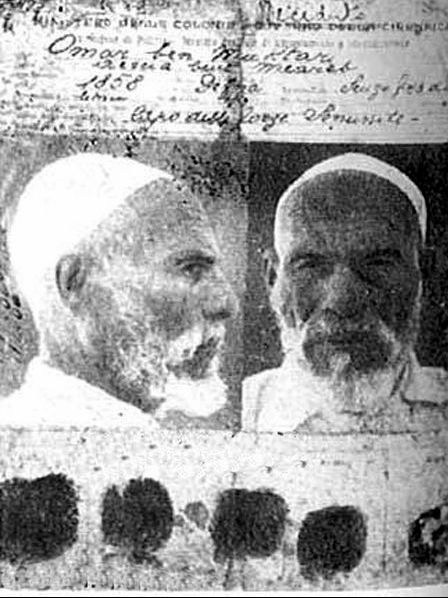
On June 10, 2009, Gaddafi stepped off his plane in Rome with a photograph of Mukhtar in Italian custody pinned to his uniform. Mohammed was in the delegation. Berlusconi had signed a treaty in Benghazi the previous year and apologized for Italy’s colonial rule. The photograph brought the man Italy had executed into the airport welcome. The October 2020 Greek account recounts Gaddafi’s gesture and calls the prisoner in the photograph Willie Lincoln. The old image had traveled from an Italian record of captivity to a Libyan demand for remembrance. The new caption presented it as evidence for an American identity.

Mohammed’s presence in Rome also gives the genealogy a date it has to account for. The 2020 German account says Mukhtar’s only son was killed by Italian military police in 1942. The man who traveled with Gaddafi in 2009, and spoke to reporters in 2011 about returning his father’s remains, died in 2018. A 2024 compilation accepts the 2018 death while retaining the claim that Mukhtar was Willie Lincoln. By 2024 the genealogy had absorbed the son’s later life in Libya while keeping the claim about his father.
To get from Mukhtar to the Kennedys, the story needs a daughter who could carry the line to another family. The Greek account dates Mary’s birth to 1890 and gives her a marriage in Benghazi. When it offers a date that could be checked against a public record, the name it gives is her husband’s.
The date given is September 12, 1914. The Greek compilation says Prince Said H. Issa Kahlooni appeared before an Italian military court in Benghazi and that the American government and an intelligence department have copies. The account of his marriage appears elsewhere. The court appearance is paired with JFK’s marriage at St. Mary’s Church on September 12, 1953, thirty-nine years later. The juxtaposition helps explain how an alleged appearance came to sound like a marriage certificate.
The city’s name is rendered oddly in the accounts of the hearing and the execution. The German account gives “US Peridous.” The Greek compilation prints Ευεσπερίδες beside variants such as “US Peridious.” Ancient Euesperides, also rendered Euhesperides, stood in the area of present-day Benghazi and took its name from the Hesperides of Greek myth. The Greek spelling explains how an ancient place-name could pass through copying until it looked like an American reference. The court in the story would have filed its papers under Benghazi and the Italian jurisdiction in operation at the time.
Italy had occupied Benghazi during the invasion that began in 1911. The 1912 agreement often called the Treaty of Ouchy or First Treaty of Lausanne ended the Italo-Ottoman War. It did not give Italy immediate control of the entire country. Colonial authorities dealt with forms of law and administration that had existed before the invasion, and Islamic courts continued to handle much of Muslim personal status, including marriage and inheritance. Italian jurisdiction and military proceedings present another line of inquiry. A marriage could leave a record in a religious register, and a military case could mention a marriage in testimony or exhibits. The title of the authority and the type of proceeding matter because they determine where to look and what any recovered document would establish.

In Rome, the guide to Italy’s Archivio Centrale dello Stato lists a Benghazi judgments series under the colonial military courts. Series 0003594 begins in 1916. The army historical office’s main Benghazi file also begins in 1916 and includes judgments, orders and investigatory papers. The central archive holds judgments cataloged under Tripoli that span 1914 and a set of hearing minutes dated 1913–15 that the guide marks unavailable for consultation. An early proceeding could have been filed in another jurisdiction or survived elsewhere. The gaps in those series give the claim about American copies real consequences. A dated copy or an identifiable docket would give the search somewhere to go.
An authenticated record for September 12 would need to be read before it could be made to support a genealogy. A register entry might contain a spelling of the name, a father’s name, witnesses or a place of residence. The original language might clarify whether “Said” was a name or a title. A military docket might establish only that a man appeared and perhaps that he had traveled from another port. To prove the larger claim one would still need a record tying the groom to Mary, evidence for her parentage, and documentation connecting both Kennedy boys to that household. Even the royal designation changes across versions. The 2020 accounts make him a prince of Golan origin. A 2024 compilation calls him a prince of Libya and Syria and names Idris as his uncle. There were recognized ruling houses in Mount Lebanon, including the Maʿn and Shihab dynasties and the Druze Arslan house. The surname in the Lebanese magazine’s survey and the princely styling of the online genealogy are separate kinds of evidence.
A secret genealogy had already acquired a library address in a more famous story. On April 27, 1967, the Dossiers secrets d’Henri Lobineau were deposited at the Bibliothèque nationale in Paris. Associated with a hoax by Pierre Plantard and Philippe de Chérisey, the papers traced Plantard’s supposed ancestry to the Merovingian king Dagobert II. Holy Blood, Holy Grail made the line descend from Jesus in 1982, and The Da Vinci Code gave the idea a mass audience in 2003. Anyone could look up the dossier. The library’s catalog recorded the deposit of the papers, while the pedigree inside remained a fabrication. The Khallooni account promises a comparable paper trail in Benghazi, with the relevant record still out of sight. The route from the French story to the 2020 posts remains uncertain.
The Greek compilation dates JFK’s birth to May 29, 1917. In another passage Mary is still pregnant with him when the same account places her husband’s execution in November 1917. Both dates come from the same page. Mary herself is assigned an October 5, 1962 death in the Greek compilation and a 1945 death in a tree linked by the 2024 account. Kennedy’s birthday stays fixed through these changes. The date it preserves comes from the family in Massachusetts.
Rose Fitzgerald Kennedy gave birth to her second son on May 29, 1917, in an upstairs bedroom at 83 Beals Street in Brookline, Massachusetts. The date is the one the Khallooni accounts keep. They move the birth to Libya, change the mother and father, and later need a way to put the boy back in Massachusetts. Joseph P. Kennedy Jr., the eldest child of Rose and Joseph Kennedy, receives the same treatment. The family’s history at Beals Street has a traceable beginning. Rose and Joseph married in 1914 and acquired the house that year. The National Park Service’s account draws on property history, family material and Rose’s later recollections of the household. Those sources vary in what they can establish, but they describe the same family in a specific house at the time when the alternative story puts two births in Benghazi.

The terms in which the boys are said to have entered the Kennedy household vary considerably. A kidnapping demands an account of who took the children and how they crossed the Atlantic. An adoption invites a search for a registration, an order, a guardian, or at least a letter from one of the two families. An informal placement still leaves a problem of timing. The alternative account has to explain why the dates of birth match the accepted dates, and when each child first appears in Massachusetts. The Greek page offers a forceful assertion of abduction. A later version presents the same relationship under the more ordinary word adopted. Neither supplies a route with an independent record at both ends. The dates of birth remain exact while the process by which the two boys supposedly changed parents becomes more flexible.
The record for Patrick begins with medicine. Jacqueline Kennedy gave birth prematurely at Otis Air Force Base on August 7, 1963. The infant had severe respiratory distress, then described as hyaline membrane disease, and was taken to Children’s Hospital in Boston for treatment. He died on August 9. The contemporary coverage follows his care over the roughly thirty-nine hours of his life. Within a week his father was answering condolences. One surviving letter, written five days after the death, thanks a couple in the family circle who had written to him. A letter of that kind belongs to the private consequences of a public event. It also places the president’s acknowledgment of the death before the November date later assigned to Patrick’s journey to Libya.
The contemporary coverage of Patrick’s illness followed the attempts to keep him alive. Time later described his grave as the first in a new Kennedy family plot, with a marker carrying the family name. The hospital account, the president’s letter and the cemetery record describe separate acts. A voyage to Libya in November would have to account for what happened between the hospital and the cemetery in August.
Patrick’s first burial was at Holyhood Cemetery in Brookline. Following the assassination, his remains and those of the Kennedys’ stillborn daughter were brought to Arlington and reinterred near their father in December. Kennedy’s own original Arlington grave, selected after his death, was later incorporated into the permanent gravesite. That public history can look stranger in a short timeline than it did to the family making decisions in 1963. In August the president’s infant son was buried in Massachusetts. In November the president was killed. In December his children were placed beside him. The two burial locations follow the change in the family’s circumstances.

Patrick’s journey in the legend runs in the other direction. The boy leaves the United States alive and reaches Benghazi on November 8, while his father is still president. He is said to have been received by a member of the hidden Lincoln family. The Greek compilation makes the survival claim by rejecting the reported death, but leaves the intervening weeks unaccounted for. A child who had been born prematurely and needed emergency treatment would have needed care in those weeks. A transatlantic journey would have required someone to take responsibility for him along the way. Naming a descendant of Willie at the destination gives the story continuity from one century to the next. The reported relative’s identity itself depends on the Willie claim that the Patrick story is then used to reinforce.
A later version of The Jesus Strand offered a photograph of John F. Kennedy Jr. and Carolyn Bessette Kennedy as evidence that Patrick grew up. It identified the man in a checked jacket behind Carolyn as her brother-in-law. An Associated Press frame from the same sequence shows the couple and the man in the same doorway. Douglas Healey took that frame as John and Carolyn left a party in New York on October 10, 1996. The AP caption identifies the couple and leaves the man behind them unnamed. His identification as Patrick appears in the later retelling.

The decision to bury Patrick again beside his father made the Kennedy and Lincoln family histories resemble each other. Jacqueline Kennedy made the resemblance closer herself. After the assassination, she asked chief usher J. B. West to make the East Room “look like when Lincoln lay there.” She remembered an engraving of Lincoln’s coffin beneath a canopy, and the White House turned to the Library of Congress for accounts of the 1865 arrangements. The East Room had also been the site of Willie’s funeral. In the Capitol Rotunda, Kennedy’s casket rested on the catafalque built for Lincoln. Some of the similarities people would later count began with a widow’s decisions about how the country would mourn.


By the summer of 1964 Americans were pairing Lincoln and Kennedy and counting similarities. The GOP Congressional Committee Newsletter circulated a version of the list, and Time reported on the phenomenon in August. The two men were elected to Congress in 1846 and 1946 and to the presidency in 1860 and 1960. Their successors were Andrew Johnson, born in 1808, and Lyndon Johnson, born in 1908. In his 1967 book The Numerology of Dr. Matrix, Scientific American columnist Martin Gardner showed how much a reader could find once the hunt for correspondences had begun.
The list even turned a real employee into one half of a pair. Kennedy’s personal secretary was Evelyn Lincoln, who worked for him from his congressional years through the White House. She called her memoir My Twelve Years with John F. Kennedy. Abraham Lincoln’s White House secretaries were John G. Nicolay and John Hay. The supposed secretary named Kennedy gave the list the second half it needed. Decades later, the name John Fitzgerald Lincoln Kahlooni Kennedy gave a single person both presidential names. The pairing and the habit of counting significant dates were already established in American folklore before Q appeared.

By the time Q appeared publicly on 4chan in October 2017, Americans had been circulating the list for more than half a century. The German genealogy appeared among people already accustomed to treating coincidences as clues and waiting for a disclosure that would explain them. The Greek compiler gives the surviving family a political role. JFK Jr., the pilot of the plane that went down in July 1999, becomes the returning Mahdi, with Princess Diana and Donald Trump assigned parts in the same future. A child who survives a public death can come home. A child said to carry a sacred line can be held in reserve until it is time to claim power.
This political future is built partly out of a way of reading numbers. Willie was born on the twenty-first, which can be written as three sevens added together. Lincoln was the sixteenth president, and Mukhtar was executed on a sixteenth, whose digits can be added to make seven. The story applies the same operation to dates assigned to Willie in the Hebrew and Islamic calendars. On the tabular Islamic calendar, Willie’s birthday does correspond to 16 Safar 1267, as the posts say. The October text also correctly gives May 29, 1917, as 7 Shaʿban 1335 by that reckoning. It then reads the last two digits of the year as Kennedy’s presidential number. In the case of Fatima, May 13 and May 29, 1917, are indeed sixteen days apart. The passage also describes the children at Fatima as three girls. They were Lúcia, Jacinta and Francisco. At Arlington, the guard really does take twenty-one steps and make timed twenty-one-second turns. The cemetery explains the number through the twenty-one-gun salute. The genealogy puts each real or alleged date through a rule selected for the occasion.
The Greek account also puts Lebanese independence in November 1943 next to Kennedy’s assassination on the same November day in 1963. In one instance the digits are added. In the other the day and month are carried forward unchanged. The letter P becomes sixteen by its place in the alphabet and seven by digit addition. U becomes twenty-one and then three sevens. The rule changes according to which letters and dates the writer is trying to bring together.
The 2019 Golan proclamation gave the October text another public event to read in this way. An act of American foreign policy acquired a family meaning once the purported ancestors were assigned to the territory. Then people began choosing dates of their own for a Kennedy to return.
On November 2, 2021, Michael Protzman and QAnon followers gathered at Dealey Plaza in Dallas to wait for JFK Jr. Some expected him to return as Trump’s vice president. Protzman used a form of gematria, assigning numerical values to letters and treating the results as clues. He also promoted the idea that the Kennedys descended from Jesus. The crowd waited near the place where Kennedy had been shot. JFK Jr. never appeared. The 2020 Greek page had given the returning son the title of Mahdi. Dallas gave a closely related expectation a date and a place where people could turn up to see it happen.

Another familiar Lincoln–Kennedy pairing gave their assassinations a financial motive. In the version still circulating in 2020, Lincoln’s greenbacks and Kennedy’s Executive Order 11110 supposedly threatened bankers enough to get both presidents killed. Congress authorized the greenbacks in 1862 to help finance the Civil War. It created the Federal Reserve in 1913. Kennedy’s order delegated existing authority over silver certificates to the Treasury secretary. The two acts took place under different monetary systems, and the claim that bankers had either president killed over them lacks evidence. What the story supplies is a reason for the two deaths to be told together.
Judy Byington’s Restored Republic via a GCR updates brought the Khallooni material into a world where money and government were both supposed to be on the verge of restoration. The July 2022 circular repeats the Willie–Mukhtar claim alongside predictions of a global currency reset, or GCR, in which currencies would be revalued. The political premise was that the lawful republic had been displaced and could resume its authority outside the government people could see. In that setting, an announcement naming a president can be treated as a restoration of an office that already exists somewhere else.
Spencer Dew has described related claims among some Moorish sovereign-citizen groups, whose paperwork can assert a source of authority outside ordinary American institutions. He also describes Moorish Science groups that warn their own members against people selling diplomatic papers and titles. That distinction matters here. The point of comparison is the legal authority claimed for the document. It helps explain how an appointment circulating online can acquire a constituency of people who believe the visible government is a replacement for the lawful one.
In December 2025, a group calling itself the United States of America Federation of States issued a notice about an internet document purporting to show that Trump had appointed “John Fitzgerald Lincoln Kahlooni Kennedy” as president. The notice treated the appointment as unconfirmed. Its authors nevertheless asked which United States the appointee would serve, because they believed rival governments operated under the same name. That question shows how far the story had moved from the first posts about Willie. The secret family now furnished a claimant to an office whose lawful occupant, in the group’s view, might be found outside the ordinary line of succession.
The 2025 notice asked which government the new claimant was supposed to inherit. In October 1962 Kennedy had faced a succession question of his own. The White House had been discussing Hasan’s future since June, when Dean Rusk laid out his case for an invitation. Idris was seventy-two, disliked foreign travel, and had yet to visit the United States as head of state. Rusk proposed November or the following spring. Meeting American officials could help the crown prince gain standing before the succession came due. The visit took place in October.
On October 15, the day before the luncheon, Robert Komer set out the stakes for Kennedy in a secret memorandum. The United Arab Republic was active in Libya. Domestic factions might compete for power on Idris’s death. A coup or an unsettled succession could put American oil interests and access to Wheelus Air Base at risk. Wheelus depended on an agreement with the country where it stood. The administration could continue to train men and build facilities there only as long as the next Libyan government saw value in the arrangement.

Komer had doubts about the prince’s ability to build a position of his own. The memorandum credits him with handling several periods as regent better than expected. It recommends encouraging him to develop a program for his reign and cultivate political support before he needed to use it. This was a plan to strengthen the successor under an existing Libyan monarchy. The confidence Washington could place in the result was limited. The recommendation appears with portions of the published text still withheld, including a paragraph between the succession discussion and the military-aid proposal. The unredacted text gives identifiable concerns and recommended steps. The missing lines show the limits of the published release.
There was a price to the arrangement, and the parties had different ideas about it. Libya had put substantial requests to Defense Secretary Robert McNamara. American military survey teams drew up a smaller package, estimated at about thirteen million dollars over five years, to expand the army and develop the beginnings of an air force with fighter and transport capability. The Joint Chiefs were still reviewing it. Komer anticipated that rising Libyan oil revenues would make economic aid increasingly hard to justify and military assistance more important in the bargain over Wheelus. In the memo, the word “rent” appears in quotation marks. A grant of aid could serve as a payment for access while retaining its own official description.
Komer proposed that Kennedy give Hasan a new topographic map of Libya completed by the U.S. Geological Survey. It was an example of American assistance that Kennedy could put directly into the prince’s hands. The briefing describes the proposed gift. The record of the visit preserves the gift that traveled in the opposite direction.
On October 16, Kennedy’s appointment log shows an off-the-record meeting on Cuba starting at 11:50 in the morning. A U-2 flight had photographed Soviet missile installations on the island, and Kennedy was hearing what his advisers thought he could do about them. The meeting ended at 12:57. Three minutes later the log had him hosting Hasan for lunch. Dean Rusk and Lyndon Johnson were listed at both.

Kennedy welcomed Hasan with a joke about foreign visitors who always wanted to see San Francisco and New York and seldom asked to go to Boston or Austin. Then he brought up the shores of Tripoli. The reference reached back to the war the young United States fought against the ruler of Tripoli in the early nineteenth century. Hasan, a member of a dynasty that had come to power in independent Libya in 1951, had his own reasons to remember the wars his country had fought. A generation before the luncheon, Italian colonial authorities hanged Omar al-Mukhtar, a Quran teacher and commander in the resistance associated with the Senussi order. The prince’s uncle, King Idris, had led that order and negotiated with the same colonial power.
A U.S. Information Agency film follows Hasan from the air above Washington to his welcome by Johnson and Rusk, his reception at the White House and his visit to the Islamic Center. From the prince’s plane, the camera picks out the Lincoln Memorial. The visit also left something behind that can still be seen in the presidential collection. Hasan presented Kennedy with a photograph of himself, signed in Arabic and set in a silver frame.

The public schedule leaves out the conversation Komer had tried to arrange. Kennedy did take Hasan aside, but a follow-up memo says he never had the opportunity to tell him privately that the United States wanted to help him succeed Idris. Komer still wanted the message delivered. The communiqué issued the next day said the two men had discussed matters of mutual interest.
Kennedy and Rusk went to the Libyan Embassy the next day for a return luncheon. The film follows the prince there and shows him greeting Kennedy again.

The Greek compilation puts the alleged death of Mary in Benghazi on October 5, eleven days before the White House luncheon. That date has its own attraction in a story that reads public events as family signs. Washington had been arranging Hasan’s visit since June. Rusk’s recommendation and Komer’s memorandum give their reasons in advance of the event, from the standing of the heir to the terms of the base agreement.
Hasan never inherited the monarchy in the way the Americans had hoped. While Idris was abroad in 1969, officers led by Muammar Gaddafi overthrew the regime. The subsequent government ended the American use of Wheelus. The crisis Komer feared was a plausible feature of Libyan politics, even though its timing and exact form differed from the scenario discussed in 1962. The American plans, the prince’s visit and the eventual loss of the base belong to the history of a relationship Washington could cultivate and could not control.
The map Komer proposed survived as a line in his briefing. Hasan’s gift survived in the presidential collection. In its silver frame there is still a photograph signed in Arabic by the man who came to Washington in October 1962. Kennedy had an air base to keep and a war to prevent. He received Hasan as the future king of Libya. The man who signed the photograph was still the crown prince when the monarchy fell.