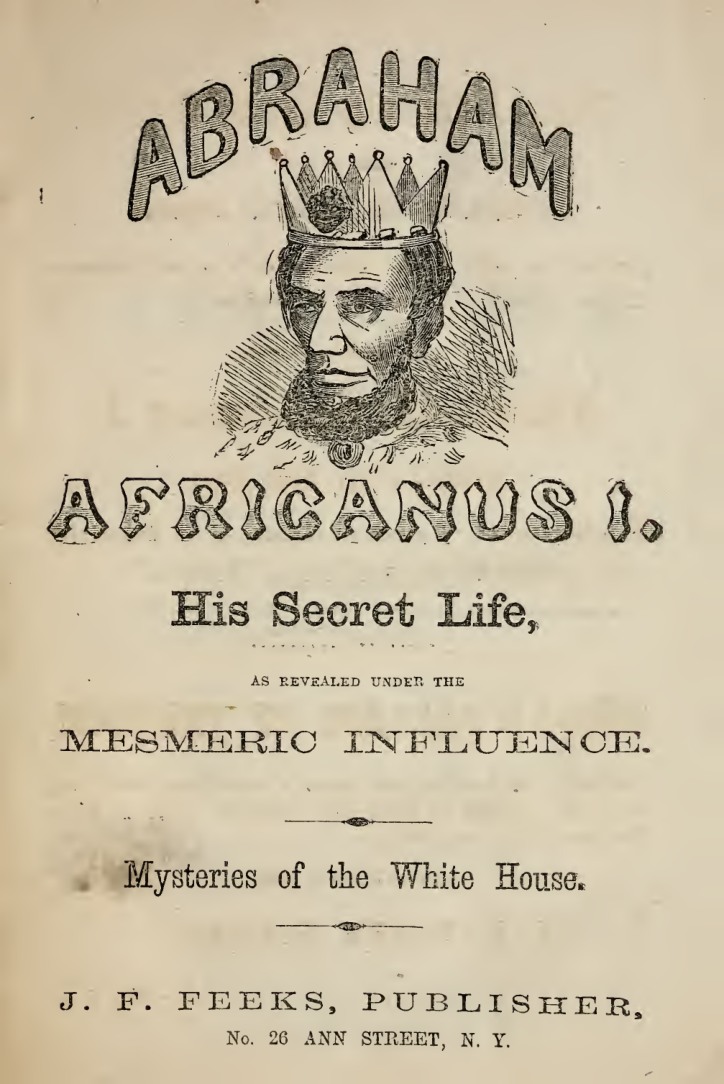
An election pamphlet gave Lincoln an earl for an ancestor. The same New York publishing circle imagined a nobility that could be made in the Treasury, one telegram ahead of the market.
The Earl of Lincoln came to America with William Penn, carrying a piece of Aaron’s rod and a copy of habeas corpus. By the time his descendant Abraham Lincoln got to the White House, the writ had gone missing.
That was the family history offered in Abraham Africanus I, an anonymous pamphlet sold by J. F. Feeks of 26 Ann Street, New York. Fifteen cents paid for the booklet and the postage. Its cover promised Lincoln’s secret life as revealed under mesmerism. Inside, the Devil drew blood for a contract that would make him president for life. Lincoln had been hoping for a monarchy or at least a first consulship. The pamphlet offered voters an explanation for that ambition, beginning with a footnote to a book they already knew.
The family on page eleven
The footnote appears as soon as the fictional Lincoln says that his father, Thomas, was of aristocratic descent. It sends the reader to page eleven of Joseph H. Barrett’s campaign biography. Barrett proposed that the Pennsylvania Lincolns might have come under William Penn’s auspices or with his settlers. He entertained a common stock with the Revolutionary officer Benjamin Lincoln. He noticed that Abraham, Thomas, and Josiah recurred in the Virginia and Kentucky branch, much as biblical names did among the New England Lincolns.
Lincoln had tried to piece together that paternal line years earlier. In 1848 he told Solomon Lincoln that his family had a vague tradition of a Quaker great-grandfather who went from Pennsylvania to Virginia. He knew that his own grandfather Abraham moved from Virginia to Kentucky and was killed there. A separate letter that spring put Uncle Josiah at Blue River in Indiana and gave the post office where his family could be reached. Lincoln supplied the names he knew and traced the relatives as far as he could.
Penn enters the family’s history through land as well as conjecture. In 1730 Lincoln’s great-great-grandfather Mordecai took title to a thousand-acre tract on the Schuylkill. The tract had been patented out of land Penn granted to the London Company and passed through Andrew Robeson. After the president’s grandfather was killed in Kentucky, the oldest of his sons, another Mordecai, inherited a substantial estate under primogeniture. That was the account of Henry Pirtle, who knew Mordecai and Josiah. The rule favoring the eldest son helps explain how there could be property on Lincoln’s paternal side and little of it in Thomas’s hands.

Barrett’s book gave the satirist Penn, the English line, and the possibility of a distinguished branch. The author supplied the earl and sent him fleeing Charlemagne, across centuries and the Atlantic. The settlers call the people resisting them rebels and find they cannot put down the rebellion in under ninety days. That was the length of the Union’s first militia enlistments in 1861. The fictional treaty demands virtually everything the Indigenous people have for a bottle of whiskey. When they revolt, Penn urges peace. His argument is “you cannot fight always.” The second footnote sends the reader to Lincoln’s First Inaugural. The earl takes the other side, proposes to wipe out the resistance, and uses his soldiers to secure the best part of the spoils.
The family fortune dwindles in the telling. The capital carried to Kentucky turns out to be a rifle and a broad ax. The timber business consists of trees still standing. By the time the account reaches the frontier, the earl’s chief legacy is a way of getting possession and holding it.
The rod and the writ
The Earl’s stump of Aaron’s rod would have been recognizable in an American Royal Arch chapter. In David Bernard’s 1829 account, the High Priest reaches into the Ark and takes out a piece of apple-tree sprout only a few inches long. He consults the King and Scribe before identifying it as Aaron’s rod. Albert Mackey’s Book of the Chapter places the rod alongside the pot of manna and the Book of the Law in the ritual. In the biblical account the rod flowers to distinguish Aaron’s priestly line. In the pamphlet a hereditary claimant carries a fragment of it beside an instrument of civil law.
The rod had a life in early Mormon scripture as well. The earliest surviving copy of an April 1829 revelation to Oliver Cowdery calls one of his powers the gift of working with a sprout. The 1833 Book of Commandments calls it a rod. The 1835 Doctrine and Covenants names it the gift of Aaron. In 1842, the Book of Abraham described an enthroned Abraham wearing a crown that represented priesthood and holding a scepter of justice and judgment. The published explanation used the phrase “grand presidency in heaven.”

Two years later, while Joseph Smith was campaigning for the American presidency, the Council of Fifty received him as Prophet, Priest, and King over the Kingdom of God. Nauvoo already had a municipal court and a charter that gave it power to issue writs of habeas corpus in cases arising under city ordinances. The city sought to extend that power by ordinance when Missouri tried to extradite Smith. John C. Bennett, writing in the Times and Seasons at the beginning of 1841, publicly credited the Illinois legislator Abraham Lincoln with supporting the charter.
A man trusted by Lincoln helped establish Nauvoo’s lodge. Abraham Jonas, the Jewish lawyer who served as Illinois Masonic grand master, authorized it in October 1841. It was installed in March 1842, and Smith took his degrees that month. In December 1862, Lincoln wrote on the papers of a Missouri man held for disloyalty that Stanton should leave the case to Jonas and his Quincy law partner, Henry Asbury. They cleared the man and he was paroled. In June 1864 Lincoln signed a three-week parole for Jonas’s own son, a Confederate prisoner on Johnson’s Island, to visit his dying father.
In 1861 Lincoln had authorized military suspension of the privilege of habeas corpus along designated routes. Congress gave him statutory authority to suspend it in 1863. In Nauvoo the dispute had turned on how far a city could reach to review an arrest. In wartime Washington it concerned how far a president could go in keeping prisoners beyond the reach of a judge. The pamphlet imagined that protection as something the family had been trusted to bring over and had somehow managed to lose.
The men who made Honest Abe
In the smoking room of the fictional White House, Seward puts Lincoln to sleep and lays a hand on his head. He touches the spot for music and Lincoln sings. Chase tries ambition. Stanton finds the bump for autobiography. Practitioners of mesmeric phrenology had been demonstrating this technique for years, claiming that touch could bring out a faculty in a subject. Among the ministers who demonstrated trance induction in the 1840s was Chauncey Burr, whose Notes on the Constitution Feeks advertised at the back of Africanus.
A Boston newspaper correspondent had already circulated a story in April 1863 about a séance in the White House with the medium Charles Shockle. His account put the Lincolns, Stanton, and Navy Secretary Gideon Welles in the Crimson Room. He described spirits pinching Stanton’s nose and pulling Welles’s beard. The ministers in Feeks’s pamphlet are after something particular. They want the version of Lincoln’s life he would tell if he were unable to govern his answers.
Seward eventually supplies a story of his own. He says he heard it from a man Lincoln had imprisoned at Fort Warren. In the story, a destitute Abe hangs his enormous worn-out boots on a ridgepole for a widow’s son, another boy named Abe. He signs his mother’s surname, Hanks, and gives Lincoln as his other name. A stranger comes up beside him and offers him a place in the legislature. Abe asks for Washington. With help and a reputation for honesty, he reckons he can manage it. The two men embrace, and the witness thinks they look enough alike to be brothers.
At the Illinois Republican convention in Decatur in 1860, John Hanks brought in two rails said to have been split by him and Lincoln. The banner named the Rail Candidate. The author of Africanus had already introduced John Hanks in an earlier chapter, where he footnotes Barrett for the story that the two men split three thousand rails. By the time the man on the prairie writes out his names, the reader has met one Hanks who helped put Lincoln’s name before a crowd.
In April 1861 William Helmick withdrew his own application for commissioner of pensions and asked Lincoln to appoint Barrett. Lincoln marked the request for discussion with his cabinet. Barrett got the job. In the pamphlet, Seward is so angry at Barrett’s account of the Chicago nomination that he rings his little bell and orders the biographer taken to Fort Lafayette. Colonel Burke is to disregard writs. An officer saves Barrett by reminding Seward that the president has already sent him abroad as a minister in return for writing the book.
Burke was a real colonel. In September 1861 Seward wrote him about Charles J. Faulkner, the recently recalled minister to France, then in custody at Fort Lafayette. The government suspected that Faulkner would lend his services and influence to the Confederacy. Seward’s little bell already stood for the reach of his arrest power in campaign prints. Feeks’s readers could recognize the bell, the fort, and the man taking the orders. The supposed arrest of Barrett put that power to work in a quarrel with the administration’s own biographer.
The Treasury’s order of nobility
In 1864, Alexander Del Mar signed his name to The Great Paper Bubble, a campaign book sold from the office of the Metropolitan Record at 419 Broadway. The wrapper asked for twenty-five cents in paper currency. Cataloguers also attribute Africanus to Del Mar. His signed book and the anonymous satire share an unusually specific joke about the machinery of public finance.
In Africanus, Chase asks Lincoln whether he believes in greenbacks. Lincoln tells a story about an old mare named Greenbacks that finally moves when a fly gets on her neck. The fly is Chase’s hope of becoming president. The prospect keeps him working. When Chase presses him for an answer about the money itself, Lincoln likens it to steam, useful under control and liable to burst when used expansively. Seward wishes Welles were there to discuss the matter. Stanton suggests Benjamin Isherwood, the Navy engineer, and brings up his Lake Erie experiments.

Del Mar takes a swipe at the Navy over the same dispute about the economy of expansive steam. Then he sends two men into a factory. One of them, a speculator versed in cornering stocks, says he knows enough about engines to show his companion how expansive steam works. He turns the controls until the hammers go wild and the factory blows to pieces. The men who worked there lose their livelihood. The narrator learns that the shares belonged to families all over the country. The works had a name, the National Finance Machine.
Del Mar gives the speculator an argument to go with the wreck. He has the two men discuss what happens when the Treasury changes the terms of its securities or lets word of its plans reach the market. The people close to the secretary get the early news. Del Mar calls them the “future order of nobility.” For a campaign writer who expected money and access to consolidate into rank, the old earl on page twenty-seven had an American counterpart among the men trading on the government’s next move.
Feeks put the connection within reach of anyone who turned past the last page. There he advertised The Washington Despotism Dissected, a collection of articles from the Metropolitan Record. The contents included a play called The Administration Telegraph. Burr’s constitutional book took the next page. Feeks sold the three accounts of the administration through the same shop.

Cairo, the Tuileries, and the wire
John Mullaly, the editor of the Metropolitan Record, had gone on Atlantic cable expeditions and written about laying the cable. Archbishop John Hughes had helped establish his newspaper. In the early months of the war, Hughes was writing his own private letters to Seward. On October 15, 1861, he urged him to strengthen Cairo, Illinois, at the junction of the Ohio and Mississippi. Playing on Cato’s demand for the destruction of Carthage, he wrote Augenda est Cairo. Cairo must be built up. Six days later Lincoln thanked Hughes and said Seward regularly showed him the letters.
On Christmas Eve, at the Tuileries, the archbishop made a case for the Union before Napoleon III and Empress Eugénie. Hughes was in Europe on a special mission he had accepted at Lincoln’s request. The discussion moved from the Trent affair and the risk of war with Britain to cotton and the blockade. Hughes brought up growing cotton in Algeria. Eugénie wondered whether anybody could blockade such a long coastline and invoked Napoleon I’s struggle with England. Hughes said that steam and electric communication might have saved the first Napoleon’s dynasty from interruption.

Hughes withdrew his patronage from the Record in March 1863 as the paper’s opposition to the Union war intensified. In The Administration Telegraph, a confidential clerk tells a senior official that six hundred thousand conscripts would give the government enough men to conquer the North. For a model he proposes the French emperor’s coup. Louis-Napoléon had come into office by election, seized power in December 1851, and become emperor the following year. He was a living example of how much could change while voters were still being asked to ratify a government.
Henry Wikoff had visited Louis-Napoléon in prison at Ham and published a book about him in 1849. Letters from the future emperor to Wikoff survive. In August 1861 Daniel Sickles wrote to Wikoff about a general’s commission he expected after Wikoff reported a conversation with Lincoln. That December Wikoff sent part of Lincoln’s annual message over the wire to the New York Herald before Congress received it. In February the House put him in custody when he refused to identify his source.
On May 18, 1864, what looked like a presidential proclamation arrived at two New York newspapers. The World and the Journal of Commerce printed it. It bore the names of Lincoln and Seward and called for four hundred thousand more men. It was a forgery. Joseph Howard Jr., a reporter, had bought gold and expected to profit if the news sent its price up.
Lincoln ordered the papers’ editors and proprietors arrested. Stanton directed General John A. Dix to take military possession of the Independent Telegraph Company’s New York offices, including the stations serving the Gold Room and the Brokers’ Exchange. A military operator recorded taking charge of the company’s Washington office that day. On May 20, Dix reported that Howard had confessed. A second reporter had copied and distributed the proclamation to the papers, and Howard cleared the telegraph company of a role in it. Dix sent him to Fort Lafayette.
The doctor at the door
Near the end of the pamphlet, a liveried servant arrives to collect the president. Seward reaches for an arrest order, and Lincoln intervenes. Once the two have left, the cabinet men discover that the servant belongs to a New York chiropodist. The doctor treats Lincoln’s corns, goes on sensitive errands, and has been to New Orleans. The author leaves his name blank.
The particulars point to Issachar Zacharie. Lincoln’s testimonial records treatment for his corns and his backache. In November 1862 he told General Nathaniel Banks that Zacharie might be useful as a physician and as someone who could make contact with Jewish residents in the area Banks was about to enter. Zacharie wrote back to Lincoln from the St. Charles Hotel in New Orleans with accounts of local sentiment and the conduct of military officials.
In October 1864 Samuel A. Lewis heard from Zacharie that men claiming to represent Jewish voters had approached the president seeking money. Lewis offered to contribute himself and to consider requests brought to him while Zacharie was traveling. Myer S. Isaacs separately asked about the reports of an electoral bargain. John Hay, writing for Lincoln, said the delegation had made no pledge of the Jewish vote. Zacharie continued canvassing in New York and Pennsylvania and sent Lincoln his own optimistic report days before the election. The correspondence shows a man who could carry intelligence and introduce people to the president, and people in his circle who disagreed about what anyone could promise.
The satire turns those relationships into charges that Zacharie directed policy, wrote speeches, and arranged the Russian Ball. Its interest in the doctor’s Jewish contacts feeds the accusation that private finance was running the country. Each of the ministers had supposed that he was the man with the president’s confidence. A doctor’s servant arrives and walks Lincoln out. Seward and Stanton leave in a fury. Alone at the table, Chase drafts a message to New York in cipher. He wants Rock Island shares bought below 140, two thousand shares of Erie sold short, and the gold market pushed up. He signs off with a single word, “Mum.”
Africanus in another hand
In April 1864, H. L. Williams wrote Lincoln from New York asking for help with a book on Black soldiers. He wanted to go to Paris to study French military records from Algeria and speak to veterans. He cited Abdelkader’s Black bodyguard, Black standard-bearers among Arab forces, and the British West India regiments. He believed the service of Black men in the Union army could give Lincoln a claim to the name Africanus as durable as Scipio’s.
Feeks printed a regnal number after the name. His pamphlet cast emancipation and the enlargement of presidential power as parts of the same offense. In Williams’s letter, the Roman name belonged to a president whose country had learned what Black troops could do. Both writers expected the war to decide the meaning of the title.
August 23
On August 5, 1864, Senator Benjamin Wade and Representative Henry Winter Davis published their attack on Lincoln’s Reconstruction policy. Both men were Republicans. They argued that Lincoln’s treatment of their bill put the electoral votes of restored Southern states within reach of his personal ambition. A president accused in pamphlets of wanting a crown was being accused in the New-York Tribune of having a means to shape the electorate that would decide his next term.
Eighteen days later, on August 23, Lincoln ordered Joseph Howard Jr. released from Fort Lafayette. The other man in the forgery, Francis Mallison, stayed there. In September, Howard wrote Lincoln on Mallison’s behalf and said Henry Ward Beecher and General Dix had appealed for him as well. Lincoln ordered his release the next day.

On the day he ordered Howard’s release, Lincoln asked his cabinet to sign the back of a folded memorandum. The men signed it while it was still sealed.
Feeks’s pamphlet ends on the eve of the election, when the Devil comes to collect on the bargain that promised Lincoln a lifetime in office. Lincoln opened his memorandum after his reelection and read it aloud to his cabinet. He had expected to lose and believed the winner would come to office on terms that would leave him unable to save the Union. Lincoln had pledged to work with him before the inauguration, while he still held the office that gave him the power to send Howard home.